

Best Time to Post Business Content in UAE for Maximum Reach
Timing isn’t everything in digital marketing, but it’s close. You could create the most engaging post your business has ever published, but if you drop it at 3 AM when your audience is asleep, it’s going to flop. On the flip side, post that same content when your audience is actively scrolling, and you’ll see likes, comments, shares, and actual business results.
For businesses in the UAE, timing is even more critical because the market is incredibly diverse. You’re not just targeting one demographic. You’re reaching Emiratis, expats from dozens of countries, working professionals, entrepreneurs, stay-at-home parents, and tourists, all with different schedules, habits, and time zones.
So when is the best time to post? The answer depends on your platform, your audience, and your goals. But there are patterns, trends, and data-backed strategies that can help you maximize reach, engagement, and conversions. Let’s break it down.
Why does posting time matter so much for UAE businesses?
Social media algorithms prioritize recency and engagement. When you post content, the platform shows it to a small portion of your audience first. If those people engage quickly by liking, commenting, or sharing, the algorithm interprets that as a signal that your content is valuable and pushes it to more people. If your post sits there with no engagement, it dies in the feed.
That initial burst of engagement is everything. And the best way to get it is to post when your audience is online and ready to engage. If you post at a time when most of your followers are working, commuting, or sleeping, your content gets buried before it has a chance to perform.
In the UAE, this matters even more because the work culture and daily rhythms are unique. The weekend is Friday and Saturday, not Saturday and Sunday. The workday often starts earlier and ends later than in Western countries. Expats in Dubai or Abu Dhabi might have family and friends in different time zones, which affects when they’re online. Ramadan shifts routines entirely, with many people staying up later and scrolling more at night.
Understanding these patterns and testing what works for your specific audience is how you turn decent content into high-performing content.
What are the best time to post on Instagram for businesses in the UAE?
Instagram is one of the most popular platforms in the UAE, especially for retail, hospitality, fitness, beauty, and lifestyle brands. The UAE has one of the highest Instagram engagement rates in the world, so getting your timing right here can make a huge difference.
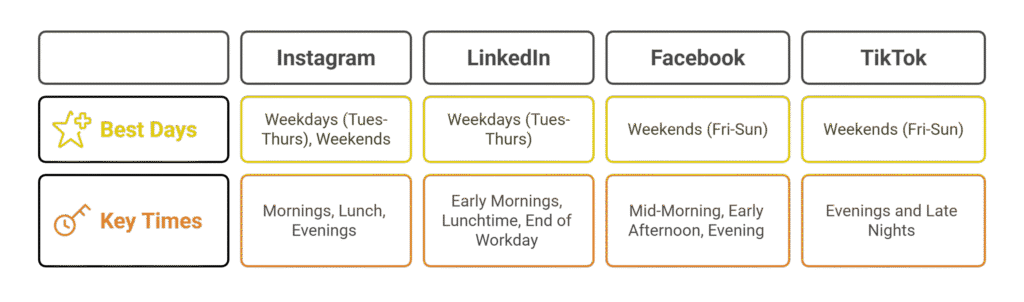
Based on data from UAE-focused businesses and global Instagram trends adapted to local time zones, the best time to post on Instagram in the UAE are typically weekdays between 8 AM and 9 AM, 12 PM and 1 PM, and 7 PM and 9 PM.
The morning window works because people check Instagram during their commute or right before they start work. Dubai and Abu Dhabi have long commutes, and many people scroll through social media on the metro, in taxis, or while having their morning coffee.
The lunchtime window catches people during their break. Offices across the UAE tend to have a midday slowdown, and many professionals scroll through Instagram while eating lunch or taking a mental break from work.
The evening window is the strongest for engagement because people are done with work, relaxing at home, and spending time on their phones. This is when you’ll see the highest volume of likes, comments, and shares, especially for lifestyle, food, and entertainment content.
Weekends, particularly Friday mornings and Saturday evenings, also perform well. Friday is a day off for most people in the UAE, so many sleep in and then spend the late morning and afternoon scrolling. Saturday evenings work because people are winding down from the weekend and catching up on social media before the work week starts.
However, these are general guidelines. Your specific audience might behave differently. If you’re targeting busy professionals, early morning or lunchtime might work best. If you’re targeting stay-at-home parents or students, mid-morning or mid-afternoon could perform better. The key is to test different times, track your engagement metrics, and adjust based on what actually works for your audience.
Instagram Insights shows you when your followers are most active. Check that data regularly and use it to guide your posting schedule. Don’t just post when it’s convenient for you. Post when it’s convenient for your audience.
When should UAE businesses post on LinkedIn for maximum engagement?
LinkedIn is the go-to platform for B2B businesses, recruiters, consultants, and professionals in the UAE. The audience here is focused on career development, industry news, and business insights, so the timing and tone of your posts matter.
The best time to post on LinkedIn in the UAE are weekdays between 7 AM and 8 AM, 12 PM and 1 PM, and 5 PM and 6 PM.
Early morning works well because professionals often check LinkedIn before they start their workday. Many people in the UAE get to the office early, and scrolling through LinkedIn while having coffee or planning the day is a common habit.
Lunchtime is another strong window. People take breaks, step away from their desks, and catch up on industry news and updates. LinkedIn posts published around noon tend to get solid engagement from professionals who are looking for a mental break without fully stepping away from work mode.
Late afternoon, around the end of the workday, is also effective. People are wrapping up tasks, checking messages, and winding down. They’re more likely to engage with thoughtful content that’s relevant to their industry or career.
Avoid posting on LinkedIn on weekends. Unlike Instagram or Facebook, LinkedIn engagement drops significantly on Fridays and Saturdays because people are in weekend mode, not work mode. If you post on a Saturday, your content will likely get buried by Monday when people are back online.
Also, consider the type of content you’re posting. If you’re sharing a long-form article or thought leadership piece, early morning is ideal because people are more likely to read and engage with in-depth content when they’re fresh. If you’re sharing a quick tip, news update, or company announcement, lunchtime works well for fast engagement.
LinkedIn’s algorithm also rewards early engagement, so if you have employees, partners, or colleagues who can like and comment on your post within the first hour, that initial boost will help your content reach a wider audience.
What about Facebook? Is it still relevant for businesses in the UAE?
Yes, Facebook is still highly relevant in the UAE, especially for businesses targeting a broad demographic or older audiences. While younger users have shifted more toward Instagram and TikTok, Facebook remains strong for community groups, local businesses, events, and family-oriented brands.
The best time to post on Facebook in the UAE are weekdays between 9 AM and 10 AM, 1 PM and 2 PM, and 7 PM and 9 PM.
Mid-morning works because people check Facebook after settling into their workday. This is a good time for news updates, promotions, or informational content that people can quickly consume.
Early afternoon catches people during lunch breaks or downtime. Facebook is often used for casual browsing, so lighthearted or entertaining content performs well during this window.
Evening is the peak time for Facebook engagement in the UAE. People are home, relaxed, and spending more time on their devices. This is when you should post content that encourages interaction, like questions, polls, videos, or community-focused posts.
Facebook also performs well on weekends, particularly Friday afternoons and Saturday evenings. Fridays are especially strong because people are off work and spending more time on social media. If you’re promoting an event, sale, or special offer, Friday is a great day to post.
One thing to note is that Facebook’s algorithm prioritizes content from friends and family over business pages, so organic reach has declined over the years. To maximize engagement, consider boosting important posts with a small ad budget or encouraging your audience to engage early by asking questions or prompting comments.
Also, Facebook Groups are underutilized by many UAE businesses. If you can build or participate in a relevant group, your content will get more visibility and engagement than it would on a business page alone.
How does posting time change during Ramadan in the UAE?
Ramadan completely shifts the daily rhythm in the UAE, and your posting schedule needs to adapt. People fast from sunrise to sunset, which means work hours are shorter, energy levels fluctuate, and online activity spikes at different times than usual.
During Ramadan, the best time to post are late night and early morning. After Iftar (the evening meal that breaks the fast), people are energized, social, and spending a lot of time online. From 9 PM to midnight is one of the highest-engagement windows of the year. This is when families are together, people are relaxed, and social media usage surges.
The pre-dawn hours before Suhoor (the meal before fasting begins) also see increased activity. Many people stay up late during Ramadan, and social media scrolling is part of that routine. Posting between midnight and 3 AM can actually work well, especially for lifestyle, food, and entertainment brands.
Avoid posting during the day, particularly in the afternoon. People are fasting, working shorter hours, and generally less engaged with social media. Content posted between 2 PM and 6 PM during Ramadan tends to underperform.
Also, adjust your content tone during Ramadan. This is a time of reflection, community, and spirituality. Content should be respectful, positive, and culturally sensitive. Avoid overly promotional or aggressive sales messaging. Instead, focus on community, gratitude, and value-driven content.
If you’re running paid ads during Ramadan, shift your budget to evening and late-night hours when people are most active. This is also a great time to promote offers, as many people shop online after Iftar, especially in the lead-up to Eid.
Should businesses in the UAE post at different times for different platforms?
Absolutely. Each platform has its own audience, behavior patterns, and engagement rhythms. A posting schedule that works on Instagram won’t necessarily work on LinkedIn or TikTok.
For Instagram, focus on mornings, lunch breaks, and evenings. For LinkedIn, stick to early mornings, lunch, and end of workday on weekdays only. For Facebook, post mid-morning, early afternoon, and evening, with extra focus on weekends. For TikTok, evenings and late nights perform best, especially on weekends.
The key is to treat each platform as its own ecosystem. Don’t just copy and paste the same content at the same time across all platforms. Tailor your message, format, and timing to fit how your audience uses each platform.
For example, a behind-the-scenes video might perform well on Instagram Stories in the morning, a thought leadership article could work on LinkedIn at lunchtime, and a fun, engaging TikTok video would crush in the evening.
Also, consider your audience’s habits. If you’re a B2B company, LinkedIn should be your priority and you should post during work hours. If you’re a lifestyle brand targeting young professionals, Instagram and TikTok in the evenings are your sweet spots.
Using a scheduling tool like Meta Business Suite, Hootsuite, or Buffer can help you manage multiple platforms without manually posting at different times. But even with automation, you should still monitor engagement and adjust your schedule based on real performance data.
How can businesses test and optimize their posting times?
Testing is the only way to truly know what works for your specific audience. General guidelines are helpful, but your audience might behave differently based on your industry, location, and content style.
Start by posting at different times over a two-week period and tracking engagement metrics like likes, comments, shares, and reach. Use each platform’s native analytics tools to see when your audience is most active and when your posts perform best.
Look for patterns. If your posts consistently get more engagement at 8 PM than at 8 AM, shift more of your content to that evening window. If your LinkedIn posts perform better on Tuesday mornings than Thursday afternoons, adjust your schedule accordingly.
Also, test different content types at different times. A carousel post might perform better in the evening when people have time to scroll through multiple slides, while a quick tip or meme might work better during a lunch break when people are looking for fast, digestible content.
Don’t just look at vanity metrics like likes. Pay attention to meaningful engagement like comments, shares, saves, and click-throughs. These actions signal that your content is resonating and driving real value.
Once you identify your best-performing times, build a consistent posting schedule around them. Consistency trains your audience to expect content from you at certain times, which can boost engagement over time.
Finally, keep testing. Audience behavior changes. Algorithms change. Seasons and events affect online activity. What works today might not work in six months, so stay flexible and keep optimizing.
Conclusion
There’s no magic formula for the best time to post in the UAE, but there are clear patterns and strategies that can help you maximize reach and engagement. The key is to understand your audience, respect their daily rhythms, and test what actually works for your business.
For most UAE businesses, weekdays between 8 AM and 9 AM, 12 PM and 1 PM, and 7 PM and 9 PM are strong windows across multiple platforms. Weekends, particularly Friday mornings and Saturday evenings, also perform well. During Ramadan, shift your focus to late evenings and early mornings.
But don’t just follow the data. Pay attention to your own audience’s behavior. Use analytics tools to track when your followers are online and when your content performs best. Test different times, formats, and messages. Adjust based on results, not assumptions.
The businesses that win on social media aren’t the ones posting the most. They’re the ones posting at the right times, with the right content, for the right audience. If you can nail that combination, you’ll see real results: more engagement, more visibility, and more business growth.
FAQ
Does posting time really make a big difference in engagement?
Yes, it can make a massive difference. Posting when your audience is actively online increases the chances of early engagement, which signals to the algorithm that your content is valuable. Early engagement leads to more reach, which leads to more overall engagement. Posting at the wrong time means your content can get buried before anyone even sees it.
What is the worst time to post for businesses in the UAE?
Generally, late nights between 2 AM and 6 AM are the worst times to post because most people are asleep. Mid-afternoon between 2 PM and 4 PM can also be slow, especially on weekdays when people are deep into work and less likely to scroll social media. Avoid posting on LinkedIn during weekends, as engagement drops significantly.
Should I post at the same time every day?
Consistency helps build audience expectations, but you don’t need to post at the exact same time every single day. Focus on posting within your best-performing windows, whether that’s mornings, lunch breaks, or evenings. Experiment with slight variations to see what maximizes engagement. The key is consistency within those windows, not rigidity down to the minute.
How do I find out when my specific audience is online?
Use the analytics tools built into each platform. Instagram Insights, Facebook Page Insights, and LinkedIn Analytics all show you when your followers are most active. Check this data regularly and use it to guide your posting schedule. You can also run small tests by posting at different times and tracking which posts get the most engagement.
Do paid posts and organic posts need different timing strategies?
Not necessarily, but there are differences. Organic posts rely heavily on timing because you need that early engagement boost to trigger the algorithm. Paid posts have more flexibility because you’re paying for reach, but posting during high-engagement windows can still improve performance and lower your cost per engagement. For ads, test different times and use the data to optimize your ad schedule.
How does the UAE weekend affect posting strategies?
The UAE weekend is Friday and Saturday, which means Friday is often the most relaxed day for social media activity. Many people sleep in, spend time with family, and scroll through social media in the late morning and afternoon. Saturday evenings also perform well as people wind down before the work week. Avoid treating Friday like a workday when planning your content calendar.

How to Optimize Website Content for AI-Powered Search?
The rules of search are changing faster than most UAE businesses realize. When a potential customer asks ChatGPT, Perplexity, or Google’s AI Overviews about “best digital marketing agency in Dubai” or “how to increase online sales,” they’re not scrolling through ten blue links anymore. They’re getting one confident answer, synthesized from across the web.
If your website isn’t built to feed these AI engines the right signals, you’re invisible in this new landscape. Traditional SEO focused on keywords and backlinks. Generative Engine Optimization (GEO) requires something different: structured authority, conversational relevance, and content that directly answers the questions your customers are actually asking.
For service businesses across Dubai, Abu Dhabi, and the wider UAE, this shift isn’t coming. It’s here. The businesses that adapt now will own the AI-powered search results. The ones that don’t will wonder why their competitors suddenly dominate every customer conversation.
What is AI-powered search and why does it matter for UAE businesses?
AI-powered search means platforms like ChatGPT, Google Gemini, Perplexity, and Bing’s Copilot generate direct answers instead of just listing websites. When someone searches “affordable web design Dubai,” these engines scan thousands of sources, synthesize the information, and present a single, confident response, often with specific recommendations.
For UAE businesses, this creates both a challenge and an opportunity. The challenge: you’re no longer competing for rankings on page one. You’re competing to be the source these AI engines cite and recommend. The opportunity: smaller businesses with better-structured, more authoritative content can leapfrog larger competitors who haven’t adapted yet.
According to recent research, over 40% of online searches now involve some form of AI-generated response. In tech-forward markets like the UAE, where smartphone penetration exceeds 95% and digital adoption is among the highest globally, that percentage is likely even higher. If your content isn’t optimized for these engines, you’re missing nearly half your potential audience.
How do I structure content so AI engines can understand it?
AI engines don’t read websites the way humans do. They scan for patterns, structure, and clear signals of authority. Your content needs to speak their language while remaining valuable to human readers.
Start with clear, hierarchical structure. Use H1, H2, and H3 tags consistently. Every page should have one H1 that clearly states the topic, followed by H2 sections that break down specific subtopics. Within those, H3 tags can handle detailed points. This hierarchy helps AI engines map your content logically.
Schema markup is non-negotiable. This structured data vocabulary tells search engines exactly what your content represents. For a Dubai restaurant, schema markup identifies your business name, location, hours, menu items, and reviews in a format AI can instantly parse. For a service business, it clarifies what you offer, where you operate, and how customers can reach you. Implementation is technical but straightforward. Most modern website platforms offer plugins or built-in tools.
Create FAQ sections on every service page. AI engines love direct question-and-answer formats because they mirror how users actually search. Instead of a generic “Services” page, include sections like “How much does social media management cost in Dubai?” or “What results can I expect from content marketing in three months?” Answer these questions thoroughly, with specific details.
Use bullet points and numbered lists for complex information. When explaining your process, pricing tiers, or service benefits, break it down visually. AI engines prioritize content that’s easy to extract and present to users.
What kind of content do AI engines prefer to cite?
AI engines favor authoritative, comprehensive, and recent content that directly addresses user intent. They’re looking for sources they can confidently recommend without hedging.
Start with depth over breadth. A 2,000-word guide on “How to choose a web developer in the UAE” that covers every relevant consideration will outperform ten shallow 200-word posts. AI engines want to provide complete answers, so they gravitate toward resources that thoroughly explore topics.
Include data and specific examples. When you write “Our clients typically see a 40% increase in qualified leads within the first quarter,” that’s more credible than “We help businesses grow.” If you can reference case studies, especially from UAE companies, you’re building authority these engines recognize.
Update content regularly. AI engines timestamp information and prioritize recent sources. A blog post from 2020 about social media strategies is less useful than one from this year. Schedule quarterly reviews of your key pages and refresh statistics, examples, and insights.
Address multiple aspects of a topic. For a post about Instagram marketing, don’t just cover posting frequency. Discuss content types, optimal posting times for UAE audiences, story strategies, reel best practices, engagement tactics, and analytics interpretation. Comprehensive coverage signals expertise.
Original research and unique perspectives matter more than ever. If every marketing agency website in Dubai says the same thing about SEO, AI engines have no reason to cite you specifically. Share your actual process, your unique approach, or insights from your client work that competitors can’t replicate.
How should I use keywords for both traditional search and AI engines?
Keywords remain important, but the strategy has evolved. AI engines understand context and intent, not just exact phrase matches.
Focus on conversational, long-tail keywords. People don’t type “web design Dubai” into ChatGPT. They ask “What should I look for when hiring a web designer in Dubai for my restaurant?” or “How much does a business website cost in the UAE?” Build content around these natural questions.
Use semantic variations naturally throughout your content. Instead of repeating “digital marketing Dubai” fifteen times, vary it: “digital marketing services in Dubai,” “online marketing for UAE businesses,” “Dubai-based digital agencies.” AI engines understand these phrases are related and reward natural language over keyword stuffing.
Include location-specific terms contextually. For UAE businesses, mention emirates, neighborhoods, and local business contexts where relevant. “Businesses in Dubai Marina often need different web solutions than those in Sharjah’s industrial areas” provides geographic context while remaining useful.
Answer the “people also ask” questions. When you Google your target keywords, you’ll see related questions that real users search. Create content that directly addresses these. They represent the questions AI engines will try to answer, so providing clear responses positions you as the source.
Don’t force keywords where they don’t fit. AI engines penalize awkward phrasing and obvious manipulation. Write for humans first, then review to ensure your target terms appear naturally in headings, opening paragraphs, and throughout the content.
What role do E-E-A-T signals play in AI-powered search?
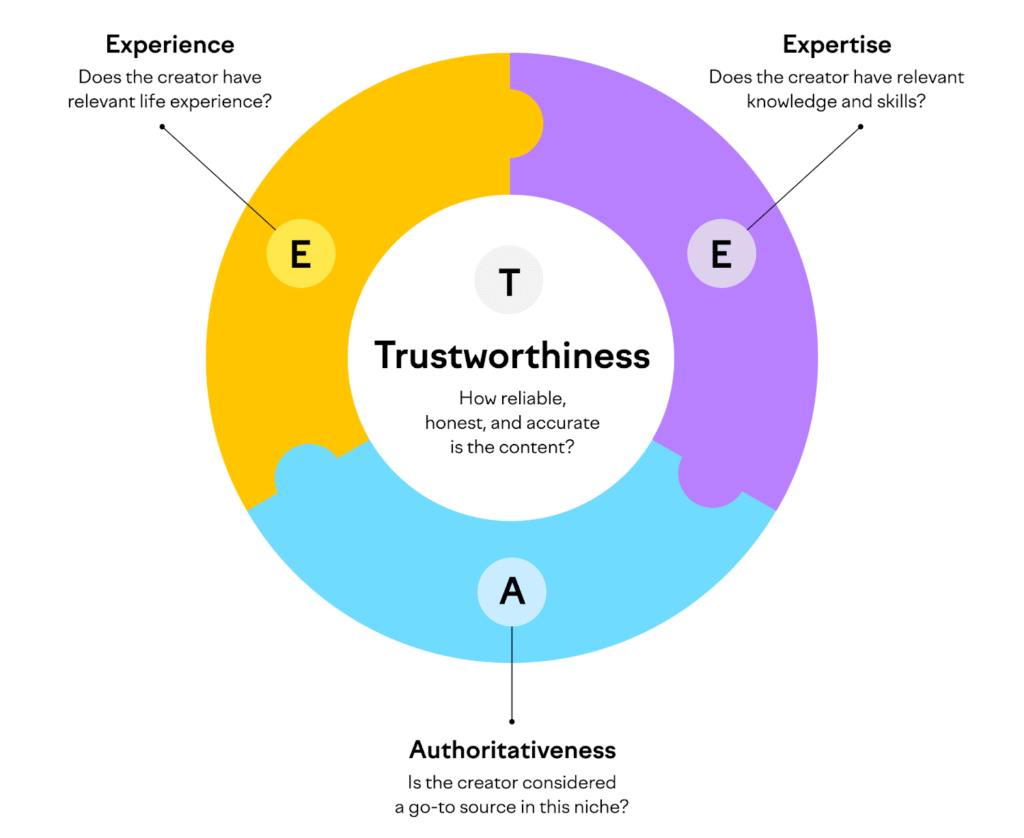
Experience, Expertise, Authoritativeness, and Trustworthiness (E-E-A-T) have become the foundation of how AI engines evaluate sources. These aren’t just SEO concepts anymore. They’re the criteria that determine whether an AI recommends your business or your competitor.
Experience means demonstrating you’ve actually done what you’re talking about. For a digital marketing agency, this includes case studies with specific results, screenshots of campaigns, client testimonials with real names and companies, and process documentation that only someone with hands-on experience could provide. Generic advice doesn’t cut it.
Expertise requires showcasing your knowledge depth. Author bios matter more than ever. If your blog posts are written by “Admin” or have no attribution, you’re losing credibility. Create author pages with qualifications, experience, and links to other published work. For service pages, detail your team’s certifications, years of experience, and specialized skills.
Authoritativeness comes from external validation. When other reputable websites link to your content, mention your company, or cite your insights, AI engines take notice. This means you need a backlink strategy, but quality trumps quantity. One link from a respected UAE business publication is worth more than fifty from random directories.
Trustworthiness involves transparency and credibility markers. Display your business registration details, physical address, and contact information prominently. Include clear privacy policies and terms of service. Show real client reviews from platforms like Google. For UAE businesses, having a .ae domain and local business listings adds trust signals.
How can I make my content more conversational for AI platforms?
AI engines prefer content that mirrors how humans actually communicate. This is especially important for voice searches and chatbot interactions, which are inherently conversational.
Write in second person when addressing the reader. “You should consider mobile optimization” feels more natural than “Businesses should consider mobile optimization.” It creates a dialogue rather than a lecture.
Use shorter sentences and paragraphs than you might in traditional business writing. While depth is important, walls of text are harder for both humans and AI to parse. Aim for 2-3 sentences per paragraph for online content, with occasional longer paragraphs when explaining complex points.
Include transitional phrases that create natural flow. “Here’s why this matters,” “Let’s break this down,” “The challenge is,” and “What does this mean for you?” These phrases signal shifts in topic and help AI engines understand content structure.
Answer implied follow-up questions. When you explain a concept, anticipate what someone would ask next. If you discuss website loading speed, the natural next question is “How do I check my website speed?” Address it immediately. This creates comprehensive, useful content that AI engines want to recommend.
Avoid jargon unless you immediately define it. Your UAE audience includes both technical and non-technical business owners. When you must use industry terms like “conversion rate optimization” or “meta descriptions,” briefly explain what they mean in practical terms.
What technical optimizations help AI engines crawl and understand my site?
Even brilliant content won’t help if AI engines can’t access and process it effectively. Technical optimization creates the foundation for visibility.
Ensure your site loads quickly. Page speed affects both user experience and how thoroughly AI crawlers explore your site. Compress images, minimize code, use browser caching, and consider a content delivery network (CDN) with UAE servers for local audiences. Google’s PageSpeed Insights tool provides specific recommendations.
Make your site mobile-responsive. In the UAE, over 70% of web traffic comes from mobile devices. If your site doesn’t work seamlessly on phones, you’re losing both human visitors and crawler efficiency. Test across different devices and screen sizes.
Create and submit an XML sitemap. This file tells search engines and AI crawlers exactly which pages exist on your site and how they’re organized. Most website platforms generate these automatically, but you need to submit them through Google Search Console and Bing Webmaster Tools.
Fix broken links and crawl errors. When AI crawlers encounter 404 errors or redirect chains, they may abandon their exploration of your site. Regularly audit for technical issues using tools like Screaming Frog or your website platform’s built-in diagnostics.
Implement breadcrumb navigation. This shows users (and crawlers) exactly where they are in your site structure. For a service page, breadcrumbs might show: Home > Services > Web Design > E-commerce Development. This hierarchical clarity helps AI engines understand relationships between pages.
Use descriptive, keyword-rich URLs. Instead of “yoursite.com/page123,” use “yoursite.com/services/social-media-management-dubai.” Clean, readable URLs provide context before AI engines even read the page content.
How do I optimize for local AI search results in the UAE?
Local optimization for AI engines requires specific strategies beyond traditional local SEO. When someone asks an AI “Who’s the best web designer near me in Dubai?” you want to be the recommended answer.
Claim and optimize your Google Business Profile completely. This isn’t just for map rankings anymore. AI engines pull heavily from these profiles for local recommendations. Fill out every field: services offered, business hours, service areas, business description, and attributes. Add photos regularly, respond to reviews, and keep information current.
Create location-specific content pages. If you serve multiple emirates, create dedicated pages for each: “Digital Marketing Services in Dubai,” “Digital Marketing Services in Abu Dhabi,” and so on. Don’t just duplicate content and swap city names. Include specific details about the local business environment, challenges unique to that area, and case studies from clients in that location.
Get listed in UAE business directories and platforms. While random directory links don’t help much, being present on legitimate UAE business platforms like Dubai Chamber, Abu Dhabi Chamber, and industry-specific directories adds local credibility signals.
Use local schema markup. Beyond general business schema, implement LocalBusiness schema that specifies your service areas, locations, and local contact information. For businesses with physical locations, include accurate coordinate data.
Build local backlinks and mentions. Partner with other UAE businesses for content collaboration, sponsor local events, contribute to UAE business publications, and engage with local business communities. When AI engines see your business mentioned alongside other established UAE companies, it reinforces your local authority.
Encourage and respond to Google reviews in detail. When you get a review, respond thoughtfully with specific references to the customer’s experience. These detailed interactions provide rich, local content that AI engines can extract and understand.
What mistakes should UAE businesses avoid when optimizing for AI search?
The shift to AI-powered search has created new pitfalls that even experienced marketers stumble into. Avoiding these mistakes can give you a significant advantage.
Don’t rely on thin, AI-generated content. The irony is real: using AI to generate shallow content that you hope AI engines will recommend rarely works. These platforms are sophisticated enough to recognize generic, low-value content. If you use AI writing tools, use them as starting points that you heavily edit, personalize, and enhance with your actual expertise.
Avoid keyword stuffing in an attempt to “game” AI engines. These systems analyze natural language patterns. Content that reads awkwardly because you’ve forced keywords into every sentence will be deprioritized. Write naturally first, then ensure your target terms appear in strategic places like headings and opening paragraphs.
Don’t neglect the user experience while chasing technical optimization. Page speed matters, but not if you’ve stripped away all visual appeal and functionality. AI engines increasingly factor in user engagement signals. If people immediately leave your site because it’s difficult to use, that hurts your visibility.
Stop ignoring mobile users. If your site requires pinching, zooming, or horizontal scrolling on a phone, you’re failing both users and AI crawlers. In the UAE market especially, mobile-first design isn’t optional.
Don’t overlook the importance of fresh content. A website that hasn’t been updated in two years signals abandonment. You don’t need daily blog posts, but regular updates to key pages, new case studies, and current examples keep your site relevant in AI rankings.
Avoid making claims you can’t back up. If you say you’re “the leading digital agency in Dubai” without any evidence, AI engines will favor competitors who demonstrate their claims with data, testimonials, and concrete results.
How can I measure success in AI-powered search visibility?
Traditional SEO metrics like keyword rankings still matter, but measuring AI-powered search visibility requires additional approaches.
Monitor traffic from AI platforms directly. In your analytics, you can identify referral traffic from ChatGPT, Perplexity, and other AI platforms. Track this separately from traditional search traffic to understand how your AI optimization efforts are performing.
Track brand mentions and citations. Use tools like Google Alerts, Mention, or Brand24 to monitor when your business name appears online, even without a direct link. When AI engines cite sources, they don’t always link back, but the mention still indicates authority.
Measure increases in direct traffic and branded searches. As AI engines recommend your business, more people will search for your company name directly or type your URL. This branded traffic indicates successful AI visibility.
Analyze the types of queries bringing users to your site. Are you attracting visitors with informational long-tail queries that suggest AI referrals? Look for increases in question-based searches and detailed queries in your search console data.
Survey new customers about how they found you. Simply asking “How did you hear about us?” can reveal when prospects discovered your business through AI-powered searches or recommendations, even if the analytics don’t clearly show it.
Monitor engagement metrics. If your AI optimization is working, you should see improvements in time on page, pages per session, and reduced bounce rates. AI engines tend to send more qualified traffic because they pre-match user intent with your content.
What content formats work best for AI-powered search optimization?
Different content formats serve different purposes in AI-powered search visibility. A strategic mix helps you appear across various query types.
Comprehensive guides and how-to articles form your foundation. These 1,500-3,000 word pieces should thoroughly cover important topics in your industry. For a digital marketing agency, this might include “The Complete Guide to Social Media Marketing for UAE Businesses” or “How to Build a Lead Generation Website in Dubai.”
FAQ pages and dedicated Q&A content perform exceptionally well. Create standalone FAQ pages for major service areas, and include FAQ sections on every service page. Format these with proper schema markup so AI engines can easily extract question-answer pairs.
Case studies with specific results provide the evidence AI engines look for. Don’t create generic “We helped Company X succeed” case studies. Detail the challenge, your specific approach, quantifiable results, and lessons learned. Include metrics, timelines, and direct quotes from clients.
Comparison and versus content helps capture decision-stage queries. “React vs. Vue for Business Websites,” “In-House Marketing vs. Agency: What UAE SMBs Should Choose,” and similar comparisons address questions people ask AI when making decisions.
List-based articles work well when they provide genuine insights. “10 Website Design Mistakes UAE Businesses Make” is fine if each point offers real value and specific guidance. Avoid shallow listicles that don’t educate.
Video content with transcripts serves dual purposes. Create videos explaining concepts, showcasing your process, or presenting case studies. Always include full transcripts on the page so AI engines can process the content.
Conclusion
Optimizing for AI-powered search isn’t about gaming algorithms or finding shortcuts. It’s about creating genuinely valuable content that directly addresses what your customers need to know, structured in ways that both humans and AI engines can understand and trust.
For UAE businesses, this shift presents an unusual opportunity. The market is sophisticated and digitally mature, but many competitors haven’t adapted to GEO yet. By implementing these strategies now, you can establish authority that compounds over time as AI search continues growing.
Start with your core service pages. Ensure they’re comprehensive, well-structured, and include natural question-based headings. Add detailed FAQ sections. Then expand to supporting content that demonstrates your expertise across various topics your customers care about.
The businesses that will dominate AI-powered search results aren’t necessarily the biggest or most established. They’re the ones providing the clearest, most authoritative, most helpful content. That’s a competition any UAE business can win with the right approach.
FAQs
How long does it take to see results from AI search optimization?
Most businesses start seeing measurable improvements in 2-4 months, but this varies based on your starting point and competition level. Unlike traditional SEO where changes can take 6-12 months to fully manifest, AI engines tend to discover and incorporate updated content more quickly. However, building genuine authority with comprehensive content, backlinks, and consistent updates is still a medium-term investment. UAE businesses in less competitive niches may see results faster than those in crowded sectors like real estate or general consulting.
Do I need to hire a developer to implement these optimizations?
Not necessarily. Many optimizations like improving content structure, adding FAQ sections, and writing more comprehensive articles require no technical skills. Schema markup and mobile responsiveness might need developer help depending on your website platform, but most modern systems like WordPress offer plugins that simplify implementation. The technical optimizations are important but should follow content improvements, not replace them. Focus first on what you can control directly.
Can small businesses compete with larger companies in AI-powered search?
Absolutely, and sometimes more effectively. AI engines prioritize relevance and authority over brand size. A small Dubai-based agency with detailed, experienced-based content about serving local SMBs can outrank a multinational with generic content. What matters is demonstrating genuine expertise in your specific area. Smaller businesses often have advantages here because they can be more specific, more personal, and more responsive to their exact audience needs.
Should I stop traditional SEO and focus only on AI optimization?
No. AI-powered search optimization and traditional SEO overlap significantly. Good content structure, keyword research, mobile optimization, and backlink building benefit both. The differences are additions, not replacements. You need conversational content, enhanced E-E-A-T signals, and FAQ formats for AI engines, but these also improve traditional search performance. Think of GEO as an evolution of SEO, not a completely separate discipline.
How often should I update my content for AI engines?
Major service pages should be reviewed and refreshed every 3-6 months. Update statistics, add new examples, refresh case studies, and ensure all information reflects current best practices. Blog content can remain evergreen longer, but plan quarterly audits of your top-performing posts to keep them current. In fast-moving industries like digital marketing, more frequent updates maintain your authority. The goal isn’t changing content for the sake of change, but ensuring everything you publish remains accurate and valuable.
What if my competitors copy my optimized content approach?
Let them. Your real competitive advantage isn’t your content structure or keyword strategy, it’s your actual experience and expertise. Competitors can copy your FAQ format, but they can’t copy your specific client results, your unique process insights, or your team’s accumulated knowledge. Focus on creating content only you could create based on your real work with real clients. That’s what AI engines ultimately reward, and it’s what will differentiate you even if others adopt similar formats.
GEO vs SEO: Which Strategy Gives Better Results in 2026?
Every marketing meeting in Dubai these days seems to include the same question: “Should we focus on SEO or this new GEO thing?”
It’s a fair question. You’ve probably spent years building your search engine presence, understanding keywords, earning backlinks, and watching your Google rankings climb. Now someone mentions Generative Engine Optimization, and suddenly it feels like the rules changed overnight.
Here’s the truth: framing GEO and SEO as competitors misses the point entirely. They’re not opposing strategies where you choose one or the other. They’re complementary approaches responding to how search behavior is evolving. But yes, the balance between them matters, and understanding which deserves more attention for your specific UAE business situation is crucial.
This article breaks down exactly what each strategy offers, where they overlap, where they differ, and most importantly, how to allocate your marketing resources between them for maximum ROI in 2026 and beyond.
What exactly is the difference between SEO and GEO?
At the core, SEO and GEO optimize for fundamentally different user experiences, even though both aim to increase visibility.
Search Engine Optimization (SEO) targets traditional search engines like Google, Bing, and Yahoo. The goal is appearing prominently in search results when people type queries. Success means ranking high for relevant keywords, earning clicks through to your website, and converting that traffic into customers. SEO has been around for decades, with established best practices, clear metrics, and predictable strategies.
Generative Engine Optimization (GEO) targets AI-powered search tools like ChatGPT, Perplexity, Google’s AI Overviews, Bing’s Copilot, and similar platforms. These tools don’t show lists of links. They generate direct answers, synthesizing information from multiple sources. The goal isn’t ranking in results but being cited within the answer. Success means your business getting mentioned, recommended, or referenced when relevant queries occur.
Think of it this way: SEO gets you on the menu. GEO gets you recommended by the waiter.
For UAE businesses, this distinction matters because customer behavior is splitting. Some people still prefer traditional search where they browse multiple options. Others increasingly ask AI assistants for direct recommendations. Your visibility strategy needs to address both behaviors.
The user journey differs too. In traditional search, someone might click through five websites comparing options. In AI search, they get one synthesized answer naming 2-3 businesses, and that’s often where their research ends. Being one of those 2-3 businesses is the new first page ranking.
What are the core tactics that differ between SEO and GEO?
While there’s significant overlap, each strategy emphasizes different optimization approaches.
SEO priorities:
Keyword targeting: Researching specific terms people search for and strategically placing them in content, titles, and meta descriptions. Keywords remain the primary signal for matching content to queries.
Backlink building: Earning links from other reputable websites. Google treats backlinks as votes of confidence, and link quality heavily influences rankings.
Technical optimization: Page speed, mobile responsiveness, proper indexing, and crawlability. Making sure search engines can efficiently access and understand your site structure.
On-page optimization: Title tags, meta descriptions, header tags, and URL structures optimized for specific keywords and click-through rates.
Content targeting specific queries: Creating pages that match exact search intents. If someone searches “web design Dubai cost,” you create a page specifically answering that query.
GEO priorities:
Comprehensive content depth: Creating thorough resources that cover topics completely. AI engines favor substantive content over keyword-targeted thin pages.
Authoritative citations: Being mentioned and referenced across credible sources. AI engines learn authority through multiple mentions in trusted publications, directories, and review sites.
Structured data implementation: Marking up content so AI engines clearly understand what information means. Schema markup becomes critical for accurate representation.
Natural language optimization: Writing how people actually speak and ask questions, not just keyword phrases. AI engines process conversational queries better.
Reputation and sentiment management: Online reviews, testimonials, and general sentiment across multiple platforms. AI engines analyze how your business is perceived.
Freshness and updates: Regular content updates signal current relevance. AI engines prioritize recent information over outdated sources.
The shift is from optimizing individual pages for specific keywords toward building comprehensive topical authority that AI engines recognize and trust.
How do the timelines and results differ between SEO and GEO?
Expectations for results look different depending on which strategy you emphasize.
SEO timeline and results:
SEO has predictable, measurable outcomes. You can track keyword rankings, watch them climb from position 15 to position 5 to position 1. Most businesses see initial movement within 2-3 months, meaningful rankings in 4-6 months, and strong results in 8-12 months for competitive terms.
The results are quantifiable. You know exactly where you rank for target keywords. You can measure organic traffic growth, calculate conversion rates, and directly attribute revenue to SEO efforts. Tools like Google Search Console, SEMrush, and Ahrefs provide detailed performance data.
For UAE businesses, local SEO can show faster results. Optimizing your Google Business Profile and targeting location-specific keywords often produces visible improvement within 4-8 weeks.
GEO timeline and results:
GEO is newer, so timelines are less predictable. Early adopters in various industries report seeing their businesses mentioned in AI responses within 6-12 weeks of focused optimization. However, measuring “success” is more nuanced.
You can’t track a “GEO ranking” the same way you track SEO rankings. Instead, success means monitoring citation frequency, tracking when your business gets named in AI responses, watching for increases in branded searches, and measuring direct inquiries that came from AI recommendations.
The results tend to be more qualitative initially. You might notice customers mentioning “ChatGPT recommended you” or see traffic from Perplexity.ai in analytics. The metrics are developing as the field matures.
For UAE businesses, GEO results often manifest as increased brand recognition and higher-quality leads who arrive already educated about your services through AI-generated content.
Which strategy gives better ROI for different business types?
The right focus depends heavily on your business model, target audience, and current digital presence.
Local service businesses (restaurants, salons, clinics):
Winner: Balanced approach, slight GEO advantage
People increasingly ask AI “best brunch spot in Dubai Marina” or “reliable dentist near Business Bay.” Getting recommended in these queries drives immediate business. However, traditional local SEO through Google Business Profile still dominates, so maintaining strong local SEO is essential.
Action: Prioritize review generation, ensure accurate listings everywhere, create comprehensive location-specific content, and optimize for conversational queries.
E-commerce businesses:
Winner: SEO with growing GEO importance
Product searches still heavily favor traditional search where users browse options. However, AI engines are starting to recommend specific products and stores, especially for research-heavy purchases.
Action: Maintain strong SEO for product pages and categories. Add GEO through comprehensive buying guides, detailed product comparisons, and structured product data.
B2B service providers (marketing agencies, consultants, software):
Winner: GEO with strong SEO foundation
Business decision-makers increasingly use AI assistants for research. Queries like “best digital marketing agency for SMBs in Dubai” or “how to choose a business consultant” are perfectly suited for AI responses.
Action: Create in-depth resource content, establish thought leadership, earn mentions in industry publications, and optimize for long-tail question-based queries.
Professional services (legal, accounting, financial):
Winner: Balanced, increasingly GEO-focused
These industries benefit from both. Traditional SEO captures intent-driven searches. GEO positions you as the trusted expert AI engines recommend for complex queries.
Action: Build comprehensive guides addressing common client questions, showcase expertise through detailed content, maintain impeccable online reputation.
Real estate businesses:
Winner: SEO with targeted GEO efforts
Property searches remain highly visual and comparison-driven, favoring traditional search. However, AI engines are getting better at recommending areas, agents, and property types based on user needs.
Action: Strong local SEO for area targeting, rich neighborhood guides for GEO authority, detailed property descriptions with structured data.
What does a combined SEO and GEO strategy actually look like?
Smart UAE businesses don’t choose one or the other. They build integrated strategies that address both.
Foundation layer (benefits both):
Start with elements that improve both SEO and GEO simultaneously. Strong website foundation with fast loading, mobile optimization, clear structure, and quality content serves both strategies. Similarly, building genuine business authority through excellent service and customer satisfaction naturally improves both traditional and AI search visibility.
Content strategy:
Create core pillar content that’s comprehensive and authoritative, perfect for GEO. Then build supporting articles targeting specific long-tail keywords for SEO. For example, a comprehensive “Complete Guide to Home Renovation in Dubai” serves GEO, while shorter posts like “Bathroom Renovation Cost Dubai 2026” or “Best Kitchen Tiles Dubai” capture specific SEO traffic.
Technical implementation:
Implement all technical SEO best practices: proper indexing, optimized page speed, clean code, logical structure. Then layer in GEO enhancements: comprehensive schema markup, FAQ structured data, and enhanced business information markup.
Authority building:
Traditional link building for SEO continues through guest posting, partnerships, and content promotion. Simultaneously pursue GEO-focused authority through getting mentioned in industry publications, building a strong review profile across platforms, and participating in local business communities.
Local optimization:
Perfect your Google Business Profile for local SEO. Expand that effort to all business directories, review platforms, and local listings for GEO. Create detailed area guides that serve both strategies.
Measurement and iteration:
Track traditional SEO metrics: keyword rankings, organic traffic, conversion rates. Add GEO monitoring: brand mention tracking, AI citation monitoring, and referral traffic from AI platforms. Use insights from both to refine your approach.
For a Dubai-based digital marketing agency like BRB, this might mean maintaining SEO-optimized service pages for “video marketing Dubai” and “web design UAE” while creating comprehensive GEO resources like “Complete Guide to Digital Marketing for UAE SMBs” and actively building authority through industry contributions and client testimonials.
What are the cost differences between investing in SEO versus GEO?
Budget allocation between these strategies varies, but understanding cost structures helps with planning.
SEO costs:
Traditional SEO requires ongoing investment in content creation, technical optimization, link building, and monitoring. For UAE SMBs, basic SEO services typically range from 3,000-8,000 AED monthly. Comprehensive SEO campaigns for competitive industries can run 10,000-25,000 AED or more monthly.
DIY SEO is possible but time-intensive. You need keyword research tools (500-1,500 AED monthly), content creation, technical implementation, and ongoing monitoring.
GEO costs:
GEO is newer, and pricing is still stabilizing. The core costs involve creating comprehensive content, implementing structured data, reputation management, and monitoring AI citations. Because GEO emphasizes quality over quantity, content costs can be higher per piece but you need fewer pieces.
Many GEO tactics like review generation, directory optimization, and reputation management overlap with existing marketing activities, so incremental cost is lower than building SEO from scratch.
The reality for most businesses:
You’re not choosing between two separate budgets. Much of the work overlaps. Quality content creation serves both. Technical optimization benefits both. Building genuine business authority improves both.
The smart approach is integrated investment. Allocate budget to building a strong foundation that serves both strategies, then emphasis additional resources based on where your specific business sees better returns. A local restaurant might add 30% extra budget toward GEO-focused review generation and local content. An e-commerce business might keep 70% focus on traditional SEO with 30% GEO enhancement.
How is the UAE market specifically affected by the shift to AI search?
The UAE presents unique considerations in the SEO versus GEO conversation.
High digital adoption rate:
UAE residents are early technology adopters. ChatGPT and similar tools gained traction faster here than in many markets. This means the shift to AI-assisted search is happening quicker, making GEO more immediately relevant for UAE businesses.
Multilingual complexity:
The UAE’s diverse population means optimization must consider both English and Arabic. AI engines handle multilingual queries better than traditional search in some ways, making GEO particularly valuable for businesses serving both language groups.
Competitive market:
Dubai and Abu Dhabi markets are intensely competitive across most industries. Traditional SEO rankings are hard-fought and expensive. GEO offers an opportunity to build visibility in a less saturated channel where early movers gain advantage.
Trust and authority emphasis:
UAE consumers place high value on recommendations and trustworthiness. AI-generated recommendations carry weight similar to personal referrals. Being the business an AI engine confidently recommends provides credibility that traditional search listings don’t quite match.
Mobile-first behavior:
UAE has one of the world’s highest smartphone penetration rates. AI search tools are predominantly mobile experiences. This alignment makes GEO particularly relevant for reaching UAE consumers where they’re already spending time.
Regulatory environment:
Certain industries in the UAE face advertising restrictions. GEO’s focus on earned authority rather than paid placement can provide visibility channels that work within regulatory frameworks.
What mistakes do businesses make when trying to balance both strategies?
As businesses navigate this evolving landscape, several common missteps emerge.
Abandoning SEO prematurely:
The biggest mistake is assuming AI search replaces traditional search overnight. Google still dominates search traffic and will for years. Completely pivoting budget from proven SEO to experimental GEO is risky.
Ignoring GEO until it’s too late:
The opposite mistake: sticking purely to traditional SEO while competitors build GEO authority. By the time you start, they’ve already established themselves as the businesses AI engines recommend.
Treating them as separate silos:
Creating separate teams or strategies for SEO and GEO misses the massive overlap. The same quality content, technical optimization, and authority building serves both.
Chasing tactics over fundamentals:
Both SEO and GEO reward fundamentals: being genuinely good at what you do, creating valuable content, building real authority, and maintaining a strong reputation. Chasing algorithm hacks for either strategy wastes resources.
Measuring with wrong metrics:
Applying traditional SEO metrics to GEO efforts leads to frustration. You can’t track GEO “rankings” the way you track keyword positions. Using appropriate metrics for each strategy prevents false conclusions.
Neglecting local optimization:
For UAE businesses, local visibility drives revenue. Both SEO and GEO require location-specific optimization. Trying to rank nationally or internationally before dominating local markets spreads resources too thin.
What does the future look like for both strategies?
Understanding where things are heading helps with strategic planning.
SEO evolution:
Traditional SEO isn’t dying, but it’s changing. Google’s AI Overviews now appear for many queries, reducing organic click-through rates. However, commercial queries, specific product searches, and informational research still drive significant SEO traffic.
SEO will remain valuable but potentially with different conversion patterns. Users might research via AI search, then go to Google to find and verify specific businesses. Your SEO ensures you’re findable at that verification stage.
GEO maturation:
GEO will become more sophisticated and measurable. As AI search tools gain market share, tracking and attribution will improve. More businesses will optimize for AI visibility, making it competitive like SEO.
We’ll likely see the emergence of specialized GEO tools, clearer best practices, and potentially even direct relationships between businesses and AI platforms, similar to how Google My Business works now.
Convergence:
The line between SEO and GEO will blur. Google already uses AI in its core search. AI engines increasingly show source links. The strategies will merge into simply “search optimization” that addresses both traditional and AI-assisted discovery.
The UAE advantage:
UAE businesses that build strong GEO foundations now will have established authority when competition intensifies. Early movers in emerging markets consistently outperform late adopters, and GEO is definitely still emerging.
Conclusion
So which strategy wins: SEO or GEO?
The answer is both, but with nuance. For 2026, most UAE businesses should maintain strong SEO fundamentals while steadily increasing GEO investment. The exact split depends on your industry, audience, and current digital maturity.
If you’re starting from scratch, build with both in mind from day one. If you have strong SEO already, enhance it with GEO tactics. If you’ve ignored both, start with integrated basics that serve both strategies before specializing.
The businesses that will dominate search visibility in 2026 and beyond aren’t those who bet everything on one approach. They’re the ones who understand that search behavior is diversifying, user journeys are fragmenting, and visibility requires presence across multiple discovery channels.
Your customers don’t care whether they found you through Google, ChatGPT, or Perplexity. They care whether they found you at all, and whether you solved their problem. Your job is ensuring that no matter how someone searches, your business appears as the clear, trustworthy choice.
That requires both SEO and GEO, working together, building on the same foundation of genuine expertise, quality service, and valuable content.
The strategy that gives better results isn’t SEO or GEO. It’s the intelligent combination of both, tailored to your specific business reality and executed consistently over time.
FAQs
Should I hire separate specialists for SEO and GEO or find someone who does both?
For most UAE SMBs, finding an agency or specialist who understands both is more cost-effective. The strategies overlap significantly, and coordinating between separate specialists creates complications. Agencies like BRB that offer integrated SEO and GEO services ensure your efforts complement rather than compete. However, larger enterprises with significant budgets might benefit from specialized expertise in each area under coordinated strategy.
If I have limited budget, should I invest in SEO or GEO first?
Start with SEO if you have minimal online presence. It’s more established, measurable, and immediately impacts visibility. Once you have basic SEO foundations (optimized website, local listings, some content), incrementally add GEO enhancements. Many GEO tactics like review generation and comprehensive content creation naturally improve SEO too, so your investment serves both strategies as you grow.
How much of my digital marketing budget should go to SEO versus GEO in 2026?
For most UAE businesses, a 70-30 split (SEO to GEO) makes sense if you already have basic SEO established. If starting fresh, allocate 60% to foundational elements that serve both, 25% to SEO-specific tactics, and 15% to GEO-specific efforts. Adjust quarterly based on results. Service businesses with local focus might shift more toward GEO, while e-commerce might maintain heavier SEO investment.
Can small businesses compete in both SEO and GEO against larger competitors with bigger budgets?
Yes, often more effectively than in traditional advertising. Both SEO and GEO reward expertise, specificity, and genuine value more than budget size alone. Small UAE businesses with deep local knowledge, specialized expertise, and strong customer relationships can outperform generic large competitors. Focus on comprehensive content in your niche, build authentic authority, and leverage local connections. Big budgets can’t easily replicate genuine expertise and real customer relationships.
Will investing in SEO be wasted if AI search takes over completely?
No. Even if AI search grows significantly, traditional SEO work creates valuable assets: quality content, technical excellence, authoritative backlinks, and strong online presence. These elements help in any digital discovery channel, including AI search. Additionally, complete AI search dominance is unlikely in the near future. Different users prefer different search methods, and diversified visibility is always smart strategy.
How do I know if my current agency understands both SEO and GEO?
Ask specific questions: “How do you optimize for AI search visibility?” “What’s your approach to structured data and schema markup?” “How do you track citations in AI-generated responses?” If they focus only on keywords and backlinks without discussing comprehensive content, authority building, and AI optimization, they may be behind the curve. Reputable agencies should demonstrate understanding of both strategies and how they integrate.

How to Rank Your Business on ChatGPT and AI Search Engines
Search is changing. Not slowly, not gradually, but dramatically and right now.
When someone wants to find a restaurant in Dubai Marina, many don’t open Google anymore. They ask ChatGPT. When a business owner needs a web designer, they might query Perplexity AI instead of scrolling through search results. When someone wants advice on UAE company formation, they’re increasingly turning to AI assistants that provide direct answers rather than lists of links.
This shift is massive for UAE businesses. You’ve spent years optimizing for Google, understanding keywords, building backlinks, and climbing those search rankings. Now there’s a new game with different rules. The businesses that figure out how to rank in AI search engines, what experts call Generative Engine Optimization or GEO, will dominate their industries. Those that ignore it will become invisible.
Here’s the reality: AI engines don’t work like Google. They don’t show ten blue links. They synthesize information and give one answer. If your business isn’t part of that answer, you don’t exist in that query. This guide shows you exactly how to position your UAE business to be cited, recommended, and ranked by ChatGPT, Perplexity, Google’s AI Overviews, and other generative AI search tools.
Why are AI search engines different from traditional Google search?
Traditional search engines like Google are retrieval-based. They crawl websites, index content, and match queries with relevant pages based on keywords, backlinks, and hundreds of other ranking factors. When you search, you get a list of options to explore.
AI search engines are generative. They read and understand content from across the web, then create original responses that synthesize information from multiple sources. Instead of showing you where to find answers, they give you the answer directly, often citing sources but sometimes not.
This fundamental difference changes everything about optimization.
In traditional SEO, you optimize to appear in results. In GEO, you optimize to be cited within answers. Think about it: ChatGPT doesn’t show you a list of ten marketing agencies in Dubai. It says, “Based on recent information, several agencies offer comprehensive digital marketing services in Dubai, including…” and might name 2-3 businesses.
Being one of those 2-3 businesses is the new ranking. If you’re not mentioned, you’re not found.
For UAE businesses, this is particularly important because local search is evolving fast. Someone asking “best brunch spots in Business Bay” might get a ChatGPT response that lists specific restaurants with details about cuisine, pricing, and atmosphere, all without the user ever clicking through to individual websites.
The opportunity? If AI engines recognize your business as authoritative, relevant, and well-documented online, you get recommended directly. That’s more powerful than being link number seven on a Google results page.
What exactly do AI engines look for when deciding what to recommend?
AI models are trained on vast amounts of internet data, but they prioritize certain signals when generating responses about businesses and services. Understanding these signals is the foundation of GEO.
Authority and credibility: AI engines favor sources that are frequently cited, referenced, and linked to by other credible sources. If industry publications, news sites, or respected directories mention your business, AI models learn to trust you as a legitimate source.
Comprehensive information: Unlike traditional SEO where you might rank with a thin 300-word page, AI engines prefer detailed, substantive content. They pull from sources that thoroughly explain topics, provide context, and demonstrate expertise.
Recency and updates: AI models value current information. A business with recent articles, fresh reviews, and updated content signals activity and relevance. Stale websites with no new content since 2019 get deprioritized.
Structured information: AI engines excel at parsing structured data. Business details like address, phone number, services offered, pricing, and hours when formatted clearly and consistently help AI understand and cite your business accurately.
Sentiment and reputation: Reviews, testimonials, and public perception matter. AI engines analyze sentiment across multiple sources. A business with consistently positive mentions gets recommended more confidently than one with mixed or negative signals.
Contextual relevance: AI understands nuance. If someone asks for “affordable web design in Dubai,” the engine considers pricing signals in your content. If they ask for “luxury,” it looks for different indicators. Your content needs to address various contexts where your business fits.
How do you optimize your website content for AI understanding?
Your website remains the foundation, but optimizing it for AI requires different thinking than traditional SEO.
Write for clarity and comprehensiveness: AI models parse content for meaning, not just keywords. Write clear, detailed explanations of what you do, who you serve, and what makes you different. A paragraph like “We offer web design services in Dubai” is weak. Better: “We specialize in custom web design and development for small and medium-sized businesses across Dubai and the UAE, creating responsive, fast-loading websites that convert visitors into customers. Our typical projects range from corporate websites to e-commerce platforms, with a focus on user experience and mobile optimization.”
Create definitive resource pages: Instead of multiple thin pages, create comprehensive guides that answer entire topics. A “Complete Guide to Digital Marketing for UAE SMBs” that covers strategy, tactics, costs, and best practices becomes a resource AI engines cite because it thoroughly addresses user queries.
Use natural question-and-answer formats: Structure content around how people actually ask questions. Create sections with headers like “What does web design cost in Dubai?” or “How long does it take to build a custom website?” This matches how users query AI engines and how those engines look for answers.
Showcase expertise through detailed explanations: Don’t just state facts, explain why. “Our web designs load in under 2 seconds because we use optimized code, compressed images, and efficient hosting” teaches AI why your approach matters and demonstrates technical understanding.
Include real examples and case studies: Specific stories and results help AI engines understand your capabilities and give them concrete examples to reference. “We helped a Dubai-based restaurant increase online orders by 140% through website redesign” is more valuable than “We increase online orders.”
Update content regularly: Add dates to articles, refresh statistics, and update examples. This signals to AI that your information is current and trustworthy.
What role do reviews and online mentions play in AI rankings?
Massive. AI engines treat online mentions and reviews as trust signals, similar to how traditional search engines treat backlinks.
Google Business Profile optimization: This is non-negotiable for UAE businesses. A complete profile with accurate information, regular posts, and positive reviews feeds directly into AI understanding of your business. When someone asks ChatGPT about businesses in your category and location, it often pulls from Google’s business data.
Review generation strategy: Actively encourage satisfied customers to leave reviews. More reviews with specific details about their experience give AI engines rich information to pull from. A review saying “Amazing service in JBR, very professional team, delivered on time” provides location, quality, and reliability signals.
Respond to all reviews: Engaging with reviews shows you’re active and care about customer experience. AI engines can detect businesses that interact with customers versus those that ignore feedback.
Get mentioned in local publications: Being featured in Gulf News, The National, Time Out Dubai, or industry-specific publications creates authoritative citations. When AI engines see your business mentioned in credible sources, trust increases.
Directory presence: Ensure your business is listed accurately across major directories like Zomato (for food businesses), Bayut (for real estate), LinkedIn, and industry-specific platforms. Consistency across these sources helps AI engines verify and trust your information.
Social media activity: While AI engines don’t crawl social media the same way they do websites, social signals contribute to your overall digital footprint. An active, engaged social presence indirectly supports your GEO efforts.
How important is structured data for AI search visibility?
Extremely. Structured data is like speaking AI’s native language.
Schema markup implementation: Adding schema markup to your website helps AI engines understand exactly what your content means. Business schema tells AI “this is a company,” Service schema explains “these are the services offered,” and Review schema highlights “these are customer ratings.”
For a Dubai restaurant, properly implemented schema would tell AI engines: business name, exact location, cuisine type, price range, opening hours, menu items, and customer ratings. This makes it far easier for AI to accurately represent your business.
Local business schema: For UAE businesses, LocalBusiness schema is critical. It includes specific fields for address, phone, geographic coordinates, and service area. This helps AI engines answer location-specific queries accurately.
FAQ schema: Implement FAQ schema on pages where you answer common questions. This directly feeds AI engines the question-answer pairs they need to cite your content when relevant queries come up.
Product and service schema: If you sell products or specific services, mark them up properly. Include pricing, availability, and detailed descriptions. This allows AI engines to compare offerings and recommend yours when appropriate.
The technical implementation might require a developer, but the ROI is significant. Structured data essentially creates a direct pipeline between your business information and AI understanding.
What content formats perform best for GEO?
Different content types serve different purposes in GEO strategy.
Long-form guides and resources: Comprehensive articles (1,500+ words) that thoroughly cover topics become reference sources for AI. These establish topical authority and get cited when AI engines need detailed information.
FAQ pages: Simple but effective. List common questions your customers ask and provide clear, concise answers. Format these properly with FAQ schema, and you’re essentially feeding AI engines ready-to-use content.
Comparison content: “Service A vs Service B” or “How to Choose Between X and Y” articles help AI engines when users ask comparative questions. If someone asks ChatGPT “Should I use SEO or paid ads for my Dubai business,” content that compares both fairly gets cited.
Statistical and data-driven content: Original research, surveys, or data compilations become valuable resources. If you publish “2025 UAE Digital Marketing Benchmark Report,” AI engines cite it when users ask about trends, statistics, or industry standards.
How-to guides and tutorials: Step-by-step content that solves specific problems gets referenced when users ask procedural questions. “How to set up Google Analytics for a Dubai e-commerce store” becomes citeable content.
Local area guides: For location-based businesses, creating comprehensive neighborhood or area guides helps with local queries. A real estate agency writing detailed guides about Dubai communities becomes a reference for AI engines answering questions about those areas.
How can UAE businesses leverage local context for AI visibility?
The UAE market has unique characteristics that smart businesses can leverage for GEO advantage.
Emphasize local expertise: Clearly communicate your understanding of UAE-specific needs, regulations, and preferences. Content that addresses VAT implications, UAE business licensing, Arabic language requirements, or cultural considerations signals local expertise to AI engines.
Create bilingual content: While English dominates online search, Arabic content is growing. Having quality Arabic content on your site, even if just key pages, expands your visibility when AI engines respond to Arabic queries.
Reference local landmarks and areas: Instead of just saying “Dubai,” mention specific locations like “Business Bay,” “Dubai Marina,” “DIFC,” or “Sheikh Zayed Road.” Specificity helps AI engines match your business with hyper-local queries.
Address regional pain points: Create content around challenges specific to UAE businesses. High competition, visa regulations, seasonal slowdowns during summer, Ramadan considerations – these topics position you as locally knowledgeable.
Highlight UAE credentials: Licenses, certifications, and partnerships with local entities build credibility. “Licensed by Dubai Economy” or “Approved supplier for Dubai Government entities” are trust signals AI engines recognize.
Participate in local conversations: Comment on UAE business trends, economic developments, or industry changes. This creates fresh, relevant content that ties you to the local market in AI understanding.
What technical factors affect how AI engines see your business?
Beyond content, technical optimization matters for GEO.
Website speed and performance: AI crawlers, like traditional search bots, struggle with slow sites. A fast-loading website ensures AI engines can efficiently parse your content. Aim for load times under 3 seconds.
Mobile optimization: Most AI-powered searches happen on mobile devices. Your site must work flawlessly on smartphones and tablets. Responsive design isn’t optional.
Clean site structure: Logical navigation and clear hierarchy help AI understand your content organization. Use descriptive URLs, proper heading structures (H1, H2, H3), and internal linking that shows topical relationships.
Accessibility: Proper alt text on images, transcripts for videos, and semantic HTML help AI engines understand non-text content. This also improves general usability.
HTTPS security: Secure sites signal legitimacy. AI engines favor content from secure sources over unsecured ones.
XML sitemaps: Make it easy for AI crawlers to discover all your content. Submit updated sitemaps showing your site’s structure and freshest content.
These technical factors aren’t just SEO best practices. They’re table stakes for AI visibility.
How do you measure and track GEO performance?
GEO is newer than SEO, so measurement looks different.
Direct monitoring: Regularly query AI engines with relevant searches and see if your business appears. Track: “Best [your service] in Dubai,” “How to [problem you solve],” “Compare [your category] providers.” Document when and how you’re cited.
Brand mention tracking: Use tools like Google Alerts, Mention, or Brand24 to track when your business name appears across the web. More mentions generally correlate with more AI citations.
Traffic source analysis: Watch for referral traffic from AI engines. While ChatGPT doesn’t send direct traffic, Perplexity and others do. Track these sources in Google Analytics.
Query analysis: If using Google Search Console, analyze queries triggering AI Overviews and whether your site appears in them. This shows which topics Google’s AI associates with your business.
Review metrics: Track review volume, average rating, and response rate. Improvements here often correlate with better AI visibility.
Content performance: Monitor engagement on your comprehensive guides, FAQ pages, and resource content. High engagement signals quality to both humans and AI.
Unlike SEO where ranking positions are clear, GEO success is more nuanced. You’re tracking presence, citation frequency, and quality of mentions rather than numerical rankings.
Conclusion
The search landscape is fundamentally changing, and UAE businesses cannot afford to wait and see what happens. AI search engines are already influencing customer decisions, and that influence will only grow.
The good news? GEO isn’t about gaming systems or manipulating algorithms. It’s about being genuinely helpful, creating valuable content, building real authority, and presenting information clearly. Businesses that have always focused on quality and customer value are naturally positioned well for this shift.
The work isn’t radically different from good SEO practices, but the emphasis changes. Comprehensive over thin. Authoritative over promotional. Clear over clever. Structured over scattered. Current over outdated.
For UAE businesses, the opportunity is significant. The local market is competitive but not yet saturated with GEO-optimized businesses. Getting ahead now means establishing authority before your competitors even understand what’s happening.
Start with your foundation: website content, business listings, reviews, and online reputation. Build from there: create comprehensive resources, earn credible mentions, implement structured data, and position yourself as the expert AI engines confidently recommend.
The businesses dominating search in 2026 and beyond won’t be those who optimized only for Google in 2020. They’ll be those who adapted, who understood how AI changes discovery, and who positioned themselves to be the answer AI engines give.
FAQs
Do I still need to focus on traditional SEO if I optimize for GEO?
Yes. Traditional search isn’t disappearing, it’s evolving. Google still drives massive traffic, and many users prefer browsing multiple sources rather than trusting a single AI response. The smartest approach is optimizing for both, which fortunately overlap significantly. Good GEO practices like comprehensive content, structured data, and authority building also improve traditional SEO. Think of them as complementary, not competing strategies.
How long does it take to see results from GEO efforts?
GEO results vary based on your starting point and competition. Businesses with existing authority and strong online presence might see AI citations within 4-8 weeks. New businesses or those with weak digital footprints might need 3-6 months of consistent effort. The key difference from SEO: there’s no clear ranking to track, so “results” mean increased mentions, more direct inquiries, and higher brand recognition through AI channels.
Can small UAE businesses compete with larger companies in AI search?
Absolutely, and sometimes more effectively. AI engines value expertise and specificity, not just brand size. A small Dubai-based specialist in e-commerce websites can outrank generic large agencies if their content better demonstrates expertise, includes specific examples, and addresses niche questions. Local businesses with strong review profiles and detailed service descriptions often get cited over bigger competitors with generic content.
Should I hire an agency or handle GEO in-house?
This depends on resources and expertise. GEO requires content creation, technical optimization, and ongoing monitoring. Businesses with in-house marketing teams can handle much of this, especially content creation and review management. Technical aspects like schema markup might require developer help. Agencies like BRB specialize in comprehensive GEO strategies, which can accelerate results if budget allows. At minimum, get an initial audit from experts to identify priorities.
Are there any risks or downsides to optimizing for AI search engines?
No significant risks if done ethically. Unlike old-school SEO tactics that could result in penalties, GEO best practices focus on genuine quality improvements. The main “risk” is resource investment without guaranteed returns, since AI search is still evolving. However, everything recommended for GEO improving content quality, structured data, better reviews simultaneously benefits traditional marketing, so it’s rarely wasted effort.
How do I optimize for AI search if my business doesn’t have a website?
While a website helps significantly, you can still build AI visibility through: complete Google Business Profile, active presence on relevant directories and industry platforms, encouraging detailed customer reviews, getting mentioned in local publications or blogs, and maintaining updated social media profiles. AI engines pull from multiple sources, not just websites. However, for maximum control and results, investing in even a basic website is highly recommended for UAE businesses.
What is Generative Engine Optimization and How Does It Work?
If you’ve been paying attention to digital marketing trends in 2024-2025, you’ve probably heard the term “GEO” thrown around. No, we’re not talking about geography or geological surveys. We’re talking about Generative Engine Optimization, and if you run a business in the UAE or anywhere else, this is something you need to understand right now.
Here’s why: the way people search for information is fundamentally changing. Instead of typing keywords into Google and clicking through ten blue links, millions of users are now asking questions to ChatGPT, Claude, Perplexity, Google’s AI Overviews, and other AI-powered search tools. And these tools don’t just show you websites, they generate complete answers by synthesizing information from multiple sources.
So if your business isn’t being mentioned in these AI-generated responses, you’re essentially invisible to a rapidly growing segment of online searchers. That’s where Generative Engine Optimization comes in.
In this comprehensive guide, we’ll break down exactly what GEO is, how it works, why it matters for UAE businesses, and most importantly, how you can start optimizing your content to appear in AI search results today.
What is Generative Engine Optimization (GEO)?
Generative engine optimization (GEO) is the process of optimizing content on web pages with the goal of ensuring it is properly displayed in AI-driven search engines such as ChatGPT, Perplexity, Gemini, Copilot, and others.
Think of it this way: Traditional SEO (Search Engine Optimization) helps your website appear in Google search results. GEO helps your content get cited when AI generates answers to questions.
Unlike traditional SEO which primarily aims to rank web pages higher in a list of search results, GEO focuses on ensuring content is directly used as a source for AI-generated answers for users.
Let’s say someone asks ChatGPT: “What are the best digital marketing agencies in Dubai?” If your agency is properly optimized for GEO, your business might be mentioned in the AI’s response, along with specific reasons why you’re worth considering. If you’re not optimized, you won’t appear at all, even if you rank #1 on Google.
That’s the fundamental difference.
Why should UAE businesses care about GEO?
You might be thinking, “Do I really need to worry about this? Isn’t regular SEO enough?”
The numbers tell a different story. AI platforms already drive 6.5% of organic traffic and are projected to hit 14.5% within the next year. That might not sound massive, but consider this: that’s growth happening in less than two years. The trajectory is clear.
For UAE businesses, the implications are even more significant. The UAE has one of the highest technology adoption rates globally. Residents here are early adopters of new tech, which means AI search tools are being used extensively across Dubai, Abu Dhabi, and the wider Emirates.
More importantly, brands with early GEO visibility gain higher pre-click trust, stronger brand recall and a long-term data advantage as AI engines learn from prior citations. Translation? If you start optimizing now while your competitors are sleeping on this trend, you’ll build a compounding advantage that becomes harder to overtake over time.
What’s the difference between SEO and GEO?
To really understand GEO, you need to see how it differs from traditional SEO:
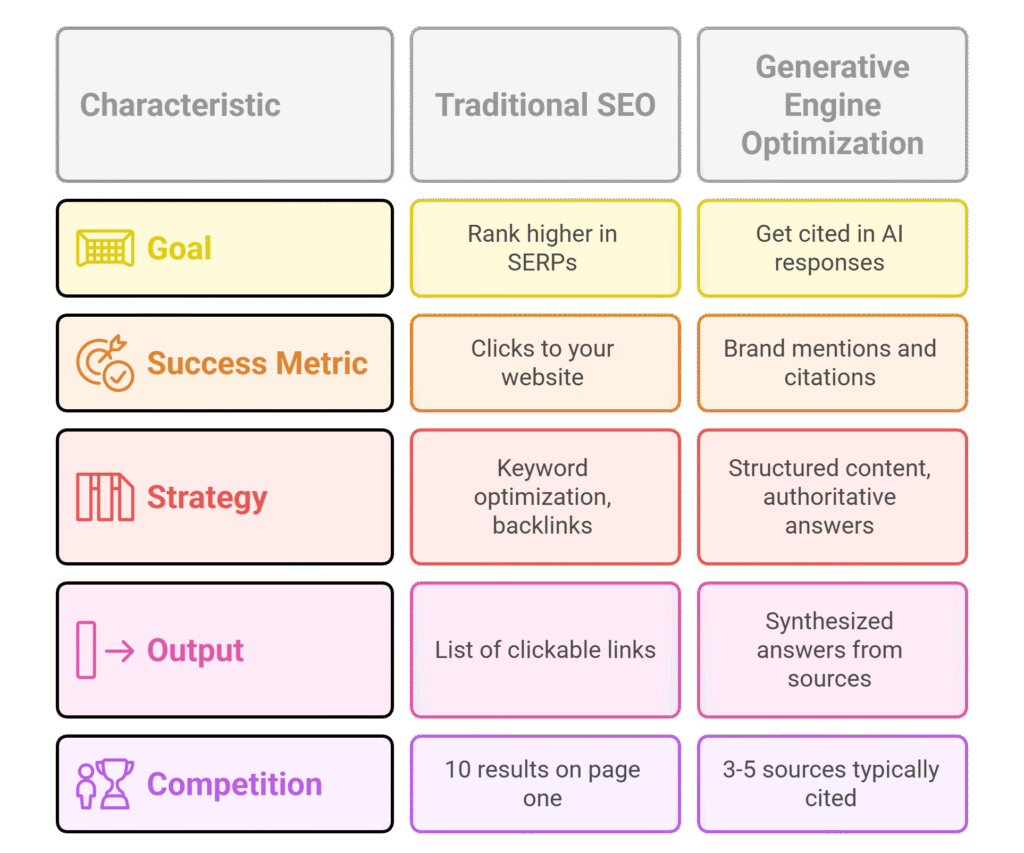
The key insight? Competition is fiercer due to the limited citation space compared to traditional search results. When Google shows search results, there are 10 spots on page one. When ChatGPT generates an answer, it might cite 2-4 sources at most. The bar is higher.
But here’s the good news: GEO doesn’t replace SEO; it extends it. A lot of SEO practices act as a foundation for GEO. A brand ranking well in the SERPs has a higher chance of getting cited in AI answers.
How do AI search engines like ChatGPT actually work?
To optimize for AI search, you need to understand how these systems function. Here’s the simplified version:
Step 1: Data Collection and Training
The engine gathers huge amounts of data from various sources to create a comprehensive knowledge base. This includes web content, documents, research papers, and structured databases. These AI models are trained on massive datasets that teach them patterns in language, context, and information relationships.
Step 2: Natural Language Processing
Natural language processing (NLP) is at the core of generative AI. It allows these models to comprehend the context and intent of the user’s query. When someone asks a question, the AI doesn’t just look for matching keywords, it understands what the person is really trying to learn or accomplish.
Step 3: Information Retrieval
When you ask a question, the AI searches through its knowledge base and recent web data to find relevant sources. This is similar to traditional search, but instead of ranking pages, it’s looking for information that can be synthesized into a cohesive answer.
Step 4: Content Synthesis
The AI reads through multiple sources, extracts key information, identifies patterns and agreements, and generates a comprehensive response in conversational language. It’s not just copying and pasting, it’s understanding and rewriting information in a way that directly addresses the user’s question.
Step 5: Citation
The AI attributes information to specific sources, typically linking to or naming the websites where information was found. This is where GEO matters most, being one of those cited sources.
What techniques actually help my content appear in AI answers?
Here’s where it gets really interesting. A peer-reviewed study conducted by researchers from Princeton, Georgia Tech, Allen Institute for AI, and IIT Delhi tested various optimization methods and found that certain techniques could boost source visibility by up to 40% in generative engine responses.
Let’s break down what actually works, based on research and real-world testing:
1. Adding Statistics and Data (High Impact)
Numbers add weight. Including data points makes your content more factually grounded, which helps AI include it in responses to factual or persuasive questions.
Example of poor optimization: “Many businesses in Dubai are investing in digital marketing.”
Example of strong optimization: “According to a 2024 market analysis, 73% of SMBs in Dubai increased their digital marketing budgets by an average of 42% compared to 2023.”
See the difference? The second statement is specific, sourced, and data-driven. AI systems love this because it’s verifiable and useful.
2. Including Direct Quotations from Experts (High Impact)
The study found that quotation addition significantly boosts performance, with some methods showing improvements of over 41% in visibility metrics.
When you include quotes from recognized authorities, industry leaders, or subject matter experts, AI engines view your content as more credible and comprehensive. This is especially valuable for UAE businesses writing about local market conditions, regulations, or industry-specific insights.
3. Optimizing for Fluency and Readability (Medium Impact)
Generative engines prefer clean, well-written content. This isn’t just about grammar but about how effortlessly the model can process and reproduce your content.
Your content should:
- Use clear, simple sentences (aim for 8th-10th grade reading level)
- Follow logical structure with proper transitions
- Avoid jargon unless it’s industry-standard terminology
- Use active voice more than passive voice
- Break up long paragraphs into digestible chunks
Fluency optimization can improve impression metrics up to 30%.
4. Citing Reliable External Sources (Medium Impact)
GEO is grounded in verifiable content. Linking or referencing known sources, even within your body text, signals trustworthiness. When you cite other authoritative sources, you’re demonstrating that your content is researched, credible, and part of a broader conversation.
For UAE businesses, this means citing:
- Local government statistics and reports
- Industry associations and regulatory bodies
- Academic research from recognized institutions
- Reputable news organizations
- International standards and certifications
5. Authoritative and Comprehensive Content (Foundational)
AI systems prioritize content that demonstrates E-E-A-T (Experience, Expertise, Authoritativeness, and Trustworthiness). GEO places a greater emphasis on the quality of the content itself, favoring expertise, experience, authoritativeness, and trustworthiness.
This means:
- Author credentials and bios matter
- Company background and credentials are important
- Industry certifications and awards add value
- Client testimonials and case studies build authority
- Depth of coverage signals expertise
6. What DOESN’T Work: Keyword Stuffing
Interestingly, keyword stuffing performs 10% worse than baseline content with no optimization at all. This is a crucial insight, tactics that might have worked in early-stage SEO are actually harmful for GEO.
AI systems can detect when content is artificially stuffed with keywords, and they penalize it by viewing the source as less trustworthy and less useful for citation.
How can I optimize my content for AI search results?
Now let’s get tactical. Here’s how to actually implement GEO for your business:
Strategy 1: Reframe Content Around Questions
Many AI queries start as a question. Producing that question with a direct answer gives the LLM exactly what it needs.
Instead of writing article titles like “Digital Marketing in Dubai,” reframe them as:
- “How much does digital marketing cost for small businesses in Dubai?”
- “What are the most effective social media platforms for UAE businesses?”
- “How long does it take to see ROI from SEO in the UAE market?”
Then answer these questions directly, clearly, and comprehensively in your content.
Strategy 2: Use Structured Formatting
AI systems can parse structured content more easily. Use:
- Clear headings and subheadings (H1, H2, H3 tags)
- Numbered lists for sequential information
- Bullet points for key takeaways
- Tables for comparisons or data
- FAQ sections that explicitly ask and answer questions
Many successful UAE businesses have noticed that content with strong structural formatting gets cited more frequently in AI responses.
Strategy 3: Implement Schema Markup
Schema markup is code that helps search engines (and AI systems) understand your content’s structure and meaning. Key schema types for GEO include:
- FAQ Schema: Marks up question-and-answer content
- How-To Schema: Identifies step-by-step instructions
- Article Schema: Defines article metadata (author, date, topic)
- Organization Schema: Establishes your business credentials
- Review Schema: Highlights ratings and testimonials
For WordPress users, plugins like All In One SEO make schema implementation straightforward without coding knowledge.
Strategy 4: Create Comprehensive, Definitive Content
GEO requires producing content that ranks and provides visual and interactive elements that AI can incorporate into its responses.
Instead of publishing five 500-word blog posts on related topics, consider creating one comprehensive 2,500-word guide that covers the topic exhaustively. AI systems tend to favor comprehensive resources that can answer multiple related questions.
For example, instead of separate posts on:
- “Best time to post on Instagram”
- “Instagram content ideas”
- “Instagram hashtag strategy”
Create one ultimate guide: “Complete Instagram Marketing Strategy for UAE Businesses in 2025”
Strategy 5: Build Topical Authority
Build your brand authority across multiple web platforms, as AI overview results reveal sites with 60% coverage in top 5 results gain significantly more visibility in generative engines.
This means consistently publishing high-quality content in your niche. If you’re a Dubai-based web development company, regularly publish content about:
- Web design trends in the UAE
- E-commerce development considerations for Middle Eastern markets
- Technical SEO for Arabic and English bilingual websites
- Website accessibility standards and UAE regulations
- Case studies of successful UAE web projects
Over time, AI systems will recognize you as an authority in this space and cite you more frequently.
Strategy 6: Leverage Local UAE Context
One massive advantage for UAE businesses is the ability to provide localized, contextually relevant information that international sources can’t match.
AI systems looking for UAE-specific information will prioritize sources that demonstrate local knowledge:
- Dubai business licensing procedures
- UAE labor law considerations
- Ramadan marketing strategies for the Gulf region
- VAT implications for e-commerce in the Emirates
- Cultural considerations for marketing to Emirati and expat audiences
Creating content that addresses these uniquely local topics positions you as the go-to source for AI systems answering UAE-related queries.
Does GEO work differently on ChatGPT vs Google vs Perplexity?
Different AI platforms have different characteristics. Here’s what you need to know:
ChatGPT (OpenAI)

- Emphasizes conversational, natural language
- Values recent, up-to-date information
- Prefers structured, well-organized content
- Often cites 2-4 sources per response
- Strong preference for authoritative domains
Google AI Overviews (formerly SGE)

- Heavily influenced by traditional SEO signals
- Prioritizes content from sites with strong domain authority
- Values structured data and schema markup
- Often pulls from existing featured snippets
- Tends to cite Google-indexed sources primarily
Perplexity AI
- Known for comprehensive source citation (often 5-8+ sources)
- Values real-time information and recent content
- Strong preference for primary sources and original research
- Good at synthesizing information from multiple perspectives
- Particularly effective for research-oriented queries
Claude (Anthropic)

- Emphasizes accuracy and nuance
- Values well-reasoned arguments and evidence
- Good at understanding context and intent
- Prefers detailed, comprehensive sources
- Strong at handling complex, multi-faceted questions
Gemini (Google)

- Integrated with Google’s knowledge graph
- Strong multimedia capabilities (images, videos)
- Values content from Google’s ecosystem (YouTube, Google News)
- Good at understanding multimodal content
- Prioritizes mobile-friendly, fast-loading sources
The key takeaway? Each AI platform has unique characteristics that require tailored optimization approaches. Understanding these differences helps you create content that performs well across multiple generative engines.
How do I track if my GEO efforts are working?
Unlike traditional SEO where you can track rankings and click-through rates easily, measuring GEO success requires different approaches:
Primary Metrics:
1. AI Visibility Score Tools like Writesonic, BrightEdge, and others are developing AI visibility tracking. This measures how often your brand appears in AI-generated responses for relevant queries.
2. Citation Frequency Track brand mentions across AI platforms by manually testing prompts you imagine people might ask, using keywords you know your content is ranking for, to see how often it shows up in citations.
3. Share of Voice Among your competitors, what percentage of AI citations are you capturing in your industry or niche?
4. Sentiment Analysis How is your brand being described when it’s cited? Is the AI presenting you positively, neutrally, or negatively?
5. Referral Traffic from AI Some AI platforms now include clickable links. Track traffic coming from these sources in your analytics.
Practical Measurement Approach for UAE Businesses:
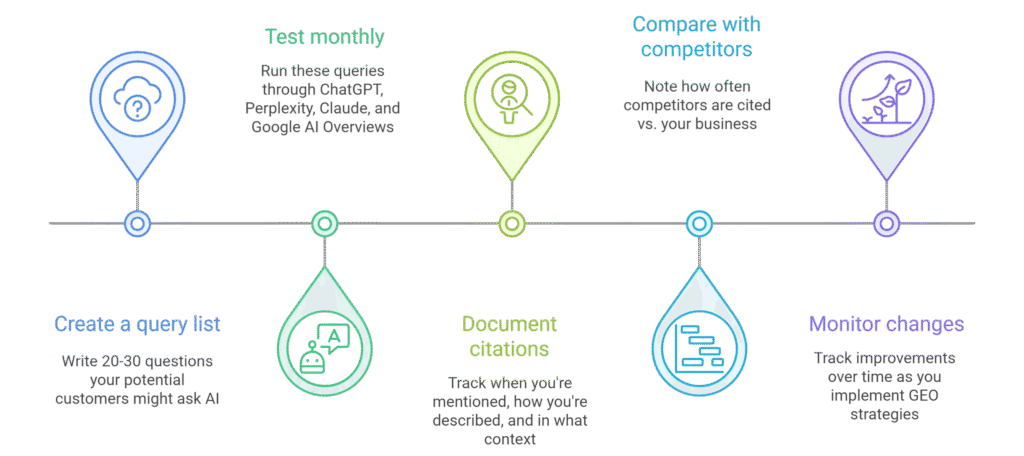
What mistakes should I avoid when optimizing for AI search?
As with any emerging field, there are pitfalls. Here’s what not to do:
Mistake 1: Abandoning SEO for GEO
GEO doesn’t replace SEO; it extends it. You still need strong SEO fundamentals (clear structure, authority, and relevance) to earn visibility inside AI answers.
Think of it this way: good SEO makes you discoverable; good GEO makes you citable. You need both.
Mistake 2: Over-Optimizing Content
AI systems are sophisticated enough to detect when content feels artificially optimized. If your content reads like it was written for robots rather than humans, both AI and human readers will reject it.
Mistake 3: Ignoring Content Quality
Traditional SEO tactics, like keyword stuffing and backlink building, will become less effective as generative engines prioritize content that delivers real value and context.
The future belongs to genuinely valuable content. Shortcuts won’t work.
Mistake 4: Neglecting Author Authority
AI systems increasingly consider who wrote the content. Anonymous or poorly-attributed content performs worse than content with clear author credentials, bios, and demonstrated expertise.
For UAE businesses, this means:
- Adding comprehensive team/author pages
- Including author bios on blog posts
- Highlighting credentials, certifications, and experience
- Linking author profiles to professional networks (LinkedIn, industry associations)
Mistake 5: Focusing Only on One AI Platform
Different users prefer different AI tools. A comprehensive GEO strategy optimizes for multiple platforms, not just ChatGPT or Google.
What’s coming next for AI search and how should I prepare?
Looking ahead, several trends will shape how GEO evolves:
Multimodal AI Search
Content creators will need to optimize across multiple formats to ensure their visibility in these enhanced search environments. This means AI systems that understand not just text, but images, videos, audio, and interactive content.
For UAE businesses, this creates opportunities to create rich, multimedia content that stands out:
- Video tutorials with transcripts
- Infographics with detailed alt text
- Interactive calculators or tools
- Audio content with show notes
- 360-degree product views
Voice Search Integration
As voice assistants become more sophisticated, optimizing for spoken queries will become crucial. Questions asked to Siri, Alexa, or Google Assistant that are answered by AI will drive another wave of search behavior change.
Localization and Language
For the UAE market specifically, bilingual content (Arabic and English) optimized for AI will become increasingly valuable. AI systems that can understand and generate responses in multiple languages will prioritize sources that provide quality content in both.
Real-Time Information
As AI algorithms become more advanced, they will deliver even more accurate and comprehensive responses to user queries. This means fresher content, more frequently updated, will have advantages over static, outdated resources.
How do I get started with GEO for my UAE business?
If you’re ready to start optimizing for generative engines, here’s your step-by-step action plan:
Phase 1: Audit and Assess (Week 1-2)
- List your top 20 service/product keywords
- Turn them into questions people might ask AI
- Test these questions across ChatGPT, Perplexity, and Google AI Overviews
- Document where you appear (or don’t appear)
- Note which competitors are being cited
Phase 2: Content Foundation (Week 3-6)
- Identify your top 5-10 most important topics
- Create comprehensive, definitive guides for each (2,000+ words)
- Ensure each includes: statistics, quotes, citations, clear structure, FAQ section
- Implement proper schema markup
- Add author bios and credentials
Phase 3: Optimization (Week 7-10)
- Rewrite existing top-performing blog posts with GEO principles
- Add data, statistics, and expert quotes to existing content
- Improve structural formatting (headings, lists, tables)
- Implement FAQ schema on relevant pages
- Create location-specific content highlighting UAE expertise
Phase 4: Expansion and Testing (Week 11-12)
- Publish new content consistently (minimum 2-4 pieces monthly)
- Test your target queries monthly
- Track citation improvements
- Adjust strategy based on what’s working
- Document successes and failures
Phase 5: Advanced Tactics (Ongoing)
- Build relationships with other authoritative sites for mutual citation
- Create original research or data that others will cite
- Engage on platforms where AI systems gather information (Reddit, Quora, industry forums)
- Monitor emerging AI platforms and optimize for new entrants
- Continuously update top-performing content with fresh information
Should I hire someone to do GEO or can I do it myself?
Should you hire a digital marketing agency in Dubai to handle GEO, or can you do it yourself?
DIY Approach Works If:
- You have in-house content creation capabilities
- Someone on your team understands SEO fundamentals
- You’re committed to learning and testing
- You have time to consistently publish content
- Your market is less competitive
Agency Makes Sense If:
- You need results faster
- Your market is highly competitive (real estate, hospitality, luxury retail)
- You lack internal resources or expertise
- You want integrated SEO + GEO + content strategy
- You need advanced technical implementation
Many UAE businesses find success with a hybrid model: working with an agency for strategy and high-value content while handling day-to-day updates in-house.
The Bottom Line: Why GEO Matters Now
Here’s the reality: AI search isn’t the future, it’s the present. Millions of people are already using ChatGPT, Perplexity, Claude, and Google’s AI Overviews as their primary search tools.
If your business isn’t appearing in AI-generated answers, you’re invisible to this growing audience. And unlike traditional SEO where you could catch up later, early GEO visibility creates compounding advantages as AI engines learn from prior citations.
The businesses that start optimizing now will build authority and recognition that becomes harder to displace over time. Think of it like domain authority in traditional SEO, it takes time to build, but once established, it provides lasting competitive advantage.
For UAE businesses specifically, the opportunity is even greater. The local market’s tech adoption rates, diverse international audience, and growing digital economy create perfect conditions for early GEO success.
The question isn’t whether you should care about Generative Engine Optimization. The question is: will you start optimizing while you still have the early-mover advantage, or will you wait until your competitors have already claimed the AI citation space in your industry?
Frequently Asked Questions
Q: Do I need to choose between SEO and GEO, or should I do both?
A: You should absolutely do both, they work together, not against each other. GEO doesn’t replace SEO; it extends it. Strong SEO fundamentals (structured data, topical authority, clarity) are still essential for getting cited in AI-generated answers. Think of SEO as building your foundation and GEO as expanding your reach into new search behaviors. The best strategy is an integrated approach where your content is optimized for both traditional search engines and AI platforms. Many of the same principles apply: quality content, clear structure, authoritative information, and user value.
Q: How long does it take to see results from GEO efforts?
A: Unlike traditional SEO where you might see ranking changes within weeks, GEO typically shows results over 2-4 months of consistent effort. This is because AI systems need time to crawl updated content, process it, and begin incorporating it into their knowledge base. However, once you start getting cited, the benefits compound. Once an AI starts citing a brand, it rarely stops, you build cumulative authority. For UAE businesses, we typically recommend a 3-month initial testing period where you implement GEO principles, monitor results, and adjust strategy. The businesses seeing fastest results are those publishing high-quality, comprehensive content consistently.
Q: Can small businesses compete with large brands in GEO, or is it only for big companies?
A: Small businesses actually have significant advantages in GEO, especially in local markets like the UAE. While large brands might have more content volume, AI systems value specificity, local expertise, and depth of knowledge, areas where small businesses can excel. For example, a boutique digital marketing agency in Dubai specializing in hospitality clients can outperform larger generalist agencies for specific queries about hotel marketing in the UAE. Focus on your niche, demonstrate deep expertise, create comprehensive content in your specialty, and build local authority. These strategies work regardless of company size.
Q: What tools are available to track my GEO performance?
A: GEO measurement tools are still emerging, but several options exist. Writesonic offers an AI visibility dashboard that tracks citations across platforms. BrightEdge has AI search analytics features. For manual tracking, you can use a simple spreadsheet approach: create a list of 20-30 questions your customers might ask AI about your industry, test them monthly across ChatGPT, Perplexity, Claude, and Google AI Overviews, and document when you’re cited. Tools like HubSpot’s AI Search Grader provide free visibility assessments. For UAE businesses, we recommend starting with manual tracking to understand the landscape, then investing in paid tools once you see traction and want to scale.
Q: Should I create separate content for GEO or optimize existing content?
A: Both approaches work, and the best strategy uses a combination. Start by optimizing your existing high-performing content, pages that already rank well in traditional search or get good traffic. These pages already have some authority, so adding GEO elements (statistics, quotes, better structure, FAQ sections) can boost them into AI citations faster. Simultaneously, create new comprehensive content specifically designed with GEO principles from the start. For UAE businesses, we recommend a 70-30 split: 70% effort on optimizing existing valuable content, 30% on creating new definitive guides. This approach delivers faster wins while building long-term authority.
Q: Does GEO work for B2B companies, or is it mainly for B2C businesses?
A: GEO works exceptionally well for B2B companies, often better than for B2C. Here’s why: B2B buyers do extensive research before purchasing, they ask detailed questions to AI about solutions, they value authoritative sources and expert content, and decision-makers often use AI tools to quickly understand complex topics. A Dubai-based software company answering detailed questions about “enterprise resource planning implementation costs in UAE” or “data privacy compliance for Middle Eastern businesses” can capture high-value B2B traffic through GEO. The key is creating educational, problem-solving content that addresses the specific questions your business customers are asking AI. B2B content tends to be more evergreen and authoritative, exactly what AI systems prefer to cite.

What video length gets the most engagement for business accounts?
You’re scrolling through Instagram during your lunch break in Dubai Marina. A 3-second clip catches your eye, but before you can process it, it’s gone. Then a 10-minute tutorial appears, and you immediately swipe past it. Sound familiar?
If you’re running a business account in the UAE, you’ve probably asked yourself: how long should my videos actually be? The answer isn’t as simple as “shorter is better” or “longer builds trust.” The truth depends on where you’re posting, who you’re talking to, and what you’re trying to achieve.
Let’s break down what actually works in 2025, backed by real data and strategies that UAE businesses are using right now to grab attention in one of the world’s most digitally active markets.
Why does video length matter so much for business engagement?
Think about the last time you watched a video all the way through on social media. What made you stay? Probably not the length itself, but how quickly it delivered value.
Video length matters because it directly affects three critical metrics: watch time, completion rate, and engagement rate. Platforms like Instagram, TikTok, and LinkedIn use these signals to decide whether your content deserves a spot on someone’s feed or gets buried under cat videos.
In the UAE, where the average person spends over 3 hours daily on social media according to recent digital reports, you’re competing for attention in a market that’s both highly connected and incredibly selective. Your video length needs to match the platform’s algorithm preferences and your audience’s expectations.
Here’s what the data tells us: videos under 30 seconds consistently see completion rates above 70% on platforms like TikTok and Instagram Reels. But here’s the interesting part, videos between 60-90 seconds often generate more saves and shares, which are weighted heavily by algorithms in 2025.
For business accounts specifically, the sweet spot varies by goal. If you’re building brand awareness, 15-30 seconds works brilliantly. If you’re educating your audience about a complex service like GEO or web development, 60-90 seconds gives you room to explain without losing viewers.
Which video lengths perform best on different social media platforms?
Every platform has its own rhythm, and what works on TikTok might flop on LinkedIn. Let’s look at each major platform and what UAE businesses are seeing work.
Instagram Reels favor videos between 7-15 seconds for maximum reach, but 30-60 second videos often generate better engagement from your existing followers. A real estate agency in Downtown Dubai we’ve studied saw their highest save rates on 45-second property tours, even though their 10-second teasers got more initial views.
TikTok rewards both extremes. Videos under 15 seconds can go massively viral because they’re easy to watch multiple times (which the algorithm loves). But longer videos up to 3 minutes are gaining traction for storytelling and tutorials. A Dubai-based café went viral with 8-second “coffee art reveals,” while their 2-minute “day in the life” content built deeper community connections.
YouTube Shorts perform best between 15-60 seconds. The platform is still pushing Shorts aggressively, and businesses that keep videos under 45 seconds are seeing completion rates around 65-75%. A fitness studio in Abu Dhabi found that 30-second workout tips consistently outperformed their longer content.
LinkedIn is the outlier. Business audiences here will actually watch longer content if it provides genuine value. Videos between 60-90 seconds perform well, but thought leadership content up to 3 minutes can work if the first 10 seconds hook viewers with a compelling question or insight. Professional service providers in Dubai Media City are successfully using 90-second expert tips to establish authority.
Facebook still favors slightly longer content, with 60-120 seconds showing strong engagement. The platform’s older demographic in the UAE (compared to TikTok) is more willing to invest time in content that educates or entertains thoroughly.
How do you choose the right video length for your business goals?
Start by asking yourself what you want viewers to do after watching. Different objectives need different approaches to length.
For brand awareness campaigns, shorter is almost always better. When you’re trying to reach new people, you need to capture attention fast and leave them wanting more. Think 10-20 seconds maximum. A perfume retailer in Dubai Mall used 12-second fragrance reveal videos that generated over 500,000 views in a month by keeping things punchy and visually striking.
For product demonstrations, you need enough time to show value without dragging. The magic range is usually 30-60 seconds. Show the problem, reveal the solution, and end with a clear call to action. A home services company in Sharjah increased inquiry rates by 40% using 45-second before-and-after videos of their cleaning work.
For educational content about your industry, 60-120 seconds lets you establish expertise. This works especially well for service-based businesses that need to build trust. A financial consulting firm in DIFC uses 90-second explainer videos about UAE tax changes, positioning themselves as the go-to experts while keeping content digestible.
For storytelling and emotional connection, you can push to 2-3 minutes if your narrative is compelling. A local charity in Abu Dhabi created a 2.5-minute documentary-style video about their impact that generated more donations than any of their shorter content because it gave space for real emotional resonance.
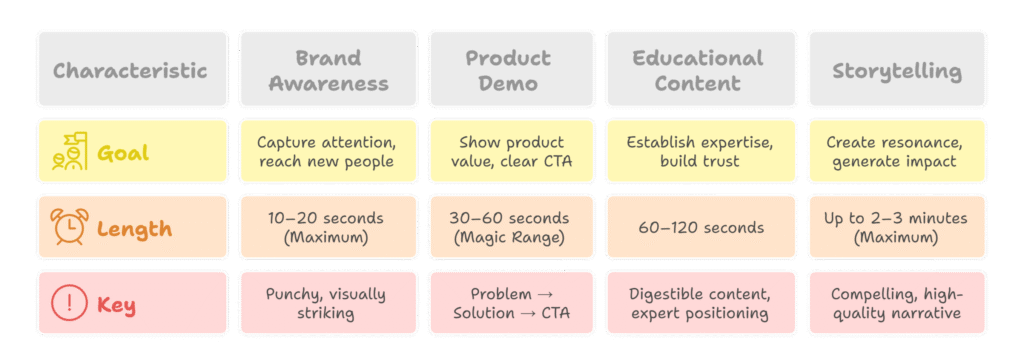
The key is matching length to intent. If you’re interrupting someone’s scroll, be brief. If they’ve chosen to engage with your content, you can elaborate.
What do the latest engagement statistics say about video length?
Let’s talk numbers, because guessing doesn’t build businesses.
According to 2024-2025 social media benchmarks, videos under 30 seconds see average engagement rates of 5-8% on Instagram, compared to 3-5% for videos over a minute. But here’s what most businesses miss: engagement rate alone doesn’t tell the full story.
Longer videos (60-90 seconds) generate 3x more saves than videos under 15 seconds. Saves are gold for algorithms in 2025, they signal that your content has lasting value, which boosts your reach for days or even weeks after posting.
Completion rate is another critical metric. If 80% of viewers watch your entire 20-second video, that’s algorithmically more valuable than 40% watching your 60-second video. The math matters: a 20-second video with 75% completion delivers 15 seconds of watch time per viewer, while a 60-second video at 40% completion delivers 24 seconds. The longer video wins even with lower completion.
For business accounts specifically, data shows that videos between 30-45 seconds hit a sweet spot: high enough completion rates (typically 60-70%) combined with enough length to drive meaningful actions like website clicks or profile visits.
In the UAE market specifically, where mobile viewing dominates and users are comfortable with both English and Arabic content, videos that deliver value in the first 3 seconds maintain viewer attention across all lengths better than global averages.
How can small businesses maximize engagement without big production budgets?
You don’t need a film crew to create engaging videos. What you need is strategic thinking about length and format.
Start with batch creation. Film multiple short videos in one session, then test different lengths by cutting the same content into 15-second, 30-second, and 60-second versions. A restaurant in JBR did this with menu items, same footage, three different edits, and discovered their 20-second versions outperformed everything else by 60%.
Use native platform tools instead of expensive software. Instagram Reels editor, TikTok’s built-in features, and even smartphone apps like CapCut give you professional-looking results. The algorithm actually favors content created with native tools because it looks authentic rather than overly polished.
Focus on hooks, not length. The first 3 seconds determine whether someone keeps watching. Start with movement, bold text, or a provocative question. A beauty salon in Dubai increased their average watch time by 45% just by changing their opening frames from logo animations to immediate transformations.
Repurpose longer content into shorter clips. If you have a 5-minute YouTube video explaining your service, extract the most valuable 30-second moment and post it as a Reel or Short with a call-to-action to watch the full version. This approach multiplies your content’s value across platforms.
Test systematically. Post videos of different lengths at the same times and track not just views, but completion rate, engagement rate, and conversion actions. A personal trainer in Abu Dhabi discovered that while their 15-second videos got more views, their 60-second workout breakdowns generated 4x more DM inquiries.
Should business videos always include captions regardless of length?
Absolutely, and here’s why this matters even more in the UAE than in other markets.
Over 85% of social media videos are now watched without sound, according to recent platform data. When someone is scrolling through their feed in a quiet office, on the Metro, or during a meeting, captions determine whether they engage with your content or skip past it.
In the UAE’s multilingual environment, captions serve another critical function: accessibility across languages. Even if your video is in English, clear captions help viewers whose first language might be Arabic, Hindi, Urdu, or Tagalog. This expands your reach significantly.
Short videos (under 30 seconds) benefit from minimal, punchy captions that highlight key points. Think 5-7 words per screen that reinforce your core message. Long videos (over 60 seconds) need accurate full transcriptions to keep viewers engaged throughout.
Captions also improve your content’s discoverability. Platforms like Instagram and TikTok can now read and index your caption text, meaning videos with well-written captions show up in more searches. This is crucial for GEO (Generative Engine Optimization), as AI engines parse your video’s text content when deciding whether to recommend it.
A tech startup in Dubai Silicon Oasis increased their video engagement by 73% simply by adding bold, easy-to-read captions to all their product demo videos. The length stayed the same, but the accessibility improved dramatically.
What role does video length play in algorithm ranking across platforms?
Algorithms don’t care about your video length directly, they care about how viewers respond to your content. But length affects those responses, which is why it matters indirectly.
Every platform measures watch time differently. TikTok’s algorithm loves replays, so a compelling 9-second video that people watch 3 times gives you 27 seconds of watch time from one viewer. Instagram Reels prioritize completion rate, so a 25-second video that 70% of viewers finish completely often outperforms a 60-second video with only 30% completion.
YouTube Shorts use a combination of watch time and engagement velocity, how quickly likes, comments, and shares accumulate in the first few hours after posting. Shorter videos (15-30 seconds) tend to get faster initial engagement, which triggers algorithmic promotion.
LinkedIn’s algorithm is unique because it factors in professional relevance. A 90-second video from a business owner sharing industry insights might get more promotion than a 20-second generic tip because the platform recognizes the content’s value to professional networks.
For business accounts, the algorithm ranking sweet spot in 2025 is creating videos that maximize both completion rate and total watch time. This usually means 30-60 seconds of highly focused content that delivers immediate value.
A digital marketing agency in Abu Dhabi (hint: might be us) tested this by posting the same message as 15-second, 45-second, and 90-second videos. The 45-second version got 3x the reach of the shortest and 5x the reach of the longest because it balanced completion and watch time perfectly.
How do you test which video length works best for your specific audience?
Testing isn’t optional if you want real results. Here’s a practical framework that UAE businesses can use starting today.
Pick one content theme and create three versions: short (15-20 seconds), medium (40-50 seconds), and long (70-90 seconds). Post them on the same platform at similar times across three different days. Track completion rate, engagement rate, and any conversion actions (link clicks, profile visits, inquiries).
Use platform analytics, not just vanity metrics. Instagram Insights shows you exactly where viewers drop off in your videos. If 80% of viewers leave at the 12-second mark of your 60-second video, you know you need a stronger hook or you should cut the content shorter.
Pay attention to which videos get saved or shared. These signals indicate genuine value, not just passive scrolling. A home decor store in Dubai found that their 55-second room transformation videos got 8x more saves than their 18-second style tips, even though the shorter videos got more initial views.
Test by customer journey stage. New audience members might prefer shorter, attention-grabbing content. People already following you might engage more with longer, detailed videos. Segment your content strategy accordingly.
Survey your audience directly. Post a story or poll asking what video length they prefer. You might be surprised, a B2B software company in DIFC discovered their audience actually wanted longer, more detailed demos, contradicting the “shorter is always better” assumption.
Run A/B tests on paid promotions. If you’re boosting posts or running ads, test identical content at different lengths with the same budget split. The performance difference will show you exactly what your target market responds to.
What are the common mistakes businesses make with video length?
Let’s talk about what not to do, because we see these mistakes constantly across UAE business accounts.
Mistake one: Adding unnecessary intros. Your logo animation might look cool to you, but viewers scroll past 3-second branded intros without a second thought. Start with value immediately. A law firm in Dubai lost 60% of their viewers in the first 5 seconds just from a slow animated intro. When they removed it, completion rates jumped to 68%.
Mistake two: making videos long to “look professional.” Length doesn’t equal quality. A 2-minute video with 30 seconds of actual value trains your audience to skip your content. A boutique in City Walk learned this when their detailed product videos (90+ seconds) got far less engagement than their quick 20-second styling tips.
Mistake three: cutting videos too short to include a clear call-to-action. If your video ends before viewers understand what you want them to do next, you’ve wasted their attention. Always reserve 3-5 seconds at the end for a simple CTA, even in short-form content.
Mistake four: ignoring platform-specific best practices. Posting the same 2-minute video across TikTok, Reels, and LinkedIn without adaptation means you’re using the wrong length for at least two of those platforms. A restaurant group in Dubai Marina started customizing video length per platform and saw engagement rise by 90% overall.
Mistake five: not front-loading value. If the most interesting part of your video happens at the 40-second mark, you’ve already lost most viewers. Put your hook, reveal, or key insight in the first 5 seconds, then build from there.
Mistake six: forgetting mobile viewing. In the UAE, over 90% of social media access happens on mobile devices. Videos that work on desktop might feel too long or too slow on a phone screen. Always preview your content on mobile before posting.
Conclusion
Video length isn’t about following rigid rules, it’s about understanding your audience, your platform, and your goals. The businesses winning on social media in the UAE right now are those testing systematically, adapting quickly, and focusing on value delivery rather than arbitrary time limits.
If you’re just starting out, begin with 30-45 seconds. This range gives you enough time to communicate clearly while maintaining high completion rates across most platforms. As you gather data on what your specific audience responds to, adjust accordingly.
Remember: a 15-second video that drives 10 inquiries beats a 3-minute video that gets zero conversions every single time. Measure what matters to your business, not just what looks impressive in your analytics dashboard.
The UAE market moves fast. What works this quarter might need adjustment next quarter as platforms update algorithms and audience preferences evolve. Stay flexible, keep testing, and always start your videos with something worth watching.
FAQs
What is the ideal video length for maximum reach on Instagram Reels?
Videos between 15-30 seconds typically achieve the highest reach on Instagram Reels because they maintain strong completion rates while delivering enough content to trigger engagement. However, 45-60 second videos often generate more saves and shares, which provide sustained algorithmic promotion over time.
Do longer videos perform better for business credibility?
Not automatically. Business credibility comes from delivering valuable insights efficiently, not from video duration. A 40-second video that clearly demonstrates your expertise can build more trust than a rambling 3-minute video. Focus on substance and clarity rather than length.
Should small businesses post different video lengths on different platforms?
Yes, definitely. Each platform has different algorithm preferences and audience expectations. A 15-second TikTok video should be reformatted to 60-90 seconds for LinkedIn if you want optimal performance on both. Repurpose strategically, but customize length per platform.
How long should explainer videos be for service-based businesses in the UAE?
For social media, aim for 60-90 seconds maximum. This gives you enough time to explain a concept or service benefit while maintaining viewer attention. If you need longer than 90 seconds, consider breaking the content into a series or directing viewers to a full-length version on YouTube.
Does adding captions change the optimal video length?
Captions don’t change the optimal length, but they significantly improve engagement across all video lengths by making content accessible to viewers watching without sound. Videos with captions consistently outperform identical videos without them by 20-40% in engagement metrics.
What video length gets the most comments and shares?
Videos between 30-60 seconds tend to generate the most comments and shares because they provide enough content to spark conversation without requiring significant time investment. Shorter videos get quick likes, but slightly longer videos drive deeper engagement and sharing behavior.
How to Measure ROI from Viral Video Marketing Campaigns?
You’ve just posted a video that’s racking up thousands of views, hundreds of shares, and your comment section is buzzing. It feels great. But then your finance team asks the inevitable question: “What’s the actual return on this?” And suddenly, those vanity metrics don’t seem quite enough.
For small and medium-sized businesses in the UAE, viral video marketing has become one of the most powerful tools for cutting through the noise. Whether you’re a Dubai-based cafe, an Abu Dhabi tech startup, or a Sharjah retail brand, short-form video content on platforms like Instagram Reels, TikTok, and YouTube Shorts can deliver exposure that traditional ads simply can’t match. But without a clear framework for measuring ROI, you’re essentially flying blind.
The truth is, measuring ROI from viral video campaigns isn’t as straightforward as tracking clicks on a Google ad. Viral content creates ripple effects across brand awareness, customer trust, and long-term growth. However, with the right approach and tools, you can tie your video performance directly to business outcomes. This guide will walk you through exactly how to do that.
What counts as ROI when your video goes viral?
Let’s start by redefining what ROI actually means in the context of viral video marketing. Most businesses default to the classic formula: (Revenue – Cost) / Cost. That works for direct-response campaigns, but viral videos rarely operate in a straight line from view to purchase.
When a video goes viral, you’re not just generating immediate sales. You’re building brand equity, creating social proof, and planting seeds that might convert weeks or months later. A potential customer in Dubai might see your video today, remember your brand when they need your product next month, and only then make a purchase.
That’s why you need to track both hard metrics (direct revenue, lead generation, conversions) and soft metrics (brand awareness, engagement quality, audience growth). In the UAE market, where word-of-mouth and social validation carry enormous weight, these soft metrics often predict future revenue better than immediate conversion rates.
How do you calculate the actual cost of your viral video campaign?
Before you can measure return, you need to know your true investment. Many UAE businesses underestimate their video marketing costs by only counting production expenses. But a complete cost calculation includes:
Direct production costs: This includes everything from concept development and scripting to filming, editing, motion graphics, and any talent fees. In the UAE, a professionally produced short-form video typically ranges from AED 2,000 to AED 15,000 depending on complexity, though DIY content can be produced for much less.
Platform advertising spend: Even “organic” viral videos often get an initial paid boost. If you’re spending AED 500 to AED 5,000 to seed your content to the right audiences, that needs to be factored in.
Internal resource allocation: If your marketing team spent 20 hours planning, coordinating, and managing the campaign, that’s a real cost. Calculate this based on their hourly rates or opportunity cost.
Software and tools: Subscription costs for video editing software, analytics platforms, social media management tools, and any AI-powered content optimization services you’re using.
Let’s say you spent AED 8,000 on production, AED 2,000 on paid promotion, and your team invested 30 hours of work valued at AED 150 per hour. Your total investment is AED 14,500. That’s your baseline for measuring return.
Which metrics actually predict business growth from viral videos?
Not all metrics are created equal. View counts might stroke your ego, but they don’t pay the bills. Here’s how to separate signal from noise:
View-through rate and average watch time tell you if people are actually consuming your content or just scrolling past. On TikTok and Reels, videos with over 50% average watch time typically signal strong relevance. For UAE audiences, content that hooks viewers in the first three seconds and maintains attention tends to drive better downstream results.
Engagement rate (likes, comments, shares, saves divided by reach) reveals how much your content resonates. In the GCC market, where sharing is a form of social endorsement, high share rates often correlate with trust-building. A 5-8% engagement rate is considered strong for business accounts.
Profile visits and follower growth show interest beyond a single video. If your viral video drives 2,000 new followers in a week, you’ve just expanded your owned audience that you can market to repeatedly without additional ad spend.
Link clicks and website traffic are where viral content starts connecting to revenue. Use UTM parameters on every link in your bio or stories to track which videos drive the most traffic. Google Analytics will show you exactly how many sessions, pages per session, and goal completions came from each campaign.
Direct attribution conversions happen when someone watches your video and immediately takes action (visits your website, makes a purchase, fills out a lead form). These are your easiest wins to track. Use platform-specific pixels (Meta Pixel, TikTok Pixel) to monitor these conversions.
How can you connect video views to actual sales and leads?
This is where most businesses struggle, especially in the UAE where customer journeys often involve multiple touchpoints across online and offline channels. Here’s a practical framework:
Set up conversion tracking properly: Install tracking pixels on your website before launching any campaign. Create custom conversions for key actions like “Add to Cart,” “Lead Form Submit,” “WhatsApp Click,” or “Store Locator Visit.” For UAE businesses, tracking WhatsApp clicks is especially important since it’s a primary conversion channel.
Use unique promo codes: Include campaign-specific discount codes in your videos. If your viral video mentions “Use code VIRAL23 for 15% off,” you can directly attribute every redemption to that campaign. This works particularly well for e-commerce and service-based businesses in Dubai and Abu Dhabi.
Implement multi-touch attribution: A customer might discover you through a viral video, visit your website twice, see a retargeting ad, and then convert. Multi-touch attribution models (available in Google Analytics 4 and platform-specific dashboards) show you how much credit your video deserves in that journey. For most UAE SMBs, a time-decay model works well since it gives more credit to touchpoints closer to conversion.
Survey your customers: Sometimes the simplest method is the most effective. Add “How did you hear about us?” to your checkout process or inquiry forms. You’d be surprised how many customers will mention “I saw your video on Instagram.”
Track branded search lift: After a video goes viral, monitor your Google Search Console data. If searches for your brand name spike, that’s a direct indicator of awareness lift. Tools like Google Trends can show you search interest over time, filtered specifically for UAE regions.
What should you do when engagement is high but conversions are low?
This is a common scenario: your video gets massive reach and engagement, but your sales or lead numbers don’t reflect it. Here’s what’s likely happening and how to fix it:
Your funnel has a leak: People are interested but hitting friction points. Check your bio link is it clear and compelling? Does your landing page load quickly on mobile? For UAE audiences, is your checkout process optimized for local payment methods and fast delivery expectations?
Your offer isn’t aligned with intent: Viral content often attracts a broad audience. If your video is entertaining but doesn’t clearly connect to what you’re selling, people engage but don’t convert. The solution is to create content that’s both engaging AND relevant to your product or service.
You’re not retargeting effectively: Most people won’t buy on first exposure. Set up retargeting campaigns to re-engage video viewers with more specific offers. On Meta platforms, you can create custom audiences of people who watched 75% or more of your video and show them conversion-focused ads.
Timing matters: In the UAE market, purchasing behavior varies significantly by season, day of week, and even time of day. Eid periods, Dubai Shopping Festival, and weekend browsing patterns all affect conversion rates. Track when your video viewers are most likely to convert and optimize your follow-up accordingly.
How do long-term brand benefits factor into viral video ROI?
Here’s where viral video marketing separates itself from direct-response advertising. A single viral video can deliver benefits for months or even years:
Brand recall and top-of-mind awareness: When someone in Dubai needs a service you offer six months from now, will they remember you? Viral videos create memorable associations. While hard to quantify immediately, this translates to lower customer acquisition costs over time.
Social proof and trust signals: A video with 500,000 views and 15,000 likes becomes a trust marker. New customers researching your brand will see that others have validated you. In the UAE’s community-oriented market, this social proof is invaluable.
Content asset multiplication: One viral video can be repurposed into multiple formats: website hero content, email newsletter features, case studies, and even recruitment material. Each additional use compounds the ROI of your initial investment.
Earned media and backlinks: Viral videos often get picked up by local blogs, news sites, and industry publications. These mentions drive referral traffic and improve your SEO through quality backlinks. For UAE businesses, getting featured in Gulf News, Khaleej Times, or industry-specific publications can drive substantial long-term value.
To quantify these benefits, track your Customer Lifetime Value (CLV) and Cost Per Acquisition (CPA) over time. If you notice that customers acquired through viral video campaigns have higher CLV or lower CPA in subsequent months, that’s your long-term ROI showing up in the data.
What tools help UAE businesses track video marketing ROI accurately?
You don’t need an enterprise-level tech stack to measure ROI effectively. Here are the essential tools for UAE SMBs:
Google Analytics 4: Free and powerful for tracking website traffic, conversions, and user behavior from social referrals. Set up goals for each important action (contact form, purchase, download).
Native platform analytics: Instagram Insights, TikTok Analytics, and YouTube Studio provide detailed data on reach, engagement, and audience demographics. Check these weekly to spot trends.
UTM parameter builders: Create unique tracking links for each video campaign. This lets you see exactly which videos drive traffic and conversions in Google Analytics.
Social media management platforms: Tools like Hootsuite or Sprout Social consolidate analytics across multiple platforms and help you compare performance. They also track sentiment and brand mentions that indicate wider impact.
CRM systems: If you’re collecting leads, connect your CRM (like HubSpot, Zoho, or even a simple Google Sheet) to your video campaigns. Track how many video-sourced leads convert to customers and their average deal value.
For UAE businesses operating in both English and Arabic markets, make sure your analytics setup can segment by language and location. Dubai, Abu Dhabi, and Sharjah audiences may respond differently to the same content.
How can you improve ROI on your next viral video campaign?
Learning from each campaign is how you compound success. Here’s a framework for continuous improvement:
Analyze your top performers: Which videos drove the most valuable actions (not just views)? Look for patterns in content type, format, messaging, and posting time. In the UAE market, videos featuring local landmarks, cultural references, or Arabic text overlays often see higher engagement.
Test strategically: Don’t just spray and pray. Run controlled tests on one variable at a time (hook style, video length, CTA placement). Document your results and build a playbook of what works for your audience.
Optimize your conversion funnel: Even if your video performance stays constant, improving your landing page, simplifying your checkout, or refining your offer can dramatically increase ROI. Sometimes the biggest wins aren’t in the video itself.
Build a content series: One-off viral hits are great, but a consistent content strategy builds sustainable growth. Plan video series that keep audiences coming back and create multiple conversion opportunities.
Leverage user-generated content: Encourage customers to create content featuring your product or service. This reduces production costs while building authenticity. In the UAE, where influencer culture is strong, UGC campaigns can deliver exceptional ROI.
The businesses that win with viral video marketing in the UAE aren’t the ones chasing one lucky hit. They’re the ones systematically testing, measuring, and optimizing based on real data.
Conclusion
Measuring ROI from viral video marketing campaigns requires looking beyond surface-level metrics. For UAE businesses, success means tracking the entire customer journey from first view to final purchase, while accounting for longer-term benefits like brand awareness and social proof.
Start by calculating your true costs, set up proper tracking mechanisms, connect video performance to business outcomes, and continuously optimize based on data. The businesses seeing the highest returns are those who treat video marketing not as a gamble, but as a measurable, improvable system.
Remember that in the UAE’s competitive digital landscape, consistency matters more than virality. A strategic approach to video marketing with clear ROI measurement will always outperform hoping for lucky breaks.
FAQs
What is a good ROI for viral video marketing campaigns?
A strong ROI for video marketing campaigns is typically 3:1 or higher, meaning you earn AED 3 for every AED 1 spent. However, this varies by industry and campaign goals. For brand awareness campaigns, you might measure success through reach and engagement metrics rather than immediate sales. UAE e-commerce businesses often see 4:1 to 8:1 returns on well-optimized campaigns, while service businesses might focus on cost per lead, aiming for leads that are 50-70% cheaper than traditional channels.
How long does it take to see ROI from viral video campaigns?
Most viral videos show immediate engagement within 24-72 hours, but full ROI measurement takes 30-90 days. Direct response campaigns might show conversions within the first week, while brand awareness campaigns need longer to demonstrate impact. In the UAE market, consider seasonal factors like Ramadan and Dubai Shopping Festival, which can accelerate conversion timelines. Track both immediate metrics (traffic, engagement) and delayed conversions (repeat purchases, brand searches) for a complete picture.
Can small businesses in UAE afford viral video marketing?
Absolutely. You don’t need a Hollywood budget to create effective video content. Many successful UAE businesses start with smartphone-shot videos and basic editing tools, investing AED 1,000-3,000 per campaign. The key is understanding your audience and creating authentic, valuable content. As you prove ROI, you can reinvest profits into higher production quality. Focus on consistency and strategy over expensive production, especially when starting out.
Which social platforms deliver the best ROI for UAE businesses?
Instagram and TikTok currently deliver the strongest returns for most UAE businesses due to high engagement rates and sophisticated targeting options. LinkedIn performs well for B2B companies, while YouTube works for longer educational content. The best platform depends on your audience demographics and business type. Most successful UAE brands maintain presence on 2-3 platforms rather than spreading too thin, focusing their budget where their specific audience is most active.
How do you measure ROI when your video goes viral organically?
Organic viral success still requires measurement. Track the same metrics as paid campaigns: website traffic spikes, follower growth, conversion rate changes, and direct sales attribution. Use Google Analytics to monitor referral traffic from social platforms and set up goals for key actions. Even without paid promotion costs, factor in production time and resources. The ROI calculation becomes (Revenue Generated – Production Costs) / Production Costs. Many organically viral videos deliver exceptional ROI since your main investment is creative effort rather than ad spend.
What mistakes do UAE businesses make when measuring video ROI?
The most common mistakes include tracking only vanity metrics (views, likes), not setting up proper conversion tracking before launching campaigns, ignoring long-term brand benefits, failing to account for full production costs, and not testing different content approaches. Many UAE businesses also make the mistake of expecting immediate direct sales from every video, rather than understanding that some content builds awareness that converts later. Always connect your video metrics to actual business outcomes like leads, sales, or cost savings.

Which Platform is Best for Business Viral Content in Dubai?
Let’s be honest. Scrolling through Instagram Reels or TikTok, you’ve probably thought: “Why did this random video get 2 million views while my carefully crafted content barely reaches 200 people?”
For UAE businesses, this frustration is real. You’re competing not just with local brands but with global content that floods every feed. Yet here’s the thing: viral short-form videos aren’t just about luck or having a massive budget. They’re about understanding a formula that combines psychology, timing, and strategic planning.
More importantly, when done right, these videos don’t just rack up vanity metrics. They generate actual leads, drive inquiries, and turn viewers into customers. This guide breaks down exactly how to create short-form videos that spread fast and bring real business results, especially for small and medium-sized businesses operating in the UAE market.
What makes a short-form video actually go viral?
The first thing to understand is that “viral” doesn’t mean random. Platforms like Instagram, TikTok, and YouTube Shorts use algorithms that favor specific types of content. These algorithms look for watch time, engagement rate, shares, and saves. If your video keeps people watching until the end and makes them interact, the algorithm pushes it to more people.
In the UAE context, there’s an added layer. Your audience is diverse, multilingual, and highly visual. They expect production quality, but they also crave authenticity. A perfectly polished corporate video might get ignored, while a slightly raw, genuine piece of content that solves a real problem can explode.
Research shows that videos under 15 seconds have the highest completion rates, but videos between 21-34 seconds tend to get shared more often. The sweet spot? Around 20-30 seconds where you deliver one clear, valuable idea without fluff.
Here’s what actually makes content spread:
Pattern interrupts: The first 1-2 seconds must stop the scroll. This could be an unexpected visual, a bold statement, or a relatable problem stated clearly.
Emotional hooks: Content that triggers curiosity, surprise, humor, or even mild controversy gets remembered and shared. Think about the last video you sent to a friend. It probably made you feel something strong.
Value delivery: Even entertainment needs value. Whether it’s a laugh, a useful tip, or a fresh perspective, viewers should feel like watching wasn’t a waste of time.
Relatability: UAE audiences respond to content that reflects their reality. Traffic on Sheikh Zayed Road, the struggle of finding good shawarma, balancing work during Ramadan – these small touches make content feel local and relevant.
How do you structure a short-form video for maximum engagement?
Structure matters more than most businesses realize. You can’t just point a camera and hope for the best. Every second needs a purpose.
The Hook (0-3 seconds): This is your make-or-break moment. Start with the payoff, not the setup. Instead of “Today I’m going to show you…” try “This one change doubled our leads in two weeks.” Lead with the result, the surprise, or the problem.
The Value (4-20 seconds): Deliver on your hook’s promise. If you promised a tip, give it. If you teased a story, tell it. Keep language simple. One idea per video works better than cramming three concepts into 30 seconds.
The Call-to-Action (21-30 seconds): Don’t be subtle. Tell viewers exactly what to do next. “Save this for later,” “Send this to someone who needs it,” or “Follow for more tips like this.” Direct CTAs work because people are often willing to act but need clear direction.
For UAE businesses specifically, consider adding Arabic text overlays even if you’re speaking English. About 65% of UAE residents speak Arabic, and dual-language content performs significantly better in regional algorithms.
What type of content generates leads, not just views?
This is where most businesses get it wrong. They chase views without thinking about conversion. A video with 50,000 views but zero inquiries is just noise. You want content that moves people down the funnel.
Problem-solution format: Show a common business problem your audience faces, then tease your solution. A Dubai-based accounting firm could create a video: “Why most SMBs overpay on taxes in the UAE” then offer a free checklist. The video educates, builds authority, and gives a clear next step.
Behind-the-scenes content: People buy from brands they trust. Showing your process, your team, or how you handle challenges builds that trust. A restaurant showing food prep, a web agency showing a design process, or a fitness trainer showing client transformations all work because they prove capability.
Customer results: Nothing sells like proof. Short testimonial clips, before-and-after comparisons, or quick case studies turn viewers into believers. A real estate agency in Dubai could show a 15-second clip: “We sold this villa in 72 hours. Here’s how.”
Educational hooks: “3 mistakes costing you customers” or “The one thing every Dubai business needs in 2025.” These videos position you as an expert while naturally leading to your services.
The key difference between viral entertainment and lead-generating content is intent. Entertainment might get millions of views, but educational or solution-focused content converts better because it attracts an audience already interested in what you offer.
How often should you post to see results?
Consistency beats perfection. The businesses seeing real ROI from short-form video post at least 4-5 times per week. That might sound overwhelming, but remember: these are 15-30 second videos, not full productions.
The UAE market moves fast. Trends come and go within days. If you’re posting once a week, you’re missing opportunities. Daily posting keeps you in the algorithm’s good graces and increases your chances of catching a trend wave.
Here’s a realistic posting schedule for SMBs:
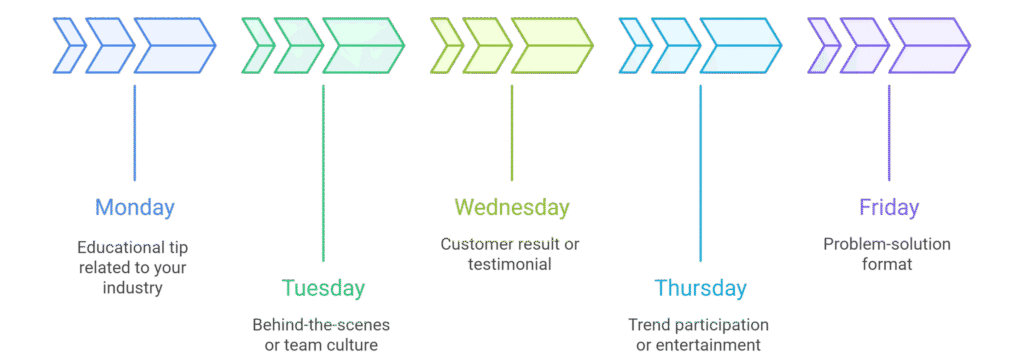
This mix keeps your content varied while ensuring you’re always providing value. You’re not just selling. You’re building a presence.
Batch creation is your friend. Set aside 2-3 hours every two weeks to film 10-15 videos at once. Change your shirt, adjust the background slightly, and you’ve got content for weeks.
What mistakes kill video performance before it even starts?
Even with great content, simple technical mistakes can tank your reach. Here are the most common ones:
Poor audio quality: People will tolerate average video quality, but bad audio makes them leave instantly. Invest in a basic lapel mic or use your phone’s voice memo app to test audio before filming.
No captions: Over 80% of social media videos are watched without sound. If your video relies on audio without captions, you’re losing most of your audience. Always add captions. Platforms like Instagram and TikTok have auto-caption features, but review them because they’re not always accurate.
Weak thumbnails: For platforms like YouTube Shorts, the thumbnail matters. A blurry, dark, or confusing thumbnail gets scrolled past. Make sure your thumbnail clearly shows what the video is about.
Ignoring analytics: Your platform tells you exactly what’s working. Check which videos got saved, shared, or drove profile visits. Double down on those topics and formats.
Overproduced content: This might surprise you, but overly polished content often underperforms. UAE audiences are sophisticated and can spot inauthentic marketing. Raw, genuine videos that show real people and real results often outperform expensive productions.
Talking at people, not with them: The best-performing creators speak as if they’re talking to a friend. They use “you” language, ask questions, and create a conversation rather than a broadcast.
How do you turn video views into actual business inquiries?
Views mean nothing without conversion. Here’s how to bridge that gap:
Profile optimization: When someone watches your video and checks your profile, what do they see? Your bio should clearly state what you do, who you help, and how to contact you. Include a link to your website, booking page, or lead magnet.
Strategic CTAs: Every video needs a purpose. Are you building awareness? Drive follows. Want leads? Direct people to link in bio. Want engagement? Ask for comments. Match your CTA to your goal.
Lead magnets in stories: After posting a video that performs well, create a story with a swipe-up link (if you have 10k+ followers) or link sticker directing people to a free resource, consultation, or exclusive offer.
Comment engagement: Reply to every comment in the first hour. This signals to the algorithm that your content is sparking conversation, which boosts reach. It also builds relationships with potential customers.
Retargeting: People rarely buy on first contact. Use paid ads to retarget people who watched 75% or more of your videos. These are warm leads who’ve already shown interest.
For UAE businesses, WhatsApp integration is crucial. Many local customers prefer WhatsApp over email or phone calls. Make sure your WhatsApp Business number is visible and easy to access.
What tools and resources actually matter?
You don’t need expensive gear to create viral content. Most successful creators use just their smartphones. Here’s what actually helps:
Smartphone with good camera: Any recent iPhone or Samsung flagship is more than enough. You’re not shooting a Hollywood film.
Basic ring light: Improves video quality significantly, especially for indoor content. You can find decent ones in Dubai for under 200 AED.
Editing apps: CapCut is free and powerful. It has templates, auto-captions, and music libraries. InShot is another solid option for quick edits.
Trending audio source: Both TikTok and Instagram show trending sounds. Using these in the first 24-48 hours of a trend exploding gives you an algorithmic advantage.
Content calendar: A simple Google Sheet tracking what you post, when, and performance metrics. This helps you spot patterns and refine your strategy.
Analytics tools: Use native platform insights. They tell you when your audience is most active, which content formats work best, and demographic information.
The difference between struggling creators and successful ones isn’t gear. It’s strategy, consistency, and willingness to adapt based on data.
How do successful UAE businesses approach video content differently?
Local businesses that win with short-form video understand cultural nuances. They know that UAE audiences value:
Quality and professionalism: Even in casual content, there’s an expectation of polish. Messy backgrounds, poor lighting, or sloppy editing reflect poorly on your brand.
Bilingual content: Mixing English and Arabic, or providing Arabic subtitles, significantly expands your reach. Many successful UAE brands create two versions of popular videos, one in each language.
Cultural sensitivity: Understanding local customs, holidays, and values prevents missteps. Content that acknowledges Ramadan, National Day, or other significant events resonates strongly.
Practical value: UAE business owners are busy. They want content that respects their time. Quick tips, clear solutions, and actionable advice perform better than long-winded explanations.
Social proof: Showing real customers, real results, and real testimonials builds trust faster than claims. The UAE market is crowded and competitive. Proof differentiates you.
Several Dubai-based businesses have grown almost entirely through strategic short-form video. A local coffee shop went from 200 to 45,000 followers in six months by posting daily behind-the-scenes content and coffee-making tips. A business consultant in Abu Dhabi generates 15-20 qualified leads monthly through educational TikTok videos. These aren’t lucky accidents. They’re the result of consistent, strategic content creation.
Conclusion
Creating viral short-form videos that generate leads isn’t about gaming the system or getting lucky. It’s about understanding what makes people watch, engage, and eventually buy. It’s about showing up consistently with valuable, authentic content that speaks directly to your audience’s needs.
For UAE businesses, the opportunity is massive. The market is digitally connected, culturally diverse, and hungry for content that feels relevant and genuine. Whether you’re a restaurant in Dubai, a consultancy in Abu Dhabi, or an e-commerce brand serving the Emirates, short-form video is no longer optional. It’s how modern customers discover, evaluate, and choose businesses.
Start simple. Pick one format, create five videos, and see what resonates. Then refine, repeat, and scale. The businesses winning with video today started exactly where you are now. The only difference? They started.
FAQs
How much does it cost to create viral short-form videos?
You can start with zero budget beyond your smartphone. Free editing apps like CapCut provide everything needed for professional-looking content. As you scale, investing 500-1,000 AED in basic equipment like a ring light and microphone improves quality, but expensive gear isn’t necessary for viral content. Time investment matters more than money.
Do short-form videos work for B2B businesses in the UAE?
Absolutely. B2B buyers are still humans scrolling social media. Educational content explaining complex services simply, showing client results, or addressing common industry challenges performs well. Several UAE-based B2B service providers generate significant leads through LinkedIn Reels and TikTok by positioning themselves as industry experts through consistent short-form content.
Which platform should UAE businesses focus on for short-form video?
Instagram Reels typically performs best for UAE businesses due to the platform’s strong local user base. TikTok is growing rapidly, especially with younger audiences. YouTube Shorts offers longevity since YouTube content stays discoverable longer. The smartest approach is creating once and posting everywhere, with slight optimizations for each platform’s culture and audience.
How long does it take to see results from short-form video marketing?
Most businesses see increased engagement within 2-4 weeks of consistent posting. Lead generation typically kicks in around the 6-8 week mark once you’ve built enough content and audience trust. Viral moments can happen anytime, but sustainable growth comes from consistency. Think months, not days, but the compound effect is worth the patience.
Can I outsource video creation or does it need to be me on camera?
Both work. Personal brand content with you on camera builds stronger connection and trust. However, businesses successfully use team members, customer testimonials, product demos, or text-based videos. The key is authenticity and value, not necessarily showing your face. Choose what fits your comfort level and brand strategy.
What’s the biggest mistake UAE businesses make with short-form videos?
Treating it like traditional advertising. Posting promotional content constantly while ignoring entertainment and education kills growth. The best approach is 80% value and entertainment, 20% promotion. People follow accounts that enrich their feed, not broadcast ads at them. Give before you ask, and the asking becomes easier.
How to Create Viral Short-Form Videos That Generate Leads?
You’ve seen it happen. A 30-second video blows up overnight, racks up hundreds of thousands of views, and suddenly a brand nobody heard of yesterday is everywhere today. Meanwhile, your carefully crafted video gets 47 views (and 12 of those are probably you refreshing the page).
Here’s the truth most UAE businesses don’t realize: viral videos aren’t lucky accidents. They’re strategic combinations of psychology, timing, and platform understanding. But here’s the better news: going viral doesn’t matter nearly as much as generating leads. A video with 10,000 views and 50 quality leads beats a million-view video with zero conversions every single time.
For businesses in Dubai, Abu Dhabi, and across the Emirates, short-form video has become the fastest path to visibility. With UAE internet users spending an average of 3 hours daily on social media, the opportunity is massive. The challenge? Creating content that stops the scroll AND moves people toward your business.
This guide breaks down exactly how to create short-form videos that don’t just entertain but convert viewers into customers.
What makes a short-form video actually go viral?
The algorithm doesn’t care about your production budget. It cares about one thing: watch time. If people watch your entire video and immediately rewatch it, share it, or comment on it, the platform pushes it to more people. Simple as that.
But getting people to watch requires understanding the first three seconds. Studies show you have exactly 1.3 seconds before someone scrolls past your content. That’s not even enough time to finish reading this sentence out loud.
Successful viral videos in the UAE market typically use one of these proven hooks: asking a provocative question that creates curiosity, showing an unexpected visual that breaks pattern recognition, making a bold claim that demands attention, or starting with the result before explaining the process.
Take a real example from a Dubai-based real estate company. Instead of starting with “Welcome to our property tour,” they opened with “This apartment rents for 120,000 AED a year and doesn’t have a kitchen.” Immediate curiosity. Why doesn’t it have a kitchen? The video explained it was a commercial space perfectly suited for restaurants. That hook generated 340,000 views and 23 qualified inquiries in one week.
The content structure matters just as much. Your video needs conflict or tension (a problem people recognize), transformation (showing the solution), and a clear next step (what to do with this information). If your video feels like it’s going nowhere, viewers leave. If it pays off the promise from the hook, they engage.
How do you optimize video content for different platforms?
Instagram Reels, TikTok, and YouTube Shorts might look similar, but they reward different content strategies. Treating them all the same is like using the same sales pitch for a 22-year-old student and a 55-year-old CEO.
TikTok prioritizes raw, authentic content. The algorithm actually punishes overly polished videos that feel like traditional ads. A study of 100,000 TikTok videos found that user-generated style content gets 2.3 times more engagement than professional productions. For UAE businesses, this means your iPhone footage of behind-the-scenes moments often outperforms your expensive brand video.
Instagram Reels favors aesthetically pleasing content with trending audio. The platform’s user base in the UAE skews slightly older and more affluent than TikTok, making it ideal for premium services, real estate, and lifestyle brands. Reels also benefit from cross-promotion through Instagram Stories and the main feed, giving them longer visibility windows.
YouTube Shorts works differently. It rewards educational content and leverages your existing subscriber base. A Shorts video can drive viewers to your longer YouTube content, making it perfect for service-based businesses that need to build trust. Dubai-based consultants and agencies see particularly strong performance here because viewers actively search for expertise.
Platform-specific optimization means adjusting your captions, hashtags, and posting times. UAE businesses should post Reels between 7-9 PM when engagement peaks. TikTok sees highest activity during lunch hours (1-2 PM) and after 8 PM. YouTube Shorts performs consistently throughout the day but spikes during weekend mornings.
What type of content actually converts viewers into leads?
Entertainment gets views. Education builds trust. Trust generates leads. The sweet spot is educational content delivered in an entertaining format.
Problem-solution videos consistently outperform pure entertainment for lead generation. A Dubai-based pest control company created a 45-second video showing “three signs you have a termite problem most homeowners miss.” No sales pitch, just value. The video generated 89 direct inquiry calls in two weeks because it positioned them as experts while highlighting a problem their audience didn’t know they had.
Tutorial and how-to content works especially well in the UAE market where DIY culture is growing. A furniture store in Sharjah posted quick assembly tips and styling ideas instead of product showcases. Their “how to arrange a small bedroom in Dubai apartments” video got 156,000 views and drove 34 furniture purchases, with customers specifically mentioning they bought because the brand helped them first.
Behind-the-scenes content humanizes your brand while demonstrating expertise. People buy from people, not logos. An Abu Dhabi restaurant showed their chef selecting ingredients at the fish market at 5 AM, explaining what to look for in fresh seafood. The video built credibility that translated into reservations from people who wanted to experience that level of care.
The key to conversion is the call-to-action. Subtle but clear. “Link in bio for free consultation” works better than “buy now.” “Comment GUIDE for our free PDF” creates engagement that boosts algorithmic reach while capturing leads. “Tag someone who needs to see this” extends your reach organically.
How should you structure videos specifically for lead generation?
Lead-generating videos follow a specific framework that differs from pure brand awareness content. The structure needs to create desire, establish authority, and remove friction from the next step.
Start with the transformation, not the process. “We helped this Dubai startup get 50,000 Instagram followers in 90 days” is stronger than “Here’s our social media strategy.” Lead with results because results create desire.
The middle section should demonstrate expertise without giving away everything. Think of it as a trailer for your service. A digital marketing agency might show three quick optimization techniques that improved a client’s website traffic, but save the detailed implementation strategy for paying clients. You’re proving you know what you’re doing while leaving room for professional help.
End with a friction-free next step. “DM us GROW for a free audit” is easier than “visit our website, fill out the contact form, wait for our response.” Lower the barrier. One Dubai-based business coach used “Reply with your biggest business challenge” as her CTA. She got 200+ responses because it felt like a conversation, not a transaction.
Urgency works when it’s genuine. “We’re taking 5 new clients this month” creates scarcity without being pushy. “50% off if you book today” feels desperate. UAE consumers respond well to exclusivity and limited availability but are increasingly skeptical of artificial urgency.
What role does trending audio and hashtags play in reach?
Trending audio acts like a distribution multiplier. When you use a sound that’s currently popular, the platform tests your video with a broader initial audience because trending sounds indicate timely, relevant content.
But here’s the nuance: trending audio needs to match your content. Forcing a trending sound onto unrelated content confuses viewers and hurts watch time. A corporate law firm shouldn’t use a comedy audio trend unless they can make it genuinely relevant to their message.
For UAE-specific content, mixing English and Arabic hashtags expands reach across both demographics. A video about Dubai real estate should include both #DubaiRealEstate and #عقارات_دبي to capture the full local audience. Research shows bilingual hashtag strategies in the UAE increase average reach by 43% compared to English-only tags.
Hashtag strategy follows a 70-20-10 rule: 70% niche-specific hashtags that your target audience follows, 20% broader industry hashtags for discovery, and 10% trending or high-volume hashtags for algorithmic boost. A bakery in Dubai might use #DubaiBakery, #DubaiFoodie, and #CustomCakes (niche), #UAEFood and #DubaiBusiness (broader), and whatever food trend is currently viral (trending).
The number matters too. TikTok performs best with 3-5 highly relevant hashtags. Instagram Reels can handle 8-12. YouTube Shorts uses hashtags less prominently but benefits from detailed descriptions with keyword-rich text.
How do you maintain consistency without burning out your team?
Content creation fatigue kills more video strategies than lack of ideas. The businesses winning at short-form video have systems, not hustle.
Batch creation is non-negotiable. Set aside one day monthly to film 20-30 videos. Change your shirt, rearrange the background slightly, and knock out multiple pieces of content in one session. A financial advisor in Abu Dhabi films all his monthly content in a 4-hour Sunday morning session. That single time investment generates daily content for 30 days.
Content buckets solve the “what should I post” problem. Create 4-5 repeatable categories that align with your business goals. A gym might rotate between workout tips, nutrition advice, member transformations, myth-busting, and motivational content. You’re not creating from scratch each time, you’re filling predetermined buckets.
Repurposing multiplies your effort. One long client success story becomes: a 60-second case study video, a carousel post with key stats, a before/after comparison video, three quote graphics, and two educational tips derived from the project. One piece of source material generates a week of content across platforms.
UAE businesses often overlook user-generated content as a consistency tool. Encourage customers to tag you, then reshare their content (with permission). A Dubai coffee shop reposts customer photos and videos, creating authentic content that requires zero creation effort while building community.
Templates and frameworks speed up production. Create 3-4 video templates (intro animation, text overlay style, outro branding) that you reuse with different content. This builds brand recognition while eliminating design decisions from every video.
What metrics actually matter for measuring lead generation success?
View count is vanity. Lead count is sanity. Revenue is reality. Most businesses obsess over the wrong numbers.
The metrics that actually predict lead generation are watch time percentage (how much of your video people watch), saves and shares (indicators of high-value content), profile visits after viewing (interest in your business), and link clicks or DM responses (direct lead actions).
A video with 5,000 views, 78% average watch time, and 34 profile visits is outperforming a video with 50,000 views, 23% watch time, and 12 profile visits. The first audience is engaged and interested. The second audience scrolled past after three seconds.
For UAE businesses, tracking geographic data reveals whether you’re reaching your actual market. A video with 100,000 views from the Philippines doesn’t help a Dubai-based service business. Platform analytics show viewer locations, letting you optimize content for your actual target audience.
Cost per lead tells you what’s working. If you’re running paid promotion behind your videos, divide your spend by qualified leads generated. A video that costs 500 AED in promotion and generates 10 qualified leads has a 50 AED cost per lead. Compare that against your other marketing channels to determine where to invest more.
Attribution tracking connects videos to actual revenue. Use unique discount codes, dedicated landing pages, or specific email addresses in your CTAs. When someone books a service, ask how they found you. You’ll discover which videos are actually driving business, not just engagement.
How much should you invest in production quality?
Here’s what UAE businesses get wrong: they either spend 20,000 AED on a single professional video that feels like an ad, or they post blurry, poorly lit iPhone footage that looks careless. The sweet spot is in between.
Minimum viable quality means good lighting, clear audio, and stable footage. You don’t need a film crew. You need a 300 AED ring light, a phone tripod, and a quiet room. The difference between amateur and professional isn’t equipment cost, it’s attention to these basics.
That said, certain industries benefit from higher production. Real estate videos need high-quality footage because you’re selling premium properties. A cleaning service can thrive with simple before-and-after content. Match your production level to your audience expectations and pricing.
The 80-20 rule applies perfectly here. 80% of your content should be quick, authentic, value-driven videos you create in-house. The remaining 20% can be higher-production cornerstone content that showcases your best work. A Dubai-based interior designer might post daily quick tips on her iPhone but invest in one professional project showcase monthly.
Consider hybrid approaches. Film on your phone but pay a freelance editor 200 AED per video to add professional touches like text animations, color grading, and branded outros. This gives you professional-feeling content without professional-level costs.
What are the biggest mistakes that kill video performance?
Starting with your logo and brand intro is the fastest way to get scrolled past. Nobody cares about your brand in the first three seconds. They care about what’s in it for them. A 5-second logo animation at the start of a 30-second video means you’ve lost 20% of your audience before delivering any value.
Talking too slowly wastes precious seconds. The pace of short-form video should feel energetic. Watch your footage back at 1.5x speed. If it still feels engaging, your pacing is right. If it feels frantic, slow down slightly. But most businesses talk too slowly, assuming viewers need time to process. They don’t. They need momentum.
Poor audio quality kills credibility faster than poor video quality. People will watch grainy footage if the information is valuable, but they won’t tolerate audio that’s hard to understand. Background noise, echo, or muffled sound makes you seem unprofessional. A 200 AED lavalier microphone solves this problem completely.
Ignoring the caption opportunity is leaving reach on the table. 85% of social media videos are watched without sound. If your video requires audio to make sense, you’ve lost most of your audience. Add text overlays for key points or full captions for accessibility and algorithm benefits.
Making every video a sales pitch destroys trust. The ratio should be 80% value-driven content, 20% promotional. If every video ends with “call us now,” your audience learns to scroll past because they know you’re always selling. But if 8 out of 10 videos help them genuinely, that 9th video with a CTA feels like a natural next step.
Conclusion
Creating viral short-form videos that generate leads isn’t about luck or trends. It’s about understanding platform algorithms, knowing your audience’s pain points, and delivering value in the most engaging format possible.
The UAE market presents unique opportunities for businesses willing to invest in video content. With high social media usage, a diverse multilingual audience, and growing digital adoption across industries, the potential reach is enormous. But reach without conversion is just noise.
Start with consistency over perfection. Post 4-5 videos weekly with decent quality and clear value. Track what resonates with your specific audience in your specific niche. Double down on what works. Eliminate what doesn’t.
Remember that lead generation through video is a compound effect. Your first ten videos might generate two leads. Your next fifty might generate thirty. Your hundredth video benefits from the authority and audience you’ve built with the previous 99. This is a long game that rewards persistence and strategy over one-off viral attempts.
The businesses winning at short-form video in the UAE right now aren’t the ones with the biggest budgets. They’re the ones with the clearest strategy, the most consistent execution, and the deepest understanding of their audience’s needs.
FAQs
How long should short-form videos be for best lead generation results?
The optimal length is 30-60 seconds for most business content. This gives you enough time to present a problem, hint at a solution, and include a clear call-to-action without losing viewer attention. Videos under 30 seconds often feel too rushed to build trust, while videos over 60 seconds see dramatic drop-offs in completion rates. Test both ends of this range with your specific audience to find your sweet spot.
Do I need to show my face in videos to generate leads?
Not necessarily, but face-to-camera videos typically build trust faster, especially for service-based businesses. People buy from people they feel they know. That said, successful alternatives include screen recordings with voiceover for tech products, text-based videos for quick tips, and product demonstrations for physical goods. If you’re uncomfortable on camera, start with voiceover content and gradually work toward showing your face as you get comfortable.
How often should I post short-form videos to see results?
Minimum three times weekly for momentum, ideally 5-7 times for optimal algorithm performance. Consistency matters more than frequency. Posting daily for two weeks then disappearing for a month trains the algorithm to deprioritize your content. A sustainable three-videos-per-week schedule maintained for six months will outperform sporadic daily posting every time.
Can I use the same video across TikTok, Instagram Reels, and YouTube Shorts?
Yes, but optimize for each platform. Remove watermarks (TikTok logo on Instagram content gets suppressed), adjust captions for platform culture, and consider reformatting aspect ratios if needed. Some content performs well everywhere, while other videos need platform-specific versions. Test cross-posting first, then create unique content for platforms where you see the strongest engagement.
How long does it take to start generating leads from short-form video?
Most UAE businesses see initial leads within 30-45 days of consistent posting, but meaningful lead flow typically begins around the 90-day mark. This timeline assumes you’re posting valuable content 3-5 times weekly, engaging with your audience, and testing different CTAs. The first month builds your content library and algorithm trust. The second month starts attracting your target audience. The third month is when conversion momentum picks up.
Should I use paid promotion to boost my videos?
Organic growth should come first. Master creating content that naturally engages your target audience before spending money on promotion. Once you identify videos that perform well organically (high engagement rate, strong watch time, profile visits), allocate 200-500 AED to boost those proven winners. Paid promotion amplifies what already works, it doesn’t fix content that doesn’t resonate.

What makes business content go viral on social media in 2026?
Let’s be honest: every business wants their content to go viral. That one video, post, or reel that suddenly explodes, bringing thousands of new eyes to your brand, flooding your DMs with inquiries, and making your phone buzz with notifications.
But here’s what most businesses don’t realize, viral content in 2026 isn’t about luck anymore. It’s about understanding the science behind shareability, knowing your audience deeply, and creating content that resonates on an emotional and algorithmic level.
If you’re a UAE business wondering why your competitors’ videos are getting hundreds of thousands of views while yours barely crack a hundred, this guide is for you. We’re going to break down exactly what makes content go viral in 2026, backed by data, real examples, and insights from working with businesses across Dubai, Abu Dhabi, and the wider UAE market.
What’s different about viral content in 2026 compared to before?
Viral content isn’t what it used to be. Back in 2020-2022, you could post a trending dance, use a popular sound, and ride the wave. Not anymore.
In 2026, social media algorithms have become significantly more sophisticated. They’re not just looking at views and likes, they’re analyzing watch time, completion rates, saves, shares, and even how quickly engagement happens after posting.
Here’s what’s different now:
Algorithm sophistication has increased dramatically. Platforms like Instagram, TikTok, and YouTube Shorts use AI to understand content context, not just hashtags. They know if you’re posting about food, fashion, or financial services, and they show your content to audiences interested in those specific topics.
Authenticity beats polish. Overly produced, commercial-looking content often performs worse than authentic, slightly raw videos that feel genuine. UAE audiences, in particular, are tired of being sold to, they want real stories and honest recommendations.
Niche audiences drive virality. You don’t need millions of views to “go viral” in a way that matters for your business. 50,000 views from highly targeted UAE customers interested in your specific product is often more valuable than 5 million random views.
Speed matters more than ever. Jumping on trends 24-48 hours after they emerge is too late. Businesses seeing viral success in 2026 are reacting within 4-6 hours, or better yet, anticipating trends before they explode.
What makes people actually share and engage with content?
After analyzing thousands of viral posts from UAE businesses and global brands, certain patterns emerge consistently. Here are the non-negotiables:
1. The First 3 Seconds Are Make-or-Break
Your content has approximately 1.3 seconds to capture attention as someone scrolls. That’s it.
The most successful viral content starts with a “pattern interrupt”, something unexpected that stops the scroll:
- A surprising statement (“We lost AED 50,000 before learning this…”)
- Visual shock (unusual angles, bright colors, unexpected movement)
- Immediate value proposition (“Here’s exactly how we got 10,000 followers in 30 days”)
- Relatable problem stated bluntly (“Why does everyone in Dubai…”)
Notice how all of these create immediate curiosity or recognition. That’s the hook. Without it, even incredible content won’t get watched.
2. Emotional Resonance Beats Everything
Data from 2025-2026 shows that content triggering strong emotions gets shared 3-5x more than neutral content. But not all emotions are equal:
High-share emotions:
- Surprise and awe (transformations, before/afters, reveals)
- Humor (especially culturally relevant jokes)
- Inspiration (success stories, overcoming challenges)
- Anger or frustration (relatable complaints, industry problems)
- Belonging (community-focused, “this is so us” content)
Low-share emotions:
- Sadness (unless it has a redemptive arc)
- Contentment (nice but not share-worthy)
- Confusion (people won’t share what they don’t understand)
For UAE businesses, humor and inspiration perform particularly well. Content that celebrates local culture, pokes fun at everyday Dubai experiences, or showcases dramatic business transformations consistently goes viral.
3. The Goldilocks Length: Not Too Long, Not Too Short
In 2026, optimal video length varies by platform and content type:
- TikTok: 21-34 seconds for maximum reach
- Instagram Reels: 15-30 seconds sweet spot
- YouTube Shorts: 25-45 seconds
- LinkedIn: 45-75 seconds (professional audiences tolerate longer)
The key isn’t the exact length, it’s the completion rate. If 70% of viewers watch your entire video, algorithms will push it harder. A 25-second video with 70% completion will outperform a 60-second video with 30% completion every time.
4. Sound Strategy: Original vs. Trending
Here’s the 2026 truth about audio: trending sounds give you a boost in the first 6-12 hours, but original audio can create longer-term virality.
Use trending sounds when:
- You can jump on them within 24 hours
- They genuinely fit your brand and message
- Your target audience is actively using that sound
Use original audio when:
- You’re creating educational content
- Building brand recognition (people remember your voice)
- The trending sounds don’t match your message
Many successful UAE businesses are creating their own signature sounds or voiceovers that build brand recognition while still getting algorithmic love.
5. The “Save Factor”: Building Utility
Instagram and TikTok now heavily weight “saves” in their algorithms. Why? Because saves indicate value, people want to return to this content.
Content that gets saved typically:
- Teaches something specific (recipes, tutorials, tips)
- Lists valuable information (best restaurants, product recommendations)
- Provides templates or frameworks (business advice, productivity tips)
- Offers inspiration that people want to reference later (design ideas, quotes)
For UAE businesses, content like “5 best spots for coffee in Dubai Marina” or “How to get your trade license in 48 hours” consistently gets saved and continues gaining views weeks after posting. A content creation agency Dubai will recognize that this evergreen, practical content delivers far better long-term ROI than trendy posts that fade after 24 hours, making it essential for sustainable Instagram growth.
What works best on Instagram Reels vs TikTok vs YouTube Shorts?
Each platform has its own “viral DNA.” What works on TikTok might flop on Instagram, and vice versa.
Instagram Reels: The Aspirational Platform
Instagram’s UAE audience skews slightly older (25-45) and responds to polished, aspirational content with authentic moments.
Viral formula:
- Stunning visuals (crucial for UAE audiences used to luxury content)
- Clear value or entertainment in the first frame
- Trending audio or creative original audio
- Caption that adds context or sparks conversation
- Mix of product/service with lifestyle
What’s working: Before/after transformations, day-in-the-life content, “unpopular opinion” posts, aesthetic how-tos, luxury lifestyle moments
TikTok: The Trend Multiplier
TikTok remains the fastest path to viral reach, especially for businesses targeting younger UAE audiences (18-35).
Viral formula:
- Jump on trends FAST (within hours)
- Raw, authentic feel (perfect doesn’t win here)
- Strong personality or character
- Trend participation with your unique twist
- Consistent posting (minimum 1-2 daily for algorithm favor)
What’s working: POV videos, “I tried every [X] in Dubai” series, cultural contrast content (expat experiences), behind-the-scenes, comedy sketches
YouTube Shorts: The Evergreen Opportunity
YouTube Shorts is still underutilized by UAE businesses, creating major opportunity. Content here has longer shelf life than other platforms.
Viral formula:
- Educational or tutorial-focused
- Strong thumbnail (yes, even for Shorts)
- Clear title that includes searchable keywords
- Hook in first 3 seconds
- Content that encourages channel subscriptions
What’s working: Quick tutorials, problem-solving content, “explained simply” videos, satisfying processes, value-packed tips
LinkedIn: The B2B Viral Path
Don’t sleep on LinkedIn for UAE businesses in B2B or professional services. Viral content here drives actual business leads.
Viral formula:
- Contrarian or surprising professional opinions
- Personal story with business lesson
- Industry insights with data
- Thought leadership on emerging topics
- Authentic success or failure stories
What’s working: Behind-the-scenes of business growth, lessons learned from failures, UAE market insights, hiring/culture content, predictions about industry future.
Why do people share content on social media?
Understanding why people share content is the secret to engineering virality. Research shows people share for these core reasons:
1. Identity Expression
People share content that makes them look good or aligns with how they want to be perceived. For UAE businesses, this means creating content that your audience would be proud to have on their feed.
Example: Luxury brands that share stunning Dubai skyline content get shared because people want to be associated with that lifestyle.
2. Social Currency
People share things that make them appear knowledgeable, insider, or ahead of trends. Content that feels exclusive or “insider knowledge” gets shared more.
Example: “Only Dubai residents will understand these 7 things” or “Here’s what locals actually do in Abu Dhabi” gives people social currency to share.
3. Practical Value
If content helps solve a problem or makes life easier, people share it with others who might benefit. This is especially strong in close-knit communities like UAE expat groups.
Example: “How to save 40% on your DEWA bill” or “The fastest route to Dubai Airport during rush hour” gets shared because it’s genuinely useful.
4. Emotional Impact
Content that makes people feel something strongly (laugh, inspired, shocked, angry) creates a psychological need to share that emotion with others.
Example: Inspirational rags-to-riches stories of business owners in Dubai consistently go viral because they trigger strong positive emotions.
5. Community Building
Content that creates a sense of belonging or shared experience drives shares within specific groups.
Example: “Things every Dubai expat has experienced” creates community around shared experiences, leading to tags and shares.
What mistakes stop my content from going viral?
Even great content can fail if you make these mistakes:
1. Over-Optimizing for Algorithms
Ironically, content that feels too algorithm-focused often performs worse. When your captions are stuffed with keywords, you use every trending sound whether it fits or not, and your content feels manufactured for virality, audiences sense it and scroll past.
The best approach: Create for humans first, optimize for algorithms second.
2. Ignoring Your Existing Audience
Many businesses chase viral trends that have nothing to do with their brand or audience. A Dubai law firm jumping on a dance trend might get views, but it won’t build their business.
Focus on content that can go viral within your target audience, even if that means smaller total reach.
3. Inconsistent Posting
One viral video is great, but algorithms favor consistent creators. If you post one video and disappear for two weeks, you lose momentum. Most successful UAE businesses post minimum 4-5 times weekly.
4. Weak Call-to-Action (or No CTA at All)
Viral content is useless if it doesn’t convert to business value. Every video should have a clear next step: follow for more, visit link in bio, DM us, check our latest post, etc.
5. Not Engaging With Your Audience
When content starts gaining traction, the first 2-3 hours are crucial. Respond to every comment, answer questions, and keep engagement high. Algorithms reward active engagement.
How can UAE businesses use local culture to create viral content?
UAE businesses have unique advantages for creating viral content:
Cultural Diversity
The UAE’s incredibly diverse population means content that celebrates different cultures or bridges cultural gaps resonates strongly. Content highlighting expat experiences, comparing cultures, or showcasing unity in diversity performs exceptionally well.
Visual Appeal
Dubai and Abu Dhabi are inherently photogenic. Content featuring iconic landmarks, stunning architecture, or luxury experiences has built-in visual appeal that international audiences find fascinating.
Business Hub Energy
The UAE’s reputation as a business and innovation hub means entrepreneurial content, startup stories, and business insights have extra credibility and interest.
Ramadan and Cultural Events
Timing content around major cultural events (Ramadan, Eid, National Day, etc.) can dramatically increase viral potential as everyone’s seeking relevant content simultaneously.
What type of content actually went viral for UAE businesses recently?
Looking at successful viral campaigns from UAE businesses in the past year reveals interesting patterns:
Restaurant content that worked:
- Behind-the-scenes kitchen preparation videos
- “Secret menu items” revealed
- Dramatic food preparation (fire, height, size)
- “This is how much restaurants actually mark up food” transparency
Retail content that worked:
- Before/after styling videos
- “Affordable vs. luxury” comparisons
- Store inventory “hidden gems” tours
- Relatable shopping fails/wins
Service business content that worked:
- Time-lapse transformations (fitness, home services, beauty)
- “Busting myths about [industry]”
- Client testimonials told as stories (not just reviews)
- “Behind the scenes of what we actually do”
Real estate content that worked:
- Stunning property tours with personality
- “This is what [X amount] gets you in Dubai” series
- Hidden amenities or features revealed
- Neighborhood comparison guides
The common thread? All combined education or entertainment with authentic personality and visual appeal.
What equipment and editing do I need to create viral videos?
You don’t need expensive equipment, but you do need to meet minimum quality standards:
Minimum Requirements
- Smartphone with good camera (iPhone 12+ or equivalent Android)
- Basic ring light or good natural lighting
- Lapel or smartphone mic for clear audio
- Simple editing app (CapCut, InShot, or Adobe Rush)
Game-Changers Worth Investing In
- Gimbal stabilizer (AED 300-800) for smooth movement
- Professional mic (AED 200-500) for crisp audio
- Basic lighting kit (AED 400-1000) for consistent quality
- Premium editing software (AED 80/month) for advanced effects
The editing matters as much as filming. Fast cuts, engaging transitions, text overlays that appear perfectly timed, these technical elements keep people watching.
How should I plan my content calendar for maximum reach?
Random posting won’t cut it in 2026. Successful UAE businesses use strategic content calendars:
70-20-10 Rule:
- 70% core content (your niche, what you’re known for)
- 20% trending content (timely topics, viral formats)
- 10% experimental (trying new things, testing)
Daily vs. Weekly Focus:
- Daily: Quick reactionary content, trends, behind-scenes
- Weekly: Higher-production value, planned campaigns, series
Batch Creation: Most successful businesses film 10-15 videos in one or two sessions monthly, then schedule them out. This allows for trend insertion while maintaining consistency.
What metrics actually matter beyond views and likes?
Views are nice, but smart businesses track what actually matters:
Primary Metrics
- Engagement rate: Likes, comments, shares divided by views (aim for 5-10%)
- Save rate: Saves divided by views (3-5% is strong)
- Watch time: Average percentage viewed (70%+ is excellent)
- Profile visits: How many people check out your profile after watching
- Link clicks: Traffic driven to your website or landing page
Business Metrics
- Follower quality: Are new followers your target audience?
- DM inquiries: Are you getting actual business inquiries?
- Conversion rate: What percentage of engaged users become customers?
- Customer acquisition cost: How much did you spend per new customer?
A video with 50,000 views that generates zero business inquiries isn’t as valuable as one with 5,000 views that brings 10 qualified leads.
Can AI tools help me create viral content?
Smart businesses are using AI tools to enhance their viral potential (without losing authenticity):
Caption generation: AI helps write compelling captions faster Trend analysis: Tools that predict emerging trends before they peak Optimal posting times: AI analyzing when your specific audience is most active A/B testing: Automated testing of thumbnails, captions, formats Competitor monitoring: Tracking what’s working for similar businesses
However, AI should enhance human creativity, not replace it. The most viral content in 2026 still comes from genuine human insight and creativity.
How do I keep creating successful content long-term?
One viral video is exciting. Consistent viral-level performance is what transforms businesses.
The UAE businesses seeing sustained success share these habits:
- They post consistently (minimum 4-5x weekly)
- They test constantly (new formats, topics, styles)
- They engage deeply (responding to comments, building community)
- They analyze obsessively (tracking what works, doubling down)
- They stay authentic (not chasing every trend blindly)
- They think in series (creating content that keeps people coming back)
Remember: algorithms favor creators who help them keep users on the platform longer. If your content consistently keeps people watching, you’ll get consistent reach.
Final Thoughts: Your Viral Content Strategy for 2026
Creating viral content in 2026 isn’t about magic, it’s about understanding platforms, knowing your audience, and consistently creating content that provides value or entertainment.
For UAE businesses, the opportunity is massive. The market is sophisticated, digitally active, and hungry for authentic, valuable content. Whether you’re a restaurant in Downtown Dubai, a fitness studio in Abu Dhabi, or an e-commerce brand serving the UAE, the principles remain the same. Working with a content marketing agency Dubai that understands local market nuances can accelerate your results, but the foundation is always about creating content that genuinely serves your audience’s needs.
Start with one platform. Master it. Post consistently. Test constantly. Engage genuinely. Track what works. Scale what succeeds.
And remember: you don’t need millions of followers to build a thriving business through social media. You need the right followers, people genuinely interested in what you offer. That’s the kind of viral success that actually matters.
Frequently Asked Questions
Q: How many posts do I need before one goes viral?
A: There’s no magic number, but data shows that businesses posting 4-5 times weekly typically see their first viral-level post (10x+ their normal reach) within 6-8 weeks. The key is consistency and testing. Each post is a learning opportunity, you’re testing hooks, formats, topics, and styles to discover what resonates with your specific audience. Some UAE businesses hit viral success on their 10th video, others on their 100th. The businesses that succeed are those that keep posting and optimizing based on data.
Q: Can B2B businesses in UAE create viral content, or is it mainly for B2C?
A: Absolutely B2B businesses can go viral, it just looks different. Instead of dance trends, think educational content, industry insights, behind-the-scenes of your business, or contrarian professional opinions. LinkedIn is particularly strong for B2B viral content. For example, a Dubai-based software company’s video “5 things we wish clients understood before starting a project” could easily go viral within their target audience. Remember, viral doesn’t always mean millions of views, it means significantly exceeding your normal reach within your target market.
Q: Should I use trending sounds even if they don’t fit my brand perfectly?
A: Only if you can make them work authentically. Forcing a trending sound just for the algorithm boost often backfires, it feels inauthentic and confuses your audience about your brand. The better approach: find trending sounds that naturally align with your message, or put your unique spin on trends to make them fit your brand. For example, a financial services company might use a trending sound about “investments” in a creative way. If it feels forced, skip it and focus on original audio that showcases your brand personality.
Q: How quickly do I need to jump on trends to see viral success?
A: In 2026, speed is critical. Trends typically have a 24-48 hour window of maximum effectiveness. The businesses seeing best results respond within 4-6 hours of a trend emerging. This requires having systems in place: monitoring trends daily, quick approval processes, and ability to film and edit rapidly. However, some businesses successfully create their own trends or take popular formats and adapt them weeks later with unique twists. If you can’t move quickly, focus on creating original content that stands out rather than chasing every trend late.
Q: Do I need to show my face for content to go viral?
A: No, but it usually helps. Face-to-camera content tends to perform better because it builds personal connection and trust. However, plenty of UAE businesses create viral content without showing faces: product demonstrations, hands-only cooking videos, voiceovers with B-roll footage, animated explainers, or text-based content with engaging visuals. The key is creating connection somehow, whether through a face, a distinctive voice, a unique visual style, or compelling storytelling. Choose what feels authentic to your brand.
Q: How much should I invest in paid promotion to help content go viral organically?
A: This might surprise you, but paid promotion rarely makes content go viral organically. Viral success is driven by organic engagement and algorithmic amplification. However, strategic paid promotion (AED 500-2000 per post) can help quality content reach initial audiences who then engage organically, triggering algorithmic boost. The best strategy: create content designed for organic virality first, then use minimal paid boost (AED 200-500) in the first 2-3 hours to jumpstart engagement. If content doesn’t gain organic traction after initial boost, more money won’t fix it, the content itself needs refinement.