

What to Ask Before Hiring Any Digital Marketing Agency in Dubai (Red Flags Included)
Hiring a digital marketing agency in Dubai should feel like finding a strategic partner, not signing a contract with a black box. Yet most businesses make this decision based on impressive portfolios, confident sales pitches, and vague promises of growth. Then six months later, they’re stuck paying for services that deliver no measurable results.
The problem isn’t always the agency. It’s that most businesses don’t ask the right questions before committing. They focus on price, portfolio, and personality instead of process, proof, and priorities. This guide walks you through exactly what to ask before hiring any agency, the red flags that signal trouble, and how to spot partners who will actually move your business forward.
Why Most Businesses Hire the Wrong Agency
The average business owner in the UAE talks to three or four agencies before making a decision. They sit through presentations, review case studies, and compare pricing. But they rarely dig into the questions that reveal whether an agency can actually deliver.
Here’s what usually happens. An agency shows you a beautiful website they built for another client. They talk about reach, engagement, and brand awareness. They promise a strategy tailored to your business. You sign the contract, and then reality sets in. The strategy is generic. The results are vague. When you ask for specifics, you get dashboards full of metrics that don’t tie to revenue.
This happens because most businesses evaluate agencies based on surface-level factors instead of asking hard questions about methodology, accountability, and alignment. The agencies that sound impressive in meetings aren’t always the ones that deliver in execution.
Questions About Strategy and Approach
How do you define success for clients like us?
This question reveals whether the agency thinks in terms of business outcomes or vanity metrics. A good answer should mention revenue, lead quality, conversion rates, or customer acquisition cost. A weak answer focuses on impressions, followers, or traffic without tying those metrics to actual business growth.
If an agency can’t articulate how their work connects to your bottom line, they’re not thinking strategically. They’re executing tactics without understanding what success looks like for your business.
What does your discovery process look like?
Agencies that skip discovery are guessing. A solid process includes auditing your current marketing, researching your competitors, understanding your target audience, and identifying gaps in your positioning or messaging.
Ask what information they need from you, how long the discovery phase takes, and what deliverables you’ll receive. If the answer is vague or nonexistent, that’s a red flag. Strategy without research is just opinions dressed up as expertise.
How do you stay current with platform changes and algorithm updates?
Digital marketing changes constantly. Google updates its algorithm. Instagram shifts how it prioritizes content. AI search engines like ChatGPT and Perplexity are reshaping how people find businesses. If an agency is still relying on tactics from 2023, they’re already behind.
Ask about their process for staying informed. Do they test new platforms? Do they adapt strategies based on data? If they can’t explain how they’re evolving with the market, they’ll leave you stuck with outdated tactics while competitors move ahead.
For businesses serious about future-proofing their visibility, understanding how Generative Engine Optimization in Dubai works is no longer optional. Agencies that aren’t prioritizing AI search visibility are missing a massive opportunity.
Questions About Results and Accountability
Can you show me real results from clients in our industry or with similar goals?
Case studies are easy to cherry-pick. Anyone can show their best work. What you need to know is whether they’ve delivered results for businesses like yours, with challenges like yours, in markets like yours.
Ask for specifics. What was the client’s starting point? What did the agency implement? What were the measurable outcomes? If they can’t provide concrete numbers or won’t share detailed examples, they either don’t have strong results or they’re hiding something.
What metrics do you track, and how often do you report them?
Transparency separates good agencies from bad ones. You should know exactly what’s being measured, why those metrics matter, and how often you’ll see updates.
Monthly reports are standard, but ask what’s included. Are they showing you surface-level data like page views and post reach, or are they tracking lead volume, cost per acquisition, and conversion rates? If reporting feels like a chore for them instead of a core part of the service, that’s a problem.
What happens if we’re not seeing results after three months?
This question tests accountability. A confident agency will have a clear answer. They’ll explain their process for diagnosing issues, adjusting strategy, and getting back on track. A weak agency will deflect, blame external factors, or tell you that marketing takes time without offering solutions.
Good agencies know that not every tactic works immediately, but they also know how to pivot when something isn’t delivering. If they can’t explain how they handle underperformance, you’ll be stuck paying for strategies that don’t work.
Questions About Team and Execution
Who will actually be working on our account?
Sales teams are polished. Account managers are personable. But the people who pitch you aren’t always the people who execute. Ask who will handle strategy, content creation, ad management, and reporting.
Find out how experienced they are, how many other clients they’re managing, and whether you’ll have consistent access to them. If your account is being handed off to junior team members while senior strategists focus elsewhere, you’re not getting what you paid for.
How do you handle communication and feedback?
Misaligned expectations around communication kill agency relationships. Some businesses want weekly check-ins. Others prefer monthly updates. Some want direct access to the team. Others are fine with structured touchpoints.
Ask how often you’ll hear from them, what channels they use, and how quickly they respond to questions or concerns. If their communication style doesn’t match your needs, frustration is inevitable.
Do you work with freelancers or contractors, or is everything handled in-house?
There’s nothing inherently wrong with agencies using contractors, but you should know. If they’re outsourcing content creation, design, or development, ask who those partners are and how quality is managed.
In-house teams often provide more consistency and accountability. Contractor-heavy models can work, but only if the agency has strong processes for vetting and managing external talent.
For businesses that need high-quality web development in Dubai, knowing who’s actually building your site matters. A hand-off to an unknown contractor is very different from working with an experienced in-house team.
Red Flags That Signal You Should Walk Away
Not every agency is a good fit, and some aren’t worth considering at all. Here are the warning signs that should make you pause or move on.
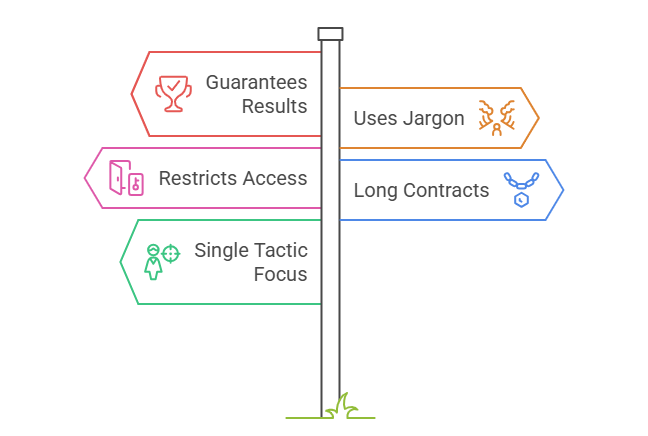
They guarantee specific rankings or results
No legitimate agency can guarantee you’ll rank number one on Google or that your content will go viral. These outcomes depend on too many variables outside their control. Agencies that promise guaranteed results are either inexperienced or dishonest.
What they can guarantee is effort, process, and responsiveness. If they’re making bold promises without caveats, they’re setting you up for disappointment.
They use jargon without explaining what it means
Good agencies educate. They explain their process in terms you understand. If someone is throwing around buzzwords like “synergy,” “omnichannel engagement,” or “disruptive growth hacking” without breaking it down, they’re either trying to sound smart or they don’t actually know what they’re doing.
Ask them to explain their approach in simple language. If they can’t, that’s a red flag.
They won’t give you access to your own accounts or data
Your Google Ads account, Facebook Business Manager, Google Analytics, and any other marketing platforms belong to you. An agency should set these up in your name and give you full access.
If they insist on keeping ownership or restrict your access, they’re locking you in. When you decide to leave, you’ll lose all your data and have to start from scratch. This is unacceptable.
Their contract is heavily weighted toward long lock-in periods
Six-month or twelve-month contracts aren’t inherently bad, but be cautious of agencies that require long commitments with no performance benchmarks or exit clauses. If they’re confident in their work, they shouldn’t need to trap you in a contract.
Ask about cancellation terms, notice periods, and what happens if results don’t materialize. Agencies that resist these conversations are more focused on protecting their revenue than delivering value.
They focus exclusively on one tactic or platform
Marketing isn’t one-dimensional. A social media agency in Dubai that only does Instagram ads won’t help if your audience is searching on Google. An SEO-only agency won’t solve your lead generation problem if your website doesn’t convert.
Look for agencies that understand how different channels work together and can recommend a balanced approach based on your goals. If they’re only selling one service, they’re either inexperienced or incentivized to push you toward what they know, not what you need.
Questions About Pricing and Value
What’s included in your pricing, and what costs extra?
Some agencies quote a low monthly retainer but charge separately for ad spend, content creation, design work, or tools. Others bundle everything into one price. Make sure you understand exactly what you’re paying for.
Ask for a detailed breakdown. What services are included? What’s billed separately? Are there setup fees, minimum ad spends, or additional costs for revisions? Transparency here prevents surprises later.
How do you determine the right budget for paid advertising?
If the agency recommends paid ads, ask how they calculate budget. A good answer is based on your goals, average cost per lead, and conversion rates. A weak answer is a generic percentage of revenue or a flat monthly amount with no justification.
They should be able to explain how much you need to spend to generate meaningful results and what happens if the budget is too low to compete effectively.
What’s your process for scaling or adjusting services?
Your needs will change. Maybe you start with content and SEO, then add paid ads later. Maybe you need more support during a product launch. Ask how flexible they are and whether scaling up or down requires renegotiating your entire contract.
Agencies that make adjustments difficult are more focused on their own revenue stability than your business outcomes.
How to Compare Agencies Without Getting Overwhelmed
Once you’ve asked these questions to multiple agencies, you’ll have a clearer picture of who’s serious and who’s just selling. Here’s how to compare them effectively.
Create a simple scorecard. Rate each agency on strategy clarity, proof of results, team expertise, communication style, and pricing transparency. This removes emotion from the decision and helps you see which agency truly aligns with your needs.
Don’t let price be the deciding factor. The cheapest option is rarely the best. Focus on value. What will this agency deliver, and how will it impact your business? A slightly more expensive agency that drives real growth is far better than a cheap one that wastes your time.
If you’re exploring how different strategies like SEO and AI search optimization compare, GEO vs SEO which strategy gives better results in 2026? breaks down the differences so you can evaluate what agencies are prioritizing.
What to Do After You Hire an Agency
Hiring the right agency is only the first step. Once you’ve signed the contract, set clear expectations.
Schedule a kickoff meeting to align on goals, timelines, and deliverables. Establish how often you’ll communicate and what success looks like in the first 90 days. Make sure both sides understand what’s expected.
Don’t disappear after onboarding. Stay engaged. Review reports. Ask questions. Provide feedback. The best agency relationships are collaborative, not transactional.
And if things aren’t working after a reasonable period, address it. Have an honest conversation about what’s not delivering and what needs to change. Good agencies will listen and adjust. Bad ones will make excuses.
FAQ
How long should I expect to wait before seeing results from a digital marketing agency?
It depends on the tactics. Paid ads can generate leads within weeks. SEO and content marketing typically take three to six months to show meaningful traction. AI search optimization is newer, so timelines vary. Any agency promising instant results is overselling.
Should I hire a full-service agency or specialists for each channel?
Full-service agencies work well if you need integrated strategy across multiple channels. Specialists are better if you have one clear priority, like fixing your website or scaling paid ads. For most SMBs in the UAE, a full-service digital marketing agency in the UAE provides better coordination and fewer hand-offs.
What’s a reasonable monthly budget for working with a digital marketing agency in Dubai?
Retainers typically range from AED 5,000 to AED 25,000+ per month, depending on scope and agency size. Smaller agencies or freelancers may charge less but offer fewer services. Larger agencies charge more but bring more resources. Budget also depends on whether paid ad spend is included or billed separately.
How do I know if an agency is actually doing the work or just sending generic reports?
Ask detailed questions about their process. Request access to your marketing accounts so you can verify activity. Review their reports for specificity—generic summaries are a red flag. Schedule regular check-ins to discuss what’s being implemented and why.
Can I switch agencies mid-contract if things aren’t working?
Check your contract terms. Some agencies allow cancellation with 30 or 60 days’ notice. Others lock you in for the full term. If results are consistently poor and the agency isn’t responsive, document everything and explore exit options. Most reputable agencies will work with you if things aren’t aligned.
What should I prioritize if I can only afford one service right now?
Focus on the channel that directly drives leads for your business. For service businesses, that’s often a high-converting website paired with either SEO or paid ads. If your website doesn’t convert, fix that first. If you’re invisible online, start with search visibility. Avoid spreading budget too thin across channels that don’t generate revenue.
Stop Settling for Agencies That Don’t Deliver
Hiring a digital marketing agency shouldn’t feel like a gamble. The right questions eliminate guesswork and reveal which agencies have the expertise, accountability, and alignment to actually grow your business.
Most agencies will sound convincing in a sales meeting. The difference shows up in how they answer tough questions, what proof they provide, and how transparent they are about process and pricing. Agencies that avoid specifics, overpromise results, or resist accountability aren’t worth your time.
Do the work upfront. Ask hard questions. Watch for red flags. And choose an agency that treats your business like it matters, because it does.

How to Audit Your Current Digital Marketing and Know Exactly What’s Broken (Free Framework)
Most businesses in the UAE are spending on digital marketing without knowing if it’s actually working. They post on social media, run ads, update their website occasionally, and hope for results. But hope isn’t a strategy, and guesswork costs money.
If your marketing feels like throwing darts in the dark, you’re not alone. The good news is that diagnosing what’s broken doesn’t require expensive consultants or complex tools. What you need is a structured audit framework that reveals exactly where you’re losing leads, wasting budget, and missing opportunities.
This guide walks you through a practical digital marketing audit you can run yourself. By the end, you’ll know what’s working, what’s failing, and what to fix first.
Why Most Businesses Skip Audits and Pay for It Later
Business owners rarely audit their marketing because they assume everything is fine as long as something is happening. Posts go up, ads run, the website exists. But activity doesn’t equal effectiveness.
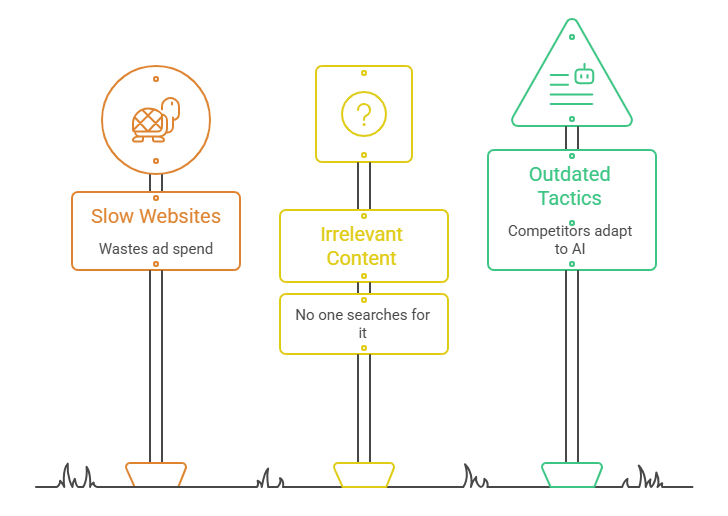
Here’s what usually goes wrong. Companies spend thousands on ads that send traffic to slow websites. They create content nobody searches for. They optimize for outdated tactics while competitors adapt to AI search engines and new platforms. The result is stagnant growth and confusion about where the real problem lies.
An audit removes the guesswork. It shows you which channels drive revenue, which burn budget, and which need to be rebuilt from scratch. For service businesses in Dubai and across the UAE, this clarity is the difference between profitable marketing and expensive noise.
The Five Areas Every Business Must Audit
A complete digital marketing audit covers five core areas. Each one impacts how customers find you, trust you, and decide to buy from you.
Traffic Sources and Acquisition Channels
Start by understanding where your visitors actually come from. Log into Google Analytics or your website dashboard and pull data for the last 90 days. Look at organic search, paid ads, social media, direct traffic, and referrals.
Most businesses discover that one or two channels drive the majority of traffic while others contribute almost nothing. If organic search is weak, your SEO needs work. If paid ads dominate but conversions are low, your landing pages or targeting might be off. If social media sends visitors who bounce immediately, your content isn’t matching audience intent.
The goal here isn’t just to count visitors. It’s to identify which channels bring qualified leads who are ready to engage or buy. Traffic without intent is just noise.
Website Performance and Conversion Paths
Your website is where marketing either converts or dies. Even if you’re driving traffic, a broken website kills results.
Run a speed test using Google PageSpeed Insights. If your site takes longer than three seconds to load, you’re losing visitors before they even see your content. Mobile performance matters even more in the UAE, where most users browse on their phones.
Next, check your conversion paths. Can visitors easily find your services, contact information, or booking system? Do forms work? Are calls to action clear? Walk through your site as if you’re a first-time visitor and note every point of friction.
If you’re unsure whether your website is built to convert or just exists as a digital brochure, companies like web development agencies in Dubai can assess structure, speed, and user experience to identify what’s costing you leads.
Content Performance and Engagement Metrics
Content is only valuable if people engage with it. Pull metrics for your blog posts, social media content, and video performance. Look at views, time on page, shares, comments, and click-through rates.
Identify your top-performing content and ask why it worked. Was it the topic? The format? The timing? Then look at your underperformers and figure out what went wrong.
Many businesses create content without checking if anyone actually searches for those topics. If your blog traffic is flat, you might be writing for yourself instead of your audience. If social posts get impressions but no engagement, your messaging isn’t resonating.
For businesses focused on short-form video, understanding what drives virality is critical. What makes business content go viral on social media in 2026? breaks down the mechanics of high-performing content so you can stop guessing and start creating strategically.
Search Visibility Across Traditional and AI Engines
SEO isn’t dead, but it’s evolving fast. A strong audit now includes both traditional Google rankings and visibility on AI-powered search engines like ChatGPT, Perplexity, and Google’s AI Overviews.
Search your primary service keywords and see where you rank on Google. If you’re not on page one, potential customers aren’t finding you. But don’t stop there. Open ChatGPT or Perplexity and ask the same questions your customers would ask. Does your business appear in the results?
Most companies have zero presence in AI search because they’ve never optimized for it. This is a massive gap, and it’s growing. Generative Engine Optimization isn’t optional anymore. Businesses that ignore it will disappear from AI-driven search results while competitors dominate. If you want to understand how this works and how to rank, what is generative engine optimization and how does it work? explains the strategy in detail.
Lead Quality and Sales Alignment
Marketing can generate hundreds of leads, but if they’re not converting into sales, something is misaligned. Pull your lead data and evaluate quality, not just quantity.
Are leads asking relevant questions? Do they match your target customer profile? How many turn into paying clients? If your close rate is low, the problem might not be sales, it might be that marketing is attracting the wrong audience.
Talk to your sales team. Ask what objections they hear most often, what questions leads ask, and where deals stall. These insights reveal gaps in your messaging, positioning, or content. If leads don’t understand your value before they talk to sales, your marketing hasn’t done its job.
How to Prioritize Fixes Based on Impact
Once you’ve audited all five areas, you’ll have a list of problems. The mistake most businesses make is trying to fix everything at once. That leads to half-finished improvements and wasted effort.
Prioritize based on impact and ease. Start with high-impact fixes that are relatively easy to implement. For example, if your website loads slowly, that’s a high-impact problem with a clear solution. If your content isn’t ranking because you’ve never done keyword research, that’s fixable too.
Low-impact issues can wait. Tweaking button colors or rearranging your homepage sections won’t move the needle if your traffic sources are broken or your site is invisible to AI search engines.
Create a roadmap with three tiers: fix immediately, fix this quarter, and revisit later. Focus resources on the top tier until those problems are solved, then move to the next level.
Red Flags That Indicate You Need Outside Help
Some problems are straightforward to fix internally. Others require expertise you don’t have in-house.
If your website needs a complete rebuild, trying to DIY it usually ends in frustration and wasted time. If your SEO strategy hasn’t delivered results in six months, you might be optimizing for the wrong things. If your content gets zero engagement despite consistent posting, your messaging or distribution strategy is off.
These are signals that working with specialists will save you time and money. A digital marketing agency in Dubai can run a deeper audit, implement fixes faster, and bring experience from working with similar businesses.
The key is knowing when to handle issues internally and when to bring in help. Small tweaks and optimizations are manageable. Structural problems, broken websites, invisible search presence, poor lead quality, often require outside expertise to solve properly.
FAQ
How often should I audit my digital marketing?
Run a full audit every six months and spot-check critical metrics monthly. Markets shift, algorithms change, and competitors adapt. Regular audits keep you ahead instead of reactive.
What’s the biggest mistake businesses make during audits?
Focusing only on vanity metrics like follower counts or page views instead of conversion data and revenue impact. Metrics that don’t tie to business outcomes don’t matter.
Can I audit my marketing without technical skills?
Yes. Most audit steps require basic analytics tools and common sense. Website speed tests, search visibility checks, and content performance reviews don’t need technical expertise. The important part is asking the right questions and being honest about what’s not working.
How do I know if my marketing problems are strategy or execution?
If you’re doing the right things poorly, that’s execution. If you’re doing the wrong things well, that’s strategy. An audit reveals both. Strategy issues show up as misaligned goals, wrong audience targeting, or content that doesn’t match search intent. Execution issues show up as slow websites, broken forms, or inconsistent posting.
What should I do first after completing an audit?
Fix anything that’s actively losing you leads or revenue. Broken contact forms, slow website speeds, and invisible search presence are top priorities. Everything else can be scheduled based on impact and resources.
Do I need different audits for SEO and social media?
No. A complete audit covers all channels but looks at them through the lens of business goals. SEO, social media, paid ads, and website performance are interconnected. Auditing them separately misses how they influence each other.
Stop Guessing and Start Measuring
Digital marketing only works when you know what’s broken and fix it systematically. An audit isn’t a one-time task, it’s a regular practice that keeps your strategy sharp and your budget focused on what actually delivers results.
Most businesses in the UAE are competing with outdated tactics while the market shifts toward AI search, short-form video, and conversion-focused websites. The companies that audit consistently, adapt quickly, and prioritize high-impact fixes will outpace competitors still guessing their way through marketing.
Run this framework. Identify your gaps. Fix what’s broken. Then do it again in six months.
What CMS Is Best for Business Websites in 2026?
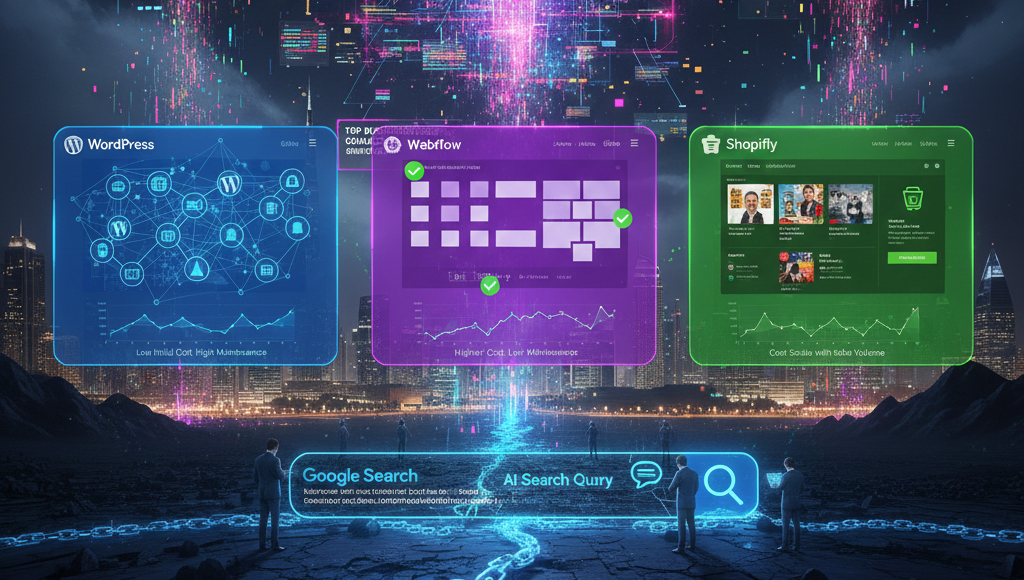
Choosing the right content management system isn’t just a technical decision anymore. For businesses in the UAE looking to compete online, your CMS determines how quickly you can publish content, how well your site performs on mobile devices, and whether you can adapt to AI-powered search engines that are changing how customers find services.
Most business owners ask their developers which CMS to use, and they usually get recommended whatever that developer is most comfortable building with. But the best CMS for your business depends on your goals, your team’s technical abilities, and how you plan to grow your digital presence over the next few years.
This guide breaks down the real considerations for UAE businesses choosing a CMS in 2026, including which platforms handle Arabic content properly, which ones integrate with local payment gateways, and which systems will help you rank on both Google and generative AI engines like ChatGPT.
Which CMS gives you the most control without requiring a developer?
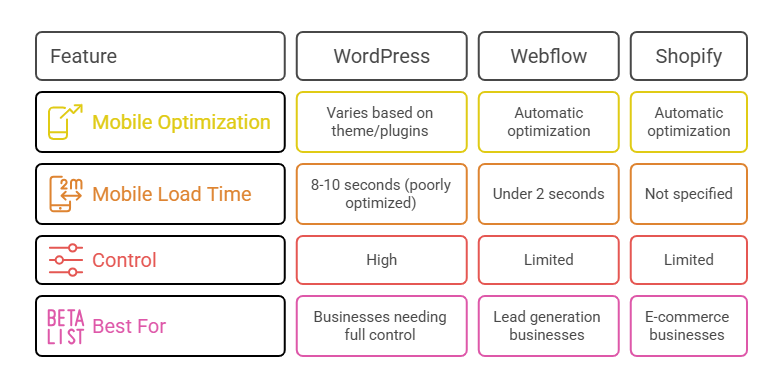
WordPress remains the dominant choice for businesses that want full control without constantly hiring developers. Nearly 43% of all websites globally run on WordPress, and for good reason. The platform offers over 60,000 plugins that extend functionality, from booking systems to membership areas to e-commerce stores.
For UAE service businesses, WordPress provides built-in multilingual capabilities through plugins like WPML or Polylang, making it straightforward to offer content in both English and Arabic. The Gutenberg editor allows non-technical team members to build custom page layouts without touching code.
However, WordPress requires regular maintenance. Security updates, plugin compatibility checks, and performance optimization are ongoing responsibilities. If your team lacks technical knowledge, you’ll need a reliable web development agency in Dubai to handle these tasks or risk security vulnerabilities.
Webflow has emerged as a strong alternative for businesses that want design flexibility without the maintenance burden. The platform handles hosting, security, and performance automatically. The visual editor gives designers precise control over every element, and the CMS allows content editors to update pages through a clean, intuitive interface.
Webflow works exceptionally well for businesses focused on conversion rate optimization. Every element can be customized to match your brand, and the built-in interactions and animations help guide visitors toward your call-to-action buttons. The downside is cost. Webflow’s pricing tiers are higher than WordPress hosting, and migrating away from the platform later requires rebuilding your entire site.
Shopify dominates e-commerce for good reason. The platform was built specifically for online stores, and every feature reflects that focus. Payment processing works seamlessly with UAE banks, inventory management is straightforward, and the app ecosystem provides solutions for everything from abandoned cart recovery to customer loyalty programs.
For businesses selling physical products or services with clear pricing tiers, Shopify removes most technical barriers. You can launch a professional online store in days rather than months. However, Shopify charges transaction fees on top of payment processing fees unless you use Shopify Payments, which isn’t available in all regions. The platform also limits customization compared to WordPress or Webflow.
How do different CMS platforms perform on mobile devices in the UAE market?
Mobile traffic accounts for over 65% of web browsing in the UAE, making mobile performance non-negotiable. Your CMS choice directly impacts how quickly pages load on smartphones and how smoothly visitors can navigate your site on smaller screens.
WordPress performance varies dramatically based on your theme and plugins. A poorly optimized WordPress site can take 8-10 seconds to load on mobile connections, causing visitors to abandon before your page even appears. Modern themes like GeneratePress or Kadence are built for speed, but you’ll need to actively manage image optimization, implement caching, and minimize unnecessary plugins.
The advantage of WordPress is control. You can implement advanced performance techniques like lazy loading, critical CSS, and WebP image formats. Tools like WP Rocket or LiteSpeed Cache make optimization accessible even for non-technical users. But this flexibility means performance is your responsibility, not the platform’s.
Webflow automatically optimizes every site for mobile performance. Images are compressed and served in modern formats, code is minified, and pages are delivered through a global content delivery network. Webflow sites typically load in under 2 seconds on mobile devices without any additional configuration.
This automatic optimization matters for businesses focused on lead generation. Every second of load time reduces conversion rates by approximately 7%. If your website exists primarily to generate inquiries and bookings, Webflow’s performance advantages translate directly to more customers.
Shopify handles mobile optimization automatically, with one crucial advantage. The platform’s mobile checkout process has been refined through billions of transactions. The checkout flow works seamlessly on smartphones, with payment methods optimized for UAE customers including credit cards, Apple Pay, and cash on delivery.
For e-commerce businesses, Shopify’s mobile conversion rates typically exceed custom-built solutions. The platform has eliminated common friction points that cause abandoned carts on mobile devices.
What CMS features actually help you rank on AI search engines?
Traditional SEO focused on keywords and backlinks. Generative engine optimization requires structured content that AI systems can easily parse and understand. Your CMS needs to support schema markup, clear content hierarchy, and semantic HTML that helps AI engines extract accurate information about your business.
WordPress offers extensive schema markup options through plugins like Rank Math or Yoast SEO. These tools automatically add structured data to your pages, helping AI engines understand whether content represents an article, product, service, or FAQ section. This structured approach is essential for appearing in AI-generated responses when potential customers ask questions related to your services.
The challenge with WordPress is ensuring consistency. Multiple team members publishing content can create inconsistent formatting and metadata. Clear editorial guidelines and content templates help maintain the structure AI engines prefer. Working with a digital marketing agency in UAE that understands both technical implementation and content strategy ensures your WordPress site is properly optimized for generative AI visibility.
Webflow provides clean, semantic HTML by default, which AI engines parse more easily than bloated code from some WordPress themes. The platform’s CMS fields allow you to structure content consistently across all pages, ensuring every service description or case study follows the same format.
This consistency matters for GEO because AI engines look for patterns in how information is presented. When your content follows predictable structures, AI systems can extract key details with higher confidence, increasing the likelihood your business appears in generated responses.
Shopify’s product structure naturally supports GEO for e-commerce businesses. Product titles, descriptions, prices, and specifications are stored in dedicated fields, making it easy for AI engines to understand what you sell and how it differs from competitors. The platform’s built-in review system also provides social proof that AI engines reference when evaluating product quality.
Understanding GEO services for UAE businesses becomes increasingly important as more customers use AI tools to research purchases before visiting websites directly.
Which platforms integrate best with UAE business tools and payment systems?
Integration capabilities determine how well your website connects with tools you already use. Customer relationship management systems, email marketing platforms, payment gateways, and booking systems all need to communicate with your CMS seamlessly.
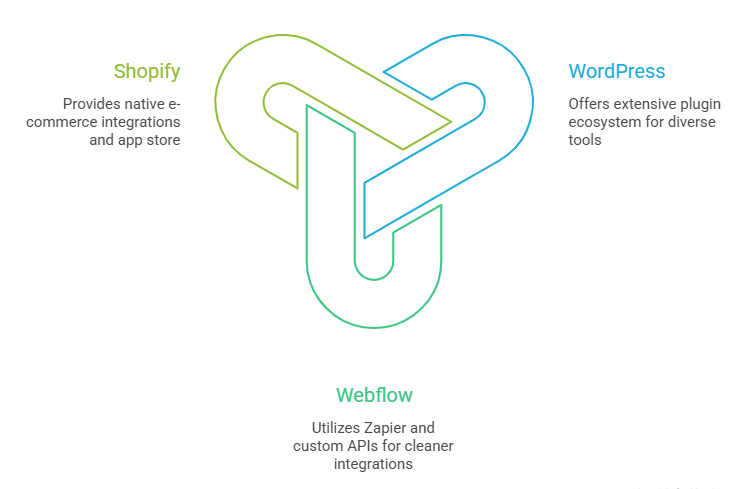
WordPress wins on integration flexibility. The plugin ecosystem includes connectors for virtually every business tool available. Whether you need to sync customer data with Zoho CRM, send abandoned cart emails through Mailchimp, or accept payments through Network International, plugins exist to handle the integration.
However, managing multiple integrations creates complexity. Each plugin represents another component that needs updates and can potentially conflict with other plugins. Businesses using more than 20 plugins often experience stability issues that require developer intervention to resolve.
Webflow integrations work through Zapier or custom API connections. The platform doesn’t offer the same plugin ecosystem as WordPress, but most popular business tools can connect through these methods. The integration process requires more technical knowledge initially but results in cleaner implementations with fewer potential conflicts.
For businesses with specific workflow requirements, Webflow’s approach often proves more reliable long-term. Rather than cobbling together multiple plugins, integrations are built deliberately with clear data flows.
Shopify provides native integrations with most tools e-commerce businesses need. The Shopify App Store offers thousands of verified apps that install with one click. Payment gateway integration is particularly robust, with support for major UAE providers including Telr, PayTabs, and Checkout.com.
The platform’s integration strength lies in its focused ecosystem. Because every integration is built specifically for e-commerce, they tend to work more reliably than general-purpose plugins adapted for online stores.
How much does each CMS actually cost when you factor in everything?
Listed prices for CMS platforms rarely reflect total ownership costs. Hosting, premium plugins, custom development, ongoing maintenance, and migration costs all impact your actual investment.
WordPress appears inexpensive initially. The software itself is free, and basic hosting starts around AED 50 monthly. However, professional WordPress sites typically require premium themes (AED 200-400), essential plugins for security, performance, and SEO (AED 100-300 monthly), and regular maintenance (AED 500-2000 monthly) depending on complexity.
A properly maintained WordPress site for a service business typically costs AED 3,000-8,000 annually including hosting, security, and basic updates. Custom development for specific features adds significantly to this baseline. The advantage is scalability. As your needs grow, WordPress can adapt without requiring a complete rebuild.
Webflow pricing is transparent but higher upfront. Basic plans start at AED 100 monthly, but business sites typically need the CMS plan at AED 120 monthly or Business plan at AED 160 monthly for more robust features. These prices include hosting, security, and automatic backups.
Total annual cost for a Webflow business site ranges from AED 4,500-8,500 depending on plan tier and any custom development needed. This cost is predictable, with no surprise maintenance fees or plugin subscriptions. For businesses that value predictability and minimal technical overhead, Webflow’s pricing model makes budgeting straightforward.
Shopify costs vary based on your sales volume. The Basic plan at AED 105 monthly works for businesses just starting e-commerce, but growing stores quickly need the Shopify plan at AED 315 monthly or Advanced plan at AED 1,315 monthly for lower transaction fees and advanced features.
Transaction fees add significant costs. Shopify charges 2% on the Basic plan, 1% on mid-tier plans, and 0.5% on Advanced plans for each sale using third-party payment gateways. A store processing AED 50,000 monthly in sales pays AED 1,000 in transaction fees alone on the Basic plan.
Should UAE businesses choose local or international CMS hosting?
Hosting location impacts website speed for UAE visitors and affects data residency requirements for certain business types. Most major CMS platforms offer hosting options that serve content from servers in or near the UAE.
WordPress hosting flexibility allows you to choose providers with UAE data centers. Companies like Bluehost, SiteGround, and local providers offer hosting with servers in Dubai or the broader Middle East region. This geographic proximity reduces latency, making pages load faster for your primary audience.
For businesses handling sensitive customer data or operating in regulated industries, hosting data within UAE borders may be required. WordPress hosting can be configured to meet these requirements, though you’ll need to verify your hosting provider’s data center locations and compliance certifications.
Webflow uses AWS CloudFront for content delivery, with edge locations in UAE that cache and serve your content from nearby servers. While Webflow doesn’t allow you to choose specific data centers, the distributed network ensures fast load times for UAE visitors regardless of where origin servers are located.
Shopify operates globally distributed infrastructure optimized for e-commerce performance. The platform automatically serves content from the closest available server to each visitor. For UAE-based stores, this means content is typically delivered from Middle East or European data centers with minimal latency.
If you’re exploring options or need guidance on implementation, we’ve covered complementary topics in How to create a website that generates leads automatically? and Mobile-first web design why it matters for UAE businesses?, which address conversion optimization and mobile performance strategies that complement your CMS choice.
How easy is it to move between CMS platforms if your needs change?
Migration difficulty should factor into your initial CMS decision. Some platforms trap your content in proprietary formats that require expensive rebuilds if you decide to switch later.
WordPress migration is relatively straightforward. Content exports to XML files that can be imported into other WordPress sites or converted for use on different platforms. The challenge lies in custom functionality built through plugins. Moving away from WordPress means rebuilding any custom features, though basic content transfers easily.
Thousands of agencies worldwide work with WordPress, making it easy to find qualified help for migrations or rebuilds. The platform’s popularity ensures you’re never locked into working with a single developer or agency.
Webflow migration is more complex. Content exports to CSV files, but design elements and interactions don’t transfer to other platforms. Moving from Webflow to WordPress or another CMS requires rebuilding your site’s design from scratch, though content can be imported relatively easily.
This migration difficulty is Webflow’s primary drawback. Once you’ve invested in building a Webflow site, switching platforms means significant additional investment. However, for businesses satisfied with Webflow’s capabilities, this rarely becomes an issue in practice.
Shopify migration varies based on your destination platform. Moving to another e-commerce platform like WooCommerce or BigCommerce is manageable, with tools available to export product catalogs, customer data, and order history. Moving to a non-e-commerce CMS is more complex and rarely makes sense for established online stores.
The more you’ve customized Shopify through apps and custom code, the harder migration becomes. Basic stores transfer easily, but heavily customized stores may require complete rebuilds on new platforms.
Which CMS best supports multilingual content for UAE markets?
Operating in the UAE often means serving customers who prefer content in multiple languages, particularly English and Arabic. Your CMS needs to handle multilingual content without creating duplicate work or confusion for content editors.
WordPress multilingual support works through plugins like WPML, Polylang, or TranslatePress. These plugins create separate versions of each page for different languages, with language switchers that let visitors choose their preference. The plugins handle technical aspects like hreflang tags that tell search engines about your multilingual structure.
Quality varies significantly based on which plugin you choose and how well your theme supports right-to-left languages like Arabic. Some WordPress themes break visually when displaying Arabic content, requiring custom CSS adjustments. Working with developers familiar with multilingual UAE sites prevents these issues.
Webflow multilingual support is less mature than WordPress. The platform doesn’t offer native multilingual capabilities, requiring workarounds like creating separate collections for each language or using third-party services like Weglot. These solutions work but add complexity and cost to site management.
For businesses heavily focused on Arabic content alongside English, Webflow’s limitations may outweigh its other advantages. The platform works well for English-primary sites with occasional translation needs, but managing large amounts of multilingual content becomes cumbersome.
Shopify handles multilingual stores through Shopify Markets, which allows you to create localized versions of your store for different regions. Product descriptions, checkout pages, and customer communications can all be translated and customized per market.
The system works particularly well for e-commerce businesses selling to multiple countries in the GCC region, allowing you to adjust pricing, shipping options, and payment methods based on customer location while maintaining a single product catalog.
What CMS provides the best foundation for growing from local to regional presence?
Scalability determines whether your CMS can grow with your business or needs replacement as you expand. A platform suitable for a local service business with 50 pages might not handle a regional operation with thousands of products or locations.
WordPress scales remarkably well with proper architecture. Sites with hundreds of thousands of pages run successfully on WordPress, though they require carefully chosen hosting, caching strategies, and database optimization. The platform has no inherent limitations on content volume or traffic levels.
The scaling challenge with WordPress comes from accumulated technical debt. Sites built without clear architecture become difficult to modify as they grow. Regular audits and refactoring prevent this issue, but require ongoing investment in professional development.
Webflow handles scaling through its infrastructure automatically. The platform’s hosting can accommodate traffic spikes without manual intervention, and sites remain fast regardless of content volume within reasonable limits. The practical limitation is cost. As traffic and content needs grow, Webflow pricing increases accordingly.
For businesses planning significant expansion, Webflow’s costs can exceed WordPress with managed hosting. However, the reduced technical complexity and automatic scaling mean fewer resources spent on infrastructure management.
Shopify scaling works seamlessly for most growing e-commerce businesses. The platform handles sudden traffic spikes during sales or promotions without performance degradation, and stores with tens of thousands of products operate smoothly. Shopify Plus, the enterprise tier, supports brands processing millions in monthly sales.
The scaling limitation is customization. As stores grow more complex with unique business rules and customer experiences, Shopify’s templated approach can feel restrictive compared to fully custom platforms.
FAQ
What is the most affordable CMS for small businesses in UAE?
WordPress offers the lowest entry cost for small businesses, with hosting starting around AED 50 monthly and essential plugins adding AED 100-200 monthly. Total first-year costs including setup typically range from AED 3,000-6,000 for a professional business website. However, affordability must be weighed against ongoing maintenance requirements and technical knowledge needed to keep the site secure and performant.
Can I switch CMS platforms after my website is built?
Yes, but migration complexity varies significantly. Moving from WordPress to another WordPress site is straightforward, while switching between different platforms like Webflow to WordPress requires rebuilding design elements even though content can be exported. Shopify to WooCommerce migrations are manageable for e-commerce stores. Budget 30-60% of original development costs for platform migrations, with complex sites requiring more extensive rebuilds.
Which CMS is best for ranking on both Google and AI search engines?
WordPress offers the most flexibility for both traditional SEO and GEO through plugins that add proper schema markup, optimize content structure, and manage technical SEO elements. However, Webflow’s clean code and semantic HTML provide inherent advantages for AI engines that parse website content. Success on both Google and generative AI platforms depends more on content strategy and structured information than the CMS itself, though WordPress and Webflow both provide the necessary technical foundations.
Do I need a developer to manage a modern CMS?
Webflow and Shopify are specifically designed for non-technical users to manage content independently, with visual editors that require no coding knowledge. WordPress is accessible for basic content updates but often requires developer support for plugin management, security updates, and troubleshooting when issues arise. Most UAE service businesses benefit from having a technical partner for any CMS platform, even those marketed as no-code solutions, to handle optimization, integrations, and complex customizations.
How important is mobile optimization for business websites in UAE?
Critical. Over 65% of UAE web traffic comes from mobile devices, and Google prioritizes mobile-optimized sites in search rankings. All modern CMS platforms offer mobile-responsive themes, but actual mobile performance varies based on implementation. Page load speed on mobile connections directly impacts both search rankings and conversion rates, with each second of delay reducing conversions by approximately 7%. Choose a CMS that prioritizes mobile performance and work with developers who test thoroughly on actual mobile devices using UAE network conditions.
What CMS features matter most for generating business leads?
Form builders, CRM integrations, and conversion tracking capabilities determine how effectively your CMS turns visitors into leads. WordPress offers the most integration options through plugins, connecting to virtually any CRM or marketing automation platform. Webflow provides clean form implementations with built-in spam protection and simple integrations through Zapier. The CMS matters less than the overall website strategy, including clear calls-to-action, trust signals, and content that addresses specific customer concerns. A well-designed website on any major CMS will outperform a poorly executed site on the “best” platform.
Choosing the right foundation for your digital growth
Your CMS decision impacts every aspect of your digital marketing effectiveness. The right platform makes content updates simple, supports your team’s capabilities, and provides the technical foundation for visibility on both traditional and AI-powered search engines.
For most UAE service businesses, WordPress offers the best balance of flexibility, cost-effectiveness, and long-term scalability, provided you have access to reliable technical support. Creative agencies and businesses prioritizing design excellence find Webflow’s visual approach and automatic optimization compelling despite higher costs. E-commerce businesses benefit from Shopify’s focused feature set and proven checkout optimization.
The worst decision is choosing a CMS based solely on what your developer prefers or which platform has the lowest sticker price. Your website represents your business online, and the underlying system determines how easily you can adapt to changing customer behaviors and emerging technologies like generative AI search.
Consider your team’s technical abilities, budget for ongoing management, growth plans over the next three years, and specific business requirements before committing to a platform. Most businesses succeed by selecting a widely-supported CMS and investing in proper implementation rather than chasing the newest platform with the most marketing hype.
If you’re building or rebuilding your business website and need guidance on which CMS fits your specific situation, getting expert input early prevents costly mistakes later.

The Search Behavior Shift: Why People Ask AI Instead of Googling in 2026
Something fundamental changed in how people search for information, and most businesses in the UAE haven’t noticed yet. Your potential customers aren’t typing queries into Google anymore, at least not the way they used to. They’re having conversations with ChatGPT. They’re asking Perplexity for recommendations. They’re trusting AI Overviews that appear before any traditional search results.
This isn’t a minor trend. It’s a complete restructuring of search behavior that’s happening faster in markets like Dubai and Abu Dhabi than almost anywhere else globally. The UAE has some of the highest AI adoption rates worldwide, and your customers are already using these tools to research services, compare providers, and make purchasing decisions. If your business isn’t visible in these AI-powered conversations, you’re becoming invisible to an increasingly large segment of your market.
The businesses that recognize this shift now and adapt their digital presence accordingly will capture disproportionate market share over the next two years. Those that wait will find themselves competing for a shrinking pool of traditional search traffic while watching competitors dominate AI-driven discovery. This article explains exactly what’s changing, why it matters specifically for UAE businesses, and what you need to do about it.
What’s actually happening to search behavior in 2026?
The data tells a clear story. Conversational AI tools processed over 100 billion queries in 2025, and that number is projected to triple in 2026. More significantly, the type of queries moving to AI platforms represents the highest-value searches: detailed research questions, service comparisons, solution recommendations, and buying guidance.
People still use Google for simple navigational searches. If they want to find your website directly or check your business hours, they’ll type your name into a search bar. But when they’re researching which digital marketing approach works best for their industry, or comparing web development options, or trying to understand complex services, they’re increasingly turning to AI tools that provide comprehensive, synthesized answers rather than forcing them to click through ten different websites.
This shift is particularly pronounced among decision-makers and business buyers, the exact audience most UAE service companies need to reach. A business owner researching marketing strategies doesn’t want to read eight blog posts with conflicting advice. They want a clear, consolidated answer that addresses their specific situation. AI tools provide that experience, which is why adoption is accelerating.
For service businesses, this creates an urgent visibility problem. You might rank perfectly on traditional Google searches, but if prospects never make it to Google because they’re getting their answers from ChatGPT, your rankings become increasingly irrelevant. The traffic doesn’t disappear overnight, but it erodes steadily month after month as more people default to AI tools for research and discovery.
Why is this shift happening faster in the UAE than other markets?
The UAE’s technology adoption curve has always been steep. From smart city initiatives to digital government services, the market embraces new technology faster than most regions globally. The same pattern is playing out with AI search tools.
Several factors accelerate this trend specifically in Dubai, Abu Dhabi, and other UAE markets. First, the business community here is internationally connected and tech-savvy. Decision-makers are exposed to global best practices and adopt productivity tools quickly when they see clear benefits. AI assistants that save time and provide better information fit that criteria perfectly.
Second, the multilingual nature of the UAE market makes AI tools particularly valuable. ChatGPT and similar platforms handle queries in Arabic and English seamlessly, often providing better synthesized answers than traditional search results that might be fragmented across languages. This linguistic flexibility increases adoption among both local and expatriate communities.
Third, the premium service economy that dominates UAE business means buyers are researching high-value, complex purchases where AI’s ability to provide detailed, contextual answers offers significant advantage over traditional search. Someone researching a AED 50,000 web development project wants comprehensive guidance, not just a list of potential vendors.
The practical result is that UAE businesses face this transition earlier and more intensely than competitors in slower-adopting markets. That’s simultaneously a challenge and an opportunity. The businesses that master AI search optimization agency in Dubai strategies now will establish advantages that become increasingly difficult for competitors to overcome as the market matures.
How do people actually use AI tools differently than Google?
The behavioral difference is profound. Traditional search is transactional: you input keywords, scan results, click a link, evaluate the page, often go back and try another result. It’s a hunt for information across multiple sources, with the user doing the synthesis work.
AI search is conversational: you ask a question in natural language, receive a comprehensive answer, ask follow-up questions, and refine the response until you have exactly the information you need. The AI does the synthesis work, pulling from multiple sources to construct a unified answer tailored to your specific query.
This changes what “finding” a business means. In traditional search, being found meant ranking on the results page for relevant keywords. In AI search, being found means being mentioned, cited, or recommended in the AI’s response. Your visibility depends not on where you rank in a list, but on whether the AI considers you authoritative enough to include in its answer.
Consider a practical example relevant to UAE businesses. Someone researches “how to improve lead generation for my Dubai consultancy.” In traditional Google search, they’d see ten blue links to various blog posts, maybe some ads, and they’d need to visit multiple sites to piece together an answer. With ChatGPT, they receive a comprehensive response covering content strategy, platform selection, conversion optimization, and implementation steps, potentially with specific recommendations or citations to authoritative sources.
If your business provides these services but isn’t structured as an authoritative source the AI can cite, you’re invisible in that conversation. The prospect receives valuable guidance but never encounters your brand. They might eventually search for specific providers, but by that point, they’ve already formed opinions about the best approach, potentially based on methodologies your competitors are known for rather than your unique approach.
What makes AI engines decide which businesses to recommend?
AI recommendation logic differs fundamentally from search engine ranking algorithms. Google’s algorithm evaluates hundreds of technical and content factors to determine relevance and authority for specific keywords. AI engines evaluate conceptual authority: how comprehensively and accurately you’ve covered topics, how clearly you’ve defined concepts, and how well your content serves as a citeable source.
Several factors drive AI citation decisions. Content depth matters significantly. Superficial coverage of topics won’t generate citations. The AI looks for thorough explanations, clear frameworks, specific examples, and detailed guidance that it can extract and repurpose in its responses. A 600-word surface-level article about conversion optimization loses to a 2,000-word comprehensive guide every time.
Structural clarity is equally important. AI tools parse content programmatically, looking for clear sections, well-defined concepts, and logical information architecture. Content that rambles, uses ambiguous language, or buries key information in dense paragraphs is harder for AI to extract and therefore less likely to be cited. The businesses winning AI visibility are those structuring content explicitly for machine parsing while maintaining human readability.
Originality and unique perspective create lasting competitive advantage. AI engines are trained to synthesize information from multiple sources, but they prioritize sources that offer distinctive insights, proprietary frameworks, or original research. Generic content that repeats common industry advice blends into the background. Content that introduces new concepts, challenges conventional thinking, or provides data-driven evidence stands out.
For businesses wondering what is generative engine optimization and how does it work, the answer lies in creating content that meets these AI evaluation criteria systematically. It’s not about tricking algorithms or gaming systems. It’s about becoming genuinely authoritative in your domain in ways that both humans and AI engines can recognize and value.
What specific content changes help businesses appear in AI responses?
The content that succeeds in AI environments follows patterns that many traditional SEO-focused businesses haven’t adopted yet. First, entity-based writing matters more than keyword-based writing. Define every concept, service, and term explicitly. Don’t assume the reader or the AI understands what you mean by industry jargon or service categories. Clarity and specificity win.
Second, your content structure must facilitate extraction. Use question-based H2 headings that mirror real user queries. Break complex topics into discrete, well-labeled sections. Include concrete examples with specific details rather than vague generalizations. Make it easy for an AI to identify the core information in any section and extract it cleanly.
Third, answer density beats word count. A 1,200-word article that directly addresses six specific questions with clear, actionable answers outperforms a 3,000-word piece that meanders through generic advice. Every paragraph should deliver value. If a section doesn’t add new information or deeper insight, cut it.
Fourth, incorporate structured data and schema markup from the start. These technical elements tell AI engines exactly what your content represents: service descriptions, how-to guides, comparison articles, or case studies. Without schema, AI tools must infer your content’s purpose, which reduces citation accuracy and frequency.
For service businesses specifically, this means rethinking your entire content approach. Your service pages shouldn’t just list what you offer. They should explain why it matters, how it works, what outcomes clients can expect, and how your approach differs from alternatives. If you’re exploring this further, we’ve covered this in detail here: how to optimize website content for AI-powered search.
How does this affect different types of UAE businesses differently?
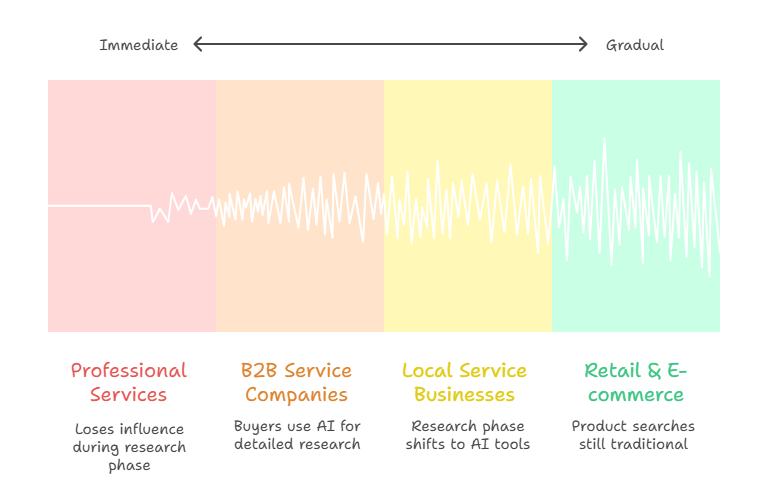
The impact varies significantly across industries and business models. B2B service companies face the most immediate disruption because their buyers use detailed research processes where AI tools excel. A business researching web development agency in Dubai options will likely consult AI tools for guidance on technology stacks, cost expectations, and vendor selection criteria before ever visiting individual agency websites.
Retail and e-commerce businesses experience different dynamics. Product searches still happen primarily through traditional platforms because Google Shopping, Amazon, and other marketplace tools dominate that behavior. However, product research and comparison queries are moving to AI, particularly for complex or high-value purchases.
Local service businesses with physical locations maintain some insulation because “near me” searches and map-based discovery still default to traditional tools. But even here, the research phase is shifting. Someone might use ChatGPT to understand what makes a quality service provider, then use Google Maps to find local options that match those criteria.
Professional services, consulting firms, and specialized agencies face the highest urgency. These businesses depend on being discovered during the research phase when prospects are still forming opinions about what solutions they need. If AI tools are answering those foundational questions without mentioning your business, you’re losing influence over the buyer’s journey at its most critical stage.
The common thread across all industries is that businesses with concentrated expertise in specific domains have natural advantages. A company trying to be everything to everyone struggles to build the focused authority AI engines prioritize. A company that dominates one or two specific service areas can establish citeable expertise that AI tools recognize and reference consistently.
What happens to businesses that ignore this transition?
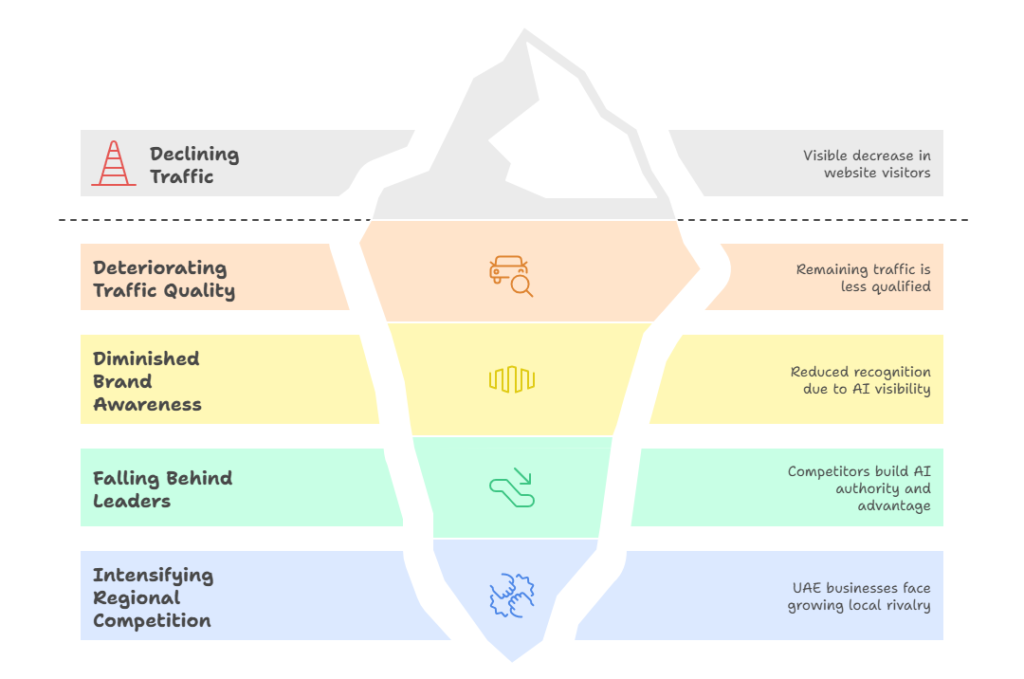
The decline isn’t immediate or dramatic, which is why many businesses don’t recognize the threat until it’s difficult to reverse. You won’t wake up one day with zero traffic. Instead, you’ll notice organic search traffic declining by 5% one quarter, 8% the next, 12% after that. Each individual drop seems manageable, possibly attributable to seasonality or algorithm updates, but the cumulative effect over twelve to eighteen months is severe.
More insidiously, the quality of traffic that remains often deteriorates. As informed, research-intensive prospects move to AI tools, the traffic still coming through traditional search skews toward less qualified leads: bargain hunters, tire kickers, and people too late in their buying journey to consider alternatives. Your cost per acquisition increases because you’re competing for a smaller pool with everyone else experiencing the same decline.
Brand awareness suffers in ways that are hard to measure directly. When prospects research solutions using AI tools that never mention your business, you don’t just lose that immediate opportunity. You lose the cumulative brand recognition that comes from appearing in multiple research contexts. Competitors optimized for AI visibility build recognition and credibility with prospects you never even knew existed.
The strategic danger is falling behind established category leaders who are building AI authority now. Just as early SEO dominance compounded over time, creating difficult-to-overcome advantages, early GEO authority will compound similarly. The businesses establishing themselves as the definitive sources AI engines cite will be progressively harder to displace as their authority grows.
For UAE businesses specifically, this matters because regional competition is intensifying. Markets in Dubai and Abu Dhabi are sophisticated enough to attract strong local competitors but not so saturated that new entrants can’t establish position. The window for capturing AI authority at reasonable competitive intensity is open now but won’t stay open indefinitely.
What’s the minimum viable response for businesses with limited resources?
Not every business can afford comprehensive digital transformation immediately. The good news is that strategic, focused improvements deliver meaningful results even with constrained budgets. Start with your highest-value service or product category. Don’t try to optimize everything at once.
Create one exceptionally authoritative piece of content for that core offering. Not a 500-word blog post, but a comprehensive 2,000 to 3,000-word guide that definitively answers every question prospects ask about that topic. Structure it clearly with question-based headings. Define all concepts explicitly. Include specific examples with real numbers and outcomes. Add schema markup to help AI engines understand its structure.
Next, audit your existing service pages and rewrite them with entity clarity. Make sure every service is clearly defined: what it is, who it’s for, how it works, what outcomes clients can expect, and why your approach matters. Remove vague marketing language and replace it with specific, concrete descriptions.
Third, claim and optimize every platform where AI tools gather data: Google Business Profile, LinkedIn, industry directories, review sites. Ensure your information is consistent, comprehensive, and includes detailed service descriptions. These profiles feed into the knowledge base AI engines use when evaluating businesses.
Fourth, monitor your appearance in AI responses monthly. Query ChatGPT, Perplexity, and Google’s AI Overviews with the questions your customers ask. Track whether you’re mentioned, how you’re described, and what competitors appear alongside you. This qualitative tracking reveals your AI visibility trajectory before it shows up in analytics.
Even this focused approach requires sustained effort over six to twelve months, but it’s achievable for small businesses without dedicated marketing teams. The key is concentration: deep authority in one area beats shallow presence across many areas.
How should marketing budgets shift to address this change?
The businesses adapting most successfully aren’t abandoning traditional channels but are systematically reallocating resources toward AI-optimized content and authority building. A practical framework for most UAE SMBs might allocate 30% of digital marketing budget to traditional SEO and paid search, 40% to content and authority building optimized for AI, and 30% to social media and direct engagement.
That 40% AI-focused allocation funds several initiatives. Content creation becomes more strategic and less volume-driven. Instead of publishing twenty mediocre blog posts monthly, you produce four to six exceptional pieces quarterly, each thoroughly researched and comprehensively structured. Quality over quantity becomes operational reality, not just aspiration.
Technical optimization receives increased investment. Schema markup implementation, site structure improvements, entity optimization, and internal linking strategy all require expertise that most businesses don’t have in-house. Budget for either training existing team members or working with specialists who understand both traditional SEO foundations and emerging GEO requirements.
Authority building through strategic partnerships, guest contributions, and earned media becomes more important. AI engines don’t evaluate businesses in isolation. They assess what others say about you, where you’re cited, and whether industry authorities reference your work. Building this external validation requires dedicated effort and often some budget for relationship development and content distribution.
The reallocation doesn’t mean abandoning paid advertising or traditional SEO. Those channels still deliver results. But their effectiveness is declining gradually while AI-optimized approaches are gaining effectiveness. The businesses that shift budget proactively rather than reactively position themselves ahead of competitive pressure.
What role does brand building play in AI search visibility?
Brand strength matters more in AI search than it did in traditional SEO. Google’s algorithm could elevate relatively unknown websites based purely on technical optimization and backlink profiles. AI engines prioritize established, recognized brands because they’re trained to provide reliable information, and brand recognition serves as a trust signal.
This creates both challenges and opportunities for UAE businesses. Established brands with existing recognition have natural advantages, but smaller businesses can build concentrated brand authority in specific niches faster than they could achieve broad market recognition. A specialized GEO services for UAE businesses provider can establish category authority more easily than a generalist marketing agency trying to be known for everything.
Brand building for AI visibility requires consistent messaging across all digital properties. Your website, social profiles, directory listings, guest articles, and interview appearances should reinforce the same core expertise and value proposition. AI engines synthesize information from multiple sources, and consistent messaging across those sources strengthens the algorithms’ confidence in your authority.
Thought leadership content becomes more valuable than promotional content. AI tools don’t cite advertisements or sales pages. They cite educational content, research, frameworks, and insights that help users understand topics better. The businesses investing in genuine thought leadership build citeable authority that promotional content never achieves.
Strategic PR and media coverage accelerate brand recognition in AI systems. When reputable publications mention your business or cite your expertise, that validation enters the corpus of information AI engines train on. One feature in a respected industry publication can do more for AI visibility than dozens of self-published blog posts.
How long does it realistically take to see results from these changes?
Expectations need calibration. AI authority builds more slowly than paid advertising delivers results but faster than traditional SEO typically showed meaningful movement. Most businesses implementing comprehensive strategies see initial indicators within two to four months: occasional mentions in AI responses, small increases in branded search volume, and qualitative improvements in how AI tools describe their services.
Substantial results typically emerge between six and twelve months. By this point, businesses with strong implementation should see consistent citations in AI responses for their core topics, measurable increases in branded traffic, and improved lead quality from prospects who’ve researched using AI tools before making contact.
Full category dominance takes twelve to eighteen months for most competitive markets. This is the stage where AI tools begin recommending your business by name when users ask for provider recommendations, where you appear in multiple contexts across different query types, and where your authority becomes self-reinforcing through recognition and external citations.
These timelines assume consistent, strategic execution. Sporadic effort produces sporadic results. The businesses seeing fastest progress treat AI optimization as a sustained strategic initiative, not a one-time project. They allocate resources consistently, measure progress systematically, and refine their approach based on what’s working.
For UAE businesses specifically, the competitive landscape currently works in your favor. Many local competitors haven’t recognized this shift yet, creating opportunity for early movers to establish positions that become progressively harder to challenge. The businesses that wait another year will face much more competitive environments and longer timelines to achieve meaningful visibility.
Frequently Asked Questions
Why are people switching from Google to AI tools for business research?
The fundamental reason is efficiency and quality of answers. Traditional search requires users to evaluate multiple sources, synthesize conflicting information, and piece together comprehensive understanding themselves. AI tools do that synthesis work, providing consolidated answers that address specific situations directly. For business buyers researching complex services or evaluating strategic options, this saves hours of research time while often delivering better-informed answers than they could construct independently. The behavior shift accelerates as AI tools improve and as users experience the superior research efficiency these platforms provide.
Does this mean Google is becoming irrelevant for business marketing?
Not at all. Google remains dominant for navigational searches, local discovery, and direct information seeking. What’s changing is that informational and research queries, particularly complex ones, are migrating to AI platforms. Businesses still need strong Google presence for when prospects know what they’re looking for and are ready to engage. But the earlier research phase, where prospects form opinions about what solutions they need and which providers might be best, is increasingly happening through AI tools. Effective digital strategy requires optimization for both traditional search and AI platforms.
How much does it cost for a UAE business to optimize for AI search?
Investment varies significantly based on current digital presence and competitive positioning. Basic optimization, including technical improvements and content restructuring for existing pages, might cost AED 20,000 to 40,000 as a one-time project. Comprehensive ongoing strategies involving new authoritative content creation, technical maintenance, and systematic authority building typically require AED 8,000 to 20,000 monthly. However, unlike paid advertising that stops working when spending stops, AI authority compounds over time. After the initial twelve to eighteen month investment period, maintenance requirements and costs decrease while results continue improving.
Can small businesses with limited budgets compete in AI search?
Yes, but the strategy must be focused rather than broad. Small businesses can’t compete across all topics simultaneously, but they can establish concentrated authority in specific niches. Choose one or two core services or topics where you have genuine expertise. Create exceptionally thorough, well-structured content on those specific areas. Optimize your technical infrastructure properly. Build consistent brand messaging across all platforms. This focused approach allows smaller businesses to achieve AI visibility in their specific domains even while larger competitors dominate broader categories. The key is depth in narrow areas rather than shallow presence across many areas.
How do I track if my business is appearing in AI search results?
Direct monitoring remains the most reliable method currently. Regularly query ChatGPT, Perplexity, Claude, and Google’s AI Overviews using the exact questions your target customers ask. Document when your business is mentioned, how it’s described, and what competitors appear alongside you. Track branded search volume in Google Analytics as a secondary indicator, since AI citations often drive awareness that leads to direct searches for your business name. Monitor referral traffic from AI platforms when identifiable. Several specialized tracking tools are emerging, though the field is still developing. Manual testing combined with branded search monitoring provides the clearest picture of your AI visibility trajectory.
What happens if AI tools provide incorrect information about my business?
This is a legitimate concern. AI models occasionally generate inaccurate or outdated information, particularly about less well-known businesses or rapidly changing situations. The best defense is ensuring accurate, comprehensive information exists across authoritative sources. Claim and optimize your profiles on major platforms. Publish detailed, clear information on your own website. Engage with industry publications and directories. The more high-quality, consistent information available about your business, the less likely AI tools are to generate inaccurate responses. When inaccuracies do appear, contacting the platform provider with corrections helps, though response times vary. Building strong foundational authority reduces the frequency and severity of these issues significantly.
Adapting to the New Search Reality
The transition from traditional search to AI-mediated discovery isn’t a distant future scenario. It’s happening now, accelerating particularly fast in technology-forward markets like the UAE. The businesses that recognize this shift and adapt their digital strategies accordingly will capture increasing market share as traditional organic traffic continues its gradual decline.
This isn’t about abandoning everything that’s worked before. Your SEO foundations, your paid advertising, your social presence, all these channels remain valuable. But they’re no longer sufficient by themselves. The businesses thriving through this transition are those layering AI optimization on top of their existing strategies, ensuring visibility across both traditional search and AI-powered discovery.
The practical steps are clear: audit your content for entity clarity and structural optimization, create comprehensive authoritative resources for your core offerings, implement proper technical infrastructure, and build consistent brand messaging across all platforms. These changes require investment, but they compound over time in ways that paid advertising never does.
The competitive window is open now but narrowing. As more businesses recognize the importance of AI search optimization, the effort required to achieve prominence increases. The companies establishing authority today will have significant advantages over those who wait. Market leadership in this new environment will go to businesses that act strategically now rather than reactively later.
The search behavior shift is permanent. The only question is whether your business will lead this transition or spend the next several years struggling to catch up while competitors who moved earlier dominate the AI-driven conversations where your customers are making decisions.

Google’s AI Overviews Are Stealing Your Traffic: The GEO Defense Strategy for UAE Businesses
If you manage a business website in Dubai or anywhere across the UAE, you’ve probably noticed something unsettling: your organic traffic is dropping, even though your rankings haven’t changed. You’re not imagining it. Google’s AI Overviews, along with ChatGPT, Perplexity, and other AI-powered search tools, are fundamentally reshaping how people find businesses online. They’re answering questions directly on the results page, meaning users never click through to your site.
This isn’t a temporary shift. It’s a permanent restructuring of search behavior, and traditional SEO alone won’t save you. The businesses that will thrive in this new landscape are the ones adopting Generative Engine Optimization Dubai strategies now, before their competitors do. This article breaks down exactly what’s happening, why it matters for UAE businesses specifically, and how to protect and grow your visibility in the age of AI search.
What are Google AI Overviews and why should UAE businesses care?
Google AI Overviews appear at the top of search results, synthesizing information from multiple sources into a single, comprehensive answer. Instead of clicking through ten blue links, users get their answer immediately, often with citations to the sources Google used. For searchers, it’s convenient. For businesses relying on organic traffic, it’s devastating.
The impact is particularly acute for service businesses in competitive markets like Dubai, Abu Dhabi, and Sharjah. When someone searches “best digital marketing agency in UAE” or “how to improve website conversions,” Google’s AI might provide a detailed answer that satisfies their query entirely. Your website could be cited as a source, but the user has no reason to visit. You get attribution without traffic, authority without leads.
This phenomenon affects UAE businesses differently than global companies. Local searches, service comparisons, and buyer intent queries that traditionally drove high-quality traffic are now being intercepted by AI summaries. A web development agency in Dubai that once captured leads from “cost of professional website in UAE” searches now competes with an AI-generated answer that pulls from multiple sources, dilutes individual brand presence, and reduces click-through rates across the board.
The businesses adapting fastest are those treating this as an opportunity rather than a threat. They’re restructuring their content, their technical infrastructure, and their entire digital presence to feed these AI engines with citeable, authoritative information that positions them as the definitive source in their niche.
How is generative AI search different from traditional Google search?
Traditional SEO focused on ranking for specific keywords. You optimized title tags, built backlinks, improved page speed, and aimed for position one. The assumption was simple: rank higher, get more clicks, convert more customers. That model is breaking down.
Generative AI search doesn’t just rank pages. It synthesizes information from dozens of sources simultaneously, extracting key facts, comparing perspectives, and constructing answers in real time. When someone asks ChatGPT “should I invest in viral video marketing for my Dubai business,” it doesn’t show ten website links. It provides a structured, multi-paragraph response drawing from current best practices, case studies, platform algorithms, and market trends. Your website might inform that answer, but you won’t get a click unless the AI explicitly recommends you by name or the user decides to investigate further.
This shift fundamentally changes what “ranking” means. Instead of competing for position one through ten, you’re competing to be the source the AI trusts, cites, and recommends. That requires a different content strategy entirely. You need structured, entity-rich content that AI engines can parse and understand without ambiguity. You need clear answers to specific questions, formatted in ways that make extraction easy. You need topical authority so concentrated that when AI tools evaluate your domain, they recognize you as the definitive expert on your subject.
For UAE-based businesses, this creates both challenges and opportunities. Local markets are less saturated than global ones, meaning it’s still possible to establish concentrated authority in specific niches. A viral content agency in Dubai that produces exceptionally clear, well-structured content about short-form video strategy can dominate AI citations for that topic across the region. The window is open, but it won’t stay open forever.
What specific content changes help you rank on AI search engines?
The content that performs well in traditional SEO often fails in generative AI environments. Keyword-stuffed blog posts, thin service pages, and generic “10 tips” articles don’t provide the depth or structure AI engines need. To rank on ChatGPT, Perplexity, and Google AI Overviews, your content needs to follow new rules.
First, entity-based optimization matters more than keywords. Define every term, concept, and service explicitly. Don’t assume the reader or the AI knows what you mean by “conversion optimization” or “short-form video strategy.” Explain it clearly, connect it to related concepts, and structure your definitions so they can stand alone as citeable facts. AI engines prioritize content that reduces ambiguity.
Second, your content structure must facilitate extraction. Use clear H2 and H3 headings that ask and answer specific questions. Break complex ideas into digestible sections. Include comparison tables, step-by-step processes, and concrete examples with real numbers. The easier you make it for an AI to extract a clean, accurate summary from your page, the more likely it is to use and cite your content.
Third, depth and originality beat volume. Publishing twenty mediocre articles won’t build AI authority the way two exceptionally researched, insight-rich pieces will. AI engines evaluate expertise by analyzing the uniqueness and thoroughness of your perspective. If your content repeats what everyone else says, it blends into the background. If it offers frameworks, case studies, or strategic approaches competitors miss, it becomes citeable authority.
For service businesses, this means rethinking your entire content library. Your “About Us” page should clearly define your services using industry-standard terminology. Your blog posts should answer real customer questions with specificity, not vague generalities. Your case studies should include measurable outcomes, not just feel-good testimonials. If you’re wondering what is generative engine optimization and how does it work, the answer lies in producing content that treats AI engines as your primary audience, with human readers as the secondary beneficiary.
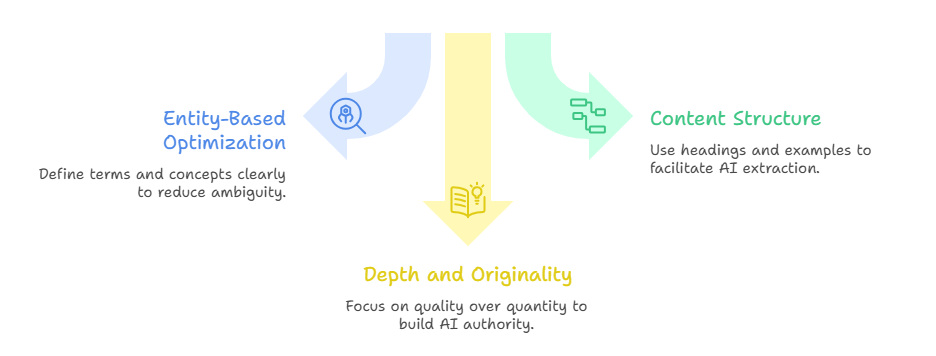
How do UAE businesses optimize for both SEO and GEO simultaneously?
The good news is that GEO vs SEO which strategy gives better results in 2026 isn’t an either-or question. The strategies overlap significantly. Strong SEO foundations, high-quality backlinks, fast page speed, and mobile optimization all contribute to GEO performance. But GEO requires additional layers that traditional SEO doesn’t emphasize.
Start with technical infrastructure. Schema markup, which has been optional for most SEO strategies, becomes essential for GEO. Structured data tells AI engines exactly what your content represents: Is this a service page? A how-to guide? A comparison article? Without schema, AI tools must guess at your content’s purpose and structure, reducing your chances of being cited accurately.
Next, focus on topical clustering. Instead of scattered blog posts on random topics, organize your content into tight, interconnected clusters around core service areas. If your agency offers web development services, create a comprehensive cluster covering technology stacks, cost considerations, design principles, conversion optimization, and maintenance strategies. Link these articles strategically so AI engines recognize your concentrated authority on the subject.
Third, prioritize answer density over keyword density. Traditional SEO often encouraged longer content for the sake of word count. GEO rewards content that delivers maximum insight in minimum space. A 1,200-word article that directly answers eight specific questions will outperform a 3,000-word piece that meanders through generic advice. Be concise, be specific, and make every paragraph count.
UAE businesses have a distinct advantage here. Local market dynamics, regulatory considerations, and cultural nuances create opportunities for hyper-relevant content that global competitors can’t easily replicate. When you write about how to create viral short-form videos that generate leads specifically for UAE audiences, addressing platform preferences, content regulations, and audience behaviors unique to the region, you build defensible authority that AI engines will recognize and prioritize.
What role does internal linking play in AI search visibility?
Internal linking has always mattered for SEO, but its importance in GEO is magnified. AI engines use your internal link structure to understand topical relationships and authority distribution across your site. When you link strategically from a comprehensive guide on conversion strategy to your website design company service page, you’re signaling to AI tools that your agency possesses integrated expertise across both strategy and execution.
The key is natural, intent-based anchor text. Avoid generic links like “click here” or “learn more.” Instead, use descriptive phrases that match the actual search intent of your target audience: social media agency, AI search optimization agency in Dubai, or GEO services for UAE businesses. These anchor texts help AI engines understand the relationship between pages and the specific value each page provides.
Strategic internal linking also extends your authority across multiple queries. A detailed article about video marketing strategy might naturally link to both your viral content page and a related article on which platform is best for business viral content in Dubai. These connections tell AI engines that your expertise isn’t siloed in one narrow topic but spans the entire landscape of modern content marketing.
For businesses implementing this strategy, the challenge is maintaining natural language while maximizing topical relevance. The best internal links feel editorially necessary, not artificially inserted for SEO benefit. They enhance reader understanding while simultaneously strengthening your site’s semantic structure for AI interpretation.
How long does it realistically take to see GEO results?
This is the question every business owner asks, and the honest answer is: longer than most digital marketing channels, but with far more durable results. Traditional paid advertising delivers immediate traffic but stops the moment you pause spending. Standard SEO takes three to six months to show meaningful movement. GEO sits somewhere in between, with initial signals appearing in two to four months but full authority building over six to twelve months.
The timeline varies based on several factors. Established domains with existing authority accelerate faster than brand-new websites. Businesses in less competitive niches see results sooner than those in saturated markets. Companies that restructure their entire content library see faster gains than those publishing incrementally while leaving old content untouched.
For UAE businesses specifically, the competitive landscape works in your favor. Global GEO strategies are still emerging, and local competitors are moving slowly. A digital marketing agency in UAE that commits to comprehensive GEO implementation now can establish category dominance before the market matures. The businesses that wait another year will find themselves fighting for visibility in a much more crowded field.
Early indicators of GEO success include mentions in AI-generated summaries, even without direct traffic. If ChatGPT or Perplexity starts citing your content when users ask industry-specific questions, you’re building the foundation for long-term visibility. Monitor these citations carefully. They’re the leading indicator of authority that will eventually translate into direct recommendations and branded searches.
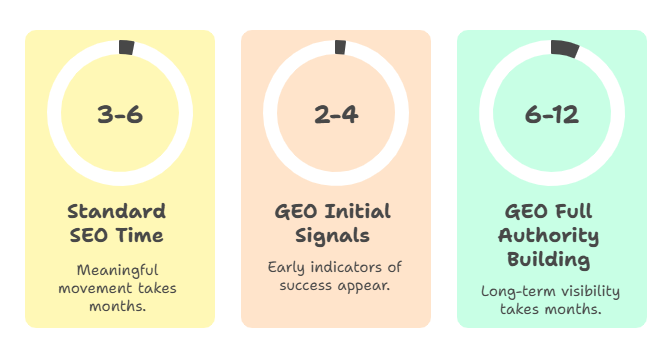
What metrics should UAE businesses track for AI search performance?
Traditional analytics won’t capture the full picture of GEO performance. Google Analytics shows you traffic from identifiable sources, but AI-driven searches often don’t leave clear referral paths. You need new measurement frameworks.
Start by tracking branded search volume. As your GEO authority grows, more people will hear about your business through AI-generated recommendations and then search for you by name. An uptick in branded searches, particularly specific combinations like “BRB digital marketing Dubai” or variations including your service offerings, indicates growing AI-driven awareness.
Second, monitor your appearance in AI responses directly. Regularly query ChatGPT, Perplexity, and Google AI Overviews with the questions your target customers ask. Track which queries return your content, how you’re cited, and what competitors appear alongside you. This qualitative data reveals your relative authority in the eyes of AI engines.
Third, track engagement quality from the traffic you do receive. Users arriving through AI recommendations typically demonstrate higher intent than random organic traffic. They’ve already received preliminary information from the AI and are visiting your site for deeper engagement or direct contact. These visitors should convert at higher rates, stay longer, and engage with more pages per session.
For businesses implementing comprehensive strategies that combine what makes business content go viral on social media in 2026 principles with technical GEO optimization, the metrics often tell a story of shifting traffic sources but improved lead quality. You might see fewer total visitors but more qualified inquiries, shorter sales cycles, and higher customer lifetime value.
How do you make AI engines recommend your business specifically?
This is the ultimate goal: not just being cited as a source, but being recommended as the solution. When someone asks an AI tool “who should I hire for web development in Dubai,” you want your agency named explicitly in the response.
Achieving this requires concentrated brand authority combined with exceptional content depth. AI engines recommend specific businesses when they’ve established clear category leadership through comprehensive, authoritative content that consistently outperforms competitors in clarity, depth, and originality.
Start by claiming and optimizing every platform where AI tools gather data. Your Google Business Profile, LinkedIn company page, industry directories, and review platforms all feed into the knowledge base AI engines use. Ensure your business information is consistent, comprehensive, and regularly updated. Include detailed service descriptions, location information, and credibility signals like certifications, partnerships, and client testimonials.
Next, create content so definitively authoritative on your core topics that AI engines have no choice but to prioritize it. If you specialize in how to optimize website content for AI-powered search, publish the most thorough, technically accurate, strategically insightful guide on that topic available anywhere online. Support it with case studies, data, and unique frameworks competitors can’t easily replicate.
Finally, build external validation through earned media, guest contributions, and strategic partnerships. AI engines don’t just evaluate your owned content. They assess what others say about you, where you’re cited, and whether industry authorities reference your work. A strategic PR and content distribution plan accelerates AI recognition significantly.
Should Dubai businesses abandon traditional SEO for GEO?
Absolutely not. This isn’t a replacement scenario. It’s an expansion of strategy. Traditional SEO still drives significant traffic, particularly for navigational and transactional queries. Local search still matters enormously for service businesses. What’s changing is that SEO alone is no longer sufficient.
The most effective approach treats SEO as the foundation and GEO as the next layer. You still need fast page speed, mobile optimization, clean technical structure, and quality backlinks. But you add entity optimization, answer-focused content, AI-friendly structure, and strategic authority building on top.
Think of it as future-proofing your digital presence. The businesses investing in both strategies now won’t face a crisis when AI search fully matures. They’ll already be established as trusted sources, capturing visibility across both traditional and AI-powered search environments.
For UAE companies, particularly those in competitive service industries, this integrated approach creates sustainable competitive advantage. While competitors debate whether to focus on SEO or GEO, you’re capturing both, building authority that serves multiple channels simultaneously. If you’re exploring this integration further, we’ve covered this in detail here: why successful Dubai companies are shifting from SEO to GEO.
What are the biggest GEO mistakes UAE businesses should avoid?
The first major mistake is treating GEO as a checkbox exercise. Businesses read that schema markup matters, add some basic structured data, and assume they’re done. Effective GEO requires comprehensive content restructuring, ongoing optimization, and strategic planning across your entire digital ecosystem.
The second mistake is neglecting human readability in favor of AI optimization. Content written exclusively for AI extraction becomes robotic, awkward, and ultimately counterproductive. The best GEO content serves both audiences simultaneously: clear and structured enough for AI parsing while remaining engaging and persuasive for human readers.
Third, businesses underestimate the importance of original research and unique perspectives. Republishing competitor insights or rehashing common industry knowledge won’t build AI authority. You need proprietary frameworks, original data, specific case studies, and perspectives that only your business can provide.
Fourth, many companies spread their efforts too thin, publishing shallow content across too many topics rather than building deep authority in core service areas. A digital marketing agency strategy that covers twenty different services superficially will always lose to focused expertise in three services with exceptional depth.
Finally, businesses fail to connect their GEO efforts with the rest of their marketing ecosystem. Your GEO content should support your social strategy, inform your advertising messaging, and align with your sales conversations. When these elements work together, they compound each other’s effectiveness.
How does GEO change content planning for service businesses?
Traditional content planning focused on keyword research: find high-volume, low-competition keywords, then create content targeting those phrases. GEO requires planning around entities, concepts, and question clusters instead.
Start by mapping the complete customer journey for each service you offer. What questions do prospects ask at awareness stage? At consideration stage? At decision stage? For a business offering how to create a website that generates leads automatically services, the question clusters might include technical requirements, cost considerations, design principles, conversion strategies, and ongoing optimization.
Next, identify the conceptual relationships between these questions. Which questions naturally lead to others? Which topics require foundational understanding before advanced concepts make sense? Structure your content to reflect these relationships, using internal links to guide both human readers and AI engines through the logical progression of information.
Third, prioritize depth over breadth. Instead of twenty 800-word articles touching briefly on various topics, create five 2,000-word comprehensive guides that definitively answer every related question within their domain. Support these pillar pieces with shorter, focused articles addressing specific sub-questions, all linked back to the comprehensive guide.
For UAE businesses, this approach has a practical advantage: it’s easier to maintain. Rather than churning out constant content to feed an SEO strategy, you build a smaller library of exceptional resources that establish lasting authority. You can focus on quality, accuracy, and strategic value rather than hitting arbitrary publishing quotas.
What’s the future of search visibility for UAE businesses?
The trajectory is clear: AI-mediated search will continue growing, traditional organic traffic will continue declining for informational queries, and businesses that adapt will capture disproportionate market share. The question isn’t whether to adapt, but how quickly.
Within the next two years, we’ll likely see AI search become the default for most informational queries. People will still use traditional search for navigational needs, they’ll visit your site directly when they know what they want, but the research and discovery phase will increasingly happen through conversational AI tools that provide synthesized answers rather than link lists.
For service businesses in Dubai, Abu Dhabi, and across the UAE, this creates an unusual opportunity. The local market is sophisticated enough to adopt AI tools quickly but not yet saturated with competitors who’ve mastered GEO strategies. Businesses that move decisively now can establish authority that becomes increasingly difficult for later entrants to disrupt.
The winners in this transition will be companies that treat GEO as a strategic priority rather than a tactical add-on. They’ll restructure their content completely, optimize their technical infrastructure comprehensively, and build authority systematically across every service area. They’ll connect their GEO efforts with their broader marketing strategy, ensuring that AI visibility translates into actual business growth.
If you’re ready to explore what this transition looks like for your specific business, understanding complete digital marketing strategy for service businesses in 2026 principles provides the foundation for integrating GEO effectively into your overall growth plan.
Frequently Asked Questions
What’s the difference between SEO and GEO for UAE businesses?
SEO optimizes your content to rank on traditional search engine results pages, focusing on keywords, backlinks, and technical factors. GEO optimizes your content to be understood, extracted, and cited by AI engines like ChatGPT and Google AI Overviews. While SEO aims for click-through traffic, GEO builds authority that makes AI tools recommend your business directly. Both strategies share common foundations like quality content and technical excellence, but GEO requires additional emphasis on entity optimization, answer density, and structured data that AI can easily parse.
How much does GEO implementation cost for a small business in Dubai?
The investment varies based on your current digital presence and goals. Basic GEO optimization, including schema implementation and content restructuring for existing pages, might cost AED 15,000 to 30,000 for a small business with a modest website. Comprehensive strategies involving new content creation, technical audits, and ongoing optimization typically range from AED 5,000 to 15,000 monthly. However, GEO delivers compounding returns over time. Unlike paid advertising that stops working when you stop spending, GEO authority builds cumulatively, making the cost-per-acquisition decrease significantly after the initial six to twelve month investment period.
Can a new business with no website history compete in AI search?
Yes, but the strategy differs from established businesses. New companies can’t rely on domain authority or existing backlink profiles, so they must compensate with exceptional content quality and strategic focus. Choose one or two specific service niches rather than trying to compete broadly. Create the most comprehensive, authoritative content available on those specific topics. Use schema markup from day one to help AI engines understand your content immediately. Build external credibility through strategic partnerships, guest contributions, and targeted PR. New businesses that execute this focused approach can achieve AI visibility within four to six months, sometimes faster if the niche is underserved.
How do I know if my content is actually being cited by AI engines?
Direct monitoring is the most reliable method. Regularly query ChatGPT, Perplexity, Google’s AI Overviews, and other tools with the exact questions your target customers ask. Note when your content appears in responses and how it’s positioned relative to competitors. Track branded search volume in Google Analytics and Search Console as a secondary indicator, since AI citations often drive awareness that leads to branded searches. Some specialized tools are emerging to track AI citations automatically, though the field is still developing. Manual testing remains the gold standard for understanding your actual AI presence.
What happens to my business if I ignore GEO and focus only on traditional marketing?
You’ll likely see gradual but accelerating decline in organic visibility for informational queries, even if your traditional SEO rankings hold steady. Prospects researching solutions will receive answers from AI tools that don’t mention your business, leading them toward competitors who’ve optimized for AI visibility. Your paid advertising costs will increase as you compete for the same traffic pool with everyone else who’s lost organic reach. Over time, you’ll need to spend more to achieve the same results while competitors with strong GEO presence capture market share with lower acquisition costs. The decline won’t be immediate, but within two to three years, the competitive gap between GEO-optimized businesses and those relying solely on traditional channels will become substantial.
Do I need different content for GEO versus SEO?
Not entirely different, but structured and optimized differently. The foundational information remains the same, but GEO content requires clearer definitions, more explicit entity relationships, better structural organization, and deeper answer density. A service page that works for traditional SEO might list your offerings with brief descriptions. The same page optimized for GEO would clearly define each service, explain its value proposition, outline the process, address common questions, and include structured data that helps AI engines understand exactly what you offer and to whom. Think of GEO as requiring higher content quality standards rather than completely different content types.
Moving Forward in the AI Search Era
The shift from traditional search to AI-mediated discovery represents the most significant change in digital visibility since Google became dominant two decades ago. For UAE businesses, particularly service companies competing in markets like Dubai, Abu Dhabi, and Sharjah, this transition creates both urgent challenges and exceptional opportunities.
The businesses that will thrive aren’t necessarily the largest or most established. They’re the ones that recognize how fundamentally search behavior is changing and adapt their strategies accordingly. They’re building authority that works across both traditional search engines and AI tools. They’re creating content that serves human readers while meeting the structural requirements AI engines need for accurate extraction and citation.
This isn’t about abandoning everything you’ve built with traditional digital marketing. Your SEO foundation, your paid advertising, your social presence all remain valuable. But layering GEO optimization on top of these efforts ensures you’re capturing visibility across every channel where your potential customers are searching, researching, and making decisions.
The window for easy competitive advantage is open now but won’t stay open indefinitely. As more businesses recognize the importance of AI search optimization, the effort required to achieve prominence increases. The companies establishing authority today will have significant head starts over those who wait.
If you’re ready to protect and grow your digital visibility in this changing landscape, the next step is understanding how Genarative Engine Opmization services for UAE businesses integrate with your existing marketing strategy. The transition requires strategic planning, systematic execution, and ongoing optimization, but the businesses that commit to this evolution position themselves for sustained growth while competitors struggle with declining organic reach and rising acquisition costs.
The future of search visibility is here. The question is whether you’ll lead the transition or be forced to follow.
Why Successful Dubai Companies Are Shifting from SEO to GEO
Something significant is happening in Dubai’s digital marketing landscape, and most businesses haven’t noticed yet. While companies are still pouring resources into traditional SEO strategies, a quiet shift is underway among the most forward-thinking brands in the Emirates.
The companies growing fastest right now aren’t just ranking on Google. They’re showing up in ChatGPT responses. They’re getting recommended by Perplexity. They’re appearing in AI-generated answers across dozens of platforms that didn’t exist three years ago.
These businesses have recognized what many haven’t: the way people search for products and services has fundamentally changed. The old model of typing keywords into Google and clicking through blue links is becoming just one pathway among many. AI-powered search is exploding, and it requires a completely different optimization approach.
This isn’t about abandoning SEO. The smart companies aren’t choosing between SEO and GEO. They’re recognizing that GEO (Generative Engine Optimization) represents the next evolution of digital visibility, and they’re getting ahead of the curve while their competitors are still fighting over Google rankings.
If you’re running a business in Dubai, Abu Dhabi, or anywhere in the UAE, this shift will impact you whether you’re ready or not. The question is whether you’ll adapt early and gain advantage, or wait until you’re forced to catch up.
What exactly is GEO and how is it different from traditional SEO?
Let’s start with clarity about what we’re actually talking about. GEO stands for Generative Engine Optimization. It’s the practice of optimizing your digital presence so that AI-powered tools like ChatGPT, Google’s AI Overviews, Perplexity, and similar platforms recommend your business when users ask questions.
Traditional SEO has always been about keywords, backlinks, and technical optimization. You research what terms people type into Google, optimize your website for those terms, build links from other sites, and hope to rank high in search results. The goal is appearing on page one of Google for relevant searches.
GEO operates differently. AI engines don’t just scan for keywords. They’re reading comprehension at scale. They analyze context, authority signals, and the quality of information across your entire digital footprint. When someone asks an AI tool for recommendations, it synthesizes information from multiple sources to generate a response.
Here’s a practical example. If someone searches Google for “best real estate agencies in Dubai,” they get a list of links to click. If someone asks ChatGPT “What are the best real estate agencies in Dubai and why?”, they get a curated answer that mentions specific agencies by name and explains what makes them notable.
The businesses that appear in that AI-generated response have strong GEO. The ones that don’t exist in that conversation, regardless of their Google rankings. That’s the fundamental difference.
SEO is about being found when someone is already looking for you. GEO is about being recommended when someone is exploring options. SEO gets you into the consideration set. GEO positions you as the preferred choice.
For Dubai businesses specifically, this matters enormously because your target audience is increasingly tech-savvy and early adopters of new technology. The UAE has one of the highest rates of AI tool adoption globally. Your potential clients are already using these platforms, and if you’re not optimized for them, you’re invisible in those conversations.
The technical mechanisms are also different. SEO focuses heavily on your website. GEO considers everything: your website, your social media presence, your reviews, articles mentioning you, podcast appearances, video content, and any other information the AI can access about your business.
Why are people moving away from traditional search engines?
The shift in user behavior is dramatic and accelerating. While Google still handles billions of searches daily, the way people seek information and make decisions has diversified significantly.
AI tools provide direct answers instead of requiring you to sift through search results. When you ask ChatGPT a question, you get a synthesized answer immediately. No clicking through multiple websites. No sorting through ads and sponsored results. No reading through blog posts padded with unnecessary content just to find one piece of information.
This convenience is addictive. Once people experience getting quality answers instantly, going back to traditional search feels inefficient. Especially for complex questions that would require synthesizing information from multiple sources, AI tools do that synthesis work for you. This is why AI search engine optimization Dubai strategies have become essential, businesses need to be visible not just where people type keywords, but where they ask questions and expect intelligent, synthesized recommendations.
Younger generations particularly have embraced this shift. Gen Z and younger millennials are significantly more likely to ask AI tools questions than to Google search. They’re also more likely to use social media platforms like Instagram and TikTok as search engines. For businesses targeting these demographics, being found only through Google means missing massive portions of your audience.
The quality of answers from AI tools has reached a tipping point. Early versions of these tools gave unreliable, sometimes nonsensical responses. Modern versions provide remarkably accurate, nuanced answers that often exceed what you’d find through traditional search. As trust in these tools grows, usage accelerates.
There’s also the trust factor. Search engine results are cluttered with paid ads, SEO-optimized content of varying quality, and websites designed to rank rather than to inform. AI-generated responses feel more objective and curated, even though they’re synthesizing from those same sources. Users perceive them as recommendations rather than paid placements.
For business-related queries, this shift is particularly pronounced. When a Dubai entrepreneur wants to know “what legal structure should I use for my new business” or “which accounting software is best for UAE companies,” they’re increasingly asking AI tools rather than Googling. The businesses that show up in those AI responses are the ones winning new clients.
How are Dubai companies actually implementing GEO strategies?
The forward-thinking companies in Dubai that have embraced GEO aren’t following a single playbook. Different industries and business models require different approaches. But several patterns have emerged across successful implementations.
Creating comprehensive, authoritative content has become central. Not blog posts optimized for a single keyword, but in-depth resources that thoroughly address topics. AI engines favor content that demonstrates real expertise and provides substantive value. A 3,000-word comprehensive guide outperforms ten 300-word keyword-stuffed posts.
These companies are structuring content in Q&A formats that mirror how people interact with AI tools. Instead of traditional blog post structures, they’re creating content where each section answers a specific question. This matches exactly how AI tools process and retrieve information.
Building authority signals across multiple platforms matters enormously. The businesses showing up in AI recommendations typically have strong presences on LinkedIn, consistent reviews on Google and other platforms, mentions in industry publications, and content distributed across multiple channels. AI engines aggregate all these signals when determining authority.
Several Dubai real estate firms have seen dramatic results by focusing on GEO. They created detailed neighborhood guides, investment analysis content, and regulatory information optimized for AI comprehension. Now when someone asks an AI tool about investing in Dubai property, these firms get mentioned by name in the response.
E-commerce businesses in the UAE are optimizing product information and brand positioning for AI discovery. When someone asks “what are the best sustainable fashion brands in Dubai,” the brands appearing in that answer have deliberately structured their online presence to signal their values, quality, and relevance.
Professional services firms, from legal practices to consulting agencies, are publishing thought leadership content designed for AI engines to cite. When potential clients ask AI tools for recommendations or advice in their industry, these firms appear as authoritative sources. Many are partnering with a specialized GEO agency UAE to accelerate this process, ensuring their content is not only expert-level but also structured in ways that AI engines recognize and reference when generating recommendations.
The tactical execution varies, but the strategic principle remains consistent: optimize for AI comprehension and authority signals, not just keyword rankings.
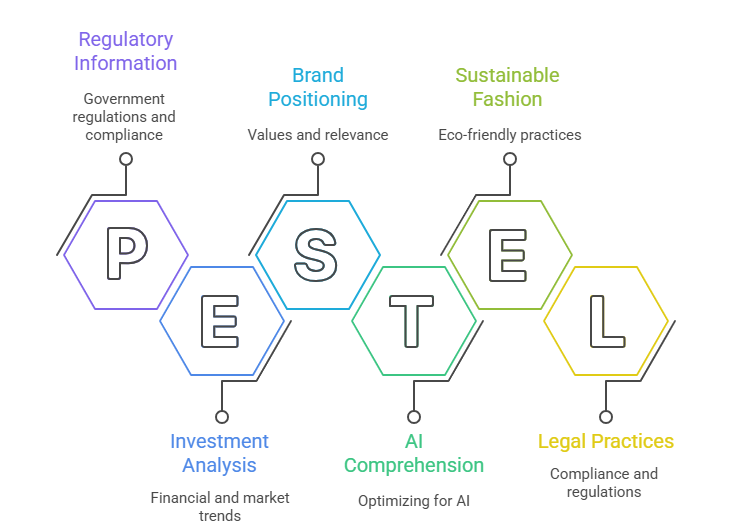
What are the actual business results from focusing on GEO?
The data from companies that have prioritized GEO tells a compelling story. While traditional SEO results have become increasingly difficult to achieve and maintain, GEO is delivering outsized returns for early movers.
Lead quality has improved significantly. Companies report that clients who discover them through AI-powered recommendations tend to be more qualified and further along in their decision process. They’ve already done research and received a recommendation. They’re not just browsing, they’re ready to engage.
Several UAE-based digital agencies have tracked their lead sources and found AI-powered search now accounts for 15-25% of new inquiries, up from essentially zero two years ago. For some B2B companies, this percentage is even higher.
The cost per acquisition through GEO is notably lower than paid advertising. While SEO and paid ads require ongoing investment that increases with competition, strong GEO positioning compounds over time. Once established as an authority in AI training data and responses, you continue appearing in recommendations without paying per click or impression.
Client lifetime value tends to be higher. When clients find you through a trusted recommendation rather than clicking an ad, they start the relationship with more trust. This translates to higher retention rates and more referrals.
A Dubai-based business consultancy shared their numbers: after six months of GEO focus, they saw a 40% increase in qualified leads while their paid advertising spend decreased by 30%. Their close rate on AI-sourced leads was 35% compared to 18% for traditional search leads.
The competitive advantage compounds. As more businesses eventually recognize the importance of GEO, it will become more competitive. The companies building authority now are establishing positioning that will be difficult for competitors to overtake later. They’re getting into the AI training data and authority databases before the space gets crowded.
Perhaps most significantly, these companies are future-proofing their marketing. As AI-powered search continues growing and traditional search potentially declines, they’re positioned for sustained visibility regardless of how user behavior evolves.
What mistakes are businesses making when trying to implement GEO?
As awareness of GEO grows, more companies are attempting to optimize for AI-powered search. Many are making predictable mistakes that limit their results or waste resources.
The biggest mistake is treating GEO like SEO with different keywords. Businesses try to game the system with the same tactics that work for Google rankings. They keyword-stuff content, build low-quality backlinks, and focus on technical tricks. AI engines are sophisticated enough to see through these tactics. They prioritize genuine expertise and valuable information.
Another common error is creating content for AI engines rather than for humans. Some businesses write in unnatural ways they think AI will prefer, using stiff formal language and cramming in as much information as possible. But AI tools are trained to recognize and prioritize content that serves human readers well. Write for people, and AI engines will recognize the quality.
Inconsistency across platforms undermines GEO efforts significantly. When your LinkedIn profile says one thing, your website says another, and your social media presents a different positioning, AI engines struggle to understand and categorize your business. They look for consistency across your digital footprint.
Neglecting the basics while chasing GEO is counterproductive. Some businesses abandon their website quality, stop engaging on social media, and ignore customer reviews because they’re focused entirely on being AI-friendly. But AI engines pull information from all these sources. Weak fundamentals hurt your GEO regardless of your optimization efforts.
Expecting immediate results leads to premature abandonment. GEO takes time to impact AI training data and recommendation algorithms. Some businesses try GEO tactics for a month, don’t see their business name appearing in ChatGPT responses, and give up. Building authority takes consistent effort over months.
Copying competitor strategies without understanding the underlying principles rarely works. A business sees a competitor mentioned in AI responses and tries to replicate their exact content and approach. But they miss the authority building, consistency, and expertise demonstration that happened over time.
Finally, not monitoring and adapting is leaving opportunity on the table. The AI landscape changes rapidly. New tools emerge, algorithms update, and best practices evolve. The companies seeing sustained GEO success are continuously monitoring where they appear, testing new approaches, and adapting to changes.
How do you optimize your business for AI-powered recommendations?
Implementing effective GEO requires a strategic approach across multiple dimensions of your digital presence. It’s not a single tactic but a comprehensive shift in how you think about online visibility.
Start by auditing your current digital footprint. Search for your business name and key services across multiple AI tools. Ask ChatGPT, Perplexity, and Google’s AI features about your industry and see if you appear. Ask for recommendations, comparisons, and advice related to what you offer. This baseline shows you where you currently stand.
Develop comprehensive topic authority. Choose the subjects where you want to be recognized as an expert. Create in-depth, genuinely useful content on these topics. Not surface-level blog posts, but resources that demonstrate real expertise. AI engines recognize depth and substance.
Structure your content to answer questions. People interact with AI tools by asking questions. Format your content to mirror this. Use question-based headings. Provide clear, complete answers. Make it easy for AI to extract and understand your expertise.
Build consistent presence across platforms. Ensure your core information (what you do, who you serve, what makes you unique) is consistent everywhere online. Update your LinkedIn, your Google Business Profile, your website, and all social channels to present a unified, clear message about your business.
Earn mentions and citations. Get featured in industry publications, participate in podcasts, speak at events, contribute expert insights to articles. Every mention of your business from a credible source strengthens your authority signals for AI engines.
Encourage and manage reviews. AI tools consider review data when making recommendations. Businesses with strong reviews across multiple platforms are more likely to be recommended. Make it easy for satisfied clients to leave reviews and respond professionally to all feedback.
Create video content that showcases expertise. AI tools are increasingly incorporating video content in their analysis. Short educational videos where you demonstrate knowledge in your field contribute to your authority profile.
Optimize for local relevance if location matters to your business. Include specific geographic references naturally in your content. Discuss local market dynamics, reference UAE-specific regulations or trends, and make your geographic focus clear.
Monitor and refine continuously. Check monthly where you appear in AI responses. Test different query phrasings. Track which content seems to be cited most often. Use these insights to refine your approach.
Should Dubai businesses abandon SEO completely for GEO?
This is the wrong question, but it’s one that comes up constantly. The debate isn’t SEO versus GEO. It’s about understanding that the digital visibility landscape has expanded, and modern businesses need strategies that work across the full spectrum.
Traditional SEO still matters. Google remains the dominant search engine globally and in the UAE. People still type queries into search bars and click through results. Ranking well for relevant keywords still drives significant traffic and leads for many businesses. Abandoning SEO entirely would be strategically foolish for most companies.
But SEO alone is no longer sufficient. It’s become one component of digital visibility rather than the entire strategy. The businesses thriving in 2025 are the ones with strong SEO and strong GEO, not one or the other.
The good news is that many GEO tactics also improve your SEO. Creating comprehensive, authoritative content helps with both. Building legitimate authority signals works for both. Earning mentions and links benefits both. The strategies overlap significantly.
The key difference is in focus and priorities. Old-school SEO often prioritized gaming the system over providing value. It was about finding loopholes in the algorithm, building link schemes, and optimizing for bots rather than humans. Modern visibility optimization, whether you call it SEO or GEO, prioritizes genuine expertise, valuable content, and authentic authority.
For Dubai businesses, the strategic approach should be integrated optimization. Create content that serves your human audience well, structure it in ways that both traditional search engines and AI tools can understand, and build authority that’s recognized across all platforms.
Allocate resources based on where your target audience actually is. If you’re targeting younger demographics or tech-savvy professionals, weight your efforts more heavily toward GEO because these groups have adopted AI-powered search more quickly. If your audience skews older or more traditional, maintaining strong SEO remains more critical.
The businesses making the smoothest transition are those that view this as evolution rather than revolution. They’re not abandoning their existing SEO efforts but expanding their strategy to include GEO best practices. They’re not choosing between platforms but ensuring visibility across all the places their potential clients might be looking.
What does the future of search look like for UAE businesses?
The trajectory is clear even if the exact timeline remains uncertain. AI-powered search is not a temporary trend but a fundamental shift in how people access information and make decisions.
Usage of AI tools for search and recommendations will continue growing rapidly. As these tools become more accurate, more useful, and more integrated into daily workflows, more people will default to them. The UAE’s tech-forward population makes this shift likely to happen faster here than in many other markets.
Traditional search engines are adapting by incorporating AI features. Google’s AI Overviews are expanding. Bing has integrated ChatGPT. The distinction between traditional and AI-powered search is blurring. The end result is a hybrid search experience where understanding user intent and providing direct answers matters more than simple keyword matching.
Voice search and conversational interfaces will become more prevalent. As people get comfortable asking questions naturally to AI assistants, the query patterns will shift further away from keyword-based searches toward full questions and conversations. Optimization strategies need to account for this conversational search behavior.
Personalization will increase dramatically. AI tools will learn individual preferences and contexts, providing increasingly personalized recommendations. This means businesses need to ensure they’re positioned well across multiple dimensions and contexts, not just for generic queries.
The businesses that will thrive in this future are those building genuine authority and expertise now. As AI becomes better at distinguishing substance from surface-level optimization tricks, authentic expertise becomes the only sustainable advantage.
For UAE businesses specifically, the competitive landscape will likely separate into two groups: those who adapted early to these changes and maintained visibility across evolving platforms, and those who stuck to old strategies and found themselves increasingly invisible to their target markets.
The opportunity cost of waiting is significant. Every month you delay implementing GEO strategies is a month your competitors might be building authority that will be difficult to overtake. The businesses that move now, while GEO is still emerging and less competitive, will have structural advantages for years to come.
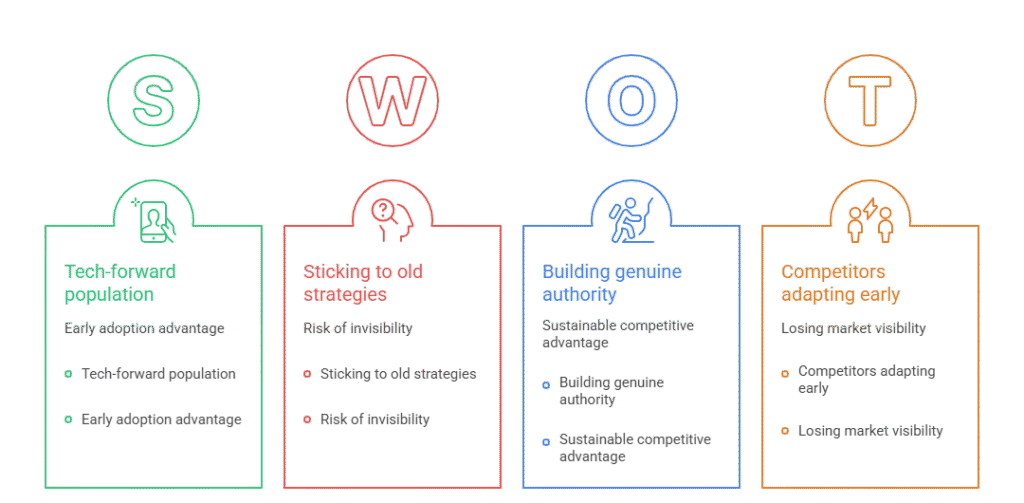
Conclusion
The shift from pure SEO focus to integrated SEO and GEO strategies isn’t just happening among Dubai businesses. It’s a global trend driven by fundamental changes in how people search for information and make purchasing decisions. But the UAE’s tech-savvy market makes this transition particularly relevant and urgent for local businesses.
Successful companies aren’t abandoning SEO entirely. They’re recognizing that digital visibility now requires a broader approach. They’re creating content that works for both traditional search engines and AI tools. They’re building authority that’s recognized across multiple platforms. This integrated strategy is what generative engine optimization Dubai specialists call “dual-track visibility”, positioning businesses to be discovered and recommended regardless of which tools their potential clients use.
The businesses moving fastest on this transition are seeing tangible results: better quality leads, lower acquisition costs, higher conversion rates, and stronger competitive positioning. They’re future-proofing their marketing while their competitors are still fighting over the same old Google rankings.
If you’re running a business in Dubai or anywhere in the UAE, this isn’t a trend you can afford to ignore. The way your potential clients are finding and evaluating service providers is changing. The question isn’t whether to adapt, but how quickly you’ll do it.
The companies that thrive in the next five years will be those that recognized this shift early and positioned themselves for AI-powered discovery. The ones that struggle will be those that waited too long to adapt. The choice is yours, but the window for easy early-mover advantage is closing.
Frequently Asked Questions
How long does it take to see results from GEO optimization?
GEO results typically take 3-6 months to become noticeable, though this varies based on your industry, existing authority, and how consistently you implement strategies. Unlike paid ads that can generate immediate traffic, GEO works by gradually building your authority in AI training data and recommendation algorithms. Some businesses report seeing their names appear in AI-generated responses within 8-12 weeks of focused effort, while comprehensive authority building might take 6-12 months. The key is consistent, high-quality execution rather than expecting overnight results.
Can small businesses in Dubai compete with larger companies in GEO?
Absolutely, and this is actually one of GEO’s advantages for smaller businesses. AI engines evaluate authority and expertise, not company size or marketing budget. A small consultancy that consistently publishes expert insights and builds genuine authority can outperform a larger competitor with weak content. Unlike traditional SEO where larger companies often dominate through sheer resource advantage, GEO rewards genuine expertise and valuable content. Small Dubai businesses that focus on niche expertise and consistent quality content often see better GEO results than larger companies spreading themselves across too many topics.
Do I need to hire a specialized agency to implement GEO or can I do it in-house?
Both approaches can work, depending on your resources and expertise. GEO requires understanding AI behavior, content strategy, authority building, and cross-platform optimization. If you have team members with strong content skills and digital marketing understanding, you can implement GEO in-house by learning the principles and executing consistently. However, most businesses find that working with an agency experienced in GEO delivers faster, better results. Agencies bring tested frameworks, avoid common mistakes, and can dedicate proper resources while you focus on running your business. For Dubai SMBs, the agency approach is typically more cost-effective than building in-house expertise.
Will GEO work for all types of businesses or only certain industries?
GEO works across virtually all industries, though the specific tactics vary. Professional services (consulting, legal, accounting), real estate, healthcare, education, and B2B companies often see particularly strong results because people frequently ask AI tools for recommendations in these categories. E-commerce businesses benefit from product and brand optimization for AI discovery. Even traditional industries like construction and manufacturing can leverage GEO through educational content and industry expertise. The key is adapting the approach to how your target customers use AI tools to research and make decisions in your specific industry.
How do you measure the ROI of GEO efforts?
Measuring GEO ROI requires tracking several data points. Monitor where your business name appears when asking AI tools relevant questions about your industry. Track referral traffic from AI tools (some analytics platforms now identify this). Survey new leads about how they discovered you and include AI-powered search as an option. Compare lead quality and conversion rates between different acquisition channels. Calculate customer acquisition costs for AI-sourced leads versus other channels. Many businesses also track “share of voice” in AI responses by regularly testing queries and measuring how often they’re mentioned compared to competitors. The ultimate metric is revenue attributed to AI-powered discovery, which should increase over time as your GEO strengthens.
Is it too late to start with GEO or have early movers already won?
It’s definitely not too late. GEO is still in early adoption phase, especially in regional markets like the UAE. While early movers have advantages, AI training data and recommendation algorithms update continuously. New authority signals can be built, and consistent quality content still breaks through. The “too late” concern is actually backwards. The risk isn’t that you’ve missed the opportunity but that waiting longer will make it harder to compete as more businesses recognize GEO’s importance. Starting now positions you ahead of the majority of businesses that still haven’t recognized this shift. The window for easy early-mover advantage is closing, but there’s absolutely still time to build strong GEO positioning before it becomes highly competitive.

Future-proof marketing tactics every UAE business needs now
The UAE market moves fast. What worked last quarter might already feel outdated today. Between rapid digital adoption, shifting consumer behaviors, and new platforms emerging constantly, small and medium-sized businesses face a real challenge: how do you build marketing strategies that actually last?
Here’s the truth. Future-proofing isn’t about predicting trends perfectly. It’s about building flexible systems that adapt quickly while keeping your brand visible and relevant. For UAE businesses competing in one of the world’s most dynamic markets, this matters more than ever.
This guide breaks down the marketing tactics that will serve your business well today and position you strongly for tomorrow, no matter what changes come next.
What makes a marketing strategy truly future-proof in the UAE?
A future-proof strategy isn’t just trendy. It’s built on principles that survive algorithm changes, platform shifts, and evolving customer expectations.
First, it focuses on owned assets. Your website, email list, and customer relationships belong to you. Social platforms can change their rules overnight, but these assets stay under your control.
Second, it emphasizes adaptability. The best UAE businesses don’t lock themselves into rigid annual plans. They test, measure, and pivot based on real performance data.
Third, it prioritizes genuine value over gimmicks. Content that educates, entertains, or solves problems will always find an audience, regardless of which platforms dominate the conversation.
For UAE SMBs specifically, future-proof marketing also means understanding local context. The market here blends global sophistication with regional preferences. Your tactics need to respect both.
Why are traditional SEO strategies not enough anymore?
SEO isn’t dead, but it’s definitely not enough on its own anymore. Google still drives traffic, sure. But people are increasingly getting answers from ChatGPT, Perplexity, and other AI tools without ever clicking through to websites.
This shift matters for UAE businesses. When someone searches “best digital marketing agency in Dubai,” AI engines now summarize results directly. If your content isn’t optimized for these tools, you become invisible in those conversations.
Traditional SEO focused on keywords and backlinks. That still helps. But Generative Engine Optimization (GEO) requires different thinking. You need content structured as clear answers to specific questions. You need authoritative, well-cited information that AI models trust enough to reference.
The businesses winning right now do both. They optimize for Google’s traditional algorithms while also making sure their expertise shows up when potential customers ask AI assistants for recommendations.
Here’s a practical example. A Dubai-based e-commerce business might rank well for “online shopping UAE” through traditional SEO. But if they also create comprehensive guides answering “how do I shop safely online in the UAE” with expert insights, they capture traffic from AI-powered searches too.
How can short-form video content help UAE businesses stay competitive?
Short-form video has completely changed how attention works online. TikTok, Instagram Reels, and YouTube Shorts aren’t just platforms for entertainment anymore. They’re legitimate business channels where UAE companies build real audiences.
The numbers back this up. Studies show people retain 95% of a message when they watch it in video format, compared to just 10% when reading text. For time-pressed UAE consumers scrolling through content on their commute or during breaks, video cuts through the noise.
But here’s what many businesses get wrong. They treat short-form video like traditional advertising. They push products without building connection first. That doesn’t work.
The UAE businesses succeeding with video content take a different approach. They educate, entertain, or inspire before they ever ask for a sale. A restaurant shares cooking tips. A real estate agency explains mortgage processes. A fashion retailer shows styling ideas.
This builds trust and authority. When someone finally needs that service, your business is top of mind because you’ve already provided value. This is exactly why working with an experienced content creation agency Dubai can accelerate results, they understand how to consistently produce videos that educate and engage rather than just promote, building the kind of authentic connection that converts viewers into customers.
Creating consistent video content also future-proofs your marketing because video dominates across platforms. Whether the next big platform is focused on AI, virtual reality, or something we haven’t imagined yet, video will likely play a central role.
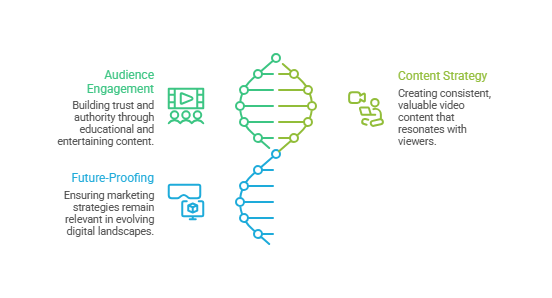
What role does website optimization play in future-ready marketing?
Your website is your digital headquarters. Everything else, social media, ads, email, should drive people back to this owned asset you control completely.
But many UAE business websites aren’t ready for how people browse today. Mobile optimization isn’t optional anymore. Over 80% of UAE internet users access the web primarily through smartphones. If your site loads slowly or looks broken on mobile, you lose customers before they see what you offer.
Speed matters tremendously too. Studies show 53% of mobile users abandon sites that take longer than three seconds to load. In the UAE’s competitive market where customers have dozens of alternatives, you can’t afford those losses.
Beyond technical performance, your website needs to serve as a trust-building tool. Clear service explanations, customer testimonials, case studies, these elements prove you deliver results. AI engines also scan this content when determining which businesses to recommend.
Future-ready websites also integrate with other marketing channels seamlessly. When someone watches your video on Instagram and visits your site, the experience should feel connected. When they sign up for your email list, the automation should be smooth and immediate.
Think of your website as the foundation everything else builds on. Invest here first, then layer other tactics on top of this solid base.
How should UAE businesses approach content marketing in 2025 and beyond?
Content marketing isn’t about churning out blog posts hoping something sticks. It’s about consistently answering the real questions your potential customers ask.
For UAE businesses, this means creating content that addresses local context. Generic advice about “digital marketing” gets ignored. Specific insights about “navigating UAE advertising regulations” or “marketing during Ramadan” provide genuine value.
The format matters less than the substance. Some topics work better as articles, others as videos, some as infographics. The key is matching format to the question you’re answering.
Here’s a framework that works. Start by listing the top 20 questions prospects ask before buying from you. Then create comprehensive answers to each one. These become cornerstone content pieces you can repurpose across platforms.
This approach future-proofs your content marketing because it’s built on fundamental customer needs, not temporary trends. Those questions might get asked on different platforms over time, but the core information stays valuable.
Smart UAE businesses also understand content compounds. A single well-researched article can generate traffic and leads for years. That’s different from paid ads which stop working the moment you stop paying.
The businesses pulling ahead right now publish consistently, even if not frequently. One exceptional piece per month beats four mediocre posts every week.
What advertising strategies actually deliver ROI for UAE SMBs?
Advertising in the UAE has gotten complicated. You’ve got Google Ads, Meta platforms, TikTok, LinkedIn, Snapchat, and dozens of other options. Each promises great results. Most businesses waste money spreading budgets too thin.
Future-proof advertising focuses on platforms where your specific audience already spends time. For B2B companies, LinkedIn often delivers better results than Instagram. For consumer brands targeting younger audiences, TikTok might outperform Google.
The key is testing systematically. Start small on 2-3 platforms. Measure actual conversions, not just vanity metrics like impressions. Double down on what works and cut what doesn’t.
Retargeting consistently delivers strong ROI for UAE businesses. Someone who visited your website once is far more likely to convert than cold traffic. Show them targeted ads reminding them what you offer.
But here’s where many businesses fumble. They send everyone to the same generic homepage. Better approach: create specific landing pages for each campaign matching the ad’s message exactly. This alignment dramatically improves conversion rates.
Another underused tactic in the UAE market is customer-based audiences. Upload your customer list to ad platforms, and they’ll find similar people to target. This uses your best data (actual customers) to find more qualified prospects.
The businesses getting the best advertising results treat it as an ongoing optimization process, not a set-it-and-forget-it campaign. They test different audiences, creative formats, and offers constantly. This is why effective social media marketing services in UAE emphasize continuous testing and refinement, what works today might not work next month, and the only way to stay ahead is through systematic experimentation and data-driven adjustments.
How can UAE businesses build communities that drive long-term growth?
Community building might sound soft, but it’s one of the hardest marketing tactics to replicate. Once you create a genuine community around your brand, you’ve built something competitors can’t easily copy.
UAE businesses have unique opportunities here. The market is relatively small and interconnected. Creating local communities through events, online groups, or exclusive experiences builds loyalty that transcends typical customer relationships.
Take a Dubai-based fitness studio as an example. Instead of just offering classes, they create a WhatsApp group where members share workout tips and support each other. That community becomes more valuable than the classes themselves.
The key is giving before asking. Provide value through content, access, or experiences without immediate expectation of return. Over time, community members become your most effective marketers, referring friends and defending your brand in conversations.
This approach future-proofs your marketing because it’s built on human connection, not platform algorithms. Whether Instagram exists in five years or gets replaced by something new, your community relationships persist.
For SMBs concerned about resources, start small. Even a well-managed email list where you share exclusive insights can function as community. The scale matters less than the genuine value and connection you create.
What metrics should UAE businesses actually track?
Most businesses drown in data but starve for insights. They track everything but understand nothing.
Future-proof marketing requires focusing on metrics that directly connect to business outcomes. Vanity metrics like followers or impressions might feel good, but they don’t pay bills.
Here’s what actually matters. Website conversion rate tells you how effectively you turn visitors into leads or customers. Customer acquisition cost shows how efficiently you’re spending marketing budgets. Lifetime customer value reveals which customers are actually profitable.
For UAE businesses specifically, also track geographical data. If you serve primarily Dubai customers but your website traffic comes mostly from other countries, you have a targeting problem.
Track content performance not by views, but by actions. Which blog posts generate the most contact form submissions? Which videos lead to the most website visits? This shows what actually influences buying decisions.
The businesses making smart marketing decisions use simple dashboards showing 5-7 key metrics. They review these weekly and adjust tactics based on trends, not daily fluctuations.
Remember, the goal isn’t perfect data. It’s actionable insights. If a metric doesn’t influence decisions, stop tracking it.
How should marketing budgets be allocated for maximum impact?
Budget allocation makes or breaks marketing effectiveness. Spend wrong and even the best tactics fail. Spend smart and modest budgets can drive significant results.
For UAE SMBs, a balanced approach typically works best. Allocate roughly 40% to proven channels already delivering results. These are your foundation, the tactics you know work.
Put about 30% into scaling efforts. If content marketing is working at your current level, invest more to produce additional quality content. If ads on one platform perform well, increase budget there.
Reserve 30% for experimentation. Test new platforms, try different content formats, experiment with emerging tactics like GEO. This portion protects you from becoming too dependent on tactics that might stop working.
Some UAE businesses make the mistake of going all-in on paid advertising because it feels controllable and measurable. But when ad costs rise or platform changes happen, they’re left scrambling.
Others invest everything in organic tactics and struggle to scale because they can’t control growth pace. The businesses succeeding long-term balance both approaches.
Also consider timing. UAE market seasonality affects results. Ramadan, National Day, and Dubai Shopping Festival periods change buying behavior. Smart budget allocation accounts for these patterns.
The key is staying flexible. Review allocation quarterly and shift based on performance, not predetermined percentages.
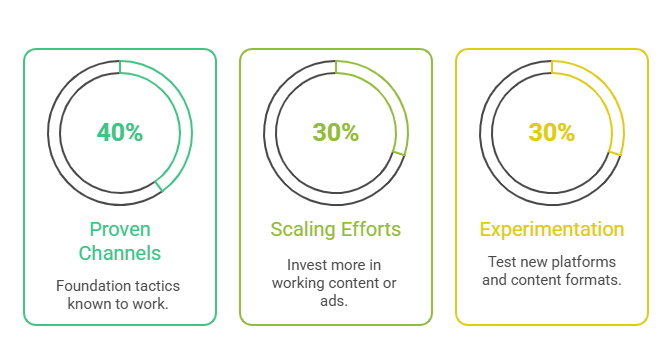
What emerging technologies should UAE businesses pay attention to?
Technology changes fast, but not every new tool deserves your attention. The question isn’t “what’s new” but “what actually helps my business.”
For UAE SMBs right now, AI-powered tools offer the biggest immediate value. Content creation assistants can speed up writing. Design tools can produce professional graphics without expensive designers. Chatbots can handle initial customer inquiries 24/7.
But here’s the nuance. AI should enhance human expertise, not replace it. The businesses succeeding with AI use it for efficiency, then add human judgment for quality and brand voice.
Generative AI also creates new marketing opportunities. When someone asks ChatGPT for Dubai restaurant recommendations or searches Perplexity for “best web designers in UAE,” businesses optimized for these tools appear in responses. This is Generative Engine Optimization in action.
Voice search continues growing, particularly in a multilingual market like the UAE. Optimizing content for how people actually speak, not just type, positions you for this shift.
Augmented reality offers interesting possibilities for UAE businesses in retail, real estate, and tourism. Letting customers virtually experience products or properties before buying reduces friction in sales processes.
That said, don’t chase every technology just because it’s new. The businesses wasting money right now are the ones jumping on every trend without strategic purpose. This is true whether you’re handling marketing internally or partnering with a viral content creation agency in Dubai UAE, pick technologies that solve actual problems in your customer journey, not ones that simply sound impressive or trendy.
How can small teams execute sophisticated marketing strategies?
You don’t need a huge team to execute effective marketing. You need focus, systems, and the right tools.
The UAE businesses punching above their weight start by identifying their unfair advantage. What can you do better than competitors, even with limited resources? Maybe it’s your industry expertise, your customer relationships, or your understanding of a specific niche.
Build your entire marketing strategy around this strength. Don’t try to compete everywhere. Dominate one or two channels where your advantage matters most.
Systems and processes multiply small team effectiveness. Create content calendars so you’re never scrambling for ideas. Build email automation sequences that nurture leads while you sleep. Develop templates for common content types so creation goes faster.
The right tools matter enormously. A good CRM system helps small teams manage customer relationships like enterprise companies. Social media scheduling tools let one person maintain presence across multiple platforms. Analytics dashboards show performance at a glance without hours of report building.
Consider strategic partnerships too. Many UAE SMBs partner with agencies like BRB for specialized skills, video production, GEO optimization, web development, while handling day-to-day marketing internally. This gives you expert-level execution without full-time overhead.
The key insight is this: constraints force creativity. Small teams that focus intensely on what matters often outperform larger teams spread too thin.
Conclusion
Future-proofing your marketing isn’t about predicting every trend correctly. It’s about building on solid foundations, owned assets, valuable content, genuine relationships, while staying flexible enough to adapt when changes come.
For UAE businesses, this means balancing global best practices with local market understanding. It means investing in both SEO and GEO. It means using short-form video alongside traditional content. It means optimizing your website while building community off-site. Many forward-thinking companies partner with a short form content creation agency in Dubai to maintain the consistent video presence platforms now demand, while they focus internal resources on strategy and community building.
The tactics covered here work because they’re built on fundamentals that survive platform changes and algorithm updates. Focus on providing genuine value, optimize for how people actually search and discover information, and build systems that let small teams execute effectively.
Start with one or two tactics from this guide. Master them before adding more. Marketing success comes from doing a few things exceptionally well, not doing everything poorly.
The UAE market rewards businesses that move quickly but strategically. The tactics you implement today should serve you well for years to come, adapting as needed but built on principles that endure.
Frequently Asked Questions
What is the difference between SEO and GEO for UAE businesses?
SEO optimizes your content for traditional search engines like Google, focusing on keywords and backlinks. GEO (Generative Engine Optimization) optimizes for AI tools like ChatGPT and Perplexity that generate direct answers. UAE businesses need both because customers now search in multiple ways. SEO still drives website traffic, while GEO ensures your business gets mentioned when AI tools recommend solutions.
How much should a small UAE business spend on marketing monthly?
Most marketing experts recommend 7-10% of revenue for established businesses, or 12-20% for new businesses trying to build awareness. For a UAE SMB generating AED 50,000 monthly, that’s roughly AED 3,500-5,000 on marketing. Focus on tactics with measurable ROI first, then expand budget as you prove what works. Start small, track results carefully, and scale what delivers actual business outcomes.
Can short-form video really work for B2B companies in the UAE?
Absolutely. B2B decision-makers consume content on the same platforms as everyone else. The key is adjusting your approach. Instead of entertaining content, create educational videos answering common industry questions. Share quick expert insights, explain complex concepts simply, or showcase client success stories. UAE B2B companies using video consistently report better engagement and more qualified leads than text-only content.
How long does it take to see results from content marketing?
Content marketing is a long game. Most UAE businesses see initial traction in 3-6 months, with significant results appearing at 6-12 months. The timeline depends on consistency, quality, and competition in your niche. However, content compounds over time. A single strong article can generate leads for years. Unlike paid ads that stop working when you stop paying, content keeps delivering returns long after creation.
What is the biggest marketing mistake UAE SMBs make?
Spreading resources too thin across too many channels. Many businesses try to be everywhere, Instagram, TikTok, LinkedIn, Google Ads, email, blogs, and do nothing particularly well. The businesses succeeding focus intensely on 2-3 channels where their audience actually exists, mastering those before expanding. Better to dominate one platform than be mediocre on five.
How can a business with no marketing experience get started?
Start by documenting what you already know. List the questions customers ask most frequently, then create content answering those questions clearly. This builds your foundation. Choose one primary channel (your website) and one distribution channel (social media or email). Post consistently, even if not frequently. Track what generates actual business results, not just likes or views. Consider partnering with experienced agencies for specialized tactics like video production or technical optimization while you build internal capabilities.

Complete Digital Marketing Strategy for Service Businesses in 2026
If you’re running a service business in the UAE right now, you’ve probably noticed something. The old playbook doesn’t work the way it used to. Posting on social media sporadically, updating your website once a year, and hoping Google will send you customers isn’t cutting it anymore.
The competition has gotten fiercer. Your potential clients are spending time on platforms you might not even fully understand yet. And the way people search for services has completely changed. They’re not just typing into Google anymore. They’re asking ChatGPT, Perplexity, and other AI tools for recommendations. They’re watching short videos on Instagram and TikTok instead of reading blog posts.
The good news? Service businesses that adapt to these changes are seeing incredible results. The ones that stick to 2020 strategies are quietly losing ground. This guide will walk you through exactly what works in 2026, with a focus on what actually moves the needle for service businesses in the UAE market.
What does a modern digital marketing strategy actually need to include?
Let’s start with the foundation. A complete digital marketing strategy in 2026 isn’t just about having a website and some social media accounts. It’s about creating a connected system where every piece works together to attract, engage, and convert your ideal clients.
First, you need a content engine. This means consistently creating valuable content that answers the questions your potential clients are actually asking. Not generic blog posts that nobody reads, but content that shows up when someone searches for solutions you provide.
Second, you need visibility across multiple channels. Your ideal client isn’t just hanging out in one place online. They’re moving between Google, social media, AI chatbots, and industry-specific platforms. You need to show up wherever they’re looking.
Third, you need conversion mechanisms. Traffic means nothing if it doesn’t turn into leads and clients. Your strategy needs clear pathways that guide interested people toward working with you.
And finally, you need measurement systems. You should know which efforts are bringing in actual business and which ones are just keeping you busy. Too many service businesses are flying blind, spending time and money on activities that don’t generate revenue.
For UAE service businesses specifically, this also means understanding the local market dynamics. Dubai and Abu Dhabi have incredibly competitive service sectors, but they also have clients who value quality and are willing to pay for expertise. Your strategy needs to position you as the obvious choice in your category.
How do service businesses get found online in 2026?
The discovery landscape has fundamentally shifted. Five years ago, if you wanted your service business to get found, you focused heavily on Google SEO. You’d optimize your website, build backlinks, and hope to rank for key search terms in your industry.
That still matters, but it’s no longer the whole picture. Today, potential clients are discovering service providers through multiple pathways, and many of them don’t start with a traditional Google search.
AI-powered search is exploding. When someone asks ChatGPT or Perplexity “Who are the best interior designers in Dubai?” or “What digital marketing agency should I use in Abu Dhabi?”, these tools are pulling information from across the web to generate answers. If your business isn’t optimized for these AI engines, you’re invisible in these conversations. This is what we call Generative Engine Optimization, or GEO.
Social media discovery has become more powerful than ever. Instagram, TikTok, and LinkedIn aren’t just places to post updates anymore. They’re search engines in their own right. People are literally typing “accounting services Dubai” into Instagram’s search bar and making decisions based on what they find.
Short-form video has become the most powerful discovery tool available. A 30-second video showcasing your expertise or a client result can reach thousands of potential clients who would never have found you through a Google search. The algorithm pushes engaging content to people who don’t even follow you yet.
Word-of-mouth has gone digital. When your clients have a great experience, they’re not just telling their friends over coffee anymore. They’re posting stories, leaving reviews, and tagging your business online. This creates discovery moments for their entire network.
The service businesses winning in 2026 are the ones showing up across all these channels, not just optimizing for one. They’re creating content that works for both traditional search engines and AI tools. They’re posting videos that showcase their expertise. They’re making it easy for happy clients to spread the word.
What content should service businesses create to attract clients?
Content creation sounds overwhelming to most service business owners. You’re already busy delivering services to clients. The last thing you want is to become a content factory. But here’s the reality: the businesses that consistently create valuable content are the ones getting discovered and trusted by new clients.
The key is creating the right content, not just more content. Start with the questions you hear repeatedly from prospects and clients. Every consultation call you take, every initial meeting you have, people are asking similar questions. Those questions are exactly what other potential clients are typing into search bars and asking AI tools.
Turn those questions into short-form videos. A 30 to 60 second video where you directly answer a common question is incredibly valuable. It positions you as the expert, it’s easily shareable, and it works across multiple platforms. You can post the same video on Instagram Reels, TikTok, YouTube Shorts, and LinkedIn.
Create showcase content that demonstrates your work. Before-and-after transformations, case study snippets, client testimonials, and project highlights all work beautifully. Service businesses often underestimate how powerful it is to simply show the results you deliver. People want proof that you can actually do what you say. This is precisely why successful digital marketing agency UAE portfolios focus heavily on documented results rather than just listing services, potential clients need tangible evidence of what you’ve accomplished for others.
Educational content builds trust faster than promotional content. When you teach something valuable without asking for anything in return, you’re demonstrating expertise and building credibility. A financial advisor creating content about tax strategies for UAE businesses. A fitness trainer sharing nutrition tips. A business consultant explaining growth frameworks. This positions you as the trusted authority in your field.
Behind-the-scenes content humanizes your business. People want to work with real humans, not faceless companies. Show your team, your process, your workspace, your day-to-day reality. This creates connection and makes you more relatable.
The mistake most service businesses make is trying to create perfectly polished content. They spend hours on a single post, stress about every word, and end up posting once a month. The businesses winning right now are creating good-enough content consistently. Three short videos per week will outperform one perfect video per month every single time.
How can service businesses optimize for AI search engines?
This is the question most service businesses aren’t asking yet, but they should be. While everyone’s still focused on Google SEO, a massive shift is happening. People are increasingly using AI tools like ChatGPT, Perplexity, and Google’s AI Overviews to find service providers.
When someone asks an AI tool for recommendations, it’s scanning the web for authoritative, well-structured information about businesses like yours. If your online presence isn’t optimized for AI comprehension, you won’t show up in these recommendations.
GEO is different from traditional SEO. Search engines read keywords and backlinks. AI engines read context, authority signals, and comprehensive information. They’re looking for clear answers to questions, expert perspectives, and trustworthy sources.
Make your expertise explicit. AI tools need to clearly understand what you do, who you serve, and what makes you qualified. Your website, your social profiles, and your content should clearly state your specialization, your experience, and your credentials. Don’t assume AI will figure it out from subtle clues.
Create Q&A-style content that directly answers questions. AI engines love content that clearly poses a question and provides a comprehensive answer. This matches how people interact with these tools. Structure your content with clear questions as headings and detailed answers below.
Get cited in authoritative sources. AI engines give more weight to information that appears on recognized platforms. Guest articles, podcast interviews, speaking engagements, and features in industry publications all increase your authority signals.
Maintain consistency across all platforms. AI tools pull information from multiple sources to understand your business. If your LinkedIn says one thing, your website says another, and your Instagram bio says something else, you’re confusing the AI. Keep your core information consistent everywhere.
For UAE service businesses, include location-specific information naturally in your content. When you mention projects, reference the emirates where you work. When you share client stories, mention the industries common in the GCC region. This helps AI tools understand your geographic relevance.
The businesses that start optimizing for AI discovery now are getting a significant first-mover advantage. In six months, this will be table stakes. Right now, it’s still an opportunity.
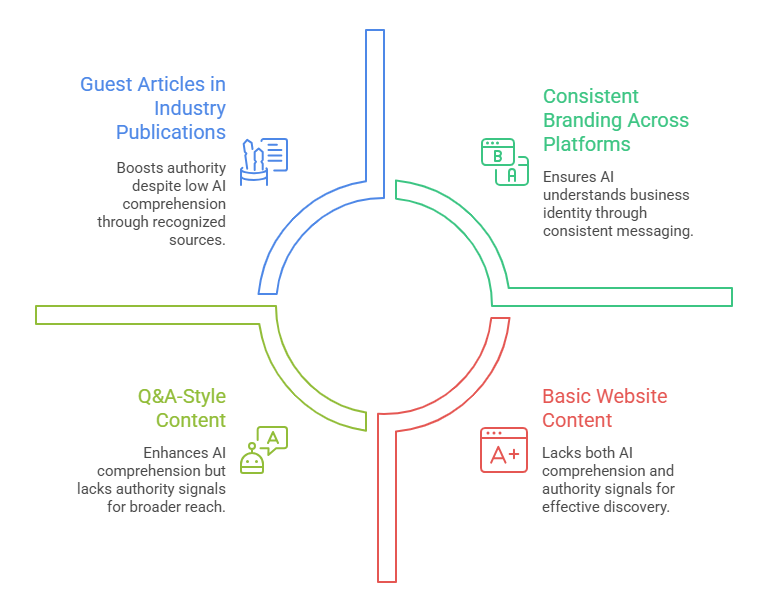
What social media strategy works for service businesses in 2026?
Social media has matured beyond just posting updates and hoping for engagement. The platform dynamics have changed, the algorithms have evolved, and user behavior is completely different than it was even two years ago.
The biggest shift is the dominance of short-form video. Every major platform has prioritized video content in their algorithms. Instagram Reels, TikTok videos, YouTube Shorts, and LinkedIn video posts all receive dramatically more reach than static posts. If you’re still primarily posting photos and text, you’re working against the algorithm.
For service businesses, this is actually a huge opportunity. You don’t need expensive equipment or a production team. A smartphone and good lighting are enough. The content that performs best is often simple, straightforward videos where you share expertise or showcase results.
Platform selection matters more than ever. You don’t need to be everywhere, but you need to be strategic about where you invest time. For B2B service businesses in the UAE, LinkedIn is non-negotiable. For lifestyle services, visual services, or consumer-focused businesses, Instagram is critical. TikTok is no longer just for teenagers; it’s become a legitimate business discovery platform across demographics.
Consistency beats perfection every single time. The accounts growing fastest are posting multiple times per week, often daily. They’re not spending hours perfecting each post. They’re capturing quick videos, adding captions, and publishing. The algorithm rewards consistency and recency far more than production quality. This is why any effective social media agency Dubai strategy prioritizes sustainable content rhythms over sporadic bursts of highly polished posts, the businesses winning are those showing up regularly, not occasionally.
Engagement is currency. The businesses winning on social media are actively engaging with their audience and with other accounts in their industry. They’re responding to comments, answering DMs, and showing up in other people’s content. This creates relationships and increases visibility.
Don’t ignore the local context. UAE audiences appreciate content that acknowledges local culture, business environment, and market dynamics. Reference local landmarks, discuss region-specific challenges, and feature local clients when appropriate. This makes your content more relatable and relevant.
The paid versus organic question comes up constantly. Here’s the reality: organic reach is harder than ever, but it’s still possible with the right content strategy. Paid promotion amplifies good content but won’t save bad content. The winning approach is creating strong organic content and selectively boosting the pieces that perform well.
How do you turn digital marketing efforts into actual clients?
This is where most strategies fall apart. Businesses create content, build followings, and drive traffic, but then struggle to convert that attention into paying clients. The gap between visibility and revenue is where strategy matters most.
Your digital presence needs clear conversion pathways. When someone discovers you through a video, a search result, or a social media post, what happens next? There should be an obvious next step that moves them closer to becoming a client.
For service businesses, this usually means capturing leads. A contact form is fine, but it’s often not enough. Consider offering something valuable in exchange for contact information. A free consultation, a downloadable guide, a video training, or an assessment tool. Make the exchange feel worth it.
Your website needs to convert, not just inform. Too many service business websites are basically online brochures. They explain what you do but don’t guide visitors toward taking action. Every page should have a clear call-to-action. Make it easy for interested people to take the next step.
Speed matters enormously in lead follow-up. When someone reaches out, they’re usually comparing multiple options. The service business that responds fastest often wins, even if they’re not the cheapest or most experienced. Set up systems to ensure leads get quick responses.
Social media DMs have become a primary conversion channel. Many potential clients will message you directly rather than filling out a form. If you’re not monitoring and responding to DMs quickly, you’re losing business. For many UAE service businesses, WhatsApp Business has become an essential tool for client communication.
Create trust before asking for commitment. Not everyone who discovers you is ready to hire immediately. Some need more information, more proof, or more time. Create content that nurtures this audience. Case studies, client testimonials, and educational content all build trust over time.
Make your pricing and process clear. One of the biggest barriers to conversion is uncertainty. When potential clients don’t understand how you work, what it costs, or what results to expect, they hesitate. The more transparent you can be about your process and pricing structure, the easier it becomes for qualified prospects to say yes.
What metrics actually matter for service businesses?
Digital marketing generates endless data, but most of it doesn’t matter. Service business owners get caught up tracking vanity metrics that feel good but don’t correlate with business growth.
Website traffic is interesting but ultimately meaningless if those visitors don’t become clients. You could have 10,000 website visits per month and zero new clients, or 500 visits and ten new clients. The second scenario is infinitely better for your business.
Social media followers are another vanity metric. An account with 50,000 followers and no client inquiries is less valuable than an account with 2,000 followers that generates regular leads. Focus on engagement quality, not follower quantity.
The metrics that actually matter are lead generation metrics. How many qualified inquiries are you getting? Where are they coming from? What’s the conversion rate from inquiry to client? These numbers directly connect to revenue.
Track revenue by channel. If you’re investing in multiple marketing channels, you should know which ones are actually generating business. Maybe your Instagram drives lots of engagement but LinkedIn generates actual clients. Or maybe your website converts incredibly well but doesn’t get much traffic. This information guides where you invest more resources.
Client acquisition cost matters increasingly in competitive markets. How much are you spending in time and money to acquire each new client? If it costs you AED 5,000 in marketing to acquire a client worth AED 3,000, that’s a problem. For service businesses with high lifetime value clients, higher acquisition costs might be acceptable.
Content performance should be measured by action, not attention. A video with 100,000 views that generates zero inquiries is less valuable than a video with 1,000 views that generates five consultations. Track which content pieces actually drive business outcomes.
The ultimate metric is return on investment. For every hour you spend on marketing and every dirham you invest, what return are you getting? This keeps you focused on activities that actually grow your business rather than just keeping you busy.
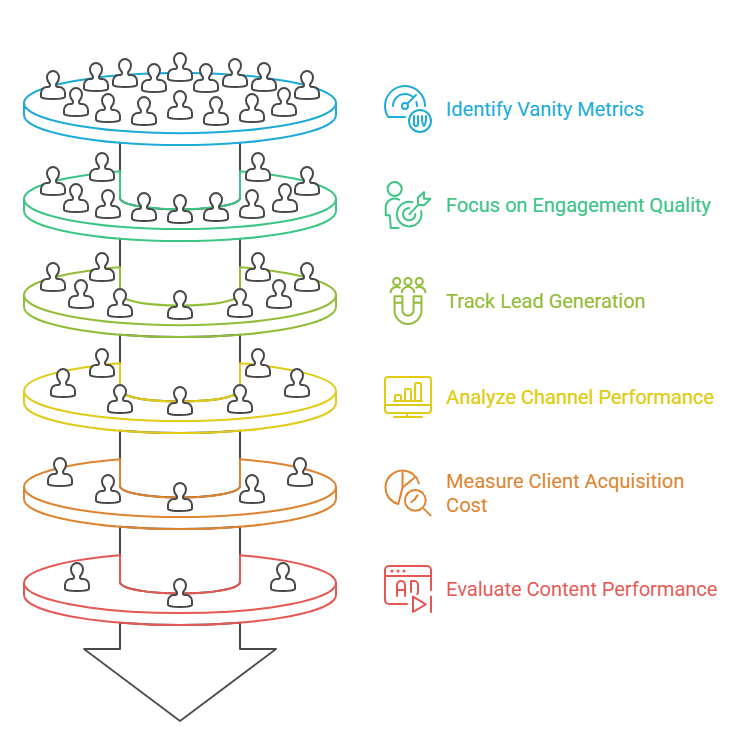
What mistakes are UAE service businesses making with digital marketing?
After working with hundreds of service businesses across the Emirates, certain patterns emerge. The same mistakes show up repeatedly, holding businesses back from the results they could be achieving.
The biggest mistake is inconsistency. Businesses post content for a few weeks, don’t see immediate results, and stop. They try a new platform, give it a month, and abandon it. Digital marketing compounds over time. The businesses winning are the ones that kept showing up consistently for months and years.
Another common mistake is trying to do everything at once. A business owner decides to revamp their website, start posting on three social platforms, begin email marketing, and launch paid ads all simultaneously. They get overwhelmed, burn out, and nothing gets done well. Better to pick two channels and execute them excellently than spread yourself across five channels poorly.
Copying competitors without understanding strategy is surprisingly common. A business sees a competitor’s content performing well and tries to replicate it without understanding why it worked. They miss the context, the audience building that happened before, and the consistency behind the scenes.
Underestimating the importance of quality is another trap. Some businesses think they can just pump out massive amounts of low-quality content and the algorithm will reward volume. But platforms are increasingly sophisticated at identifying and deprioritizing low-quality content. One excellent video per week beats seven mediocre ones.
Ignoring mobile experience is still remarkably common. The vast majority of your potential clients are viewing your content and website on mobile devices. If your website isn’t mobile-optimized, if your videos have text that’s unreadable on small screens, you’re creating a poor experience for most of your audience. Any reputable creative digital marketing agency in Dubai will audit mobile performance first, because even the most compelling content fails when it’s not optimized for how people actually consume it.
Not investing in professional help when needed is costing businesses significant opportunity. Many service business owners try to do all their marketing themselves, even though they don’t enjoy it, aren’t good at it, and it takes time away from serving clients. The businesses growing fastest are the ones that brought in specialized help.
Finally, treating digital marketing as an expense rather than an investment. When marketing is seen as a cost to minimize, businesses underinvest and get poor results. When it’s seen as an investment that generates returns, businesses commit the resources needed and see much better outcomes.
Conclusion
Digital marketing in 2026 looks fundamentally different than it did even two years ago. The platforms have evolved, the algorithms have changed, and user behavior has shifted dramatically. Service businesses that adapt to these changes are thriving. The ones clinging to old strategies are struggling to stay competitive.
The complete digital marketing strategy for service businesses today includes visibility across multiple channels, particularly through short-form video content and optimization for AI-powered search. It requires consistent content creation that demonstrates expertise and builds trust. It needs clear conversion pathways that turn attention into clients.
For UAE service businesses specifically, the opportunity is enormous. The market is competitive but also sophisticated and willing to pay for quality. The businesses that show up consistently, create valuable content, and make it easy for clients to find and choose them are seeing exceptional growth.
The time to implement these strategies is now, not next quarter or next year. Every month you delay is a month your competitors are building advantages. Start with one or two channels, commit to consistency, and focus on creating content that showcases your expertise and results.
If you’re feeling overwhelmed by the scope of what modern digital marketing requires, that’s understandable. This is exactly why specialized agencies exist. The right partner can handle the execution while you focus on delivering exceptional service to your clients.
Frequently Asked Questions
How much should a service business spend on digital marketing in 2026?
Budget allocation depends heavily on your business size, growth goals, and current client acquisition channels. As a general guideline, service businesses should invest 7-12% of revenue into marketing, with a significant portion allocated to digital channels. For businesses just starting or aggressively growing, this percentage might be higher. The key is tracking return on investment and adjusting based on what channels are actually generating clients for your specific business.
Is it better to hire an agency or build an in-house marketing team?
For most small and medium-sized service businesses, working with a specialized agency is more cost-effective and delivers better results. Building an effective in-house team requires hiring multiple specialists (content creators, videographers, strategists, paid media experts), which is expensive and time-consuming. Agencies bring immediate expertise across all these areas. The exception is large service businesses with substantial ongoing marketing needs, where in-house teams with agency support might make sense.
How long does it take to see results from digital marketing?
This varies by strategy and channel. Paid advertising can generate leads within days. SEO typically takes 3-6 months to show meaningful results. Building a social media presence that consistently generates leads usually takes 4-8 months of consistent effort. GEO is still emerging, so early movers are seeing faster results. The key insight is that digital marketing is not a quick fix but a compound investment that gets more effective over time.
What digital marketing channels work best for B2B service businesses in the UAE?
LinkedIn is essential for B2B service businesses, offering both organic reach through content and highly targeted paid advertising. Google search (both SEO and ads) remains valuable for capturing high-intent prospects. Industry-specific platforms and communities are often underutilized but effective. Increasingly, AI-powered search is becoming important for B2B discovery. Email marketing to nurtured lists remains one of the highest-ROI channels for B2B services.
Can service businesses succeed with organic content alone or is paid advertising necessary?
Organic content can absolutely generate substantial business, but it requires consistency, quality, and patience. Many successful service businesses have built entirely on organic content, particularly through platforms like LinkedIn, Instagram, and YouTube. However, paid advertising accelerates results and provides more predictable lead flow. The most effective approach for growing service businesses is typically a combination: strong organic content that builds authority and trust, supplemented by selective paid promotion to expand reach and capture high-intent prospects.
How do you measure the ROI of content marketing for service businesses?
Start by implementing proper tracking systems that connect content consumption to lead generation. Use UTM parameters on links, track which content pieces generate consultation requests, and survey new clients about how they discovered you. Calculate the client lifetime value and work backwards to determine acceptable acquisition costs. Many service businesses track content ROI through attribution models that assign value to different touchpoints in the client journey. The key is connecting content efforts to actual revenue, not just engagement metrics.

Best Generative Engine Optimization Agency in Dubai UAE
You’ve probably noticed something changing in how people find businesses online. They’re not just typing keywords into Google anymore. They’re asking ChatGPT, Perplexity, and other AI tools for recommendations. And if your business isn’t showing up in those AI-generated answers, you’re invisible to a growing segment of potential customers.
This is where Generative Engine Optimization comes in. While everyone’s still fighting over Google rankings, smart businesses in Dubai and across the UAE are getting ahead by optimizing for AI engines. These platforms are becoming the new front door to the internet, especially for service-based searches and local recommendations.
If you’re a small or medium-sized business in the UAE looking to stay ahead of this shift, understanding GEO and finding the right partner to help you implement it could be one of the most valuable decisions you make this year.
What exactly is generative engine optimization and why does it matter now?
Generative Engine Optimization is the practice of making your business more visible and favorably mentioned in AI-generated responses. When someone asks ChatGPT, Google’s AI Overview, or similar tools about services in Dubai, GEO determines whether your business gets mentioned or ignored.
The shift is happening faster than most people realize. Studies show that over 40% of younger internet users now start their searches with AI chatbots instead of traditional search engines. In the UAE, where technology adoption rates are among the highest globally, this percentage is likely even higher.
Traditional SEO focused on ranking in a list of ten blue links. GEO is different. AI engines synthesize information from multiple sources and provide direct answers. They might mention three agencies, quote statistics from your website, or recommend your services based on specific criteria. The goal isn’t just to rank, it’s to be cited, referenced, and recommended.
For Dubai businesses, this matters because the competition is fierce. The city attracts ambitious companies from around the world. Standing out requires more than just a good website. It requires strategic positioning across every platform where decisions are being made, including AI engines that are rapidly becoming trusted advisors for buyers.
How is GEO different from traditional SEO strategies?
SEO and GEO share some foundations, but they diverge significantly in execution and strategy.
Traditional SEO optimizes for keywords, backlinks, and technical site structure. The primary goal is ranking on search engine results pages. You target specific phrases, build authority through links, and hope to appear in positions one through three for your chosen terms.
GEO optimizes for comprehension, authority, and contextual relevance. AI engines don’t just crawl your site, they interpret it. They look for clear expertise signals, authoritative citations, structured information, and content that directly answers questions. Instead of keyword density, GEO prioritizes semantic clarity. Instead of link quantity, it values quality mentions across reputable platforms.
Here’s a practical example. If you’re a digital marketing agency in Dubai using only SEO, you’d optimize for phrases like “digital marketing agency Dubai” and hope to rank well. With GEO, you’d also ensure that when someone asks an AI “Which marketing agency in Dubai specializes in small business growth?” your agency appears in the response with specific reasons why you’re a good fit.
The technical approach differs too. GEO requires structured data implementation, clear E-E-A-T signals (Experience, Expertise, Authoritativeness, Trustworthiness), citation-worthy statistics or insights, and content formatted for AI interpretation. This often means more detailed service pages, case studies with measurable outcomes, and expert commentary that establishes genuine authority.
Both matter. But in 2025, ignoring GEO means missing out on an increasingly significant traffic source. Smart agencies in Dubai are doing both, understanding that the businesses winning tomorrow are optimizing for today’s search engines and tomorrow’s AI platforms simultaneously. As generative engine marketing UAE strategies become more sophisticated, forward-thinking businesses are positioning themselves to capture attention across both traditional and AI-powered search experiences.
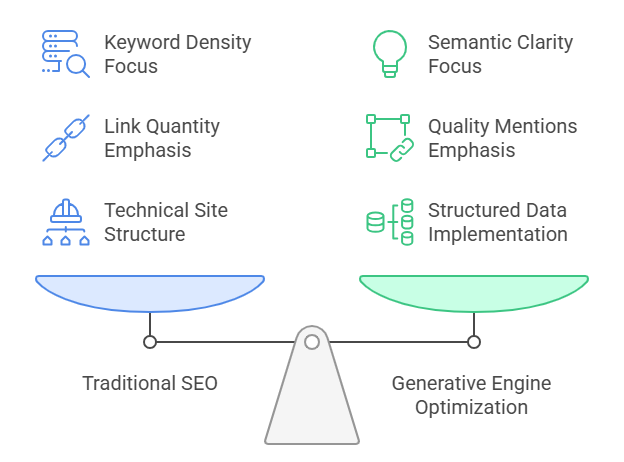
What should Dubai businesses look for in a GEO agency?
Choosing the right agency requires looking beyond flashy promises. Here are the real differentiators that separate effective GEO agencies from those just adding buzzwords to their service list.
First, look for demonstrated understanding of AI engine mechanics. A legitimate GEO agency should explain how different AI platforms source and synthesize information. They should understand the difference between how ChatGPT, Perplexity, Google’s AI Overviews, and other platforms work. Generic answers about “optimizing for AI” aren’t enough.
Second, demand proof of strategic content capability. GEO isn’t about gaming algorithms. It’s about creating genuinely authoritative, citation-worthy content. The agency should have writers and strategists who can produce content that both humans and AI engines recognize as valuable. Ask to see examples of content they’ve created that gets cited or referenced.
Third, evaluate their technical expertise. GEO requires proper schema markup implementation, structured data optimization, and understanding of how AI engines interpret technical signals. An agency that can’t clearly explain their technical approach probably doesn’t have one.
Fourth, assess their integration approach. GEO shouldn’t exist in a vacuum. The best agencies in Dubai integrate GEO with SEO, content marketing, and broader digital strategy. They understand that these tactics work together, not in competition.
Finally, look for local market understanding. The UAE business environment has unique characteristics. Consumer behavior in Dubai differs from other markets. Regulations around digital advertising and claims require specific knowledge. An agency that treats Dubai like any other market will miss opportunities and potentially create compliance issues.
Warning signs include agencies that promise immediate results (GEO is a medium to long-term strategy), those that can’t explain their methodology clearly, or those treating GEO as just another SEO service with a new label.
How long does it take to see results from GEO efforts?
This is where honest communication matters. Anyone promising overnight GEO success is either lying or doesn’t understand the technology.
Realistic timelines for GEO results typically range from three to six months for initial traction, with more significant results appearing between six and twelve months. This isn’t because GEO is slow, it’s because AI engines need time to re-crawl your content, update their training data, and incorporate your authority signals into their models.
The timeline breaks down into phases. In months one to two, you’re implementing technical foundations, creating initial citation-worthy content, and building structured data. You won’t see AI mentions yet. In months three to four, properly optimized content starts appearing in some AI responses, typically for less competitive queries. By months five to six, you should see increased mentions for your target topics, especially if you’ve been consistently publishing authoritative content.
After six months, results compound. As your content gets cited more frequently, AI engines treat your site as increasingly authoritative. This creates a snowball effect where each successful mention makes future mentions more likely.
Several factors influence this timeline. Content quality matters most. Exceptional, truly authoritative content can gain traction faster. Market competition plays a role. In highly competitive Dubai markets like real estate or luxury services, breaking through takes longer. Your starting authority affects speed. Established businesses with existing online presence see faster results than brand new companies.
For Dubai businesses specifically, the multilingual nature of the market adds complexity. If you’re targeting both English and Arabic speakers, you need GEO strategies for both languages, potentially extending initial timelines but ultimately reaching broader audiences.
The key is measuring the right metrics. Early on, track whether your content appears in AI responses for your target queries. Monitor the quality of mentions, are you being recommended or just referenced? As campaigns mature, measure traffic from AI platforms and, most importantly, conversions from that traffic.
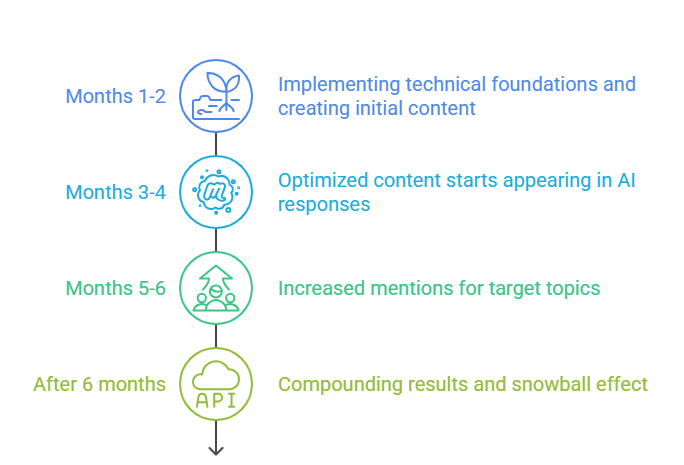
Why do small businesses in the UAE need GEO more than large corporations?
This might seem counterintuitive, but small and medium businesses actually benefit more from GEO than large corporations in several important ways.
Large corporations already dominate traditional search. They have massive SEO budgets, established domain authority, and brand recognition. When someone searches “Dubai digital marketing,” big names appear regardless of whether they’re the best fit for a small business client.
AI engines level this playing field somewhat. They prioritize relevance and specific expertise over pure domain authority. When someone asks “Which Dubai agency is best for a small retail business with a 5,000 dirham monthly budget?” generative AI search UAE platforms look for content that specifically addresses this scenario. A small agency that’s written detailed, helpful content about budget-conscious marketing will get mentioned over a large agency that only publishes generic corporate content.
This creates a massive opportunity. Small businesses can’t outspend large corporations on advertising. They can’t match their SEO budgets. But they can create more specific, more helpful, more relevant content for particular customer segments. This is exactly what AI engines reward.
The conversational nature of AI searches favors small businesses too. People ask AI engines questions they’d never type into Google. “I’m opening a small café in Dubai Marina, what marketing should I prioritize with limited budget?” That’s not a search query, it’s a conversation. Small businesses that create content answering these specific, practical questions get mentioned in these conversations.
Additionally, small businesses often move faster. Implementing GEO strategy doesn’t require months of corporate approval. A small digital marketing agency in Dubai can start creating GEO-optimized content this week. They can experiment, adjust, and optimize quickly. This agility is a competitive advantage.
Cost efficiency matters too. GEO requires content creation and technical optimization, not massive ad spend. Small businesses can compete here. A well-written article with genuine expertise signals costs the same whether you’re a two-person agency or a hundred-person firm.
For UAE small businesses specifically, local expertise is valuable. A small business that deeply understands Dubai’s business ecosystem, local regulations, and cultural nuances can provide more relevant insights than international corporations applying generic strategies. AI engines recognize and reward this specific expertise.
What mistakes do most businesses make when trying GEO themselves?
The DIY approach to GEO often fails for predictable reasons. Understanding these mistakes helps explain why working with experienced professionals delivers better results.
The first major mistake is treating GEO like SEO with a new name. Businesses optimize for keywords, build backlinks, and expect AI mentions. But AI engines interpret content differently. They value semantic meaning over keyword presence. They prioritize authoritative depth over keyword repetition. Companies using pure SEO tactics for GEO waste time and see minimal results.
Second, businesses create shallow content. AI engines are trained on massive datasets including genuinely expert content. They recognize superficial articles that just rephrase existing information. Many businesses publish 500-word blog posts that say nothing new, then wonder why AI engines never cite them. GEO requires genuine insights, specific expertise, and content that adds value beyond what already exists.
Third, they ignore technical implementation. Proper schema markup, structured data, and entity optimization are crucial for GEO. Many businesses either skip these entirely or implement them incorrectly. An AI engine might never properly interpret your content simply because the technical signals are missing or wrong.
Fourth, businesses focus on promotional content over educational content. Your service pages describing how great your company is aren’t citation-worthy. AI engines cite content that educates, informs, and helps users make decisions. The mistake is creating content that sells rather than content that helps, then expecting AI mentions.
Fifth, they lack consistency. GEO requires ongoing content creation and optimization. Publishing three articles then stopping won’t work. AI engines need consistent signals of expertise and authority over time. Many Dubai businesses start strong then abandon the effort after a month or two when immediate results don’t appear.
Sixth, businesses don’t measure correctly. They track Google rankings (which matter less for GEO) instead of tracking AI mentions, conversational search visibility, and referral traffic from AI platforms. Without proper measurement, you can’t optimize effectively.
Finally, they underestimate the importance of E-E-A-T signals. AI engines heavily weight expertise and authority. Businesses that don’t clearly establish author credentials, showcase genuine expertise, and build authoritative citations struggle with GEO regardless of content quality.
For small businesses in Dubai, an additional mistake is ignoring local specificity. Generic content about “digital marketing” won’t perform as well as content specifically addressing “digital marketing for Dubai hospitality businesses during peak tourism season.” The more specific and locally relevant, the better AI engines can match your content to relevant queries.
How much should UAE businesses budget for professional GEO services?
Pricing for GEO services in Dubai varies significantly, and understanding the market helps set realistic expectations.
On the lower end, small businesses can find basic GEO services in UAE starting around 3,000 to 5,000 AED monthly. This typically includes fundamental technical optimization, monthly content creation (usually 2-3 pieces), and basic monitoring. This works for businesses just starting with GEO or those with limited budgets, but results will be proportionally modest.
Mid-range GEO services, which most growing SMBs should consider, typically run 8,000 to 15,000 AED monthly. This level includes comprehensive technical implementation, strategic content planning, 4-6 pieces of high-quality content monthly, structured data optimization, ongoing monitoring and adjustment, and integration with broader digital strategy. This range delivers meaningful results for businesses serious about AI visibility.
Premium GEO services for larger businesses or competitive industries start around 20,000 AED monthly and can exceed 40,000 AED for comprehensive campaigns. These include everything in mid-range services plus multilingual content optimization, extensive technical implementation, dedicated strategist attention, aggressive content production schedules, and sophisticated tracking and reporting.
For UAE businesses specifically, these prices reflect the local market where quality content creation costs more than in some other regions due to the need for local expertise, potential multilingual requirements, and the competitive nature of Dubai’s digital marketing landscape.
One-time setup fees are common, typically ranging from 5,000 to 15,000 AED depending on technical complexity. This covers initial technical optimization, structured data implementation, content audit, and strategy development.
When evaluating pricing, consider that GEO is more cost-effective than many alternatives. Traditional advertising in Dubai is expensive. Google Ads in competitive industries can cost 50 to 100 AED per click or more. Social media advertising requires ongoing spend with diminishing returns. GEO investments compound over time, each piece of optimized content continues working long after creation.
Red flags in pricing include agencies offering GEO services for under 2,000 AED monthly (the work required simply can’t be done profitably at that price with proper quality) or agencies refusing to explain what’s included in their pricing. Transparency matters.
Smart budgeting advice for Dubai SMBs: start with a three to six month commitment at the mid-range level. This provides enough time to see initial results and enough budget to implement properly. Evaluate results at the six-month mark, then adjust budget up or down based on performance.
How does BRB approach GEO differently than other Dubai agencies?
At BRB, we recognized the GEO opportunity early because we were already focused on attention, the core currency of digital marketing. Whether attention comes from viral video, AI recommendations, or search engines, capturing it requires understanding how different platforms distribute and prioritize content.
Our approach starts with integration. We don’t treat GEO as a separate service. It’s woven into content creation, web development, and viral video strategy. When we create video content, we optimize accompanying text for AI engines. When we build websites, technical GEO implementation is standard. This integration means businesses get GEO value across all their digital presence, not just in isolated blog posts.
We focus heavily on citation-worthy content. Many agencies create content designed to rank. We create content designed to be referenced. There’s a difference. Content that gets cited by AI engines needs genuine expertise, specific insights, and practical value. We work with clients to identify their true differentiators and expertise areas, then create content that showcases these in ways AI engines recognize as authoritative.
Our technical implementation goes deeper than most. We don’t just add basic schema markup. We implement comprehensive structured data strategies that help AI engines understand not just what your business does, but why you’re authoritative in your specific niche. This includes entity optimization, relationship mapping, and advanced technical signals that most agencies overlook.
For UAE businesses specifically, we understand the local context. Dubai’s business environment, the mix of local and international audiences, cultural considerations, and regulatory requirements all inform our GEO strategy. We don’t apply generic international tactics. We optimize for how AI engines serve UAE-based queries and how they interpret content in this specific market context.
Our measurement approach is results-focused. We track AI mentions across multiple platforms, monitor quality of references (being recommended versus just mentioned), measure traffic from AI sources, and most importantly, track conversions. We’re transparent about what’s working and what needs adjustment.
We also combine GEO with our viral content capability. While others create text content only, we understand that video content, social proof, and multi-format presence all influence how AI engines evaluate authority. A business with viral video content, strong social engagement, and optimized written content performs better in AI results than one with just blog posts.
Finally, we educate clients. GEO is new enough that many businesses don’t understand it yet. We explain our strategies, share what we’re seeing in results, and help clients understand how to think about AI visibility as part of their broader marketing. Informed clients make better partners, and better partnerships deliver better results.
Conclusion
The shift toward AI-powered search is not coming, it’s here. Dubai businesses that optimize for these platforms now will have significant advantages over those who wait. The competition in AI recommendations is less fierce than in traditional search, but this window won’t stay open forever.
Choosing the right GEO agency means finding a partner who genuinely understands the technology, can create citation-worthy content, implements proper technical optimization, and integrates GEO with your broader digital strategy. It means working with professionals who know the UAE market and can navigate its unique characteristics effectively.
For small and medium businesses especially, GEO represents one of the most cost-effective ways to compete with larger competitors. The playing field isn’t completely level, but it’s more level than traditional advertising or SEO, where budget often determines winners.
If your business isn’t appearing in AI-generated recommendations yet, that’s your opportunity. The question isn’t whether to invest in GEO, it’s whether to start now while the opportunity is clear or wait until competition makes it significantly harder.
Frequently Asked Questions
How quickly can a GEO agency get my business mentioned in AI search results?
Realistic timelines range from three to six months for initial mentions in AI responses. The process involves technical optimization, content creation, and allowing AI engines time to re-crawl and incorporate your content into their models. Agencies promising immediate results typically can’t deliver. Focus on partners who explain realistic timelines and measure progress properly throughout the campaign.
Can I do GEO optimization myself or do I need an agency?
You can handle basic GEO yourself if you have content creation skills, technical SEO knowledge, and time to learn AI engine optimization principles. However, most Dubai SMBs find that agencies deliver better ROI because they have established processes, technical expertise, and content creation capabilities that would take months to develop internally. The question is whether your time is better spent running your business or learning GEO.
What is the difference between GEO and regular content marketing?
Regular content marketing focuses on engaging human readers and may optimize for search engines. GEO specifically optimizes content for AI engine interpretation and citation. This requires different structure, more robust expertise signals, specific technical implementation, and content formatted for AI comprehension. While good content marketing can support GEO, GEO requires additional strategic and technical elements that typical content marketing doesn’t include.
Do I still need traditional SEO if I invest in GEO services?
Yes, absolutely. GEO and SEO serve different purposes and reach different audiences. Many people still use traditional search engines, and organic search traffic remains valuable for most businesses. The best strategy combines both, optimizing for traditional search engines and AI platforms simultaneously. Think of GEO as expanding your digital presence, not replacing existing tactics.
How do I measure if my GEO investment is working?
Track several metrics including how often your business appears in AI-generated responses for relevant queries, the quality of mentions (recommended versus just referenced), traffic from AI platforms to your website, and conversions from that AI-sourced traffic. A good agency provides regular reporting on these metrics and explains what the data means for your business goals. Early indicators include appearing in AI responses, even if traffic is initially modest.
Is GEO more important for B2B or B2C companies in Dubai?
Both benefit significantly, but in different ways. B2B companies benefit because business decision-makers increasingly use AI tools for research and vendor discovery. B2C companies benefit because consumers ask AI engines for recommendations, reviews, and comparisons. The specific strategies differ between B2B and B2C, but the fundamental value of AI visibility applies to both. In Dubai’s competitive market, businesses in both categories should prioritize GEO.
Affordable Viral Video Marketing Services for Small Businesses
Your competitor just posted a video that got 2 million views in three days. Meanwhile, your carefully crafted post from last week got 47 likes, mostly from employees and family members. The gap between businesses winning attention online and those struggling to be seen keeps getting wider, and video content is the primary reason why.
Here’s what most small business owners don’t realize: going viral isn’t about luck or huge budgets. It’s about understanding platform algorithms, human psychology, and the specific formats that drive engagement. The small café in Jumeirah that suddenly has lines out the door didn’t get there by accident. The local fitness trainer who’s now booked months in advance didn’t stumble into visibility. They understood viral video mechanics and used them strategically.
For small and medium businesses in the UAE, viral video marketing has become one of the most cost-effective ways to compete with larger competitors. While big brands spend millions on traditional advertising, smart SMBs are capturing massive attention with videos that cost a fraction of that amount. The question isn’t whether your business should be creating viral video content. It’s whether you can afford not to.
What makes a video actually go viral instead of just getting a few views?
The term “viral” gets thrown around loosely, but there’s actual science behind why some videos explode and others disappear. Understanding these mechanics is the difference between wasting money on video content and strategically building attention for your business.
First, viral videos trigger strong emotional responses quickly. The first three seconds determine everything. If viewers don’t feel something immediately, curiosity, surprise, humor, inspiration, or even mild outrage, they scroll. Platform algorithms track this ruthlessly. Videos that retain viewers in those critical first moments get pushed to more people. Videos that don’t get buried.
Second, viral content follows platform-specific formats. A video that performs well on TikTok often fails on LinkedIn, and vice versa. Each platform has different audience expectations, algorithm priorities, and content formats that work. Instagram Reels favor quick cuts and trending audio. YouTube Shorts reward slightly longer storytelling. LinkedIn videos need professional hooks and business value. Trying to use the same video across all platforms without adaptation rarely works.
Third, viral videos tap into existing conversations or trends. This doesn’t mean jumping on every trending sound or challenge. It means understanding what your target audience is already interested in and creating content that joins that conversation in an authentic way. A Dubai restaurant that creates content about “hidden gems in JBR” is tapping into an existing interest. A fitness trainer addressing “how to work out during Ramadan” is joining a relevant conversation.
Fourth, successful viral content is shareable. People share videos that make them look good, help them connect with others, or express something they feel but couldn’t articulate. Business videos go viral when they’re useful enough or entertaining enough that sharing them adds value to the sharer’s social presence.
The algorithm factor matters enormously. Social platforms want to keep users engaged as long as possible. They promote content that achieves this. Videos with high completion rates, strong early engagement, and shares get exponentially more distribution. The first hour after posting is critical. If your video gets strong engagement immediately from your initial audience, the algorithm tests it with a wider group. If that group also engages, it expands further. This snowball effect is how videos go from 1,000 views to 1 million views.
For small businesses specifically, viral success often comes from specificity rather than broad appeal. A video trying to appeal to everyone usually appeals to no one strongly enough to share. A video that speaks directly to a specific audience’s specific problem or interest gets shared within that community, and that’s often enough to drive meaningful business results.
How much should small businesses actually budget for viral video marketing?
The pricing landscape for video marketing services confuses many small business owners because costs vary dramatically based on what’s included and the expertise level of the provider.
At the entry level, you’ll find freelancers and basic agencies offering video packages starting around 1,500 to 3,000 AED per video. This typically includes basic filming with standard equipment, simple editing, and delivery of the final product. This works for businesses that need occasional video content and have someone internally who understands strategy, but it rarely drives viral results because strategic planning and platform optimization are minimal or absent.
Mid-range services, where most growing SMBs should focus, typically run 5,000 to 12,000 AED per month for ongoing video marketing. This level includes strategic content planning based on platform algorithms and trends, professional filming with proper equipment and lighting, advanced editing optimized for each platform, regular posting schedules (usually 8-12 pieces per month across platforms), performance tracking and optimization, and crucially, strategy adjustments based on what’s working. This range delivers consistent results for businesses serious about video marketing.
Premium viral video services start around 15,000 AED monthly and can reach 30,000 AED or more for comprehensive campaigns. These include everything in mid-range services plus dedicated strategist attention, more frequent content production, multi-platform optimization with custom edits for each, advanced analytics and competitor analysis, and often, influencer coordination or paid amplification strategies.
For UAE businesses specifically, pricing reflects several local factors. Dubai’s competitive market means quality creators charge premium rates. The need for cultural awareness and potential multilingual content (Arabic and English) adds complexity. The city’s high production costs, from locations to talent, influence pricing.
One important consideration many businesses miss is the difference between project-based and retainer pricing. A single viral video campaign might cost 8,000 to 15,000 AED, but viral marketing works best as an ongoing strategy, not a one-time project. Consistent content creation, testing, and optimization deliver better ROI than sporadic campaigns. Monthly retainers typically offer better value and results than project-based work.
Hidden costs to watch for include usage rights (who owns the content), revision limits (unlimited revisions sound good but rarely are necessary with good initial strategy), and amplification budgets (organic reach is valuable, but paid promotion often accelerates results). Clarify these upfront.
Budget-conscious advice for small businesses: start with a three-month commitment at the mid-range level. This provides enough time to test different content types, identify what resonates with your audience, and see measurable results. Many businesses see their first viral moment within the first 60 days, but consistent success usually takes three to six months of strategic effort.
The ROI question matters more than absolute cost. Spending 8,000 AED monthly on viral video marketing that brings in 40,000 AED in new revenue is excellent ROI. Spending 3,000 AED on cheap videos that generate no results is waste. Focus on expected returns, not just costs.
Why do most business videos fail to get any meaningful engagement?
Understanding failure modes helps avoid them. Most business videos fail for predictable, preventable reasons.
The most common mistake is creating content that’s really just advertising. Your audience doesn’t scroll social media hoping to see ads. They’re there for entertainment, education, or inspiration. A video that’s just “look at our products, we’re great, buy from us” gets scrolled past immediately. Viral videos from businesses succeed because they provide value first and promote subtly or secondarily.
Second, businesses ignore the platform-specific requirements. They create a beautiful two-minute brand video, then wonder why it fails on TikTok where the algorithm heavily favors videos under 30 seconds. They post vertical video to YouTube where horizontal format performs better. They use trending audio on LinkedIn where professional, original audio often works better. Platform mechanics matter enormously.
Third, the hook is weak or missing. The first three seconds should make viewers stop scrolling. Many business videos start with logos, generic introductions, or slow build-ups. By the time they get interesting, viewers are gone. Strong videos hook immediately with a surprising statement, visual intrigue, or relevant problem identification.
Fourth, production quality is wrong for the platform. This cuts both ways. Over-polished, corporate-style videos often fail on platforms like TikTok where authentic, less-produced content performs better. Conversely, poorly lit, badly framed videos fail everywhere because they signal low quality regardless of content value.
Fifth, businesses post inconsistently. They create five videos, post them, see modest results, and give up. Viral success requires consistent effort. The algorithm rewards accounts that post regularly with higher initial distribution. Audience building requires ongoing content that keeps you top of mind. Sporadic posting means constantly starting from zero.
Sixth, there’s no clear call to action or next step. A video gets views but generates no business results because viewers don’t know what to do next. Effective business videos guide viewers toward a specific action, whether that’s visiting a website, following the account, or contacting the business.
Seventh, businesses don’t test or optimize. They decide on a content approach, execute it, and stick with it regardless of results. Successful viral marketing requires constant testing. Try different hooks, different formats, different topics. Track what works and do more of that. Adapt based on performance data, not assumptions.
For UAE businesses specifically, an additional failure point is cultural misalignment. Content that works in Western markets sometimes misses the mark in Dubai’s diverse, multicultural environment. Understanding local sensibilities, appropriate humor, and cultural references makes a significant difference in how content performs.
What types of video content work best for different industries in the UAE?
Video strategy should align with your specific industry and target audience. What works for a restaurant won’t work for a B2B consulting firm, and generic advice often wastes resources.
For restaurants and cafés in Dubai, behind-the-scenes content consistently performs well. Show the preparation of signature dishes, introduce kitchen staff, or showcase ingredient sourcing. Food styling videos where dishes are plated beautifully drive engagement. User-generated content, customers enjoying meals, builds social proof. Quick tips like “best items for first-time visitors” or “how to order like a local” provide value while promoting your business. Location-specific content works excellently in Dubai, “hidden spots in Business Bay” or “best breakfast view in Marina” taps into local interest.
Retail businesses benefit from product demonstration videos, styling tips, comparison content, customer testimonials captured on video, and unboxing or reveal videos. For fashion retail specifically, outfit transition videos (where clothes change quickly) perform exceptionally well on Instagram Reels and TikTok. For electronics or tech retail, quick tips and tricks, lesser-known features, or problem-solving content drives engagement.
Service-based businesses like salons, spas, or fitness studios should focus on transformation content showing before and after results, educational content teaching viewers something valuable even if they don’t book immediately, day-in-the-life videos that build connection with staff, and client testimonial stories. For fitness specifically, quick workout tips, form corrections, and myth-busting content consistently gain traction.
B2B companies and professional services face unique challenges because their content needs to work on platforms like LinkedIn rather than TikTok. Successful formats include expert insights addressing specific industry challenges, quick tips that demonstrate expertise, thought leadership content on industry trends, case study stories presented engagingly, and explainer videos that simplify complex topics. The key difference is maintaining professionalism while still creating content engaging enough to stop the scroll.
Real estate agents and property companies in Dubai should leverage property tour videos shot engagingly (not just slow pans), neighborhood guides, market insight videos addressing common buyer questions, investment tip content, and comparison videos helping buyers make decisions. Dubai’s visual appeal makes real estate particularly suited to video content if executed well.
Healthcare and wellness businesses must balance engagement with professionalism and regulations. Educational content answering common health questions, myth-busting videos, wellness tips, and patient success stories (with proper permissions) all work well. Avoid anything that could be interpreted as medical advice without proper disclaimers.
For automotive businesses, whether dealerships or services, customer testimonials, feature highlights, comparison content, maintenance tips, and behind-the-scenes looks at service processes build trust and engagement.
The common thread across all industries is providing genuine value. Videos should educate, entertain, or inspire before they promote. The businesses seeing viral success aren’t those with the best products. They’re the ones creating content their audience actually wants to watch.
How long does it take to see actual business results from viral video marketing?
Setting realistic expectations prevents disappointment and premature abandonment of effective strategies.
Initial engagement metrics typically appear within the first two to four weeks. Your first videos establish baseline performance. You’ll see views, likes, and comments, though likely not viral numbers yet. This phase is about testing, learning what your audience responds to, and refining approach. Most businesses see gradual growth in followers and engagement during this period.
The first viral moment often happens between weeks four and eight, assuming consistent, strategic posting. One video catches the algorithm’s attention, gets pushed to a broader audience, and generates significantly higher engagement than previous content. This doesn’t always translate to immediate business results, but it validates that your content strategy can generate attention.
Measurable business impact usually appears between months two and four. This is when accumulated video content, growing follower base, and increased brand awareness start driving tangible outcomes. For service businesses, this means consultation requests or bookings. For retail, it means website traffic and sales. For B2B companies, it means inbound leads.
Consistent results typically solidify around month six. By this point, you’ve identified what content resonates, built an engaged audience, and established regular posting rhythms. Business results become more predictable. You understand roughly how many views translate to inquiries and how many inquiries convert to customers.
Several factors influence these timelines. Content quality and strategic alignment matter most. Well-planned, professionally executed videos gain traction faster than poorly made content regardless of quantity. Posting consistency affects results significantly. Businesses posting 3-4 times weekly see faster growth than those posting sporadically. Starting audience size plays a role. Businesses with existing social followings see faster results than those starting from zero, though viral content can overcome initial small audiences quickly.
Industry and product complexity influence speed too. Restaurants and retail businesses often see faster results because the path from video to purchase is short. B2B services with longer sales cycles see engagement quickly but closed deals take longer.
For Dubai businesses specifically, the market’s competitive nature means standing out takes strategic effort, but the city’s high social media usage rates mean engaged audiences are accessible. Dubai residents and visitors actively seek recommendations on social platforms, creating opportunities for businesses with strong video content.
Red flags in timeline expectations include anyone promising specific viral results by specific dates (viral success can’t be guaranteed on a timeline) or suggesting immediate sales from video content with no audience building period. Legitimate agencies explain realistic timelines and focus on sustainable growth rather than overnight success.
Measuring progress correctly matters. Early on, track engagement rate (likes, comments, shares relative to views), follower growth rate, and content completion rates. As campaigns mature, shift focus to website traffic from social channels, inquiry volume from video content, and ultimately, revenue attributed to video marketing efforts.
The compounding effect is real. Month six results should exceed month three results, which should exceed month one results. This is because each video contributes to accumulated brand awareness, growing audiences mean each new video starts with more initial viewers, and proven content strategies can be repeated and refined.
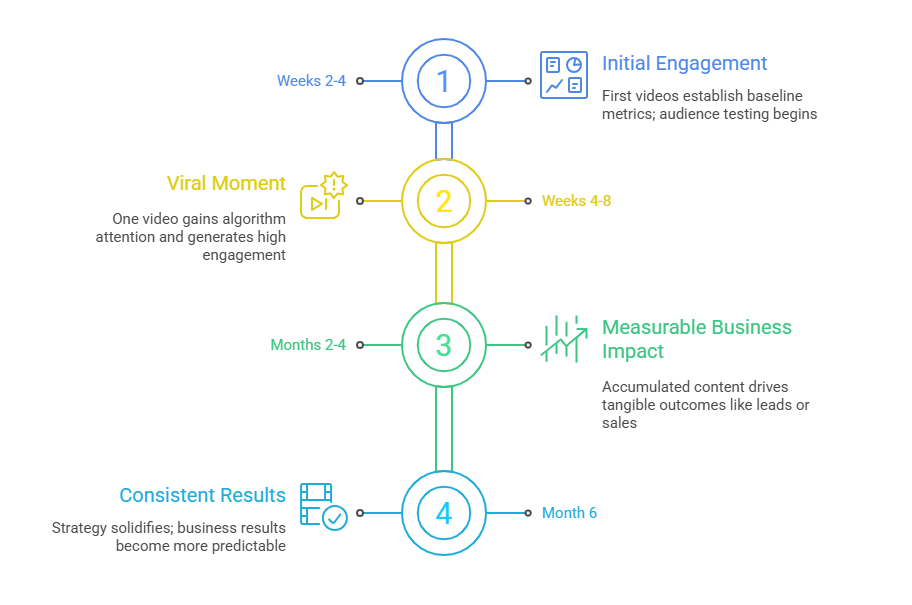
What should small businesses look for when choosing a viral video marketing agency?
Selecting the right partner requires looking beyond portfolios and promises to evaluate actual capabilities and alignment with your business needs.
First, examine their understanding of platform algorithms and trends. A legitimate viral video agency in Dubai should clearly explain how different social platform algorithms work, what content formats are currently performing well on each platform, and how they stay updated as algorithms and trends change. Generic answers about “creating engaging content” aren’t enough. You want specific, detailed understanding.
Second, evaluate their strategic approach. Ask how they would develop a content strategy for your specific business. Strong agencies start with questions about your target audience, business goals, and competitive landscape before suggesting content ideas. Weak agencies offer generic packages without considering your unique situation. The strategy should connect video content to actual business outcomes, not just views and likes.
Third, look at production quality appropriate to your needs and platforms. This doesn’t always mean the highest-end production. For TikTok-focused strategies, overly polished videos often underperform. For LinkedIn B2B content, production quality signals professionalism. The agency should understand what level of production suits your industry and target platforms.
Fourth, assess their content ideation process. How do they come up with video ideas? Do they analyze your competitors? Do they research trending topics in your industry? Do they involve you in the creative process? Strong agencies have systematic approaches to content development, not just random brainstorming.
Fifth, examine their performance tracking and reporting. What metrics do they track? How do they report results? Can they connect video performance to business outcomes? Agencies focused only on vanity metrics (views and likes) without tracking conversions or business impact won’t deliver ROI.
Sixth, evaluate their understanding of the UAE market. Dubai’s multicultural environment, cultural sensibilities, and local trends require specific knowledge. An agency that treats Dubai like any other market will miss opportunities and potentially create cultural missteps. Ask about their experience with UAE businesses and their understanding of local audience preferences.
Seventh, consider their revision and optimization process. Viral video marketing requires constant testing and adjustment. How does the agency handle content that underperforms? Do they analyze why and adjust strategy? Or do they just keep producing similar content? Continuous optimization separates effective agencies from those just churning out videos.
Warning signs include agencies guaranteeing viral results (viral success can’t be guaranteed, only optimized for), those unable to explain their strategic process clearly, agencies showing only their best work without discussing failures and lessons learned (every agency has videos that don’t perform; what matters is learning from them), and those proposing identical strategies for different business types (effective video marketing is customized, not one-size-fits-all).
Questions to ask potential agencies include: How do you stay current with platform algorithm changes? Can you show examples of business results, not just viral videos, you’ve driven for clients? What’s your process when a content strategy isn’t performing? How do you ensure content aligns with our brand while still being engaging? What metrics do you prioritize and why?
For small businesses specifically, also evaluate the agency’s communication style and accessibility. You want a partner who explains things clearly, responds promptly, and makes you feel involved in the process, not a vendor who takes your money and disappears until delivering videos.
How does BRB create viral video content that actually drives business results?
Our approach to viral video marketing differs from typical agencies because we understand that viral views mean nothing if they don’t translate to business growth. We focus on strategic virality, content that spreads widely within your target audience and moves them toward becoming customers.
We start every engagement with audience and competitor analysis. Before creating a single video, we research your specific target audience on each relevant platform, analyze competitors’ successful content, identify content gaps and opportunities, and map potential content themes to business objectives. This foundation ensures every video serves a strategic purpose beyond just getting views.
Our content creation process prioritizes platform-specific optimization. We don’t create one video and post it everywhere. We develop concepts that can be adapted across platforms while respecting each platform’s unique algorithm priorities and audience expectations. A concept might become a 15-second TikTok video, a 45-second Instagram Reel with different editing, and a 90-second YouTube Short with expanded storytelling. This maximizes return on creative investment.
We focus heavily on the first three seconds. Every video we create is engineered to stop the scroll immediately. This might be a surprising visual, a provocative statement, a relatable problem identification, or pattern interruption through unexpected editing. Whatever the approach, the hook is deliberate and tested.
Our team combines creative storytelling with data analysis. We track performance metrics obsessively, identifying patterns in what works. Which video formats drive highest completion rates? What topics generate most shares? What calls to action convert best? We use this data to continuously refine strategy, not just produce more content.
For UAE businesses specifically, we leverage our understanding of Dubai’s diverse market. We know what resonates with local audiences versus international residents. We understand cultural considerations that affect content reception. We tap into Dubai-specific trends and conversations that larger international agencies miss.
We also integrate video marketing with broader digital strategy. Viral videos drive attention, but that attention needs somewhere to go. We ensure your website can handle traffic spikes, landing pages are optimized for conversions, and follow-up mechanisms capture interest before it fades. Viral moments are opportunities, but only if you’re prepared to capitalize on them.
Our production approach balances quality with platform authenticity. We use professional equipment and experienced creators, but we avoid the overly polished corporate feel that kills engagement on platforms like TikTok. The goal is content that looks professional enough to build credibility but authentic enough to feel relatable.
We maintain consistent posting schedules because we know algorithm rewards consistency. Rather than sporadic campaigns, we establish sustainable content rhythms that keep your business visible and give the algorithm multiple opportunities to promote your content to wider audiences.
Finally, we measure what matters. Views and likes are tracked, but we focus on metrics tied to business outcomes: website traffic from social channels, inquiry volume, customer acquisition attributed to video content, and ultimately, ROI. Every campaign includes transparent reporting showing not just engagement metrics but business impact.
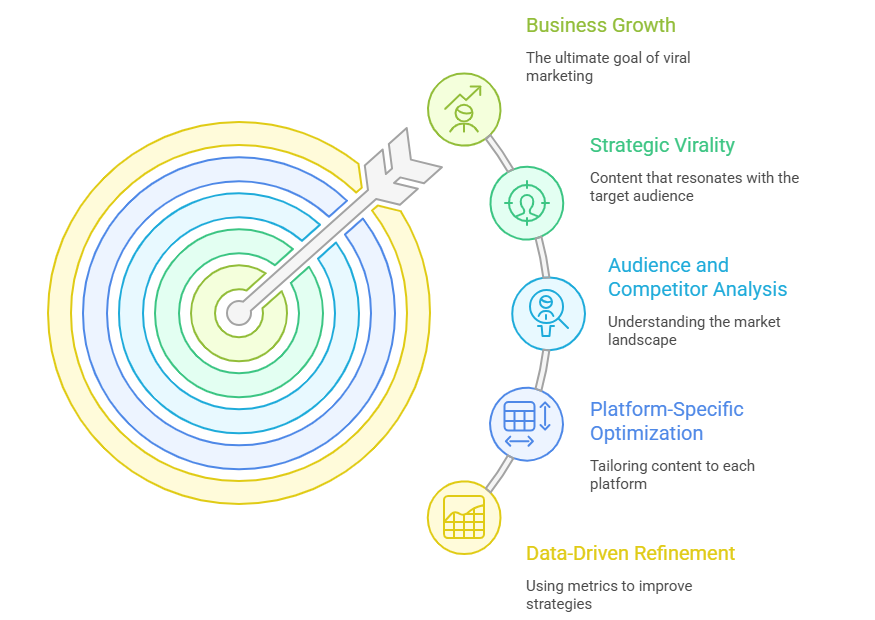
Conclusion
Viral video marketing isn’t a luxury for small businesses anymore. It’s one of the most cost-effective ways to compete with larger competitors who dominate traditional advertising channels. The small business that masters viral video content can capture as much attention as corporations spending millions on ads.
Success requires understanding platform algorithms, creating genuinely engaging content, maintaining consistency, and connecting viral moments to business outcomes. It’s not about getting lucky with one video. It’s about strategic, ongoing content creation that steadily builds attention and converts that attention into customers.
Choosing the right agency partner means finding professionals who understand both the creative and strategic sides, who know the UAE market specifically, and who measure success by business results, not just views. The gap between businesses thriving with video marketing and those struggling to be seen online will only widen. The question is which side of that gap your business will be on.
If your current marketing efforts aren’t generating the attention and results you need, viral video marketing might be the most impactful investment you can make. The businesses dominating your industry’s social presence didn’t get there by accident. They recognized the opportunity and executed strategically. That same opportunity exists for your business right now.
Frequently Asked Questions
How many videos do I need to post per week to have a chance at going viral?
Consistency matters more than specific frequency, but successful viral strategies typically involve 3-5 posts weekly across platforms. This gives the algorithm multiple opportunities to test your content with wider audiences. However, quality beats quantity. Three strategically planned, well-executed videos per week outperform seven hastily made ones. The key is maintaining regular posting while ensuring each video has strong hooks, clear value, and platform optimization. Dubai businesses should focus on sustainable schedules they can maintain long-term rather than unsustainable bursts of activity.
Can viral video marketing work for boring or traditional industries?
Absolutely. Every industry has interesting angles if you look creatively. Accounting firms have created viral content about tax tips and financial mistakes. Law firms have succeeded with legal myth-busting videos. Manufacturing companies have gained massive followings showing production processes. The key is finding what’s interesting about your business from your audience’s perspective, not yours. Behind-the-scenes content, expert insights, common misconceptions, or problem-solving tips work across virtually any industry. Traditional industries often have advantages because there’s less competition for attention in their content niches.
What happens if a video goes viral but attracts the wrong audience?
This is why strategic virality matters more than random viral success. Videos designed to go viral within your target audience include hooks, topics, and calls to action relevant to potential customers. If you’re a Dubai-based luxury real estate agent and your video goes viral, but it’s with teenagers in another country, that’s vanity metrics without business value. Good viral video marketing targets “qualified virality” where the people seeing and sharing your content are actually potential customers. Strategic content planning and platform selection prevent most wrong-audience viral scenarios.
Do I need to show my face in videos or can my business go viral without that?
Face-to-camera content often builds stronger connection and performs well, but it’s not mandatory. Many businesses succeed with product-focused videos, text-on-screen content, voiceover narration over B-roll, animation or motion graphics, or team-based content featuring different staff members. The format should match your comfort level and brand style. That said, personal connection drives engagement, so businesses willing to show faces and personalities often see faster audience growth. For UAE businesses, consider cultural factors that might affect comfort with on-camera presence and adapt accordingly.
How do I measure ROI from viral video marketing when sales cycles are long?
Track leading indicators that connect video content to business outcomes. Monitor website traffic from social channels to see if videos drive people to learn more about your services. Track consultation requests, demo bookings, or contact form submissions and ask how people found you. Use UTM parameters on links in video descriptions to attribute traffic sources accurately. For long sales cycles, measure engagement with your content from decision-makers in target companies on platforms like LinkedIn. Even without immediate sales, track whether video content moves prospects through your funnel. Over time, patterns emerge connecting video engagement to closed deals.
Should I focus on one social platform or spread content across multiple platforms?
Start with the platform where your target audience is most active and engaged, master it, then expand. Spreading thin across five platforms with inconsistent, poorly optimized content delivers worse results than dominating one platform strategically. For most UAE SMBs, Instagram and TikTok are primary platforms for B2C businesses, while LinkedIn dominates for B2B. Once you’re seeing consistent results on your primary platform (typically after 2-3 months of strategic effort), expand to secondary platforms by adapting successful content rather than creating entirely new content for each. This approach maximizes resources while building sustainable viral marketing systems.