

How Much Does Generative Engine Optimization Cost in UAE?
If you’ve noticed that ChatGPT, Google’s AI Overviews, Perplexity, and other AI engines are increasingly answering questions without sending users to websites, you’re seeing the future of search unfold. This shift is forcing UAE businesses to rethink their entire digital strategy. It’s no longer enough to rank well on Google, you need to ensure AI engines know about your business, trust your information, and recommend you to users.
This is where Generative Engine Optimization (GEO) comes in. Think of it as the next evolution of SEO, but instead of optimizing for traditional search algorithms, you’re optimizing for AI language models that generate answers. For businesses in Dubai, Abu Dhabi, and across the UAE, this represents both a significant opportunity and a potential blind spot if ignored.
But here’s the question keeping many business owners up at night: what does Generative Engine Optimization Cost in UAE? Unlike traditional SEO, where pricing models are relatively established, GEO is still emerging. Costs can vary dramatically based on your business size, industry, competition, and how aggressively you want to pursue AI visibility.
This guide breaks down exactly what you’ll pay for GEO services in the UAE market, what factors drive those costs, and how to determine if the investment makes sense for your business.
How much do UAE agencies typically charge for GEO services?
Understanding GEO costs starts with understanding what you’re actually buying. Unlike traditional SEO, which focuses primarily on rankings and traffic, GEO involves a broader set of activities designed to make your business visible and credible to AI engines.
Content audit and AI visibility assessment: Before any optimization begins, agencies need to evaluate how often your brand appears in AI-generated responses, what information is being shared about you, and how accurately you’re being represented. This involves running hundreds of test queries across multiple AI platforms to establish a baseline. In the UAE market, this includes testing queries in both English and Arabic.
Structured data implementation: AI engines rely heavily on structured markup to understand and categorize information. Implementing proper Schema markup, knowledge graphs, and other structured data formats requires technical expertise. This ensures AI engines can easily extract and cite your information.
Authority building and citation development: GEO prioritizes sources that AI models trust. This means getting your business featured in authoritative publications, industry databases, and platforms that AI engines reference. For UAE businesses, this includes local directories, regional news sites, and industry-specific platforms.
Content optimization for AI consumption: This isn’t just rewriting your existing content. It’s creating new formats specifically designed to answer the types of questions users ask AI engines. This includes comprehensive FAQ sections, detailed how-to guides, and direct answer formats that AI models favor when generating responses.
Continuous monitoring and adjustment: AI models update frequently, and what works today might not work next month. Ongoing GEO requires regular testing, tracking your AI visibility score, and adjusting strategies as platforms evolve.
Each of these components requires specialized skills, tools, and time, all of which factor into pricing.
How much do UAE agencies typically charge for GEO services?
In the current UAE market, GEO pricing varies significantly based on the agency’s experience, the scope of work, and your business needs. Here’s what you can expect:
Monthly retainer packages are the most common pricing model, ranging from AED 4,000 to AED 25,000 per month. Smaller agencies or freelancers might offer basic GEO services starting around AED 4,000-7,000 monthly. This typically includes fundamental optimization, basic content adjustments, and minimal ongoing monitoring.
Mid-tier agencies with established GEO capabilities usually charge AED 10,000-18,000 monthly. This level provides comprehensive optimization, regular content creation, structured data implementation, authority building efforts, and detailed reporting on your AI visibility.
Premium agencies serving larger enterprises or competitive industries can charge AED 20,000-40,000+ monthly. This tier includes aggressive citation building, extensive content development, multi-language optimization, competitive AI visibility tracking, and integration with broader digital strategies.
Project-based pricing is another option, particularly for businesses wanting a one-time GEO foundation rather than ongoing service. Initial GEO audits and setup projects typically range from AED 8,000 to AED 30,000 depending on your website size and complexity.
Hourly consulting rates for GEO specialists in the UAE typically range from AED 300 to AED 800 per hour. This model works if you have an internal team that needs strategic guidance rather than full implementation support.
For context, these prices are generally 20-40% higher than equivalent traditional SEO services because GEO requires more specialized knowledge, newer tools, and more complex testing methodologies.
What factors influence how much you’ll pay for GEO?
Not every business pays the same for GEO services. Several factors determine where you’ll fall in the pricing spectrum:
Your industry and competition level significantly impacts cost. If you’re in a highly competitive sector like real estate, finance, or healthcare in Dubai, expect to pay more because achieving AI visibility requires overcoming well-established competitors. Less saturated niches often require less aggressive (and less expensive) strategies.
Business size and website complexity matter. A small business with a 20-page website needs less work than an e-commerce platform with thousands of product pages. Multi-location businesses serving Dubai, Abu Dhabi, and other emirates need location-specific optimization, which adds to costs.
Current digital presence strength affects pricing. If you’re starting from zero (no SEO foundation, weak backlink profile, minimal online citations), building the authority AI engines respect will require more upfront investment. Businesses with strong existing SEO foundations can often implement GEO more efficiently.
Language requirements impact UAE pricing uniquely. If you need optimization for both English and Arabic-speaking AI users, costs increase by 30-50%. Creating quality multilingual content and managing citations across language-specific platforms requires additional resources.
Geographic targeting specificity also plays a role. Broad national targeting is more straightforward than hyper-local optimization for specific neighborhoods or emirates. If you need to dominate AI responses for “best restaurants in Dubai Marina” versus “best restaurants in UAE,” the former requires more precise, detailed work.
Content creation requirements can dramatically shift costs. If your agency needs to create substantial new content (detailed guides, comprehensive FAQ sections, industry resource pages), expect content production to add AED 2,000-8,000 monthly depending on volume and quality.
How does GEO pricing compare to traditional SEO costs in UAE?
Many UAE businesses are familiar with SEO pricing and wonder how GEO compares. The short answer: GEO typically costs 20-50% more than comparable SEO services, but delivers different (and increasingly important) results.
Traditional SEO in the UAE generally runs AED 3,000-15,000 monthly for small to medium businesses. This focuses on keyword rankings, organic traffic growth, and website optimization. The metrics are clear: you track positions, traffic, and conversions.
GEO, while overlapping with SEO in some areas, requires additional work that SEO doesn’t address. You’re not just trying to rank on a search results page, you’re trying to become the source AI engines quote when answering questions. This requires different content strategies, additional technical implementations, and more complex measurement.
However, here’s the key distinction: SEO drives traffic to your website. GEO influences whether AI engines even mention your business when users ask questions. As more people use ChatGPT, Perplexity, and Google’s AI features instead of traditional search, GEO becomes less of an add-on and more of a necessity.
The smartest UAE businesses are budgeting for both. Your SEO captures traditional search traffic, while your GEO ensures you’re not invisible when users turn to AI engines. Think of it as protecting different channels rather than choosing one over the other.
What results can you expect for your GEO investment?
ROI expectations help justify costs. What should UAE businesses realistically expect from their GEO investment?
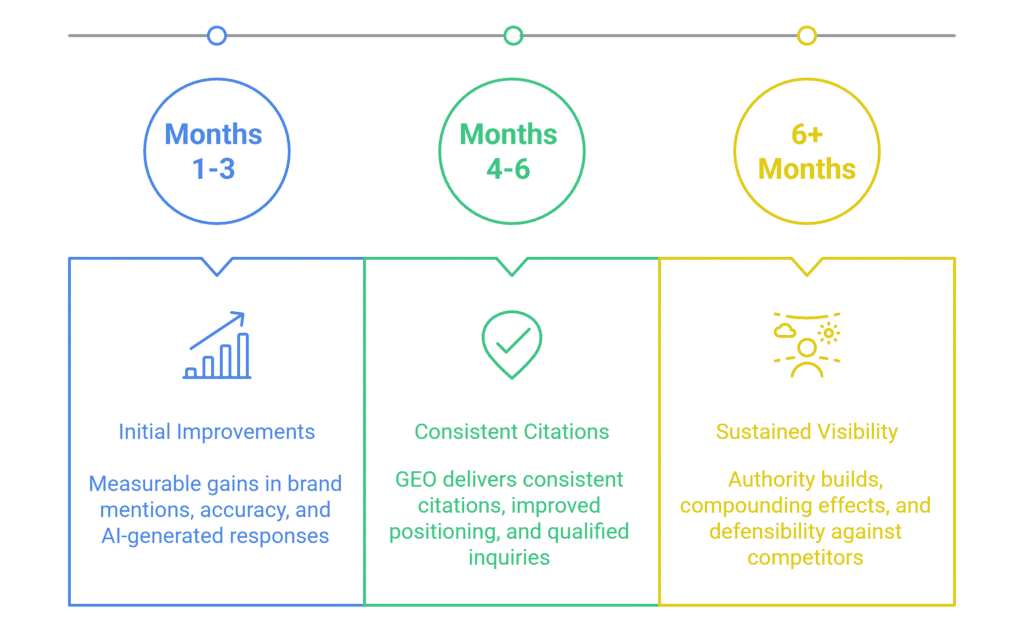
Within the first 3 months, you should see measurable improvements in how often AI engines mention your brand, more accurate information being shared about your business, and appearance in more AI-generated responses for relevant queries. Some businesses also see early increases in branded search traffic as people hearing about them through AI engines search for more information.
By months 4-6, well-executed GEO typically delivers consistent citations in AI responses for your key topics, improved positioning relative to competitors in AI-generated recommendations, and measurable traffic from AI platforms that include source links. For UAE service businesses, this often translates to more qualified inquiries from people who learned about you through AI engines.
Long-term benefits (6+ months) include sustained visibility as your authority builds, compounding effects as more citations and content reinforce each other, and defensibility against competitors who start GEO later. Businesses that establish AI engine trust early often maintain advantages even as competition increases.
In practical terms, a Dubai-based business investing AED 12,000 monthly in GEO might expect to see their brand mentioned in 40-60% of relevant AI responses within six months, compared to 0-10% before optimization. For service businesses, this often translates to 15-30 additional qualified leads monthly. E-commerce businesses might see 5-15% of their traffic coming from AI engine referrals.
The ROI varies significantly by industry. For professional services (legal, consulting, healthcare), where trust and expertise matter enormously, GEO often delivers exceptional returns because AI engines prioritize authoritative sources for these topics.
Can you do GEO yourself or do you need an agency?
This is the budget-conscious business owner’s most important question. The honest answer: you can handle some GEO activities yourself, but comprehensive implementation requires expertise most businesses don’t have in-house.
DIY GEO is possible for businesses with technical capabilities and time. You can implement structured data markup using free tools, optimize existing content for direct answer formats, actively build citations on key platforms, and monitor your AI visibility through manual testing. This approach costs mainly your time plus perhaps AED 500-1,500 monthly for necessary tools and software subscriptions.
The limitation is that DIY GEO is time-intensive and requires constant learning as AI platforms evolve. Unless you have a dedicated team member who can spend 15-20 hours weekly on this, you’ll likely achieve only basic results.
Hybrid approaches work well for some UAE businesses. You might hire a consultant for strategy and technical implementation (AED 8,000-15,000 as a one-time project), then handle ongoing content creation and monitoring internally. This reduces monthly costs while still leveraging expert knowledge for the complex components.
Full-service agency support makes sense when GEO is critical to your business model, you operate in a competitive industry, you lack internal resources or technical expertise, or you need results faster than DIY approaches deliver. The premium you pay for agency services often returns itself through faster results and avoided mistakes.
For most UAE SMBs, the optimal approach is starting with an agency to build your GEO foundation, then transitioning to a lighter retainer or hybrid model once initial optimizations are complete.
What should you look for when choosing a GEO provider in UAE?
Since GEO is relatively new, not all agencies offering these services have equal expertise. Here’s how to evaluate providers:
Demonstrated AI visibility results: Ask for case studies showing how they’ve improved clients’ presence in AI-generated responses. Be wary of agencies that only show traditional SEO metrics.
Technical implementation capabilities: GEO requires strong technical SEO skills, particularly around structured data. Ask specific questions about Schema markup, knowledge graphs, and API integrations to gauge their expertise.
Content strategy understanding: Effective GEO isn’t just technical. It requires creating content in formats and structures AI engines favor. Your provider should demonstrate content strategy capabilities, not just technical execution.
Monitoring and reporting systems: How will you know if your investment is working? Your provider should have clear processes for tracking your AI visibility and demonstrating ROI, even though GEO metrics are newer and less standardized than SEO.
UAE market knowledge: Providers should understand the local business landscape, relevant Arabic language optimization, and regional platforms and directories important to UAE GEO success.
Red flags include agencies promising immediate results (GEO takes time), those who don’t explain their methodology clearly, providers focusing exclusively on traditional SEO metrics, or anyone guaranteeing specific AI engine outcomes (which is impossible given how AI systems work).
Conclusion
GEO costs in the UAE typically range from AED 4,000 to AED 25,000+ monthly depending on your business size, competition level, and optimization needs. While this represents a significant investment, the cost of ignoring AI engine visibility is increasingly steep as more consumers turn to ChatGPT, Google AI, and similar platforms for recommendations and information.
The businesses winning in this new landscape are those treating GEO not as an experimental add-on but as a core component of their digital strategy. Start by assessing your current AI visibility, determine your budget based on business goals and competition level, and select a provider with demonstrated expertise and clear measurement systems.
Remember that GEO is an emerging field. Costs will likely stabilize as the market matures, but early movers often gain advantages that later entrants struggle to overcome.
FAQs
Is GEO worth the cost for small businesses in UAE?
Yes, particularly for service-based businesses where trust and recommendations drive sales. Even a modest GEO investment (AED 5,000-8,000 monthly) can significantly impact your visibility when potential customers ask AI engines for recommendations. Small businesses often see proportionally larger benefits because they’re competing against other small players, not international corporations. However, if your business relies primarily on walk-in traffic or established client relationships rather than online discovery, GEO might be lower priority than other marketing investments.
How long does it take for GEO to show results?
Most businesses see initial improvements within 2-3 months, with substantial visibility gains by month 6. This timeline assumes consistent optimization efforts and quality implementation. Unlike paid advertising which can deliver immediate visibility, GEO is a build-over-time strategy similar to traditional SEO. However, once established, the benefits compound and become more defensible over time. For competitive industries in Dubai and Abu Dhabi, expect the longer end of these timelines as you’re working to overcome established competitors.
Do I need GEO if I already have good SEO rankings?
Yes, because AI engines don’t simply replicate search rankings. They prioritize authoritative sources, clear answer formats, and structured information that traditional SEO might not address. Many businesses ranking well on Google search find they’re rarely mentioned in AI-generated responses. As users increasingly turn to AI engines instead of traditional search, SEO alone leaves you vulnerable to invisibility. The ideal approach is maintaining both SEO for traditional search traffic and GEO for AI engine visibility.
Can I pause GEO services and resume later without losing progress?
Unlike paid advertising which stops delivering when you pause spending, GEO improvements tend to persist because they’re based on content, citations, and authority that remain in place. However, AI platforms evolve rapidly, and competitors continue optimizing. If you pause for several months, you’ll likely maintain some benefits but lose momentum and potentially fall behind competitors. For budget-conscious businesses, a lighter ongoing maintenance retainer (AED 3,000-5,000 monthly) often works better than complete pauses.
What’s included in the cheapest GEO packages?
Budget GEO packages (AED 4,000-6,000 monthly) typically include basic structured data implementation for key pages, limited content optimization (2-3 pages monthly), minimal citation building (5-10 quality citations), and monthly reporting on AI visibility for core terms. This level works for businesses with limited competition or those wanting to establish basic AI visibility. However, for competitive industries or aggressive growth goals, budget packages rarely deliver substantial results since they lack the comprehensive approach needed to build real authority with AI engines.
How do I measure if my GEO investment is working?
Track several metrics: frequency of brand mentions in AI-generated responses (test this manually or use monitoring tools), accuracy of information AI engines share about your business, positioning relative to competitors in AI recommendations, traffic from AI platforms that include source links, and ultimately, leads or sales attributable to AI engine discovery. Your GEO provider should deliver monthly reports showing progress on these metrics. Additionally, monitor branded search increases as people often search for businesses after learning about them through AI engines.

Best GEO Strategies for Service Businesses in Dubai
If you’re running a service business in Dubai, you’ve probably noticed something strange happening with your online visibility. You could have the best SEO in your industry, rank on page one of Google, and still watch potential clients slip through your fingers because they never clicked through to your website at all.
They’re getting their answers directly from ChatGPT, Google’s AI Overviews, Perplexity, and other AI engines. They’re asking questions like “best accounting firm in Dubai” or “how much does corporate branding cost in the UAE,” and these platforms are serving up recommendations without sending anyone to your site.
This is where Generative Engine Optimization (GEO) comes in. It’s not about replacing SEO. It’s about making sure your business gets mentioned, cited, and recommended when AI engines answer questions about your industry. GEO strategies for service businesses in Dubai is essential to maintain online visibility, especially as AI platforms increasingly answer search queries directly.
Let’s break down exactly how you can position your service business to win in this new landscape.
What exactly is GEO and why should service businesses in Dubai care?
GEO is the practice of optimizing your content so that AI-powered search engines and chatbots cite, mention, or recommend your business when users ask relevant questions. Unlike traditional SEO, which focuses on ranking in a list of blue links, GEO focuses on becoming the answer itself.
Think about how your potential clients search today. They’re not just typing “digital marketing Dubai” into Google anymore. They’re asking full questions like “What’s the most cost-effective way to grow my business online in Dubai?” or “Should I hire a marketing agency or build an in-house team in the UAE?”
When AI engines respond to these queries, they pull information from sources they trust. If your content is structured, authoritative, and genuinely helpful, you get cited. If it’s generic or outdated, you get skipped over entirely.
For service businesses in Dubai, this matters even more because the market is incredibly saturated. There are hundreds of agencies, consultants, and service providers competing for the same clients. GEO gives you a way to stand out by becoming the trusted voice that AI platforms reference when someone asks a question in your field.
The UAE’s digital adoption rate is among the highest in the world. People here expect fast, reliable, and relevant answers. If your business isn’t showing up in AI-generated responses, you’re losing clients to competitors who are.
How can service businesses structure their content to get cited by AI engines?
AI engines prefer content that directly answers questions, provides clear value, and feels authoritative. The key is to stop writing content for algorithms and start writing for real people with real problems, while keeping AI-friendly structures in mind.
Start by identifying the exact questions your target audience asks. These aren’t generic keywords like “web design” or “branding.” They’re specific, intent-driven queries like “How long does it take to build a website for a small business in Dubai?” or “What should I include in a social media strategy for a Dubai-based restaurant?”
Once you have these questions, build content around them. Use the question as your H2 heading. Answer it clearly and completely in the first two sentences. Then expand with examples, data, and context. This format works because it mirrors how people actually search and how AI engines actually summarize.
Let’s say you’re a business consultant in Dubai. Instead of writing a generic blog post titled “Business Consulting Services,” write one titled “What should UAE startups look for in a business consultant?” Then answer it thoroughly. Explain what qualifications matter, what red flags to watch for, what questions to ask during a consultation, and what realistic outcomes look like. Include examples from the UAE market. Mention pricing ranges if possible. Make it genuinely useful.
Another critical element is E-E-A-T: Experience, Expertise, Authoritativeness, and Trustworthiness. AI engines are trained to prioritize sources that demonstrate these qualities. That means including real case studies, client results, credentials, and original insights rather than repackaging generic advice.
For Dubai-based service businesses, adding local context strengthens your authority. Reference UAE regulations, local business challenges, cultural considerations, or GCC market trends. AI engines recognize this specificity as a signal that you actually know what you’re talking about.
Also, make sure your content is easy to scan. Use short paragraphs, clear subheadings, bullet points where appropriate, and concise language. AI engines parse content the same way busy humans do. If your answer is buried in five paragraphs of fluff, it won’t get cited.
Should service businesses focus on long-form content or quick answers for GEO?
Both, but for different reasons. Quick answers help you get cited in direct responses. Long-form content helps you build authority and get referenced in more complex queries.
For quick answers, think about the questions that have clear, concise responses. “What is corporate branding?” or “How much does a logo design cost in Dubai?” These can be answered in 50 to 100 words. Write a tight, direct response that AI engines can pull and cite immediately. Then expand with additional context, but lead with the answer.
Long-form content works when the question is more complex or strategic. “How do I choose between hiring a freelancer or an agency for my marketing in Dubai?” or “What’s the best way to scale a service business in the UAE?” These require depth, nuance, and examples. A 1,500 to 2,000-word article that thoroughly explores the topic will perform better than a shallow 300-word post.
The mistake most service businesses make is choosing one or the other. You need both. Your homepage and service pages should have clear, scannable sections with direct answers to common questions. Your blog should have in-depth articles that explore topics your audience genuinely cares about.
Here’s a practical example. If you’re a legal consultancy in Dubai, your service page might have a section titled “What types of businesses need legal consultants in Dubai?” with a quick two-sentence answer followed by a short list. Your blog might have a long-form article titled “How to navigate Dubai’s free zone regulations as a new business owner” that dives deep into the topic with step-by-step advice, case studies, and links to official resources.
This combination signals to AI engines that you’re both helpful and authoritative. You’re not just trying to rank for keywords. You’re genuinely serving your audience.
What role do FAQs play in getting recommended by AI platforms?
Massive. FAQ sections are one of the most GEO-friendly content formats you can use because they’re structured exactly how AI engines process information: question, answer, next question, next answer.
Most service businesses in Dubai already have FAQ sections on their websites, but they’re underutilized. They’re often generic, vague, or buried at the bottom of a page. To optimize FAQs for GEO, you need to treat each question as a search query and each answer as a citation opportunity.
Write your FAQ questions the way real people ask them. Instead of “What are our services?” use “What services does a digital marketing agency in Dubai typically offer?” Instead of “Pricing information,” use “How much should I expect to pay for web design in Dubai?”
Your answers should be clear, specific, and complete. Avoid vague responses like “Our pricing varies based on client needs.” Instead, say something like “Web design projects in Dubai typically range from AED 5,000 for a basic 5-page website to AED 50,000 or more for custom e-commerce platforms, depending on features, integrations, and ongoing support.”
The more specific you are, the more likely an AI engine will cite your answer. Specificity signals authority.
Include 4 to 6 FAQs on every major service page, and consider creating a dedicated FAQ page that covers broader industry questions. For example, if you’re a branding agency, your FAQ page might include questions like “How long does a full rebrand take?” or “What’s the difference between a brand refresh and a full rebrand?” or “Do Dubai-based businesses need Arabic branding materials?”
Each FAQ should also be an opportunity to naturally include keywords without forcing them. If your keyword research shows that people search for “affordable social media management in Dubai,” then one of your FAQs should directly address that: “What’s the most affordable way to manage social media for a small business in Dubai?”
FAQs also help with voice search and conversational queries, which are becoming more common. People using AI assistants or voice search tend to ask full questions, not short keywords. Your FAQs are perfectly positioned to capture these queries.
How important is local UAE context for getting mentioned by AI engines?
Extremely important, especially if you’re targeting clients in Dubai or the broader UAE market. AI engines prioritize relevance, and local context is one of the strongest relevance signals you can send.
When you mention Dubai-specific details like free zones, the Dubai Economic Department (DED), VAT regulations, or Emiratization policies, you’re signaling that your content is tailored to the UAE market. AI engines recognize this and are more likely to cite you when someone asks a location-specific question.
Let’s say someone asks ChatGPT “How do I market a restaurant in Dubai?” If your content includes examples of Dubai food trends, references to Zomato and Deliveroo, mentions of Instagram marketing strategies for Dubai’s expat communities, and tips on navigating Dubai Municipality guidelines for food businesses, you’re far more likely to get cited than a generic article about restaurant marketing.
This doesn’t mean you should force Dubai references into every sentence. It means you should genuinely understand your local market and reflect that understanding in your content. Talk about challenges specific to Dubai businesses. Reference local success stories. Mention regulations, cultural considerations, and market dynamics that matter here.
For example, if you’re a web development agency, you might discuss the importance of Arabic-English bilingual websites for businesses targeting both local and expat audiences. Or you could explain how UAE data privacy laws affect website design and cookie policies. These aren’t just SEO keywords. They’re real concerns for your potential clients, and addressing them makes your content more authoritative.
Location-specific long-tail keywords also help. Phrases like “business setup in Dubai,” “marketing for Dubai startups,” or “corporate branding in the UAE” are more targeted and less competitive than generic terms. They also align with how people search when they’re ready to take action. A Generative Engine Optimization (GEO) agency in the UAE can help businesses identify and leverage these location-specific opportunities more effectively.
One more thing: keep your content updated with current UAE trends and regulations. The business landscape here changes quickly. If your content references outdated rules or ignores recent developments, AI engines will deprioritize it in favor of more current sources.
What types of content formats perform best for GEO in the service industry?
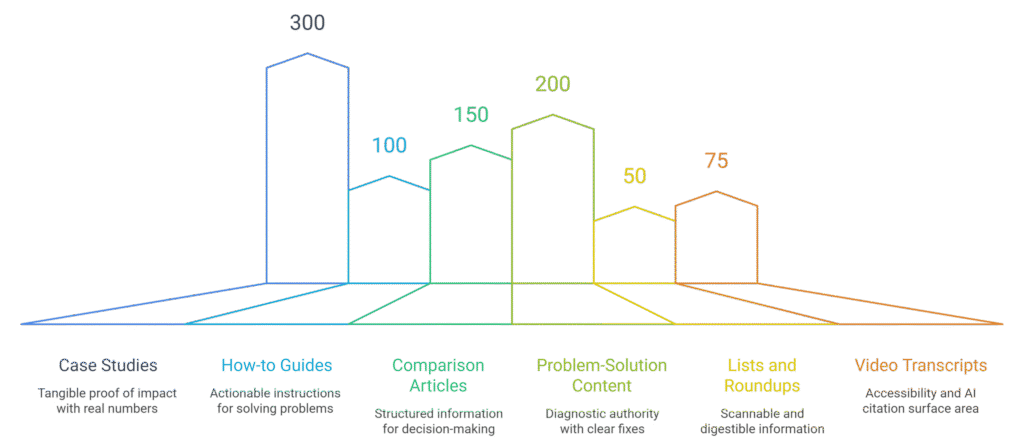
The formats that perform best are the ones that directly answer user intent and provide clear, structured information. For service businesses, that usually means how-to guides, comparison articles, case studies, and problem-solution content.
How-to guides work well because they address specific, actionable questions. “How to choose a web developer in Dubai,” “How to build a social media strategy for a Dubai retail brand,” or “How to improve your website’s load speed.” These articles should be step-by-step, practical, and filled with real examples.
Comparison articles also perform strongly because they help people make decisions. “Freelancer vs agency: which is better for your Dubai business?” or “In-house marketing team vs outsourcing: what works for UAE startups?” These pieces should be balanced, data-driven, and honest. Don’t just pitch your service. Actually help the reader decide what’s best for their situation.
Case studies are powerful for building authority. “How we helped a Dubai retail brand increase online sales by 300%” or “How a UAE startup built a brand from scratch in six months.” These should include real numbers, challenges, solutions, and outcomes. AI engines love case studies because they demonstrate proven expertise.
Problem-solution content is another strong format. Identify a common pain point your audience faces, explain why it happens, and outline a clear solution. For example, “Why Dubai businesses struggle with social media engagement and how to fix it” or “The biggest web design mistakes UAE startups make and how to avoid them.”
Lists and roundups also work, but they need to be genuinely useful. “7 marketing mistakes Dubai service businesses make” or “5 essential web design features for UAE e-commerce sites.” These should be specific, backed by examples, and actionable.
Video transcripts are becoming more important too. If you create video content, publish the full transcript on your website. AI engines can parse transcripts just like written content, and it gives you another opportunity to get cited.
Whatever format you choose, the key is depth and originality. Don’t just rewrite what everyone else is saying. Add your own insights, experiences, and perspective. That’s what separates content that gets cited from content that gets ignored.
How can service businesses in Dubai build authority signals that AI engines recognize?
Authority isn’t just about what you say. It’s about who you are, what you’ve done, and who vouches for you. AI engines evaluate authority through a combination of on-site content, external signals, and reputation markers.
Start with your about page. This is one of the most underrated pages on your website. It should clearly explain who you are, what you’ve accomplished, and why you’re qualified to offer your services. Include team bios, credentials, certifications, awards, and years of experience. If you’ve worked with well-known UAE brands or completed notable projects, mention them.
Client testimonials and reviews are critical. AI engines recognize these as trust signals. Feature them prominently on your site, and make sure they’re specific. Instead of “Great service!” aim for testimonials like “BRB helped us double our Instagram engagement in three months by creating content that actually resonated with our Dubai audience.”
Backlinks from reputable sources still matter, even for GEO. If your business has been featured in Gulf News, Arabian Business, or industry publications, make sure those links are live and prominent. If you’ve published guest articles or been interviewed, showcase that work.
Original research and data are powerful authority builders. If you can publish a report, survey, or analysis that’s relevant to your industry and the UAE market, AI engines will treat it as a valuable source. For example, “2024 Social Media Trends for Dubai Businesses Based on 500 Local Brands” would be a highly citable piece of content.
Authorship also matters. If your team members have bylines on industry blogs, LinkedIn profiles with strong engagement, or speaking credentials at UAE business events, include that information. AI engines are increasingly looking at who wrote the content, not just the content itself.
Structured data and schema markup help too. These are snippets of code that tell AI engines exactly what your content is about. Use schema for FAQs, reviews, services, and local business information. This makes it easier for AI engines to parse and cite your content accurately.
Finally, consistency across platforms strengthens authority. Your website, Google Business Profile, LinkedIn, and other digital touchpoints should all have consistent information about your services, location, and brand. Inconsistencies confuse AI engines and weaken your credibility.
What mistakes do Dubai service businesses make that hurt their GEO performance?
The biggest mistake is creating content that’s too generic. Most businesses write for everyone, which means they resonate with no one. AI engines prioritize specificity, so if your content could apply to any business in any city, it’s not going to get cited.
Another common mistake is keyword stuffing. Some businesses try to force keywords into every sentence, thinking it’ll improve their visibility. It doesn’t. It makes your content awkward and unnatural, and AI engines are trained to detect and deprioritize that kind of writing.
Outdated content is another major issue. If your blog still has articles from 2019 that reference old trends or regulations, AI engines will skip over them. Keep your content fresh, update old posts regularly, and remove anything that’s no longer relevant.
Ignoring mobile optimization is a problem too. Most people in Dubai browse on their phones, and AI engines prioritize content that’s mobile-friendly. If your site is slow, hard to read on mobile, or poorly formatted, you’re losing visibility.
Thin content is another mistake. Publishing short, shallow articles just to fill space doesn’t help. AI engines prefer content that fully explores a topic. If your blog post only scratches the surface, it won’t get cited. Go deep or don’t publish at all.
Over-promoting is a turnoff. If every piece of content is just a sales pitch for your services, AI engines will recognize it as low-value. Your content should educate, inform, and help first. Promotion should be subtle and secondary.
Neglecting user experience hurts too. If your site is cluttered, hard to navigate, or full of pop-ups, visitors will leave quickly. AI engines factor in user behavior signals like bounce rate and time on page. If people don’t stick around, your content won’t get prioritized.
Finally, failing to track and measure results is a missed opportunity. You can’t improve what you don’t measure. Use tools to monitor which content gets cited, which pages get traffic from AI engines, and which queries lead people to your site. Then adjust your strategy accordingly.
Conclusion
Generative Engine Optimization is reshaping how service businesses in Dubai get discovered online. It’s not about gaming the system or chasing algorithms. It’s about creating genuinely useful content that answers real questions, demonstrates real expertise, and reflects a real understanding of your market.
For service businesses in the UAE, the opportunity is massive. The competition is using outdated strategies. They’re still focused solely on SEO, ignoring the fact that their potential clients are getting answers from AI engines without ever clicking through to a website. By optimizing for GEO now, you position your business as the trusted source that gets recommended when it matters most.
Start by understanding the questions your audience is actually asking. Structure your content to answer those questions clearly and completely. Add local UAE context wherever it makes sense. Build authority through case studies, testimonials, and original insights. Keep your content updated, mobile-friendly, and genuinely helpful.
The businesses that win in this new landscape won’t be the ones with the biggest budgets or the flashiest websites. They’ll be the ones that consistently provide value, earn trust, and show up as the answer when someone asks a question in their field.
If you’re ready to make your service business more visible in Dubai’s competitive digital landscape, start optimizing for the way people actually search today. The AI engines are listening. Make sure they’re hearing you.
FAQs
What’s the difference between SEO and GEO for service businesses in Dubai?
SEO focuses on ranking your website in traditional search engine results pages, while GEO focuses on getting your business cited and recommended by AI-powered engines like ChatGPT, Google’s AI Overviews, and Perplexity. SEO drives clicks to your site. GEO positions you as the answer so people trust you before they even visit. For Dubai service businesses, both matter, but GEO is becoming increasingly important as more users rely on AI tools for recommendations.
How long does it take to see results from GEO efforts?
GEO is not an overnight strategy. Most businesses start seeing citations and mentions in AI-generated responses within 3 to 6 months, depending on how competitive their industry is and how consistently they publish optimized content. The key is to keep creating high-quality, question-focused content that addresses real user intent. The more authoritative and specific your content, the faster AI engines will recognize and cite you.
Can small service businesses in Dubai compete with larger agencies using GEO?
Absolutely. GEO levels the playing field because it rewards relevance, authority, and helpfulness over budget size. A small business that consistently publishes deeply useful, locally relevant content can outperform a larger agency that’s relying on generic, outdated content. Focus on your niche, answer specific questions your audience asks, and demonstrate real expertise in the Dubai market. That’s how you win.
Do I need to hire a GEO specialist or can I do this myself?
You can start implementing GEO strategies for service businesses in dubai yourself if you’re willing to learn and invest time. The basics involve understanding your audience’s questions, structuring content around those questions, and building authority through case studies and local relevance. However, if you want faster, more strategic results, working with a digital marketing agency that specializes in GEO, like BRB, can save you time and help you avoid common mistakes.
What tools can help track GEO performance for my business?
Currently, there aren’t as many dedicated GEO tracking tools as there are for SEO, but you can monitor performance by tracking direct traffic, branded search volume, referral sources, and mentions of your business in AI-generated responses. Tools like Google Search Console, SEMrush, and Ahrefs can help you see which queries lead to your site. You can also manually test by asking questions in ChatGPT, Perplexity, and other AI engines to see if your business gets cited.
Is it worth optimizing older blog posts for GEO or should I just focus on new content?
Both. Updating older posts is one of the fastest ways to improve GEO performance because those posts may already have some authority and backlinks. Go through your existing content, identify posts that answer common questions, update them with current information and local UAE context, and restructure them with clear question-based headings. At the same time, keep publishing new content to expand your reach and authority. A mix of both strategies works best.

How Fast Should My Business Website Load to Rank on Google?
You’ve spent hours perfecting your website’s design. Your product photos look sharp, your copy is on point, and you’re ready to watch the leads roll in. Then you check your analytics a month later and… nothing. Traffic is flat. Your bounce rate is through the roof. What went wrong?
Here’s what most UAE business owners miss: Google doesn’t care how beautiful your website looks if it takes forever to load. In a market where 87% of UAE internet users browse on mobile devices and expect instant results, a slow website isn’t just annoying. It’s costing you customers, rankings, and revenue every single day.
The truth is, page speed has become one of Google’s core ranking signals. But it’s not just about pleasing the algorithm anymore. It’s about meeting the expectations of UAE consumers who are shopping, comparing, and making decisions faster than ever before. When your competitor’s website loads in two seconds and yours takes six, guess who’s getting the sale?
Let’s break down exactly how fast your website needs to be, why it matters for your business in the UAE, and what you can do about it today.
What does Google actually say about website loading speed?
Google has been crystal clear about this since 2018, when they officially made page speed a ranking factor for mobile searches. But they didn’t just wake up one day and decide slow websites were bad. The data told the story first.
Google’s research found that 53% of mobile users abandon a site that takes longer than three seconds to load. Think about that for a moment. More than half of your potential customers are gone before they even see your homepage if your site is sluggish.
In 2020, Google doubled down with the introduction of Core Web Vitals, a set of specific metrics that measure real user experience. These aren’t technical benchmarks that only developers understand. They track what actual visitors experience when they land on your page: how quickly content appears, how stable the page is while loading, and how responsive it feels when they try to interact.
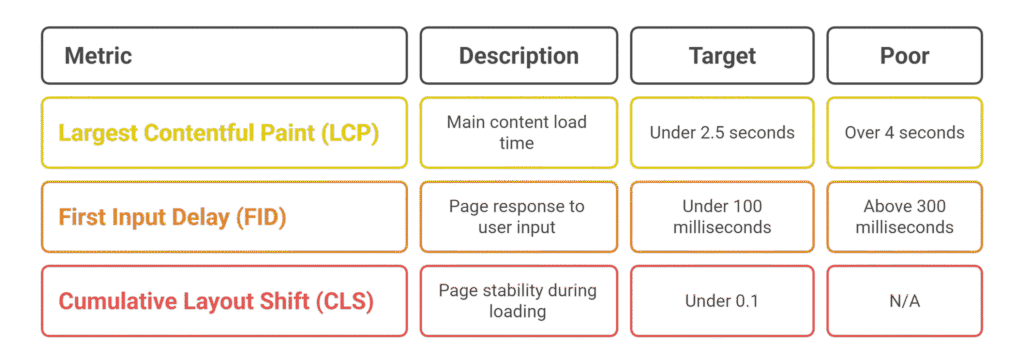
The three Core Web Vitals Google measures are:
Largest Contentful Paint (LCP): How long it takes for the main content on your page to load. Google wants this under 2.5 seconds. Anything over 4 seconds is considered poor.
First Input Delay (FID): How quickly your page responds when someone tries to click a button or tap a link. This should be under 100 milliseconds. Above 300 milliseconds and you’re in trouble.
Cumulative Layout Shift (CLS): Whether your page jumps around while loading. You know that annoying experience when you’re about to click something and the page shifts, making you click the wrong thing? That’s what this measures. Google wants a score under 0.1.
Google doesn’t publish a simple “your website must load in X seconds” rule because the relationship between speed and rankings is more nuanced. A website loading in 1.5 seconds will generally outperform one loading in 5 seconds, but it’s not the only factor. Content quality, relevance, backlinks, and dozens of other signals still matter.
However, here’s what we know from working with UAE businesses: when everything else is equal, the faster website wins. And when you’re competing for local searches in Dubai, Abu Dhabi, or Sharjah, that speed advantage can be the difference between page one and page three.
Why does page speed matter more for UAE businesses?
The UAE digital landscape has some unique characteristics that make page speed even more critical than in other markets.
First, mobile usage in the UAE is among the highest in the world. A recent study showed that UAE residents spend an average of 8 hours per day on their mobile devices. That’s not just social media scrolling. People are researching businesses, comparing prices, booking services, and making purchases all from their phones. If your website isn’t optimized for mobile speed, you’re essentially closing your doors to the majority of your potential customers. Any web development company in UAE will tell you that mobile optimization isn’t optional anymore, it’s the foundation of digital success in this market.
Second, the UAE market is incredibly competitive. Whether you’re running a restaurant in JBR, a beauty salon in Deira, or a consulting firm in Business Bay, you’re competing with dozens of similar businesses within a few kilometers. When someone searches “best Italian restaurant near me” or “emergency plumber Dubai Marina,” they’re not going to wait around for a slow website to load. They’ll hit the back button and try the next result.
Third, consumer expectations in the UAE are higher than almost anywhere else. This is a market where same-day delivery is standard, where customer service is a key differentiator, and where quality matters more than price for many segments. UAE consumers expect excellence, and that includes digital experiences. A slow website signals poor quality and lack of attention to detail.
There’s also a technical reality specific to the region. While internet infrastructure in the UAE is generally excellent, hosting location matters enormously. If your website is hosted on a server in the United States or Europe, there’s a physical delay as data travels thousands of kilometers. For UAE businesses serving UAE customers, using a local or regional server can shave hundreds of milliseconds off your website load time.
Finally, consider the business cost. The UAE has one of the highest costs per click (CPC) for Google Ads in the region. If you’re paying 15 to 50 dirhams every time someone clicks your ad, only to have them leave immediately because your page is slow, you’re literally burning money. Even a one-second improvement in website load time can increase conversion rates by 7% according to industry data. For a business spending 10,000 dirhams monthly on ads, that’s 700 dirhams in additional revenue, or 8,400 dirhams annually, just from getting faster.
How do I measure my current website speed accurately?
Before you can improve your website speed, you need to know where you stand. But here’s the tricky part: there are dozens of speed testing tools out there, and they often give you different results. Which one should you trust?
The most reliable starting point is Google’s own tools, because they’re measuring exactly what Google cares about for rankings.
Google PageSpeed Insights is your primary tool. Just enter your URL and it will test both mobile and desktop versions of your site. You’ll get a score from 0 to 100, along with specific recommendations for improvement. More importantly, it shows you your Core Web Vitals scores based on real user data from Chrome browsers (if your site has enough traffic).
The scoring system works like this:
- 90-100: Fast (good)
- 50-89: Moderate (needs improvement)
- 0-49: Slow (poor)
But don’t obsess over getting a perfect 100 score. What matters more is whether you’re in the “good” range for Core Web Vitals and whether your site feels fast to real users.
Google Search Console is your second essential tool. If you’ve verified your website with Search Console (and you should have), you can check the Core Web Vitals report to see how your pages perform in the real world. This data comes from actual Chrome users visiting your site, which makes it more reliable than synthetic testing.
Search Console will categorize your URLs into three groups: Good, Needs Improvement, and Poor. Your goal is to get as many URLs as possible into the “Good” category.
Other useful tools include:
GTmetrix: Gives you detailed waterfall charts showing exactly which files are slowing down your site. It’s more technical but incredibly useful for developers.
Pingdom: Simple interface with testing from multiple global locations. Useful for checking how your site performs for international visitors.
WebPageTest: The most detailed tool available, letting you test from specific devices and connection speeds. Great for simulating how your site performs on 3G or 4G networks.
When testing your site, follow these practices for accurate results:
Test multiple pages, not just your homepage. Product pages, service pages, and blog posts often load differently.
Test at different times of day. Server performance can vary based on traffic levels.
Test on real devices if possible. Grab your phone and actually visit your site. How does it feel? That’s what your customers are experiencing.
Look beyond the overall score. A site scoring 85 with great Core Web Vitals might outperform a site scoring 95 with poor user metrics.
For UAE businesses specifically, make sure you’re testing with a Middle East server location when possible. Tools like GTmetrix and Pingdom let you choose your test location. Select somewhere close to the UAE to get realistic results for your target audience.
What are the biggest factors slowing down my website?
After testing hundreds of websites for UAE businesses, we’ve seen the same issues pop up again and again. The good news is that most speed problems come down to a handful of fixable issues.
Images are almost always the biggest culprit. A single unoptimized product photo can be 3-5 MB in size. When you have ten images on a page, you’re forcing visitors to download 30-50 MB of data before they can see your content. On a 4G connection, that could take 15-20 seconds.
Most images on websites don’t need to be high resolution. A hero banner that displays at 1920 pixels wide doesn’t need to be saved at 4000 pixels. Product photos that appear as thumbnails at 300×300 pixels shouldn’t be full-resolution 3000×3000 images. Yet we see this constantly, especially with websites built by designers who prioritize visual quality over performance.
Hosting quality makes a massive difference. Cheap shared hosting packages that cost 10-20 dirhams per month are popular with small businesses trying to save money. But these servers are often overloaded, located far from the UAE, and use outdated technology. When 500 other websites are sharing the same server resources, your site slows to a crawl during peak hours.
Unoptimized code is another frequent issue. Websites built with page builders like Elementor or Divi are incredibly popular because they let non-technical users create beautiful designs. But these tools often generate bloated code with excessive CSS and JavaScript. We’ve seen websites loading 50-70 separate JavaScript files just to display a simple contact form.
Third-party scripts can destroy your speed. Every Facebook Pixel, Google Analytics tag, live chat widget, and marketing tool you add to your site requires additional files to load. Some of these scripts are poorly coded and can delay everything else on your page. We’ve audited sites where a single marketing tool was adding 3-4 seconds to the load time.
Lack of caching is surprisingly common. Caching means storing a pre-generated version of your page so it doesn’t need to be rebuilt from scratch every time someone visits. Without caching, your server has to query the database, generate all the HTML, and send everything to the visitor on every single page load. With caching enabled, most of that work is skipped. Yet many small business websites have no caching configured at all.
Not using a Content Delivery Network (CDN) puts UAE businesses at a disadvantage. If your website files are stored on a single server in Dubai and someone in Abu Dhabi visits your site, the data has to travel that distance. It’s not far, but it’s measurable. With a CDN, your files are stored on multiple servers around the region, so visitors always connect to the closest one.
Too many fonts can slow things down. Custom fonts have become incredibly popular, and they do make websites look more polished and branded. But loading 4-5 font families with multiple weights (regular, bold, italic) can add hundreds of kilobytes of data and multiple server requests.
Database bloat affects WordPress sites especially. If you’re using WordPress, your database stores everything: posts, pages, revisions, spam comments, plugin settings. Over time, this database can grow massive with unnecessary data, slowing down every query your site makes.
The interesting pattern we’ve noticed with UAE businesses is that most websites have multiple issues compounding each other. It’s rarely just one thing. A site might have large images, slow hosting, no caching, and excessive plugins all at once. The good news is that fixing several of these issues together can lead to dramatic improvements.
Can I improve my website speed without a developer?
Absolutely. While some optimizations require technical expertise, there’s plenty you can do yourself to speed up your site significantly.
Start with your images. This is the single biggest impact you can have with minimal technical knowledge. Before uploading any image to your website, compress it using a free tool like TinyPNG or ShortPixel. These tools can reduce file sizes by 60-80% without any visible quality loss. For a business website with 50 images, this alone could save 20-30 MB of data.
If your site is already live with unoptimized images, install a plugin like Smush (for WordPress) or ShortPixel that can automatically optimize your existing image library. Yes, it takes time to process hundreds of images, but you only do it once.
Make sure you’re also using the right image format. JPEGs work best for photos. PNGs are better for logos and graphics with transparency. And newer formats like WebP can be even smaller while maintaining quality, though not all browsers support them yet.
Enable caching with a plugin. If you’re on WordPress, this is embarrassingly easy. Install a free plugin like WP Super Cache or W3 Total Cache, activate it, and use the default settings. That’s it. You’ve just implemented caching and probably cut your load time in half. More advanced users can tweak the settings later, but the default configuration works perfectly well for most small business sites.
Choose better hosting. If you’re on a bottom-tier shared hosting plan, consider upgrading to a better provider or a higher tier. Yes, it costs more, but the difference between spending 20 dirhams per month and 100 dirhams per month is barely noticeable to your business budget, while the performance improvement is dramatic.
Look for hosting providers with servers in the UAE or at least in the Middle East. Providers like Emirati-based hosts or international hosts with UAE data centers can make a real difference for local audiences.
Clean up your plugins. Go through your WordPress plugins and deactivate anything you’re not actively using. Every plugin adds code and potential database queries. If you installed something to test six months ago and forgot about it, remove it. Most sites can function perfectly well with 10-15 carefully chosen plugins instead of 30-40.
Lazy load your images and videos. Lazy loading means images below the fold only load when a visitor scrolls down to see them. Why force someone to download images they might never see? Most modern WordPress themes have this feature built in, or you can add it with a plugin. For videos, never auto-play them. Let visitors click to play, which prevents massive video files from loading unnecessarily.
Simplify your design. This might sting a bit, but sometimes the beautiful animated sliders, parallax backgrounds, and fancy hover effects are killing your performance. If you’re not a technical person, the easiest way to speed up your site might be choosing a simpler, faster theme that does less but loads quicker. A clean, fast website converts better than a slow, flashy one every single time.
Switch to system fonts or limit custom fonts. If your brand guidelines allow it, using system fonts (the ones already on your visitor’s device) means zero load time for typography. If you need custom fonts, limit yourself to one font family with 2-3 weights maximum. You don’t need eight different font combinations to have a professional website.
For businesses using website builders like Wix, Squarespace, or Shopify, your options are more limited since you don’t have full control over the code. But you can still optimize images before uploading, use their built-in image compression features, remove unnecessary apps and widgets, and choose simpler templates.
The key mindset shift is this: every element on your page has a speed cost. Before adding anything, ask whether it’s truly necessary for your business goals or if it’s just decorative. When in doubt, remove it.
How much speed improvement is enough to see results?
This is the question every business owner really wants answered. If you invest time and money into speeding up your website, what kind of return should you expect?
The data tells us that improvements are not linear. Shaving one second off a load time that was already three seconds has a bigger impact than shaving one second off a load time that was ten seconds. In other words, the first improvements you make tend to deliver the biggest returns.
Research from Google shows that when page load time increases from 1 second to 3 seconds, the probability of a bounce increases by 32%. If it reaches 5 seconds, the bounce probability jumps to 90%. That means almost everyone leaves. Going from 6 seconds to 10 seconds doesn’t make things much worse because you’ve already lost most visitors. But going from 3 seconds to 1.5 seconds? That’s a game changer.
For conversion rates, the data is equally compelling. A 2019 study by Deloitte found that a 0.1 second improvement in mobile site speed can increase conversion rates by 8.4% for retail sites. For travel sites, the improvement was 10.1%. Even small speed gains translate to meaningful business results.
But here’s what matters most: perception. Human psychology plays a huge role in how fast a website feels. If your site appears to load quickly, even if the full page takes another second or two to complete, visitors stay engaged. This is why techniques like lazy loading and progressive image loading work so well. They make the site feel fast even while additional content loads in the background.
For UAE businesses specifically, aim for these targets:
Mobile load time under 3 seconds on a 4G connection. This puts you in the top tier for user experience and should keep your bounce rate reasonable.
Core Web Vitals in the “good” range. That means LCP under 2.5 seconds, FID under 100 milliseconds, and CLS under 0.1. These are Google’s official benchmarks and meeting them gives you a clear ranking advantage.
Above 80 on Google PageSpeed Insights. While the score itself isn’t a ranking factor, it’s a useful proxy for overall performance. Sites scoring above 80 generally have solid technical foundations.
When you make improvements, you should start seeing results within a few weeks. Google needs time to recrawl your pages and reassess their speed. Don’t expect overnight changes to your rankings, but do track these metrics:
Bounce rate should decrease. If people were leaving immediately because your site was slow, fixing that will keep them around longer. Check your Google Analytics to see if bounce rate improves.
Pages per session should increase. When pages load quickly, visitors are more willing to click through to other pages on your site.
Conversion rate should improve. Whether your goal is form submissions, phone calls, or sales, a faster site removes friction from the conversion process.
Average search ranking should gradually improve. Use tools like Google Search Console or rank tracking software to monitor whether your pages are climbing in search results.
For a real-world example from our work with UAE clients: we optimized a Dubai-based e-commerce site that was taking 7.8 seconds to load on mobile. After implementing image compression, upgrading hosting, adding a CDN, and enabling caching, we got it down to 2.3 seconds. Within six weeks, their average search ranking improved by 8 positions across their target keywords. Their conversion rate increased from 1.2% to 2.1%, nearly doubling their sales without any change to traffic levels. The investment in speed improvements paid for itself within two months.
What should I do right now to speed up my site?
If you’re reading this and realizing your website is probably too slow, here’s your action plan starting today.
Step one: Test your site. Open Google PageSpeed Insights and enter your URL. Test both mobile and desktop versions. Write down your scores and your Core Web Vitals metrics. Take screenshots so you can compare later. This is your baseline.
Step two: Check your hosting. Log into your hosting account and see what plan you’re on. If you’re on the cheapest shared hosting option, that’s likely a major bottleneck. Research UAE-based hosting providers or international hosts with Middle East servers. Compare your current plan to something mid-tier. The cost difference is usually minimal but the performance gain is substantial.
Step three: Optimize your images. This is your highest impact action. If your site is live, install an image optimization plugin and let it compress your existing library. For new images, establish a workflow where you compress everything before uploading. Make this a permanent habit.
Step four: Enable caching. If you haven’t already, install a caching plugin and activate it with default settings. This takes five minutes and can cut your load time in half immediately.
Step five: Remove unused plugins and scripts. Audit every plugin, widget, and third-party tool on your site. If you’re not actively using it, remove it. Be ruthless. You can always reinstall later if needed.
Step six: Consider a CDN. Services like Cloudflare offer free plans that can significantly speed up content delivery for UAE visitors. The setup is technical but many hosting providers offer one-click Cloudflare integration now. If you’re not comfortable doing this yourself, it’s worth paying a developer for an hour of work.
Step seven: Test again. After making changes, wait 24 hours for caching to fully populate, then test your site again with PageSpeed Insights. Compare the results to your baseline. You should see meaningful improvements.
Step eight: Monitor ongoing. Set a calendar reminder to check your site speed every month. As you add new content, install new plugins, or make design changes, your speed can degrade over time. Regular monitoring helps you catch issues early.
For businesses that want professional help, look for a UAE-based digital agency that specifically mentions page speed optimization in their services. Be wary of website designers who only care about aesthetics and don’t consider performance. Ask potential agencies about their approach to site speed and request case studies showing before-and-after improvements.
The bottom line is this: you don’t need a massive budget or technical expertise to have a fast website. You need awareness, a willingness to prioritize performance over unnecessary bells and whistles, and commitment to ongoing maintenance. The businesses that treat site speed as a core part of their digital strategy are the ones that dominate search results and convert more visitors into customers. Working with a web development and design agency in UAE that understands these priorities can make the implementation process smoother and ensure your site remains competitive in the long term.
Your website is often the first impression a potential customer has of your business. Make sure that impression is fast, smooth, and professional. In the competitive UAE market, it might just be the edge you need.
FAQ
How often should I check my website speed?
Check your website speed at least once a month, especially after making any changes like adding new plugins, updating themes, or uploading content. Major algorithm updates from Google or significant traffic increases are also good times to run tests. Set up monitoring through Google Search Console to get alerts if your Core Web Vitals scores drop into problem ranges. For e-commerce sites or businesses running paid advertising campaigns, weekly monitoring makes sense because small speed issues can quickly impact conversion rates and ad performance.
Does website speed affect my Google Ads quality score?
Yes, indirectly. While page speed isn’t a direct component of Google Ads Quality Score, it heavily influences user experience, which is a major factor. If visitors click your ad and then immediately bounce because your landing page loads slowly, Google notices that poor engagement. Lower Quality Scores mean you pay more per click and get worse ad positions. Many UAE businesses don’t realize they’re wasting ad spend because their landing pages are too slow. Improving page speed often leads to better Quality Scores, lower costs per click, and higher conversion rates from the same advertising budget.
Should I use a UAE-based hosting provider?
If your primary customers are in the UAE, yes, using a hosting provider with servers located in the UAE or nearby regions makes a noticeable difference. Physical distance matters for data transmission. A website hosted in the United States might take 200-300 milliseconds longer to respond than one hosted in Dubai, simply because of the distance data needs to travel. For local businesses serving local customers, UAE-based or Middle East-based hosting is almost always the better choice. International businesses serving global audiences might benefit from a global CDN more than local hosting alone.
Can a slow website hurt my business even if I rank well?
Absolutely. Ranking on page one means nothing if visitors leave immediately because your site takes too long to load. High bounce rates signal to Google that users aren’t finding what they need, which can eventually hurt your rankings. But beyond SEO, there’s a direct business impact. Studies show that conversion rates drop by an average of 4.42% for each additional second of load time. If your competitor ranks below you but their site loads faster, they’re getting more sales despite worse rankings. Speed is about user experience and business results, not just search position.
What is the difference between server response time and page load time?
Server response time is how long it takes your web server to send the first byte of data after someone requests your page. Page load time is the total time until everything on the page, including images, scripts, and stylesheets, has finished loading. A slow server response time means delays before anything even starts loading. You can have a fast server but slow page load time if you have large images and excessive scripts. Both metrics matter. Aim for server response times under 200 milliseconds and total page load times under 3 seconds on mobile. If your server response is slow, the problem is usually hosting quality or database performance.
How much should I spend to improve my website speed?
It depends on your current situation, but many improvements cost little to nothing. Image compression, caching plugins, and removing unused code are all free. Upgrading from budget hosting to mid-tier hosting might cost an extra 50-100 dirhams per month. Implementing a CDN can be free with Cloudflare’s basic plan or 100-200 dirhams monthly for premium options. Hiring a developer to audit and optimize your site professionally typically costs 1,500-5,000 dirhams depending on complexity. For most UAE small businesses, an investment of 2,000-3,000 dirhams plus slightly higher monthly hosting costs will dramatically improve speed. Compare that to what you spend on advertising and it becomes obvious that speed optimization has an excellent return on investment.

How to Appear in AI Engine Responses When People Search for Services
When someone asks ChatGPT, “What’s a good digital marketing agency in Dubai?” or “Where can I find web design services in the UAE?” there’s a very real chance your business won’t even be mentioned. And that should worry you.
We’re in the middle of a major shift in how people discover businesses. Traditional search engines are still important, but AI-powered tools like ChatGPT, Perplexity, and Google’s AI Overviews are becoming the new front door to the internet. These platforms don’t just list links anymore. They give direct answers, recommendations, and complete responses without requiring users to click through to websites.
For businesses in the UAE, this changes everything. If your company isn’t being cited by AI engines, you’re invisible to a rapidly growing segment of potential customers. The good news? You can influence what these AI tools say about you. It’s not magic, and it’s not luck. It’s a deliberate strategy called Generative Engine Optimization (GEO), and it’s becoming just as critical as SEO ever was.
This article will show you exactly how to position your business so that when someone asks an AI about your industry, your services, or your location, your name comes up.
What makes AI engines recommend certain businesses over others?
AI engines like ChatGPT don’t browse the web in real time the way you do. Instead, they pull information from massive datasets they were trained on, plus real-time sources when search capabilities are enabled. What matters most is whether your business exists in credible, structured, and accessible places across the internet.
Think of it like this: if a journalist were writing an article about the best marketing agencies in Dubai, they’d look for businesses with strong reputations, clear expertise, and visible proof of their work. AI engines operate similarly. They scan for signals of authority, relevance, and trust.
Here’s what influences their recommendations:
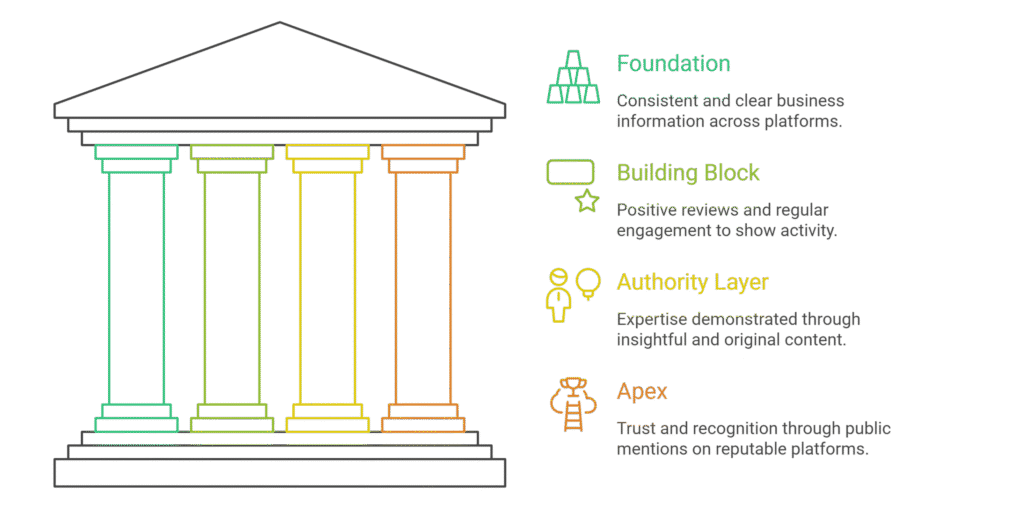
Public mentions across trusted platforms. If your business is cited on reputable websites, industry blogs, news outlets, or business directories, AI engines are more likely to recognize you as legitimate. A single mention on a high-authority site can carry more weight than dozens of low-quality backlinks.
Structured business information. AI tools favor businesses with clear, consistent details across the web. Your name, location, services, and contact information should match everywhere. Inconsistent NAP (Name, Address, Phone) data confuses AI engines just like it confuses search engines.
Content that demonstrates expertise. Publishing insightful, well-researched content signals authority. When you write about your industry with depth and originality, AI engines treat you as a credible source. Generic blog posts won’t cut it. You need to offer perspectives and information that others don’t.
Reviews and social proof. AI engines notice patterns in customer feedback. Businesses with consistent positive reviews across Google, Trustpilot, or industry-specific platforms get weighted more favorably. The volume and quality of reviews matter.
Engagement and activity. Regular updates to your website, active social media presence, and fresh content all indicate that your business is current and operational. Dormant websites raise red flags.
The key takeaway? AI engines reward businesses that look credible from multiple angles. It’s not about gaming a single algorithm. It’s about building a genuinely authoritative online presence.
How can UAE businesses make their information more accessible to AI tools?
Getting mentioned by AI engines starts with making your business easy to find and understand. Many UAE businesses have great services but poor digital foundations. If an AI can’t easily parse who you are, what you do, and where you operate, you won’t get recommended.
Claim and optimize your Google Business Profile. This is non-negotiable. Your Google Business Profile is often the first structured data source AI engines encounter. Make sure your profile is complete with accurate business hours, service areas, high-quality photos, and regular posts. Respond to every review, both positive and negative.
Get listed in reputable business directories. Focus on quality over quantity. Directories like Yelp, Yellow Pages UAE, Bayut (for real estate), and industry-specific platforms carry weight. Make sure your information is identical across all listings. Even small discrepancies can dilute your authority.
Build citations on local and industry-relevant websites. A citation is any online mention of your business name, address, and phone number. Getting cited by UAE business publications, chambers of commerce, or local event pages strengthens your regional relevance. AI engines use geographic signals heavily when making recommendations.
Create detailed service pages on your website. Don’t just list your services. Explain them thoroughly. For example, if you offer social media management, create a dedicated page that covers what’s included, who it’s for, case studies, pricing considerations, and common questions. The more comprehensive your content, the more likely AI engines will reference it.
Use structured data markup (schema). This is technical but important. Schema markup helps AI engines understand your website’s content in a structured way. Implement LocalBusiness schema, FAQPage schema, and Service schema where relevant. Most modern website platforms or plugins can handle this with minimal effort.
Publish on third-party platforms. Write guest articles for UAE business blogs, contribute to industry forums, or get interviewed for podcasts. Every mention on an external, credible platform increases your visibility to AI tools.
For UAE businesses specifically, emphasizing your local presence is crucial. Mention your Emirates location, reference local business challenges, and connect your services to regional needs. AI engines are getting better at understanding geographic context, and being explicitly UAE-focused helps.
Why do citations and authoritative mentions matter more than website traffic alone?
Here’s something most businesses get wrong: they obsess over website traffic but ignore digital authority. High traffic doesn’t automatically make AI engines recommend you. What matters more is who’s talking about you and where.
Traditional SEO focused heavily on driving clicks. The goal was to rank high in search results so people would visit your site. But AI engines don’t send traffic the same way. They synthesize information and deliver it directly. If your business is mentioned in their response, users might not even visit your website. They’ll just contact you based on the recommendation.
This shift means citations, mentions, and authoritative references have become more valuable than ever. When a respected UAE business publication mentions your agency, when a client case study appears on a partner’s website, or when you’re quoted in an industry report, these signals tell AI engines you’re worth recommending.
Quality beats quantity. One mention in Arabian Business or Gulf News carries more weight than 50 mentions on obscure blogs. Focus your effort on getting featured in places that matter. Reach out to journalists, offer expert commentary, and build relationships with industry publications.
Context matters. How you’re mentioned is just as important as where. A casual mention in a list isn’t as powerful as a detailed case study or an in-depth interview. The more context provided around your business, the more useful the information becomes to AI engines.
Consistency reinforces credibility. When the same accurate information about your business appears across multiple trustworthy sources, it creates a pattern AI engines recognize. This is why maintaining consistent NAP data matters so much.
Many UAE businesses still treat link building as a numbers game. They chase backlinks without considering source quality. But in the age of AI-powered search, a single authoritative mention can outperform hundreds of low-quality links. Shift your strategy accordingly.
What content strategies help businesses get cited by ChatGPT and other AI platforms?
Content is still king, but the rules have changed. Writing generic blog posts won’t get you noticed by AI engines. You need to create content that’s authoritative, structured, and directly answers specific questions people are asking.
Answer real questions with depth. AI engines prioritize content that thoroughly addresses user intent. Identify questions your target audience asks and create comprehensive answers. For example, instead of a surface-level post about “digital marketing tips,” write an in-depth guide on “How UAE retail businesses can use Instagram Reels to increase foot traffic.”
Focus on originality and expertise. AI engines are trained to recognize unique insights. Share case studies, proprietary data, or frameworks you’ve developed. If you’re just repackaging information available everywhere else, you won’t stand out. Offer something competitors don’t.
Use clear structure and formatting. Break your content into logical sections with descriptive headings. Use bullet points, numbered lists, and short paragraphs. AI engines parse well-structured content more effectively. FAQ sections are particularly valuable because they match how users ask questions to AI tools.
Write for questions, not just keywords. Traditional SEO targeted keywords like “best marketing agency Dubai.” GEO requires thinking about how people phrase questions to AI: “Which marketing agencies in Dubai specialize in e-commerce?” Structure your content around these natural question patterns.
Include statistics and sources. AI engines favor content that cites credible data. When you reference studies, reports, or statistics, you’re signaling authority. Always link to your sources. This not only strengthens your credibility but also creates connections to other authoritative content.
Publish consistently. Fresh content signals that your business is active and current. Aim for at least one substantial piece of content per month. Updating older content is equally important. Refresh outdated statistics, add new sections, and ensure everything remains accurate.
Create location-specific content. If you’re targeting UAE clients, make your geographic focus explicit. Write about UAE business regulations, local market trends, or regional case studies. This helps AI engines understand your geographic relevance when users ask location-specific questions.
The businesses getting recommended by AI engines aren’t necessarily the ones with the most content. They’re the ones creating the most valuable, authoritative, and well-structured content.
How should businesses handle online reviews to improve their AI visibility?
Reviews are one of the most underrated factors in AI visibility. When someone asks ChatGPT for a recommendation, positive reviews act as social proof that influences whether your business gets mentioned. But simply having reviews isn’t enough. You need the right reviews in the right places.
Focus on Google reviews first. Google remains the most important review platform for most businesses. Actively encourage satisfied customers to leave detailed reviews on your Google Business Profile. The more specific and descriptive the review, the better. Generic “great service” reviews help, but detailed feedback about specific services carries more weight.
Diversify across platforms. Don’t put all your eggs in one basket. Depending on your industry, reviews on Trustpilot, Facebook, or industry-specific platforms matter. For UAE businesses, regional platforms can be just as important as international ones.
Respond to every review. Engaging with reviews, both positive and negative, shows AI engines that your business is active and customer-focused. When responding to negative reviews, be professional, empathetic, and solution-oriented. How you handle criticism speaks volumes about your business.
Encourage detailed feedback. Generic reviews don’t provide much signal. Politely ask customers to mention specific services they used, what problems you solved, and what made their experience positive. Detailed reviews give AI engines more context to work with.
Address consistency. Make sure the services mentioned in your reviews align with what’s on your website. If customers consistently praise your web design work but your website barely mentions it, that’s a missed opportunity. Use review feedback to guide your content strategy.
Don’t buy fake reviews. This should go without saying, but businesses still do it. AI engines and platforms are increasingly sophisticated at detecting fake reviews. Getting caught can destroy your credibility permanently. Focus on earning genuine reviews through excellent service.
Monitor your reputation regularly. Set up alerts for your business name across the web. When you’re mentioned, whether in a review, article, or forum, you want to know about it. This allows you to respond appropriately and address any misinformation quickly.
For UAE businesses, remember that customer expectations around service and responsiveness are high. Building a strong review profile isn’t just about AI visibility, it’s about demonstrating that you consistently deliver quality work.
What technical elements make your website more recognizable to AI engines?
Even the best content won’t help if AI engines can’t properly interpret your website. Technical optimization ensures that when AI tools crawl your site, they understand exactly what you offer and who you serve.
Implement schema markup properly. Schema is structured data that explicitly tells AI engines what different elements of your website represent. Use LocalBusiness schema to identify your company information, Service schema to describe your offerings, and FAQPage schema for your FAQ sections. These tags make your content machine-readable.
Create an XML sitemap. A sitemap helps AI engines understand your site structure and find all your important pages. Submit your sitemap to Google Search Console and keep it updated whenever you add new content.
Ensure mobile optimization. AI engines prioritize mobile-friendly websites because most users access the internet on mobile devices. Your site needs to load quickly and display properly on all screen sizes. Test your site regularly using Google’s Mobile-Friendly Test tool.
Improve site speed. Slow websites get penalized. Compress images, minimize code, use caching, and choose quality hosting. Page speed affects both traditional SEO and how AI engines perceive your site’s quality.
Fix broken links and errors. A website with numerous 404 errors or broken links appears neglected. Regularly audit your site for technical issues and fix them promptly. Tools like Screaming Frog or Google Search Console can help identify problems.
Use descriptive URLs. Your URL structure should be clean and descriptive. Instead of “yoursite.com/page123,” use “yoursite.com/social-media-management-dubai.” This helps both users and AI engines understand page content at a glance.
Optimize for security. HTTPS is now standard. If your site still uses HTTP, switch to HTTPS immediately. Security certificates signal trust to both users and AI engines.
Create comprehensive internal linking. Link related pages within your website. This helps AI engines understand relationships between your content and discover all your important pages. It also keeps users engaged longer.
For UAE businesses, technical optimization is often overlooked in favor of design. But a beautiful website that AI engines can’t properly interpret won’t get you recommended. Invest in both.
How can businesses track whether they are being mentioned by AI engines?
You can’t improve what you don’t measure. Tracking your AI visibility is different from monitoring traditional SEO metrics. You need new tools and approaches to understand how often and where AI engines mention your business.
Test manually with targeted queries. Regularly ask ChatGPT, Perplexity, Google’s AI Overviews, and Bing Chat questions your customers might ask. Try different variations like “best marketing agencies in Dubai,” “where can I find web design services in UAE,” or “digital marketing help for small businesses in Abu Dhabi.” Document when and how your business appears.
Set up brand monitoring. Use tools like Google Alerts, Mention, or Brand24 to track when your business name appears online. While these tools primarily track traditional web mentions, they help you understand your overall digital footprint, which influences AI recommendations.
Monitor your citation profile. Tools like Moz Local or BrightLocal help track where your business information appears across the web and whether it’s consistent. Inconsistent citations hurt your visibility.
Track referral traffic sources. Pay attention to where your website traffic comes from. While AI engines don’t always send direct traffic, you might notice referrals from platforms where AI tools cited your content.
Use AI detection tools cautiously. Some emerging tools claim to track AI mentions, but the technology is still developing. Approach these tools with realistic expectations and validate their findings manually.
Survey your customers. Ask new clients how they found you. If they mention using ChatGPT or another AI tool, document it. This qualitative data is valuable for understanding your actual AI visibility.
Monitor competitor mentions. Don’t just track your own business. See how often competitors appear in AI responses. Understanding their strategies can inform your own approach.
Tracking AI visibility is still an evolving practice. There’s no perfect tool yet that captures everything. A combination of manual testing, traditional monitoring tools, and customer feedback gives you the clearest picture. Do this monthly at minimum, weekly if you’re actively working on improving your presence.
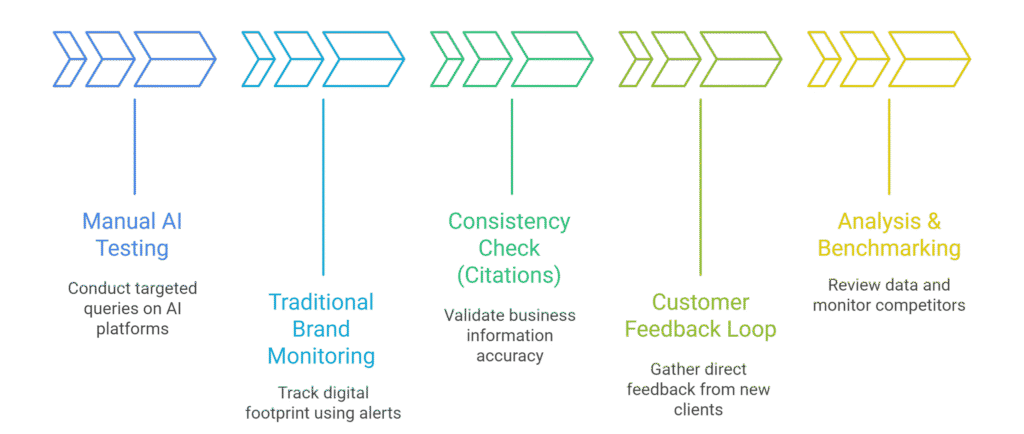
What role does social media activity play in getting recommended by AI platforms?
Social media isn’t just for engagement anymore. It’s becoming a significant factor in how AI engines evaluate businesses. Active, authentic social media presence sends signals about your business’s legitimacy and relevance.
Consistency matters more than frequency. You don’t need to post five times a day, but you should maintain a regular presence. Inactive accounts suggest a dormant business. Aim for at least a few quality posts per week across your primary platforms.
Platform choice depends on your audience. For UAE businesses, LinkedIn is crucial for B2B, Instagram works well for visual services and B2C, and Twitter can be valuable for tech and media industries. Focus your effort on platforms where your customers actually spend time.
Engagement signals authenticity. Responding to comments, participating in conversations, and interacting with your community shows AI engines that real people engage with your business. It’s not just about broadcasting messages.
Share your expertise. Use social media to demonstrate thought leadership. Share insights, comment on industry trends, and provide value. When your social content gets shared and referenced, it contributes to your overall authority profile.
Link back to your comprehensive content. Use social media to drive attention to your in-depth blog posts and resources. This creates a bridge between your social presence and your website content, both of which AI engines evaluate.
Maintain consistent branding and information. Your social profiles should match your website and business listings. Same logo, same business description, same contact information. Inconsistencies create confusion.
Build genuine connections with industry accounts. Engage with journalists, publications, and other businesses in your space. These relationships can lead to mentions and citations that boost your AI visibility.
Social media alone won’t get you recommended by AI engines, but it’s an important piece of the puzzle. It demonstrates your business is real, active, and connected to your industry.
Why should UAE businesses start optimizing for AI engines now rather than waiting?
The businesses that start positioning themselves for AI visibility today will have an enormous advantage over those who wait. This isn’t a future concern. It’s happening right now, and the gap between early adopters and laggards is widening quickly. Securing AI Search visibility optimization support UAE can help businesses bridge this gap and ensure they’re not left behind as search behavior continues to evolve.
User behavior is already changing. Millions of people worldwide already use ChatGPT, Perplexity, and other AI tools as their primary research method. This number is growing exponentially. In the UAE, tech adoption rates are among the highest globally. Your potential customers are already using these tools.
First-mover advantage is real. AI engines often develop preferences for businesses they consistently see mentioned across credible sources. If your competitors establish authority first, you’ll have to work harder to catch up. Being early means building a foundation while competition is still light.
The strategies compound over time. Unlike paid advertising where you stop getting results the moment you stop paying, GEO strategies build momentum. Each citation, each piece of authoritative content, each positive review contributes to a growing pattern AI engines recognize. Starting now means you’ll have months or years of compounding authority when your competitors finally catch on.
It’s more cost-effective than traditional advertising. Building AI visibility requires effort, not massive budgets. Small and medium businesses in the UAE can compete effectively with larger competitors by focusing on authoritative content and strategic citations. This levels the playing field in ways that paid advertising never could.
Search is fragmenting. Google’s dominance is declining as users spread across multiple platforms. Optimizing for AI engines means showing up wherever people are looking, not just in traditional search results. This diversification protects your business from over-reliance on any single channel.
UAE’s digital landscape is evolving rapidly. The UAE government’s digital transformation initiatives, smart city projects, and tech-forward policies mean AI adoption will likely accelerate faster here than in many other regions. Businesses that adapt early will be positioned to capitalize on these changes.
The question isn’t whether you should optimize for AI visibility. It’s whether you’ll do it before your competitors do. Every month you wait, they’re building authority you’ll have to overcome.
Conclusion
Appearing in ChatGPT responses and other AI engine recommendations isn’t about tricks or shortcuts. It’s about building genuine digital authority through strategic, consistent effort. The businesses AI engines recommend are the ones with credible citations across the web, structured and comprehensive content, positive reviews, and clear expertise in their field.
For UAE businesses, this represents both a challenge and an opportunity. The challenge is that many local businesses haven’t invested in building this kind of digital foundation. The opportunity is that starting now with AI Search Optimization UAE puts you ahead of most of your competition and positions your brand as a forward-thinking leader in your industry.
The fundamentals haven’t changed: provide excellent service, build real expertise, and communicate clearly about what you do and who you serve. What’s changed is how AI engines evaluate these signals and how people discover businesses. Traditional search isn’t disappearing, but it’s no longer the only game in town.
Start by auditing your current digital presence. Is your business information consistent across the web? Are you creating valuable content that demonstrates expertise? Are you actively building citations and reviews? Are you making your website technically sound and easy for AI engines to understand?
Then commit to consistent improvement. This isn’t a one-time project. It’s an ongoing strategy that compounds over time. The businesses winning with AI visibility aren’t necessarily the biggest or oldest. They’re the ones that recognized the shift early and acted deliberately.
The future of business discovery is already here. The only question is whether you’ll be part of it.
FAQs
How long does it take for a business to start appearing in AI engine responses?
There’s no fixed timeline because it depends on your starting point and how aggressively you implement GEO strategies. Businesses with some existing authority might see mentions within 2-3 months of focused effort. Companies starting from scratch should expect 6-12 months of consistent work before seeing regular AI recommendations. The key is persistence. Each citation, review, and piece of content contributes to a pattern AI engines will eventually recognize.
Do I need to hire an agency to optimize for AI engines or can I do it myself?
You can absolutely do this yourself if you have time and willingness to learn. The fundamentals involve creating quality content, building citations, managing reviews, and ensuring technical optimization. These are learnable skills. However, an experienced agency can accelerate results by knowing exactly which strategies work, having existing relationships with relevant platforms, and handling technical implementation properly. For most small businesses in the UAE, starting with DIY basics and bringing in help for technical aspects offers the best balance.
Will optimizing for AI engines hurt my traditional SEO rankings?
No, they complement each other. The strategies that help AI engines discover and recommend you also strengthen traditional SEO. Quality content, authoritative citations, positive reviews, and technical optimization benefit both. The main difference is emphasis: traditional SEO focuses heavily on keywords and backlinks, while GEO prioritizes structured information, authoritative mentions, and comprehensive expertise. A business can and should optimize for both simultaneously.
What if my competitors are mentioned by AI engines but I am not?
This means they’ve built more recognizable digital authority in areas AI engines value. Research where they’re being cited, what content they’ve published, and what review platforms they’re active on. You’ll likely find they’re doing several things consistently that you’re not. The good news is authority can be built. Focus on creating better content, earning citations from higher-quality sources, and providing exceptional service that generates genuine positive reviews. Consistency beats shortcuts.
Are some industries more likely to be recommended by AI engines than others?
Currently yes, though this is changing rapidly. Industries with clear service definitions, measurable outcomes, and established review cultures see more AI recommendations. This includes restaurants, hotels, software tools, and professional services. However, AI engines are quickly expanding into virtually every sector. Regardless of your industry, the fundamentals remain the same: demonstrate expertise, build authority, and make your information accessible and trustworthy.
Can I pay to be mentioned in ChatGPT responses or other AI tools?
Not directly, and that’s by design. AI engines aim to provide unbiased, helpful recommendations based on actual authority and relevance, not advertising dollars. However, you can invest in the strategies that build that authority: creating exceptional content, earning legitimate citations, generating genuine reviews, and improving your technical presence. These require investment of time and resources, but they’re fundamentally different from paying for placement. Focus on earning your way into AI recommendations rather than trying to buy them.
What Is the Difference Between SEO and GEO for Businesses?
If you’ve spent any time trying to grow your business online, you’ve probably heard about SEO. You might have even invested in it. But there’s a new term making waves in digital marketing circles: GEO, or Generative Engine Optimization.
Most business owners in the UAE are just starting to hear about GEO, and many assume it’s just another buzzword for the same old SEO tactics with a fresh coat of paint. That assumption could cost you customers.
The truth is, SEO and GEO are fundamentally different strategies designed for fundamentally different technologies. SEO helps you rank in traditional search engines like Google. GEO helps you appear in AI-generated responses from tools like ChatGPT, Perplexity, Google’s AI Overviews, and Bing’s Copilot.
Both matter. Both can drive business. But they require different approaches, and understanding the distinction is becoming critical for any business that wants to stay visible online. This article breaks down exactly what separates SEO from GEO, why both matter for UAE businesses, and how to approach each strategically.
How do traditional search engines and AI engines find and display information differently?
The fundamental difference between SEO and GEO comes down to how information gets found and presented to users. Traditional search engines and AI engines operate on completely different principles.
When you search on Google, the engine scans billions of web pages, ranks them based on hundreds of factors, and presents you with a list of links. The goal is to send you to websites where you’ll find your answer. Google’s business model depends on you clicking those links, seeing ads, and coming back to search again.
AI engines work differently. When you ask ChatGPT or Perplexity a question, these tools generate a direct answer by synthesizing information from multiple sources. Instead of giving you ten blue links to explore, they give you a comprehensive response right there. You might never click a single link.
This changes everything about how businesses need to think about visibility.
Traditional search engines prioritize ranking. The game is about getting your website into the top positions for specific keyword searches. Position one gets roughly 28% of clicks, position two gets about 15%, and it drops quickly from there. Being on page two might as well be invisible.
AI engines prioritize synthesis. They pull information from various sources to construct answers. Your business might be mentioned alongside competitors, or not mentioned at all, depending on whether the AI considers you authoritative and relevant. There’s no position one. There’s only whether you’re included in the response or not.
Search engines value links. Backlinks from other websites signal authority in traditional SEO. The more quality sites linking to you, the more Google trusts you. Link building has been the backbone of SEO strategy for decades.
AI engines value citations and structured data. While links still matter, AI tools place heavier weight on how often you’re mentioned across credible sources, how clear your business information is, and how well you demonstrate expertise. A single mention in a respected publication can carry more weight than dozens of backlinks from obscure blogs.
Search engines reward keyword optimization. Knowing what terms people search for and optimizing your content around those exact phrases has been essential for SEO success. Keyword research tools and strategic placement drive strategy.
AI engines reward natural language and comprehensive answers. They’re trained to understand context and intent, not just match keywords. Content that thoroughly addresses questions in natural, conversational language performs better than keyword-stuffed pages.
For UAE businesses, this means you can’t just rely on your existing SEO strategy and expect to appear in AI responses. You need a parallel approach designed specifically for how AI engines evaluate and cite sources.
What specific strategies work for SEO that may not work for GEO?
SEO tactics have been refined over two decades. Many of them are still valuable, but some don’t translate well to GEO. Understanding which strategies remain effective and which need rethinking is essential.
Keyword stuffing has always been questionable for SEO, but it’s completely ineffective for GEO. Traditional SEO, especially in its early days, sometimes rewarded repeating keywords throughout content. Modern SEO algorithms penalize this, but some businesses still try it. AI engines ignore keyword density entirely. They focus on whether your content comprehensively answers questions and demonstrates genuine expertise.
Exact match domains matter less for GEO. In traditional SEO, having a domain like “dubaimarketingagency.com” provided ranking advantages for related searches. AI engines don’t weigh domain names as heavily. They care more about the authority and quality of your actual content and citations.
Traditional link building schemes don’t help GEO. Buying links from link farms, participating in link exchanges, or creating networks of sites that link to each other might have provided short-term SEO gains. These tactics don’t influence AI engines, which focus on legitimate mentions from authoritative sources rather than technical backlink profiles.
Meta descriptions work differently. For traditional SEO, meta descriptions help improve click-through rates from search results pages. AI engines don’t display meta descriptions. Instead, they parse your actual content to extract relevant information. This means every part of your visible content needs to be substantive, not just the meta tags.
Title tag optimization is less critical for GEO. SEO best practices emphasize perfect title tags with target keywords near the beginning. AI engines can understand content regardless of title structure. They’re more interested in the depth and accuracy of the information itself.
Focusing solely on your own website limits GEO effectiveness. Traditional SEO is largely about optimizing your own site and building links to it. GEO requires a broader approach. You need to be mentioned and cited across the web, not just have a perfect website. Guest posting, getting featured in publications, and building a presence on third-party platforms become more important.
Bounce rate and time on page matter differently. Traditional SEO uses behavioral signals like how long users stay on your page. AI engines don’t have access to this data when training or generating responses. They evaluate content quality through different signals like citation frequency, content structure, and demonstrated expertise.
This doesn’t mean traditional SEO is dead or irrelevant. Many core principles still apply to both. Quality content matters for both SEO and GEO. User experience matters. Authority matters. The difference is how each system evaluates these factors and what specific tactics work best for each.
Why does content structure matter more for GEO than traditional SEO?
Content structure has always mattered for SEO, but GEO takes it to another level. AI engines are fundamentally designed to extract and synthesize information. How you structure your content directly impacts how easily AI can understand and cite it.
AI engines prioritize scannable, clearly organized information. When ChatGPT or Perplexity processes content, it looks for clear hierarchies, defined sections, and logical flow. Content that rambles or buries key information in dense paragraphs is harder for AI to parse and less likely to be cited.
Question-based headings align with how users query AI. People don’t just type keywords into ChatGPT. They ask full questions: “What’s the best way to market a restaurant in Dubai?” or “How much should I budget for social media management?” Structuring your content with headings that mirror these natural questions helps AI engines match your content to user queries.
FAQ sections are particularly valuable for GEO. Frequently asked questions provide AI engines with clear question-answer pairs they can easily extract and cite. A well-crafted FAQ section optimized for actual user questions significantly improves your chances of being mentioned in AI responses.
Lists and bullet points enhance extractability. AI engines excel at pulling specific facts from lists. When you present information as clear bullet points or numbered lists, you make it easier for AI to extract exactly what it needs. This increases the likelihood your content will be referenced.
Comprehensive coverage outperforms surface-level content. Traditional SEO sometimes rewarded shorter, keyword-focused pages. AI engines favor thorough, in-depth content that fully addresses a topic. A 2,000-word comprehensive guide often performs better in GEO than five 400-word blog posts on related topics.
Explicit definitions and explanations help AI understand context. Don’t assume AI engines know what you’re talking about. If you use industry jargon or local references, define them clearly. For example, if you mention “free zones” in a UAE business context, briefly explain what they are. This helps AI provide accurate information to users who might not be familiar with the term.
Section summaries and clear transitions improve comprehension. AI engines process content sequentially. Clear transitions between sections and brief summaries of key points help AI follow your argument and understand how different pieces of information relate to each other.
For businesses creating content, this means shifting from purely keyword-focused writing to question-focused, comprehensive, and clearly structured writing. The good news is this approach also improves user experience, making it valuable for both SEO and GEO simultaneously.
How do backlinks for SEO compare to citations for GEO?
Backlinks have been the currency of SEO for years. Citations are becoming the currency of GEO. While they might seem similar, they function differently and require different strategies to build.
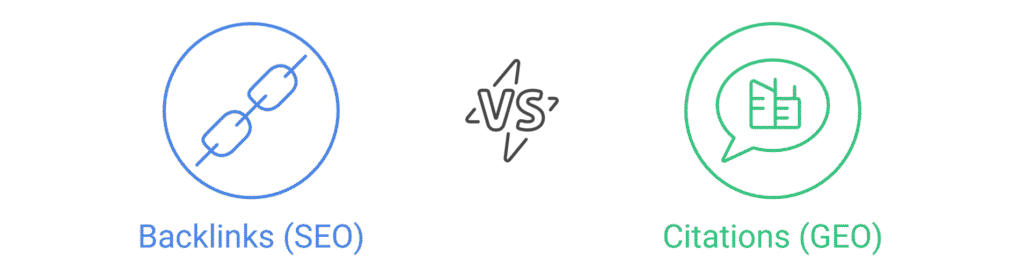
A backlink is a hyperlink from another website to yours. Traditional SEO treats backlinks as votes of confidence. Each quality site linking to you signals to Google that your content is valuable and trustworthy. The authority of the linking site, the relevance of the link, and the anchor text all influence how much SEO value that backlink provides.
A citation is any mention of your business across the web. For GEO purposes, a citation might include your business name, address, and phone number, but it can also be any reference to your company, services, or expertise. Citations don’t always include clickable links. The mention itself carries weight with AI engines.
Backlinks focus on volume and authority. Traditional link building strategies often emphasize getting as many quality backlinks as possible from high-authority domains. Tools like Ahrefs or Moz measure your site’s authority largely based on your backlink profile.
Citations focus on consistency and context. GEO cares more about whether your business information appears consistently across credible sources and whether those mentions demonstrate expertise. One detailed case study published in a respected UAE business publication might matter more than ten generic backlinks from random blogs.
Backlink anchor text influences SEO rankings. When sites link to you using specific keywords as anchor text, it helps you rank for those keywords. This is why SEO strategies often focus on getting backlinks with target keywords in the anchor text.
Citation context influences GEO recommendations. How your business is described in citations matters more than specific keywords. If multiple credible sources cite your agency as innovative or client-focused, AI engines incorporate those associations when generating recommendations.
Backlinks can be built through outreach and content marketing. Traditional link building involves creating link-worthy content, reaching out to webmasters, guest posting, and various tactics designed to earn links. It’s a proactive, targeted process.
Citations are built through broader presence and authority. Building citations for GEO requires getting featured in publications, contributing expert commentary, earning press coverage, maintaining consistent directory listings, and establishing thought leadership. It’s less about individual link placements and more about building a comprehensive digital footprint.
SEO penalizes manipulative link schemes. Google actively punishes sites caught buying links, participating in link networks, or using other black-hat link building tactics. The penalties can be severe.
GEO is harder to manipulate. Because AI engines evaluate patterns across diverse sources and prioritize authoritative mentions, there’s less opportunity for gaming the system. Fake citations or manipulated mentions are less effective because AI engines look for genuine authority signals.
For UAE businesses, this means your strategy needs to evolve beyond just link building. You need to focus on earning legitimate mentions across respected platforms, maintaining consistent business information everywhere you appear, and building genuine authority in your industry.
What role do reviews play differently in SEO versus GEO?
Reviews have always influenced consumer decisions, but their role in SEO versus GEO reveals important differences in how each system evaluates businesses.
For SEO, reviews primarily impact local search rankings. Google’s local search algorithm considers review quantity, velocity, and rating as ranking factors. Businesses with more positive reviews generally rank higher in local map packs and location-based searches. The reviews themselves don’t directly influence organic rankings for non-local queries.
For GEO, reviews influence whether AI engines recommend you at all. When someone asks ChatGPT for a recommendation, the AI considers review patterns as social proof of quality. Consistently positive reviews across platforms increase the likelihood your business gets mentioned. The content of reviews also matters because AI can extract specific information about your services and strengths.
SEO focuses on Google reviews primarily. While reviews on other platforms matter for reputation, Google reviews specifically influence Google search rankings. Businesses often concentrate their review generation efforts on Google for SEO purposes.
GEO values reviews across multiple platforms. AI engines don’t privilege Google reviews over others. Reviews on Trustpilot, industry-specific platforms, social media, and other sites all contribute to the pattern AI engines recognize. Diversity of review sources can be as important as total review count.
Review keywords matter differently. In traditional SEO, having reviews that mention specific services or keywords can help local rankings for those terms. If multiple reviews mention “web design,” Google associates your business more strongly with that service.
Review patterns and sentiment matter more for GEO. AI engines analyze review content to understand what customers value about your business. They look for patterns in sentiment, common praise points, and specific service mentions. This qualitative analysis influences how AI describes and recommends your business.
Response rates impact local SEO rankings. Google rewards businesses that respond to reviews, viewing engagement as a signal of active business management. Response content is less important than the fact that you respond.
Response quality influences GEO perception. AI engines can analyze how you respond to reviews, particularly negative ones. Thoughtful, professional responses demonstrate customer service quality and can influence how AI engines characterize your business when making recommendations.
Star ratings create clear SEO thresholds. Local SEO research shows that maintaining above 4.0 stars is important for ranking well. Small increases in average rating can impact visibility.
GEO considers review authenticity and detail. AI engines are increasingly sophisticated at recognizing genuine versus fake reviews. Detailed, specific reviews carry more weight than generic ones. A few thorough, authentic reviews can be more valuable than dozens of brief, generic ratings.
For businesses in the UAE, this means expanding review strategy beyond Google. Focus on earning detailed, authentic reviews across multiple platforms, respond thoughtfully to all feedback, and ensure your service quality generates the kind of specific, positive feedback that AI engines recognize as credible.
How does local optimization differ between SEO and GEO for UAE businesses?
Local optimization has always been crucial for UAE businesses serving specific emirates or communities. How you approach local visibility differs significantly between traditional SEO and GEO. Working with an SEO & GEO agency in Dubai that understands both strategies ensures your business maintains visibility across traditional search engines while also capturing the growing audience using AI-powered search tools.
Traditional local SEO centers on Google Business Profile. For local search rankings, your Google Business Profile is the single most important asset. Optimizing it completely, maintaining accurate information, posting regularly, and managing reviews directly impacts your visibility in local map packs and location-based searches.
GEO requires local presence across diverse sources. While Google Business Profile still matters, AI engines evaluate local relevance by finding consistent location information across many sources. Being listed in local directories, mentioned in regional publications, and cited in UAE-specific contexts all contribute to AI engines recognizing you as a local business.
SEO uses location keywords strategically. Traditional local SEO emphasizes including location keywords throughout your website. Pages optimized for “digital marketing agency Dubai” or “web design Abu Dhabi” help you rank for those geographic searches.
GEO focuses on natural local context. AI engines understand geographic relevance through context rather than just keywords. Writing content that naturally discusses UAE business challenges, references local regulations, or provides Dubai-specific examples signals local expertise more effectively than simply inserting location keywords.
Local SEO emphasizes proximity to the searcher. Google’s local algorithm heavily weighs physical distance between the business and the person searching. Being located in the right area provides ranking advantages.
GEO emphasizes local authority and relevance. Physical location matters less to AI engines than demonstrated local expertise. A business in Abu Dhabi with strong local content, citations in UAE publications, and clear focus on serving the region can be recommended to users asking about Dubai services.
Traditional SEO focuses on NAP consistency. Name, Address, and Phone number consistency across directories is a cornerstone of local SEO. Inconsistent NAP information confuses search engines and hurts rankings.
GEO values comprehensive local presence. While NAP consistency still matters, AI engines also evaluate how embedded you are in the local business ecosystem. Being mentioned in local news, participating in regional events, and demonstrating connection to the UAE business community all strengthen local relevance.
Local SEO tracks rankings for specific location-keyword combinations. Success is measured by where you rank for searches like “marketing agency near me” or “best web designer in Dubai.”
GEO tracks whether you’re mentioned in location-based queries. Success is measured by whether AI engines include you when users ask questions like “I need a marketing agency in Dubai, who should I contact?” The metric is inclusion, not position.
Review location matters for local SEO. Google prioritizes reviews from people physically near your business. Local customers leaving reviews help local rankings more than reviews from distant customers.
Review content matters for GEO location signals. AI engines analyze what reviewers say about your local service. Reviews mentioning quick response times in Dubai, understanding of UAE market, or serving local businesses strengthen your local authority for GEO purposes.
For UAE businesses, effective local optimization now requires a dual approach. Maintain strong traditional local SEO fundamentals while also building genuine local authority through content, citations, and demonstrated expertise in serving the regional market.
Why do technical SEO requirements differ from technical GEO requirements?
Technical optimization has always been a critical part of digital visibility, but what matters technically for traditional search engines doesn’t always align with what matters for AI engines.
Traditional SEO emphasizes crawlability. Search engines need to crawl your website to index it. Technical SEO focuses on removing barriers to crawling through proper robots.txt files, XML sitemaps, clean URL structures, and avoiding duplicate content issues that confuse crawlers.
GEO emphasizes interpretability. AI engines need to understand and extract information from your content. While crawlability still matters, the focus shifts to structured data, clear content hierarchy, and machine-readable formats that AI can parse and synthesize.
SEO technical audits focus on indexation issues. Are all important pages being indexed? Are there crawl errors? Is there duplicate content creating indexation problems? These questions drive traditional technical SEO.
GEO technical audits focus on data structure. Is your content marked up with appropriate schema? Are your key facts presented in extractable formats? Is your business information consistent and machine-readable across your site? These questions drive technical GEO.
Page speed impacts SEO rankings directly. Google explicitly uses page load time as a ranking factor. Faster sites rank better, especially for mobile searches. Technical SEO invests heavily in speed optimization through caching, compression, and code minimization.
Page speed impacts GEO indirectly through accessibility. While AI engines don’t directly rank based on speed, extremely slow sites might not be crawled as effectively. More importantly, speed affects user experience and whether your content gets shared and cited, which influences GEO.
Mobile optimization is critical for SEO rankings. Google’s mobile-first indexing means your mobile site performance directly impacts all rankings, not just mobile searches. Responsive design and mobile usability are non-negotiable.
Mobile optimization matters for GEO accessibility. AI engines need to access and understand your content regardless of format. Mobile-responsive design ensures content remains structured and readable when AI crawlers access it, but the ranking implications differ.
Internal linking structure influences SEO rankings. How you link between pages on your site affects how authority flows through your website and helps search engines understand your site hierarchy and most important pages.
Internal linking influences GEO context understanding. For AI engines, internal links help establish relationships between topics and provide context about how different pieces of content connect. This helps AI understand your expertise areas.
HTTPS security impacts SEO trust signals. Google gives ranking preference to secure sites. Having an SSL certificate and proper HTTPS implementation is a ranking factor.
HTTPS security impacts GEO credibility signals. While not a direct ranking factor, security signals contribute to overall site credibility. AI engines evaluating authoritative sources factor in whether a site meets basic security standards.
Structured data markup has limited SEO benefits. Schema markup can enable rich snippets in search results but doesn’t directly improve rankings. Traditional SEO treats it as a enhancement rather than a requirement.
Structured data markup is increasingly important for GEO. Schema helps AI engines extract and understand specific facts about your business, services, locations, and expertise. Proper implementation of LocalBusiness, Organization, FAQPage, and other schema types significantly helps GEO.
For businesses managing their technical presence, this means audit requirements expand. You need to ensure your site meets both traditional crawlability standards and newer interpretability standards that help AI engines extract and cite your information effectively.
What metrics indicate success in SEO versus success in GEO?
Measuring success requires different metrics depending on whether you’re optimizing for traditional search engines or AI engines. What matters for SEO doesn’t always translate to GEO success.
SEO success metrics focus on rankings and traffic. The primary KPIs for traditional SEO include keyword rankings, organic traffic volume, pages per session, bounce rate, and conversion rates from organic traffic. You can track exactly which position you hold for target keywords and measure changes over time.
GEO success metrics focus on mentions and citation frequency. Tracking GEO is less straightforward because there are no fixed rankings. Success is measured by how often AI engines mention your business when answering relevant queries, whether you’re included in recommendation lists, and the context in which you’re cited.
SEO provides clear competitive benchmarking. You can see exactly where you rank compared to competitors for any given keyword. Tools like SEMrush or Ahrefs show your position relative to others in your space.
GEO competitive analysis is more qualitative. You need to manually test relevant queries across different AI platforms and note whether you’re mentioned alongside competitors, instead of competitors, or not at all. The analysis requires regular testing rather than automated tracking.
SEO conversion tracking is straightforward. You can attribute leads and sales directly to organic search traffic using standard analytics tools. The path from keyword ranking to conversion is measurable.
GEO attribution is more complex. Users who discover your business through AI recommendations might come to your site through various paths or contact you directly without clicking through. Attribution requires asking customers how they found you and tracking mentions separately from direct traffic sources.
SEO rewards incremental keyword expansion. Success often means gradually ranking for more keywords in your target space. Expanding keyword coverage directly expands potential traffic.
GEO rewards authority depth. Success means being recognized as authoritative enough that AI engines cite you across a range of related queries. It’s less about individual keywords and more about becoming an established reference in your field.
SEO has established benchmarks and industry standards. There’s extensive data on average organic click-through rates by position, typical conversion rates by industry, and expected traffic based on search volume.
GEO benchmarks are still emerging. We’re in early days of understanding what citation frequency or mention rates indicate success. Standards are being established as more businesses track these metrics and correlations with business outcomes.
SEO tools provide automated tracking. Rank tracking tools automatically monitor your positions daily or weekly, generating reports without manual work.
GEO tracking requires more manual effort. Currently, measuring GEO success involves regularly testing queries across multiple AI platforms and documenting results. Automated tracking tools are emerging but less mature than SEO equivalents.
SEO focuses on owned properties primarily. Most SEO metrics center on your website performance, your rankings, and traffic to your properties.
GEO requires tracking mentions beyond owned properties. Success includes being cited in AI responses that pull from news articles, directories, review sites, and other third-party sources where you’re mentioned but don’t control the content.
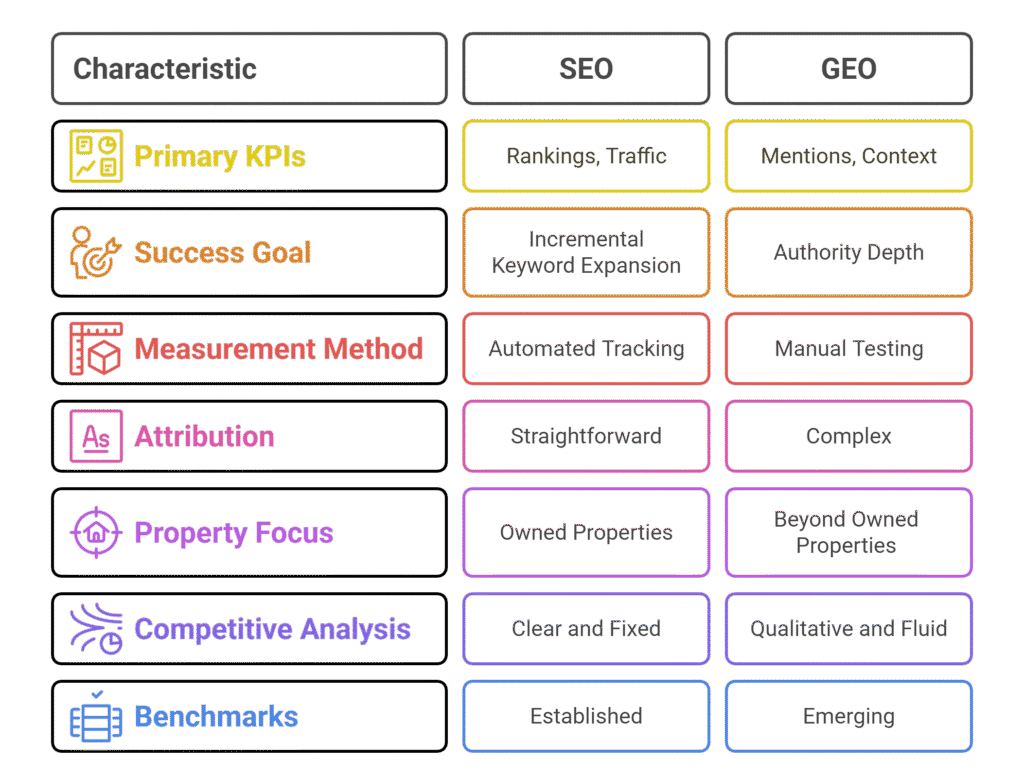
For UAE businesses, this means establishing new measurement frameworks. Continue tracking traditional SEO metrics for search engine performance, but also implement regular AI query testing, citation monitoring, and customer source tracking to understand your GEO effectiveness.
Can a business succeed with one strategy but not the other?
This is the question most businesses eventually ask: do I need both, or can I focus on just SEO or just GEO? The answer depends on your business model, target audience, and where your customers actually look for services.
You can still succeed with SEO alone in 2024, but the window is narrowing. Many businesses, especially established ones with strong existing rankings, still drive significant revenue from traditional search. If your customers primarily use Google to find services and click through to websites, SEO remains viable as a standalone strategy.
However, relying only on SEO means missing a growing customer segment. Usage of AI tools for research and discovery is growing rapidly. Studies show that younger demographics increasingly bypass traditional search engines in favor of asking AI tools directly. If you’re not optimized for GEO, you’re invisible to these users.
You could theoretically succeed with GEO alone, but it’s unnecessarily limiting. Being recommended by AI engines can drive business, but traditional search still represents the majority of online discovery. Ignoring SEO means abandoning a major channel that still works and converts.
The businesses winning are doing both strategically. The good news is that many optimization strategies benefit both SEO and GEO simultaneously. Quality content, authoritative citations, positive reviews, and technical excellence help both channels. The most successful businesses treat them as complementary rather than competing priorities.
B2B businesses might lean more toward GEO initially. Business decision-makers often use AI tools to research solutions, compare options, and gather information before reaching out. Being cited as an expert in AI responses can be particularly valuable for B2B lead generation.
Consumer-facing businesses still heavily rely on SEO. For restaurants, retail, or local services, customers often still use traditional search to find options nearby. Local SEO remains critical for these businesses, though GEO is becoming increasingly relevant.
High-consideration purchases benefit from both. When customers invest significant money or time in a decision, they often use multiple research methods. A potential client might start with a traditional search, then ask ChatGPT for additional perspective, then return to Google to visit specific sites. Being visible in both channels increases likelihood of being considered.
The integration of AI into traditional search blurs the line. Google’s AI Overviews and Bing’s Copilot integration mean traditional search engines are incorporating AI-generated answers directly into results. Optimizing only for traditional SEO without considering how AI engines cite sources increasingly means missing visibility even in traditional search contexts.
Budget constraints require prioritization. Smaller businesses with limited resources might need to choose where to focus initially. In these cases, prioritize based on where your specific target customers are looking. Test both channels, track results, and allocate resources based on what drives actual business outcomes.
The reality is that SEO and GEO aren’t really separate strategies anymore. They’re both part of comprehensive digital visibility. The businesses that will thrive are those that understand both, implement strategies that serve both simultaneously, and continuously adapt as the landscape evolves.
Conclusion
SEO and GEO represent two distinct approaches to the same fundamental goal: being found when potential customers are looking for services you provide. SEO focuses on ranking in traditional search engines through backlinks, keywords, and technical optimization. GEO focuses on being cited by AI engines through authoritative mentions, structured data, and comprehensive expertise demonstration. Understanding generative engine optimization in Dubai means recognizing that these strategies complement rather than replace each other, creating a more robust digital presence overall.
The key difference isn’t just technical. It’s philosophical. SEO asks, “How do I get my website to rank higher?” GEO asks, “How do I establish authority AI engines recognize and cite?” The tactics differ because the underlying systems evaluate businesses differently.
For UAE businesses navigating this landscape, the path forward isn’t choosing between SEO and GEO. It’s understanding how each works and building a strategy that addresses both. Many tactics serve both purposes: creating quality content, building genuine authority, earning positive reviews, and maintaining technical excellence.
Start by auditing where you currently stand in both channels. Search for your key services on Google and note your rankings. Then ask ChatGPT and other AI tools the same questions your customers would ask. Where do you appear? Where don’t you?
Then build a dual optimization strategy. Maintain strong technical foundations, create comprehensive content that serves both keyword targeting and question answering, build both backlinks and citations, and establish expertise that resonates across all platforms where your customers discover services.
The businesses that understand both SEO and GEO, and more importantly understand how they complement each other, will dominate visibility in the years ahead. The businesses that ignore one or both will find themselves increasingly invisible as search behavior continues evolving.
The future of digital discovery isn’t SEO or GEO. It’s SEO and GEO, integrated into a comprehensive visibility strategy that meets customers wherever they’re looking.
FAQs
Should I stop investing in SEO now that GEO exists?
No, absolutely not. Traditional search engines still drive the majority of web traffic and customer discovery. SEO remains essential for most businesses. However, you should start incorporating GEO strategies alongside your existing SEO efforts rather than waiting until AI engines completely dominate discovery. Think of GEO as an addition to your strategy, not a replacement. The businesses winning are doing both.
Is GEO more expensive than SEO to implement?
Not necessarily. Many GEO strategies overlap with SEO and require similar effort. Creating quality content, building citations, and managing reviews benefit both channels. The main difference is emphasis rather than entirely new work. Some aspects of GEO, like getting featured in authoritative publications or building thought leadership, may require different skills or relationships than traditional link building. Overall investment depends on your current state and how aggressively you want to pursue visibility in AI responses.
How quickly can I see results from GEO compared to SEO?
Both require patience, but timelines differ. Traditional SEO typically shows measurable results in 3 to 6 months for competitive keywords. GEO can take 6 to 12 months before AI engines consistently cite your business, primarily because you’re building authority patterns across multiple sources rather than optimizing a single website. However, once established, GEO authority tends to be more stable and less vulnerable to algorithm changes than SEO rankings.
Do small businesses need to worry about GEO or is it just for big companies?
Small businesses should absolutely care about GEO, perhaps even more than larger competitors. AI engines don’t necessarily favor big brands when making recommendations. They cite businesses that demonstrate clear expertise and authority. This levels the playing field. A small Dubai agency with strong local citations, quality content, and genuine expertise can be recommended by AI engines alongside or instead of larger competitors. For smaller businesses with limited marketing budgets, GEO represents an opportunity to compete effectively.
Will AI engines eventually replace traditional search engines completely?
Probably not completely, but their role is definitely growing. Traditional search engines are already incorporating AI features directly into results. The future likely involves both types of discovery coexisting, with different users preferring different approaches for different tasks. Some queries are better served by traditional search results with multiple options. Others are better served by AI-synthesized answers. Rather than trying to predict which will dominate, businesses should prepare to be visible in both.
Can I hire the same agency for both SEO and GEO or do I need separate specialists?
Many digital marketing agencies are expanding their services to include GEO alongside traditional SEO. The fundamentals overlap enough that an agency good at SEO can learn and implement GEO strategies. However, not all SEO agencies have adapted yet. When evaluating agencies, ask specifically about their GEO capabilities, whether they track AI mentions for clients, and what specific strategies they use to build authority for AI citations. An agency that only talks about keywords and rankings may not be equipped for comprehensive visibility strategy. At BRB, we integrate both SEO and GEO into our approach because we understand they’re both essential for modern digital visibility.

How to Improve Website Conversion Rate for Service Businesses?
Your website is getting traffic. People are clicking, scrolling, maybe even reading. But they’re not calling. They’re not filling out the contact form. They’re not booking consultations. The leads you expected aren’t materializing, and you’re left wondering whether your marketing is working at all.
This is the conversion challenge that frustrates service businesses across the UAE. You’ve invested in a professional website. You might be running ads or posting on social media. The visitors arrive, look around, and leave without taking action. The problem isn’t your service quality. It’s that your website isn’t doing its job: converting interested visitors into actual customers.
Improving website conversion rates isn’t about tricks or manipulation. It’s about removing friction, building trust, and making it absolutely clear why someone should choose your business and what they need to do next. For service businesses in particular, where the buying decision often involves trust, expertise, and sometimes significant investment, getting this right makes the difference between a website that generates leads and one that just looks nice.
What exactly is conversion rate and why does it matter more than traffic?
Website conversion rate is the percentage of website visitors who complete a desired action. For service businesses, this usually means filling out a contact form, calling your number, booking a consultation, or requesting a quote. If 100 people visit your website and 3 become leads, your conversion rate is 3%.
This metric matters more than traffic because it directly impacts your business growth and marketing efficiency. If you’re currently converting at 2% and you improve to 4%, you’ve doubled your leads without spending another dirham on advertising. Meanwhile, doubling your traffic while keeping the same website conversion rate requires twice the marketing budget with no guarantee of success.
For UAE service businesses, the math is compelling. If you’re investing 5,000 AED monthly in digital marketing and generating 20 leads at a 2% conversion rate, improving to 4% gives you 40 leads for the same spend. If your close rate is 25% and your average customer value is 10,000 AED, that conversion improvement just added 50,000 AED in monthly revenue without any increase in marketing costs.
The most successful businesses focus on both traffic and conversion simultaneously, but conversion optimization typically delivers faster, more cost-effective results. You’re working with visitors you’ve already paid to attract, making every improvement in conversion efficiency highly profitable.
How do I know what is stopping visitors from converting on my site?
Understanding conversion barriers requires looking at both data and user experience systematically. You need to identify where visitors drop off and why they’re hesitating.
Start with Google Analytics 4 to identify behavioral patterns. Look at your landing pages and track where visitors go next. If 80% of visitors land on your services page but only 5% proceed to your contact page, something on the services page is creating friction. Check bounce rates by page to find content that’s failing to engage. High bounce rates on key pages signal problems.
Set up conversion funnels to see exactly where drop-off happens. For a typical service business, the funnel might be: Homepage → Services page → Contact page → Form submission. If you’re losing 70% of people between the contact page and form submission, the issue is your form design or the information you’re requesting.
Use heatmap and session recording tools like Hotjar or Microsoft Clarity. These show you exactly where people click, how far they scroll, and where their cursor hovers but doesn’t click. When you watch real visitors navigate your site, patterns emerge. You’ll see them click non-clickable elements, scroll past your call-to-action, or abandon forms at specific fields.
Conduct user testing with people who match your target audience. Ask five potential customers to complete a task on your site like finding your pricing or requesting a quote while thinking aloud. Their confusion, questions, and pain points reveal issues you’ve become blind to through familiarity.
Monitor form analytics specifically. Most form tools show field-by-field drop-off rates. If 40% of people abandon your form at the phone number field, you’re either asking too early in the relationship or your privacy concerns aren’t addressed. If people start forms but don’t submit, you’re requesting too much information.
Pay attention to traffic sources. Visitors from Google Ads might convert differently than those from social media or organic search. If one source converts at 5% and another at 1%, the problem might not be your website but the message-match between your ads and landing pages.
What website elements have the biggest impact on service business conversions?
Certain website elements disproportionately affect whether service business visitors convert. Focusing on these high-impact areas delivers the fastest improvements.
Your value proposition and headline are the first test. Within three seconds of landing on your site, visitors should understand what you do, who you serve, and why it matters. For a Dubai-based accounting firm, “Tax Planning for Growing SMEs in the UAE” is clearer than “Your Financial Partner.” Specificity builds trust and helps the right people self-select.
Trust signals matter enormously for services because customers are buying expertise and reliability, not physical products. Client testimonials with real names, photos, and specific results outperform generic praise. Display recognized certifications, industry memberships, and years in business prominently. For UAE businesses, showing local credentials like Dubai Chamber membership or free zone registration adds legitimacy.
Contact information accessibility directly impacts conversions. Your phone number should be visible on every page, preferably in the header. For markets like the UAE where many clients prefer calling to form-filling, a clickable phone number on mobile is essential. Multiple contact options (phone, email, WhatsApp, contact form) accommodate different preferences.
Social proof beyond testimonials includes case study numbers, client logos from recognized companies, media mentions, and awards. If you’ve served 200+ UAE businesses or work with known brands, showcase it. Specific numbers (increased leads by 40%, saved clients an average of 15,000 AED) make testimonials more credible.
Clear, specific calls-to-action eliminate ambiguity about next steps. Instead of generic “Contact Us” buttons, use “Schedule Your Free Consultation,” “Get Your Custom Quote,” or “Book a Strategy Call.” Specify what happens next and what commitment level you’re requesting. “Get Started” is vague; “Speak with a specialist within 24 hours” sets clear expectations.
Page loading speed impacts website conversion rates dramatically. Studies consistently show that every additional second of loading time reduces conversions. In mobile-heavy markets like the UAE where users often browse on cellular connections, speed optimization isn’t optional.
Mobile responsiveness determines whether 70%+ of your traffic can actually use your site. Forms must be easy to complete on phones. Buttons must be appropriately sized for thumbs. Text must be readable without zooming. If your site isn’t mobile-optimized, you’re automatically losing the majority of potential conversions.
How should I structure my service pages to maximize conversions?
Service pages are often your highest-traffic pages and prime conversion opportunities. Their structure directly influences whether visitors become leads.
Lead with the outcome, not the process. People don’t care about your methodology until they understand the results. Instead of starting with “Our 5-step social media management process,” open with “Get 3-5 qualified leads per week from Instagram.” Benefits before features is the cardinal rule.
Address objections and concerns directly on the page. For expensive services, acknowledge the investment and explain the ROI. For time-consuming services, detail the timeline and what’s required from the client. For complex services, break down the process into understandable stages. When you preemptively answer the questions creating hesitation, you remove conversion barriers.
Include specific pricing information or ranges where possible. “Starting from 5,000 AED” or “Typical projects range from 15,000-30,000 AED” helps qualified prospects self-select and reduces time-wasters. If you can’t show specific pricing, explain your pricing model: “Priced based on team size and required features” clarifies what determines cost.
Use visual hierarchy to guide visitors toward conversion actions. Your primary call-to-action should be the most visually prominent element. Use contrasting colors, whitespace, and strategic placement. Secondary CTAs can exist lower on the page, but don’t create visual competition that confuses priority.
Break up text with subheadings, bullet points, and visuals. Long paragraphs intimidate readers and reduce comprehension. Each section should focus on one key point with a clear subheading. For service businesses, before-and-after images, process diagrams, or infographics help visitors understand what you do.
Include FAQs specific to that service. Common questions about timelines, requirements, processes, and expectations should be answered on the service page itself. This reduces friction by preventing visitors from having to hunt for information or contact you for basic questions.
Position multiple conversion opportunities throughout the page. Someone ready to convert immediately shouldn’t have to scroll to find your contact form. Place a CTA above the fold, another mid-page after explaining benefits, and a final one at the end. Different placement catches visitors at different decision points.
Add a secondary low-commitment option. Not everyone is ready to request a quote or book a consultation. Offer downloadable resources, free assessments, or valuable checklists that capture contact information from less-committed visitors. These nurture leads who need more time to decide.
What role does website copy and messaging play in conversion?
Your website copy is your 24/7 salesperson. It needs to communicate value, build trust, and motivate action, all while speaking directly to your ideal customer’s situation and concerns.
Write in second person, addressing the visitor directly. “You’ll get weekly performance reports” creates more engagement than “Clients receive weekly performance reports.” This subtle shift makes content feel conversational and personally relevant rather than generic.
Focus on customer problems and outcomes, not your company. The biggest copy mistake service businesses make is centering content around themselves: “We offer,” “We provide,” “Our expertise.” Visitors care about their problems being solved. Restructure content around their needs: “Struggling with inconsistent leads? Our system generates predictable new business every month.”
Use specific language over vague claims. “Increase your online visibility” is meaningless. “Rank on page one for 5+ high-value keywords in your industry within 4 months” is specific and measurable. Specificity builds credibility.
Match your copy sophistication to your audience’s knowledge level. If you’re targeting business owners with no technical background, avoid jargon. If you’re selling to CTOs, technical depth demonstrates expertise. For mixed audiences, start simple with options to dive deeper.
Create urgency without resorting to fake scarcity. Real reasons for action work better than countdown timers: “Q4 campaigns perform 30% better when started in September” or “We’re accepting 3 new retainer clients this month.” If you have genuine capacity constraints or seasonal advantages, communicate them.
Tell micro-stories within your copy. Instead of listing features, briefly describe a customer situation that mirrors your visitor’s experience and how your service resolved it. These narrative elements create emotional connection that pure facts can’t.
Address risk explicitly. Service purchases involve uncertainty. Statements like “No long-term contracts required,” “100% satisfaction guarantee,” or “Your data stays confidential” remove psychological barriers to conversion.
How do I optimize my contact forms for higher completion rates?
Contact forms are often the final conversion step, making their design critical. Small changes in form structure can dramatically affect submission rates.
Request only essential information initially. Every additional field reduces completion rates by 5-10%. For the initial contact, you typically only need name, email, and phone or a brief message about their needs. You can gather detailed information later in the sales process. If you’re asking for company size, budget, timeline, and other details upfront, you’re creating unnecessary friction. Any best web development company in Dubai will tell you that simpler forms convert better, it’s about making it easy for people to reach out first, then having the conversation about specifics.
Make required fields obvious and minimal. Use clear labels, mark required fields with asterisks, and provide immediate feedback when something is wrong. Don’t make people guess what format you need or submit only to see error messages.
Use multi-step forms for longer information requests. If you genuinely need 8-10 pieces of information, break the form into 2-3 steps with a progress indicator. “Step 1 of 3” feels more manageable than one overwhelming form. Each completed step creates commitment that increases the likelihood of finishing.
Reduce typing with dropdown menus and checkboxes where appropriate. If you’re asking what services they’re interested in, offer checkboxes of your service list rather than an open text field. This is faster for users and gives you cleaner data.
Include privacy reassurance near the submit button. A brief note like “We’ll respond within 24 hours and never share your information” addresses common hesitations about form submission.
Make forms mobile-friendly with large tap targets and appropriate input types. Phone number fields should trigger numeric keyboards. Email fields should offer autocomplete. Zoom-in on fields is acceptable, but zooming shouldn’t be required.
Implement smart defaults and autocomplete where possible. If someone is browsing from a Dubai IP address, pre-select Dubai in location dropdowns. Use browser autocomplete for names and contact information to speed completion.
Test different form placements. Some businesses find that embedded forms on service pages convert better than separate contact pages. Others succeed with floating contact widgets. Try both approaches with similar traffic volumes and measure completion rates.
What trust signals should service businesses display to increase conversions?
Trust is the primary conversion factor for service businesses. People are hiring expertise, often for important business needs. Every element that builds confidence increases conversion likelihood.
Client testimonials with specificity outperform generic praise. Include the client’s full name, company, role, and ideally a photo. The testimonial itself should mention specific results or experiences: “BRB’s content strategy increased our Instagram engagement by 200% and generated 15 qualified leads in two months” is more credible than “Great team, highly recommended.”
Case studies that detail challenges, solutions, and measurable results demonstrate proven capability. For UAE businesses, local case studies are particularly valuable. Showing you’ve successfully served businesses in Dubai, dealt with regional market conditions, or understand local business challenges builds relevant confidence.
Display professional certifications, memberships, and credentials prominently. If you’re a licensed professional, registered with industry bodies, or hold recognized certifications, showcase them. For UAE businesses, local legitimacy markers like Dubai Chamber membership or specific free zone registrations matter.
Show how long you’ve been in business. “Serving UAE businesses since 2015” signals stability and experience. New businesses can emphasize founder experience: “20+ years of combined marketing experience.”
Include recognizable client logos if you’ve worked with known brands. Even local recognition helps. If you’ve served companies your target audience would recognize, permission-based logo displays build credibility.
Media mentions, awards, and speaking engagements demonstrate industry recognition. Have you been featured in local publications? Spoken at industry events? Won business awards? These third-party validations carry significant weight.
Transparent team information with photos and bios personalizes your business. People prefer working with people, not anonymous companies. Show who they’ll be working with and why those people are qualified to help them.
Money-back guarantees or satisfaction guarantees reduce perceived risk. For service businesses, this might be “If you’re not satisfied after the first month, we’ll refund your retainer” or “Free revisions until you’re happy with the result.” Real guarantees that you actually honor build trust.
Security badges and certifications matter for forms processing payment or sensitive information. SSL certificates (the padlock in the browser) are baseline requirements. For businesses handling financial data or personal information, display relevant security credentials.
How can I use urgency and scarcity ethically to improve conversions?
Real urgency and scarcity can motivate action without manipulation. The key is authenticity, using only genuine constraints that exist in your business.
Limited capacity is often a real constraint for service businesses. If you can only take on three new web design projects per month due to team capacity, communicate this: “We’re accepting 3 new projects for December start dates.” This is honest and creates reasonable urgency.
Seasonal advantages provide natural urgency. “Q1 marketing campaigns perform better when planned in Q4” or “Get your website redesigned before the Dubai business season peaks in January” connect timing to real business benefits.
Early-bird pricing for new services or packages creates urgency without false scarcity. “Launch pricing: First 10 clients receive 20% off our new social media audit service” rewards quick decision-makers while being completely transparent about the limitation.
Project-based timelines establish urgency around business needs. “Want to launch before Ramadan? We need to start by March 15th” ties timing to the client’s goals rather than arbitrary deadlines.
Avoid fake countdown timers, inflated “limited spots,” or other manipulative tactics. These erode trust when discovered and can damage your reputation. If you’re displaying scarcity, it should be verifiable and honest.
Communicate the cost of inaction when relevant. For some services, delay has real consequences. “Every month without proper SEO is estimated lost revenue” isn’t creating false urgency; it’s stating a business reality.
What website features help service businesses stand out from competitors?
Differentiation isn’t about having the flashiest website. It’s about showcasing what makes your service genuinely different in ways that matter to customers.
Interactive pricing calculators let visitors estimate costs before contacting you. For services with transparent pricing models, this self-service tool qualifies leads and builds trust. A web design agency might offer a calculator based on page count, features, and complexity. This transparency differentiates you from competitors who hide pricing.
Video introductions from the founder or team create personal connection. A 60-90 second video explaining who you are, why you started the business, and what you believe about serving clients humanizes your brand. In the UAE market where relationship-building matters, this personal touch can be decisive.
Live chat or WhatsApp integration provides immediate response for urgent questions. Many UAE customers prefer chat communication over forms. Being accessible in their preferred channel removes conversion friction. You don’t need 24/7 staffing; clearly communicated business hours with reliable responses during those times work well.
Before-and-after showcases demonstrate tangible results. For web design, show the old site versus the new one. For marketing, display engagement metrics before and after your involvement. For consulting, present business metrics that improved. Visual proof of your impact is more compelling than any description.
Free tools or resources that provide immediate value establish expertise. A marketing agency might offer a free website audit tool. An accounting firm could provide a tax planning checklist. These value-adds generate leads while demonstrating capability.
Process transparency documentation shows exactly what working with you looks like. Create a clear timeline of what happens from first contact through project completion. Detail who does what, what’s expected from the client, and how communication works. This reduces anxiety about the unknown.
Specialized expertise positioning differentiates you from generalists. Rather than claiming to serve everyone, demonstrate deep knowledge in your niche. “Instagram Marketing for Dubai Restaurants” is more compelling to restaurant owners than “Social Media Marketing.”
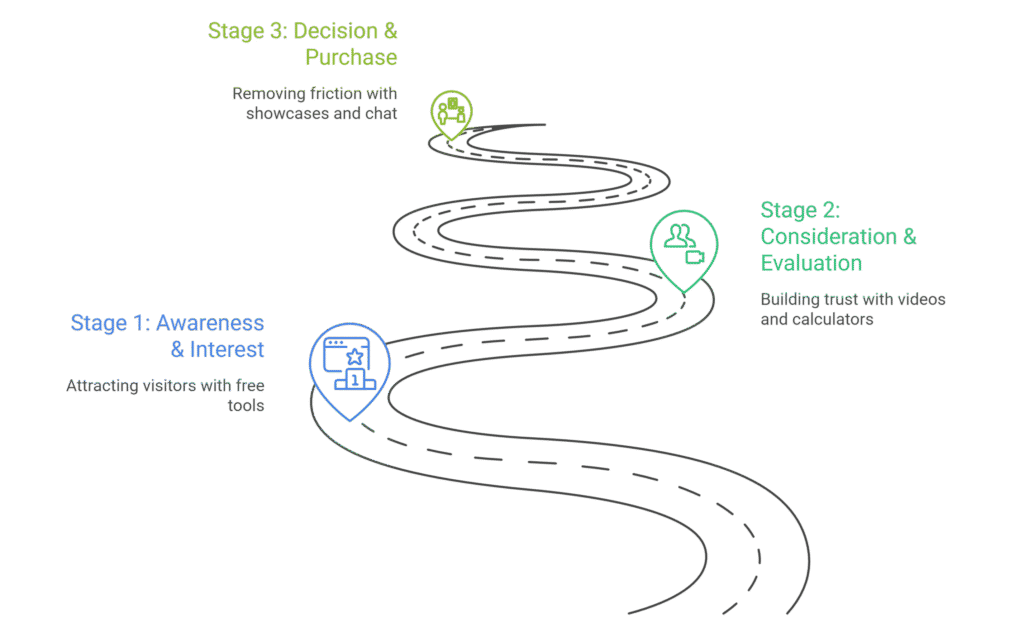
Comparison pages that honestly assess your service against alternatives help decision-making. “In-House vs. Agency Marketing: Which is Right for Your Business?” positions you as a trusted advisor, not just a vendor. You can fairly acknowledge when your service isn’t the best fit.
How do page load speed and technical performance affect conversions?
Technical performance has direct, measurable impact on website conversion rates. Google research shows that as page load time increases from 1 to 3 seconds, bounce probability increases by 32%. From 1 to 5 seconds, it increases by 90%.
For UAE businesses targeting mobile users on varying connection qualities, this matters even more. Someone browsing on 4G in a Dubai mall has different constraints than someone on fiber at home, but both expect fast loading.
Optimize images aggressively. Large, uncompressed images are the most common speed killer. Use modern formats like WebP, compress before uploading, and implement lazy loading so images only load as users scroll to them. A hero image doesn’t need to be 5MB; 200-300KB delivers excellent quality at fraction of the file size.
Minimize code bloat by removing unused plugins, scripts, and CSS. Many websites load dozens of resources that serve no active purpose. Regular audits of what’s actually necessary keep your site lean.
Use browser caching so returning visitors don’t reload unchanged elements. This makes subsequent page loads much faster, improving the experience for people exploring multiple pages.
Implement a content delivery network (CDN) if you serve international audiences or have media-heavy pages. CDNs store copies of your site on servers worldwide, delivering content from the closest location to each user.
Monitor Core Web Vitals through Google Search Console. These metrics (Largest Contentful Paint, First Input Delay, Cumulative Layout Shift) directly impact both user experience and search rankings. Address any pages flagged as poor performers.
Test your site on actual mobile devices with varying connection speeds. Emulators don’t fully replicate the experience. Have team members or testers access your site on 3G connections to understand real-world performance.
What conversion optimization mistakes do UAE service businesses commonly make?
Recognizing common mistakes helps you avoid them and spot opportunities competitors are missing.
Hiding contact information or making it difficult to reach you is surprisingly common. Some businesses bury their phone number in the footer or require visitors to navigate to a separate contact page. In markets where trust and accessibility matter, this creates unnecessary barriers.
Using generic stock photos instead of real team and work photos damages credibility. Visitors can spot stock imagery immediately, and it signals that you’re not confident enough to show your actual business. Invest in professional photos of your real team, office, and work.
Overwhelming visitors with too many choices paralyzes decision-making. If your homepage offers 10 different services, 5 calls-to-action, and multiple navigation paths, visitors don’t know where to focus. Clarity and prioritization convert better than comprehensive options.
Failing to optimize for mobile despite 70%+ mobile traffic is inexcusable. If your site requires pinching, zooming, or rotating to use, you’re losing the majority of potential conversions automatically.
Writing about yourself instead of customer problems makes content self-centered rather than customer-focused. Every page should primarily address what the visitor cares about: their challenges, goals, and desired outcomes.
Not testing different approaches means you’re guessing about what works. Implementing changes without A/B testing means you might be making things worse. Test different headlines, CTA buttons, form lengths, and page layouts systematically.
Ignoring returning visitors who don’t convert immediately misses the nurturing opportunity. Most service purchases require multiple touchpoints. If you’re not retargeting interested visitors with relevant content or offers, you’re losing potential customers who need more time.
Requesting too much information too early scares away potential leads. You don’t need to qualify every detail before initial contact. Get basic information, start the conversation, and gather specifics during the consultation.
How should I approach conversion optimization as an ongoing process?
Conversion optimization isn’t a one-time project. It’s a continuous process of testing, learning, and refining based on data and customer feedback.
Start by establishing baseline metrics. Before making any changes, document your current website conversion rate, traffic sources, top landing pages, and form completion rates. You need to know where you started to measure improvement.
Prioritize changes based on potential impact and ease of implementation. The ICE framework (Impact, Confidence, Ease) helps. Score each potential change on these three factors, then tackle high-scoring items first. Fixing a high-traffic landing page with a 1% conversion rate has more impact than optimizing a rarely-visited blog post.
Make one significant change at a time for clear attribution. If you simultaneously redesign your contact form, rewrite your homepage, and change your CTA buttons, you won’t know which change drove results. Sequential testing provides clearer learning.
Run A/B tests for significant changes to pages with sufficient traffic. You need at least 100-200 conversions per variation to reach statistical significance. For lower-traffic sites, test broader changes and trust directional data over strict statistical thresholds.
Implement obvious improvements without testing. If your form is broken on mobile or your contact number isn’t visible, fix it immediately. Don’t waste time testing things that are clearly broken.
Review analytics monthly to spot new patterns and opportunities. Which pages have traffic but low conversions? Which referral sources bring the most qualified visitors? What search terms are people using to find you? Regular reviews reveal optimization opportunities.
Gather qualitative feedback through customer conversations. Ask new clients what nearly stopped them from reaching out, what convinced them to contact you, and what could have made the decision easier. These insights reveal barriers data alone won’t show.
Stay updated on your industry and market changes. As AI search grows, as social platforms evolve, as customer preferences shift, your optimization strategy needs to adapt. What worked last year might be less effective now.
Document what you test and the results. Create a simple spreadsheet tracking changes, dates implemented, metrics before and after, and key learnings. This institutional knowledge prevents repeating failed experiments and identifies winning patterns.
Conclusion
Improving your website conversion rate isn’t about manipulating visitors or using psychological tricks. It’s about removing obstacles, building trust, and making it crystal clear how you solve problems that matter to your customers.
For UAE service businesses, the opportunity is substantial. Many competitors have decent websites but haven’t optimized the conversion path. By systematically addressing the elements covered here, you can double or even triple your website conversion rate, turning your existing traffic into significantly more leads and customers. A skilled web development company UAE can help implement these optimization strategies properly, ensuring every element works together to guide visitors toward taking action.
Start with the highest-impact changes: clarify your value proposition, add specific trust signals, simplify your contact process, and ensure mobile responsiveness. These foundational improvements often deliver 20-30% conversion increases before you move to more sophisticated optimization.
Remember that conversion optimization is ongoing. Your first round of improvements won’t be perfect, and your market evolves. Commit to monthly reviews, quarterly major optimizations, and consistent testing. The businesses that treat this as a continuous process rather than a one-time project build compounding advantages that competitors can’t easily overcome.
Your website should be your hardest-working salesperson, generating qualified leads around the clock. With systematic optimization, that becomes reality rather than aspiration.
FAQs
What is a good conversion rate for a service business website?
Service business website conversion rates typically range from 2% to 5%, though this varies significantly by industry, service complexity, and traffic quality. Professional services like legal or accounting often see 3-5% because visitors are highly qualified but cautious. Creative services like design or marketing might see 2-3% with broader audiences. What matters more than industry averages is your own improvement trajectory. If you’re currently at 1.5% and reach 3%, you’ve doubled your lead generation. Focus on beating your own baseline rather than achieving arbitrary benchmarks.
How long does it take to see results from conversion optimization?
For high-traffic websites, you can measure impact within 2-4 weeks of implementing changes. Lower-traffic sites might need 4-8 weeks to gather meaningful data. Some improvements show immediate results: fixing broken forms or adding visible phone numbers often increase conversions within days. More subtle optimizations like refined messaging or trust signals might take longer to demonstrate impact. Plan for a 3-month minimum commitment to conversion optimization, with monthly reviews to assess progress and adjust strategy.
Should I focus on increasing traffic or improving website conversion rate first?
Generally, optimize conversion first. If your site converts at 1%, doubling traffic gives you twice as many leads but at twice the cost. Improving conversion to 2% gives you the same result without additional ad spend. Start with conversion optimization until you’re converting at least 3-4%, then scale traffic knowing you’re efficiently converting visitors. The exception is if you have almost no traffic; you need at least 500-1000 monthly visitors to gather meaningful conversion data and test effectively.
Can I improve conversions without redesigning my entire website?
Absolutely. Most significant conversion improvements come from strategic adjustments, not complete redesigns. Focus on high-traffic pages first, particularly your homepage, top service pages, and contact page. Improvements like clearer headlines, simplified forms, added testimonials, prominent CTAs, and better mobile responsiveness often deliver substantial results without touching your overall design. Full redesigns are expensive and risky; incremental optimization is safer and more cost-effective.
How do I know if my conversion rate is being hurt by traffic quality or website problems?
Analyze your traffic sources separately. If visitors from Google Ads convert at 5% but organic traffic converts at 1%, the issue is likely traffic quality or message-match, not your website. If all sources convert poorly, website optimization is needed. Look at engagement metrics too. High bounce rates with short time-on-page suggest traffic quality issues; low bounce rates with good engagement but no conversions suggest website friction. Heat maps showing engaged visitors who don’t convert point to website problems rather than traffic issues.
What tools do I need to start website conversion rate optimization?
Begin with free tools that provide substantial insight. Google Analytics 4 tracks conversions and user behavior. Google Search Console shows which queries drive traffic. Microsoft Clarity offers free heat maps and session recordings. Your website platform likely includes form analytics. These tools provide everything needed for initial optimization. As you advance, consider paid A/B testing tools like Optimizely or VWO, but exhaust free tool insights first. Most UAE service businesses can achieve significant improvements using only free tools combined with systematic analysis and implementation.

How Long Does It Take to Rank on Generative AI Engines?
If you’ve been following the shifts in digital marketing over the past two years, you’ve probably noticed something significant: people aren’t just searching on Google anymore. They’re asking ChatGPT, Claude, Perplexity, and other AI engines for recommendations, comparisons, and buying advice. For businesses in the UAE, this creates both a challenge and an opportunity.
The challenge? Traditional SEO tactics don’t guarantee visibility in AI-generated responses. The opportunity? Getting cited by these engines can position your brand as a trusted authority in ways that old-school search rankings never could.
But here’s the question everyone’s asking: how long does it actually take to rank on generative AI engines? The answer isn’t as straightforward as “3 months” or “6 months” like traditional SEO timelines. Generative Engine Optimization (GEO) works differently, and understanding the timeline can help you set realistic expectations and build a strategy that actually works.
What does it mean to rank on generative AI engines?
Before we talk timelines, let’s clarify what “ranking” means in this context. When someone asks ChatGPT or Perplexity a question like “best digital marketing agency in Dubai” or “how to improve Instagram engagement for UAE businesses,” these engines don’t show a list of ten blue links. Instead, they generate a conversational response, often citing specific sources, brands, or insights.
“Ranking” in GEO means your business, content, or expertise gets mentioned, cited, or recommended in these AI-generated answers. It could be a direct citation with a link, a mention of your brand name, or your insights being paraphrased as authoritative information.
Unlike traditional search where you either rank or you don’t, GEO visibility exists on a spectrum. You might get cited occasionally for niche queries but not for broader topics yet. Or you might appear in answers from Claude but not ChatGPT. The goal is consistent, relevant visibility across multiple platforms and query types.
How is GEO different from traditional SEO in terms of timeline?
Traditional SEO has fairly predictable patterns. New websites typically take 6 to 12 months to build domain authority and rank for competitive keywords. Established sites can see movement in 3 to 6 months with strong content and backlinks.
GEO operates on different mechanics entirely. AI engines don’t crawl and index the web the same way search engines do. They pull from training data, live web searches, curated databases, and real-time information depending on the platform and query type.
This means a brand new business can potentially get cited by AI engines within weeks if they produce exceptional, authoritative content that gets picked up by the right sources. Conversely, an established brand with good SEO might not appear in AI responses at all if their content isn’t structured or formatted in ways these engines recognize as valuable.
The timeline for GEO depends less on domain age and more on content quality, citation signals, and topical authority. A well-executed GEO strategy can show initial results in 4 to 8 weeks, but building consistent, broad visibility typically takes 3 to 6 months of focused effort.
What factors actually influence how fast you can rank on generative AI engines?
Several variables determine your GEO timeline, and understanding them helps you prioritize your efforts effectively.
Content quality and depth matter enormously. AI engines favor comprehensive, well-researched content that demonstrates genuine expertise. A 2,000-word guide that answers questions thoroughly will outperform ten shallow blog posts every time. For UAE businesses, this means creating content that addresses local market nuances, regulatory considerations, and cultural context that generic international content misses.
Citation signals play a crucial role. When authoritative websites, industry publications, or trusted sources mention or link to your content, AI engines take notice. Getting featured in Gulf News, Arabian Business, or industry-specific publications accelerates your GEO timeline significantly. Building these citations takes time, typically 2 to 4 months of consistent outreach and relationship building.
Structured data and formatting help AI engines understand and extract information from your content. Using proper schema markup, clear headings, concise answers, and logical content hierarchy makes your content more “digestible” for AI systems. This is something you can implement immediately, but the impact compounds over time.
Topical authority develops through consistent publishing on specific subjects. If you publish one article about social media marketing, you’re a casual commentator. If you publish 20 well-researched pieces covering different aspects of social media strategy, platforms, tools, and case studies, you become a recognized authority. Building this authority typically requires 3 to 6 months of focused content production.
Brand mentions and awareness create signals that extend beyond your website. When people discuss your brand on social media, forums, review sites, or in other content, it builds recognition that AI engines can pick up on. For newer brands, this takes time to cultivate, usually 4 to 12 months depending on marketing investment and market penetration.
Can new businesses rank quickly or does it require established authority?
This is one of the most encouraging aspects of GEO: new businesses absolutely can rank on generative AI engines quickly if they approach it strategically.
Unlike traditional SEO where domain age and backlink history create significant barriers, AI engines prioritize content quality and relevance over legacy authority. A startup that publishes genuinely helpful, expert-level content can get cited within weeks, especially for niche or emerging topics where competition is lighter.
The key is focusing on areas where you have legitimate expertise or unique perspective. A new digital marketing agency in Dubai might struggle to rank for “best marketing agency in UAE” immediately, but could quickly establish authority for more specific queries like “TikTok marketing for Dubai restaurants” or “generative AI tools for UAE real estate marketing.”
Real-world example: a Dubai-based SaaS startup we work with began publishing detailed technical guides about their industry in March 2024. By May, ChatGPT was citing their content for specific product-related queries. By July, they were getting mentioned for broader industry topics. They had zero traditional SEO authority when they started, but they had genuine expertise and created content that demonstrated it clearly.
The timeline for new businesses typically looks like this:
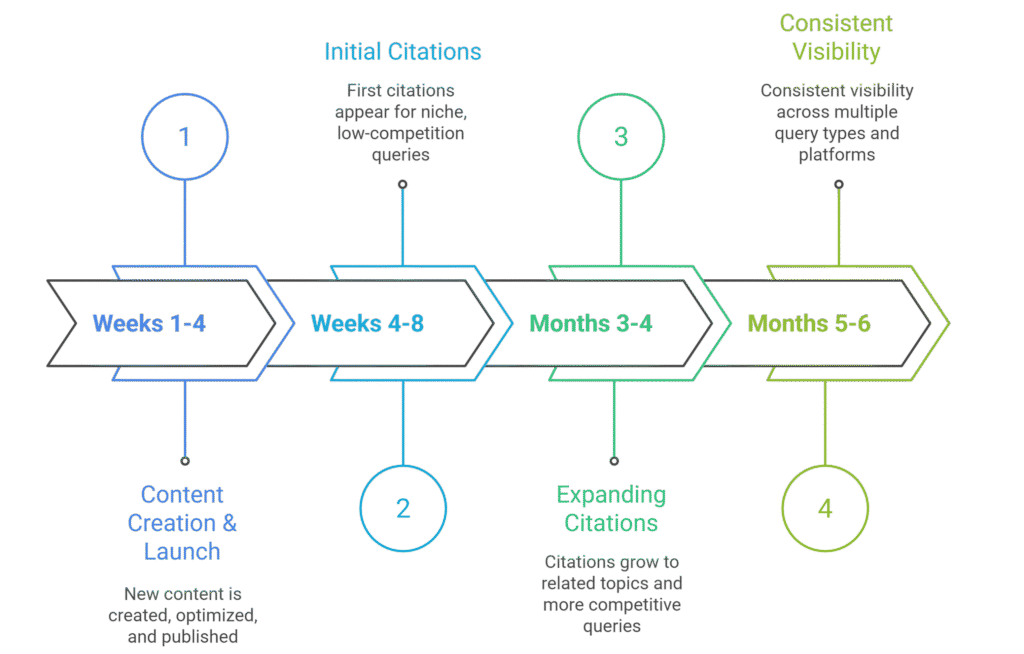
This assumes consistent, high-quality content production and proper optimization throughout the process.
Which AI platforms should UAE businesses focus on first?
Not all AI engines are created equal, and they don’t all pull information the same way. Prioritizing your efforts based on platform characteristics can accelerate your results.
ChatGPT is obviously the biggest player with massive user adoption globally and strong usage in the UAE. It pulls from a combination of training data and real-time web search through Bing. Getting cited here requires strong content quality and appearing in authoritative sources that Bing indexes well. Timeline: 6 to 12 weeks for initial citations on niche topics.
Perplexity has been growing rapidly and is particularly popular with research-focused users and professionals. It emphasizes source citation and pulls from real-time web searches. Strong content with clear sourcing and data can get picked up quickly here. Timeline: 4 to 8 weeks for specialized topics.
Claude (the platform you’re using right now) provides detailed, nuanced answers and favors comprehensive, well-structured content. It combines training data with web search capabilities. Timeline: 8 to 12 weeks as it emphasizes depth and authority.
Google’s AI Overview appears at the top of Google search results and represents Google’s entry into conversational AI. Since it’s integrated with Google Search, traditional SEO signals still matter here, but it also requires specific optimization for featured snippet-style content. Timeline: Similar to traditional SEO, 12 to 16 weeks.
For UAE businesses with limited resources, start with ChatGPT and Perplexity. These platforms have the strongest adoption locally, and success on these platforms often translates to visibility on others due to overlapping optimization principles.
How often should you publish content to see results faster?
Consistency matters more than volume, but there are practical thresholds that influence your timeline.
Publishing one piece per month won’t build topical authority quickly enough. You need sustained momentum to signal to both algorithms and human audiences that you’re a serious, active voice in your space.
A realistic content calendar for most SMBs targeting GEO results looks like this:
Minimum viable frequency: 2 comprehensive articles per week (8-10 per month). This establishes you as an active content producer and builds topical coverage steadily. Expected timeline: 5 to 7 months to strong visibility.
Accelerated frequency: 3-4 articles per week (12-16 per month). This creates faster topical authority and increases the chances of citations across multiple query types. Expected timeline: 3 to 4 months to noticeable results.
Aggressive frequency: Daily publishing (20-25 pieces per month). This is what established media brands do, and it delivers the fastest results but requires significant resources. Expected timeline: 6 to 10 weeks to initial citations.
The content type matters as much as frequency. Two 3,000-word comprehensive guides per month might deliver better results than fifteen 500-word blog posts. AI engines favor depth and expertise over surface-level content.
For UAE businesses specifically, consider cultural timing as well. Publishing during Ramadan, major holidays, or around industry events relevant to your market can accelerate visibility if the content aligns with trending queries during those periods.
What are the most common mistakes that slow down GEO results?
Even businesses that invest in content often sabotage their own timeline through avoidable mistakes.
Creating content that’s too promotional is probably the biggest issue. AI engines are designed to provide helpful, objective information. Content that reads like a sales pitch gets ignored. Instead of “Why BRB is the best digital marketing agency in Dubai,” write “How to evaluate digital marketing agencies in Dubai: a comprehensive guide.” The second approach positions you as helpful and expert while still building authority.
Ignoring structured data means AI engines struggle to extract and understand your content properly. Schema markup, clear headings, tables, lists, and logical information architecture aren’t just nice to have, they’re essential for GEO. Businesses that skip this technical foundation add 4 to 8 weeks to their timeline unnecessarily.
Publishing without citation signals limits your content’s reach. AI engines look for validation that your content is trustworthy. This comes from links, mentions, and citations from other authoritative sources. Creating great content but not promoting it, building relationships, or earning backlinks significantly delays results. Budget time for outreach and relationship building as part of your content strategy.
Focusing only on broad, competitive topics early on sets unrealistic timelines. A new business trying to rank for “digital marketing Dubai” faces enormous competition. Starting with more specific angles like “Instagram Reels strategy for Dubai fashion brands” or “LinkedIn marketing for UAE B2B companies” builds authority faster. Once you own the niche spaces, you can expand to broader topics.
Inconsistent publishing breaks momentum. Publishing 10 articles in one month then nothing for two months confuses both algorithms and audiences. Steady, predictable publishing beats sporadic bursts every time.
Not optimizing for multiple AI platforms limits your total visibility. Each platform has slightly different preferences for content structure, sourcing, and depth. Content optimized only for ChatGPT might not perform well on Perplexity or Claude. A comprehensive GEO strategy addresses multiple platforms simultaneously, which doesn’t increase timeline but does increase total citation opportunities.
How can you track and measure GEO progress over time?
Unlike traditional SEO where you can check rankings daily, GEO requires different measurement approaches.
Manual query testing is still the most reliable method. Create a list of 20 to 30 queries relevant to your business and test them weekly across different AI platforms. Document which platforms cite you, how often, and in what context. This gives you direct visibility into your progress.
Example queries for a Dubai digital marketing agency:
- “Best ways to increase Instagram engagement in UAE”
- “How do Dubai businesses use TikTok for marketing”
- “Digital marketing strategies for small businesses in Dubai”
- “What is Generative Engine Optimization”
Track these consistently, and you’ll see patterns emerge around which topics you’re gaining authority in and which need more content investment.
Citation tracking tools are emerging but still limited. Some platforms like Perplexity provide basic analytics if you’re cited. Monitor your referral traffic from AI platforms when possible. Set up Google Alerts for your brand name combined with key topics to catch mentions you might otherwise miss.
Indirect indicators help fill the gaps. Look at increases in branded search volume, direct traffic spikes following new content publication, and engagement metrics on the content itself. While not direct GEO measurements, they correlate with growing authority and visibility.
Timeframe expectations for measurement:
- Weeks 1-4: No measurable results yet; focus on production and optimization
- Weeks 4-8: First citations may appear; start tracking systematically
- Months 3-4: Clear patterns emerge; you can identify which content types work best
- Months 5-6: Consistent citation growth; you can forecast which topics to expand
Most businesses see their first measurable GEO results between week 6 and week 10, assuming they’re publishing quality content consistently and optimizing properly.
What role does traditional SEO play in speeding up GEO results?
There’s significant overlap between effective SEO and GEO, but the relationship isn’t always linear.
Traditional SEO benefits GEO primarily through these mechanisms:
Authority signals: Websites with strong backlink profiles and domain authority tend to get cited more by AI engines because these same signals indicate trustworthiness. Building high-quality backlinks remains valuable for both disciplines.
Content discoverability: AI engines often pull from indexed web content. Strong technical SEO ensures your content gets discovered, indexed, and considered for citations. Basic SEO hygiene (site speed, mobile optimization, proper indexing) supports GEO indirectly.
Structured data overlap: Schema markup benefits both traditional search and AI engine understanding. Implementing comprehensive structured data serves both goals simultaneously.
However, some traditional SEO tactics don’t accelerate GEO at all:
Keyword stuffing actually hurts GEO because AI engines are sophisticated enough to recognize and penalize unnatural language. Write for humans first.
Low-quality backlink volume doesn’t help. AI engines care about citation quality, not quantity. One mention in a respected industry publication matters more than 100 links from low-authority sites.
Over-optimization for specific keywords can make content less natural and less useful, which AI engines penalize.
The ideal approach is integrated optimization that serves both traditional search and generative AI simultaneously. This doesn’t necessarily speed up your GEO timeline, but it ensures you’re not sacrificing one channel for another. Learning how to rank on ChatGPT Dubai searches requires the same foundational content quality and authority that benefits traditional SEO, making it a natural extension of your existing digital strategy rather than a completely separate effort.
Should UAE businesses expect different timelines than international markets?
The UAE market has unique characteristics that can influence GEO timelines in both directions.
Advantages that can accelerate results:
The UAE digital market is relatively concentrated compared to global markets. There are fewer businesses competing for attention in many niches, which means less competition for AI citations in specific industries or topics. A Dubai-based e-commerce consultant, for example, faces less competition for “e-commerce strategy UAE” than they would for “e-commerce strategy” globally.
English-language content dominates business communication in the UAE despite the multicultural population. This creates opportunities because you’re not competing with non-English content that might be cited in other markets.
UAE businesses often have unique perspectives on navigating regional regulations, cultural considerations, and market conditions. This specialized knowledge naturally positions you as an authority for region-specific queries, which AI engines recognize and cite.
Challenges that might extend timelines:
The relatively smaller market size means fewer authoritative local publications to earn citations from. Gulf News, Arabian Business, and a handful of industry publications carry significant weight, but there are fewer tier-two and tier-three publications compared to larger markets like the US or UK.
Some industries in the UAE have limited local content ecosystems. If you’re in a specialized B2B industry, you might need to balance local content with international thought leadership to build sufficient topical authority.
International competition still exists for broader topics. A Dubai agency writing about “social media marketing” competes with global content, not just local competitors.
Realistic timeline expectations for UAE businesses:
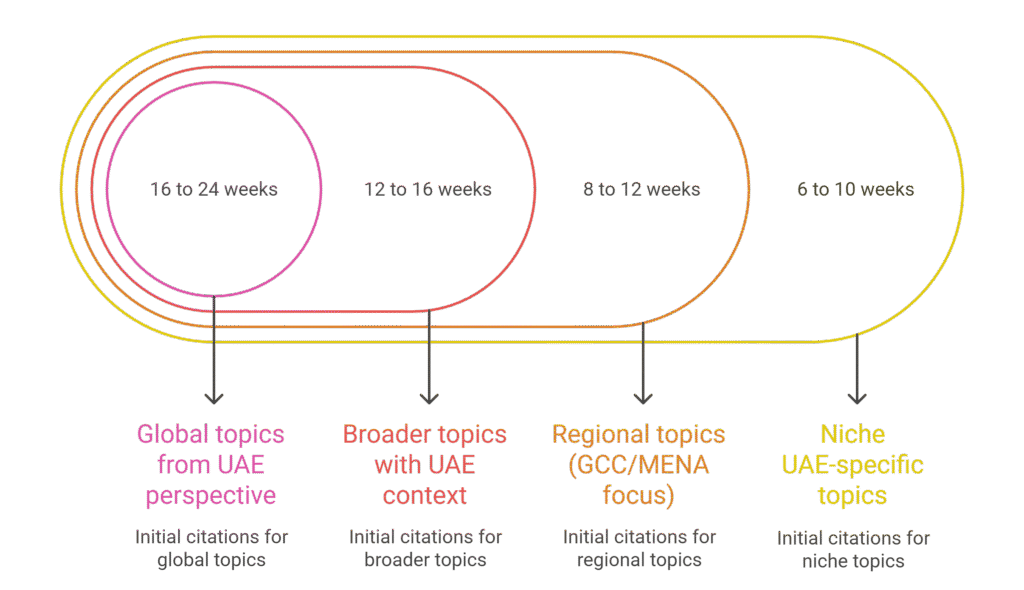
The key is leveraging your local expertise and unique market perspective while building broader topical authority over time.
What’s a realistic GEO strategy for small businesses with limited resources?
Most SMBs in the UAE can’t publish daily or hire large content teams. Here’s a practical, resource-conscious approach that still delivers results.
Month 1: Foundation
- Audit your existing content and identify your top 10 most valuable pieces
- Optimize these thoroughly for GEO (structure, depth, citations, schema)
- Identify 5 niche topics where you have genuine expertise
- Set up tracking systems for key queries
Months 2-3: Focused production
- Publish 2 comprehensive pieces per week on your niche topics
- Each piece should be 1,500+ words, well-researched, and genuinely helpful
- Begin outreach to local industry publications and relevant blogs
- Engage authentically in online communities where your audience gathers
Months 4-5: Expansion and optimization
- Continue publishing 2 pieces per week
- Update and expand successful content from months 2-3
- Begin covering related topics to broaden topical authority
- Pursue guest posting and collaborative content opportunities
Month 6+: Scaling and refinement
- Assess which topics generate citations and double down
- Maintain publishing cadence but focus on proven content types
- Update older content to maintain freshness and relevance
- Consider expanding team or resources based on documented ROI
This strategy requires approximately 15 to 20 hours per week, which a small business can handle with one dedicated team member or through agency partnership. Expected timeline for first citations: 8 to 12 weeks. Consistent visibility across multiple topics: 5 to 6 months.
Conclusion
Ranking on generative AI engines in Dubai doesn’t follow the same predictable timeline as traditional SEO, but it’s not mysterious either. Most businesses see their first citations within 6 to 12 weeks of starting a focused GEO strategy, with consistent broad visibility developing over 4 to 6 months.
The timeline depends heavily on content quality, publication consistency, topical focus, and technical optimization. New businesses can absolutely compete effectively without waiting years to build domain authority, but they need to produce genuinely expert content and optimize it properly for AI engines.
For UAE businesses, the market conditions create both opportunities through lower local competition and challenges through fewer regional citation sources. The key is leveraging unique local expertise while building broader authority strategically.
Success in GEO requires patience, consistency, and a commitment to creating genuinely valuable content. It’s not a quick fix, but businesses that invest properly are building visibility on platforms that will dominate how people find information for years to come.
If you’re ready to start building your GEO strategy but not sure where to begin, BRB specializes in helping UAE businesses navigate this transition. We handle everything from content strategy to technical optimization, letting you focus on running your business while we build your visibility on the platforms that matter most.
FAQs
How long before I see any results from GEO efforts?
Most businesses see their first citations from AI engines within 6 to 10 weeks of starting a focused GEO strategy, assuming they’re publishing high-quality, optimized content consistently. Initial results usually appear for niche, specific queries before expanding to broader topics. The timeline accelerates significantly if you already have strong content and domain authority.
Is GEO faster than traditional SEO for new websites?
Yes, typically. New websites often need 6 to 12 months to rank well in traditional search due to domain age and backlink requirements. With GEO, a new site can get cited within 8 to 12 weeks if the content demonstrates genuine expertise and is properly optimized. AI engines prioritize content quality and relevance over domain history.
Can I speed up my GEO timeline by publishing more content?
Publishing frequency matters, but quality is more important than volume. Publishing 2 comprehensive, well-researched articles per week will deliver better results than publishing 10 shallow pieces. That said, consistent publishing does accelerate results. Businesses publishing 3 to 4 quality pieces weekly typically see citations 4 to 6 weeks faster than those publishing weekly.
Do I need to optimize for all AI engines at once or can I focus on one?
You can start with one or two platforms, but the optimization principles overlap significantly. Content that works well for ChatGPT typically performs well on Perplexity and Claude too. Starting with ChatGPT and Perplexity makes sense for UAE businesses since these have the strongest local adoption. You can expand to other platforms once you’ve established authority.
How do I know if my GEO efforts are actually working?
Track specific queries related to your business across different AI platforms weekly. Create a list of 20 to 30 relevant questions and test them systematically. You should start seeing occasional citations within 6 to 8 weeks, with more consistent mentions developing by month 4. Also monitor referral traffic from AI platforms and branded search volume increases as indirect indicators.
What if I have good SEO rankings but no GEO visibility?
This is common because the optimization requirements differ. Traditional SEO content often lacks the depth, structure, and conversational quality that AI engines prefer. Audit your top-ranking pages and enhance them with more comprehensive information, better structure, clearer answers to specific questions, and proper schema markup. You should see GEO citations begin appearing within 4 to 8 weeks of these updates.

What Makes a Website Converts Visitors into Paying Customers?
You’ve spent thousands of dirhams on a beautiful website. Your designer showed you mockups that looked amazing. The developer delivered everything on time. You launched with excitement, posted on social media, maybe even ran some ads.
But here’s the problem: visitors come to your site, look around for 20 seconds, and leave without contacting you or buying anything.
Sound familiar?
This is the single most frustrating problem UAE businesses face with their websites. You’ve got traffic, Google Analytics shows people are visiting, but they’re not becoming customers. Your website looks professional, so what’s wrong?
The answer isn’t about design aesthetics or fancy animations. It’s about conversion optimization, the science and psychology of turning casual converts visitors into paying customers. And in the UAE market, where customers have high expectations and plenty of alternatives, getting this right isn’t optional.
Let me walk you through exactly what separates websites that generate business from those that just look pretty. No marketing fluff, no vague advice, just actionable strategies that work for UAE businesses right now.
How does website conversion work in the UAE?
First, let’s be clear about what “conversion” actually means. It’s not always a sale. For many businesses, a conversion might be:
- A phone call or WhatsApp message
- A completed contact form
- An email newsletter signup
- A downloaded brochure or price list
- A booked consultation or appointment
- Adding items to cart and completing checkout
Whatever action moves someone closer to becoming a paying customer, that’s your conversion goal.
Here’s the thing about the UAE market: your customers have been trained by world-class digital experiences. They’ve used Noon, Amazon, Careem, and Talabat. They’ve browsed luxury brand websites and interacted with polished international e-commerce stores. When they land on your site, they’re unconsciously comparing you to these experiences.
That means a “decent” website won’t cut it. Your site needs to work flawlessly, load instantly, and guide visitors naturally toward taking action. Let’s break down exactly how to make that happen.
What happens in the first few seconds when someone visits your website?
You have roughly 3-5 seconds to convince someone not to hit the back button. That’s it. Not minutes, seconds.
Research shows that 38% of people will stop engaging with a website if the layout is unattractive. In UAE’s competitive digital landscape, that percentage is probably higher. Here’s what makes or breaks those crucial first seconds:
Instant clarity on what you do: Your headline should answer “what is this?” within a blink. Not clever wordplay. Not vague mission statements. Clear, direct language about what you offer and who it’s for.
Bad example: “Transforming dreams into reality through innovative solutions” Good example: “Custom Kitchen Renovations for Dubai Homes, Completed in 4 Weeks”
See the difference? The second version immediately tells a Dubai homeowner exactly what you do, who you serve, and addresses a key concern (timeline).
Professional visual presentation: I know I said this isn’t about aesthetics, but let me clarify: it’s not about being trendy or flashy. It’s about looking trustworthy and professional to your specific audience. UAE customers, particularly in emirates like Dubai and Abu Dhabi, expect a certain polish. Poor image quality, dated design, or messy layouts immediately trigger distrust.
Fast loading speed: If your site takes more than 3 seconds to load, roughly 40% of visitors will abandon it before they even see your content. In UAE’s fast-paced business environment where mobile usage dominates, speed isn’t a nice-to-have, it’s essential. Google also ranks faster sites higher, so slow loading costs you both direct visitors and search visibility.
Mobile perfection: Over 70% of UAE internet users access websites primarily via mobile devices. If your site doesn’t work flawlessly on phones, you’ve already lost most of your potential customers. And “mobile-friendly” isn’t enough, it needs to be mobile-optimized, with touch-friendly buttons, readable text without zooming, and intuitive navigation.
Why do UAE customers trust some websites and not others?
Trust is currency in the UAE market. With diverse populations, language barriers, and concerns about online fraud, establishing credibility quickly is non-negotiable.
Physical presence signals: UAE customers want to know you’re a real business they can visit or contact. Display your physical address prominently (bonus points for recognizable emirates like “Dubai Marina” or “Abu Dhabi Business Park”). Include a local UAE phone number, not just international numbers or contact forms. Adding a Google Maps embed showing your actual office location builds significant trust.
Social proof everywhere: Reviews, testimonials, case studies, client logos, awards, certifications, these aren’t vanity metrics. They’re trust accelerators. When someone sees that other UAE businesses have worked with you successfully, their perceived risk drops dramatically.
But here’s the key: social proof must be specific and authentic. Generic testimonials like “Great service!” mean nothing. Powerful testimonials include:
- The client’s full name and company/role
- Specific results or benefits they experienced
- Preferably a photo (even better: video testimonial)
- Relevant to your target audience
Trust badges and certifications: If you have relevant certifications, display them. UAE business licenses, industry certifications, security badges (for e-commerce), payment provider logos, association memberships, these all contribute to credibility. Just don’t overdo it; choose the most relevant ones and place them strategically, usually in footers or near checkout areas.
Professional content quality: Spelling mistakes, grammatical errors, poor translations (especially Arabic), or low-quality images signal unprofessionalism. UAE customers associate these with scam sites or low-quality businesses. Invest in proper copywriting and, if offering bilingual content, professional translation, not Google Translate.
Transparent pricing information: Nothing frustrates UAE customers more than “Contact us for pricing” when they just want a ballpark figure. While you can’t always provide exact prices, offering starting prices, price ranges, or sample packages helps qualify leads and builds trust through transparency. The “request a quote” approach should be reserved for truly custom work where pricing genuinely varies significantly.
Why should customers choose your business over competitors?
Your value proposition answers the fundamental question every visitor is asking: “What’s in it for me, and why should I choose you over competitors?”
Many UAE businesses make the mistake of talking about themselves, their history, their mission, their values. While these have a place, they’re not your value proposition. Your visitors care about their problems and your solutions.
Problem-solution clarity: Start by acknowledging the specific problem your target audience faces, then present your solution. This creates immediate relevance.
For example, if you’re an AC maintenance company in Dubai: “Dubai’s extreme heat demands reliable AC systems. When your AC fails, you need fast, professional repair. We provide same-day service across Dubai with certified technicians and 12-month guarantees on all repairs.”
This works because it:
- Acknowledges the context (Dubai’s heat)
- Identifies the problem (AC failure and urgency)
- Presents the solution (same-day service)
- Adds differentiators (certified technicians, guarantees)
Unique selling points that actually matter: Your USPs should be specific, provable, and relevant to your audience. “Best quality” is neither specific nor provable. “24/7 customer support with Arabic-speaking agents based in UAE” is both specific and relevant to local customers.
Common effective USPs for UAE businesses:
- Same-day or specific timeframe service
- Free delivery within UAE
- Arabic-speaking support team
- Physical locations in multiple emirates
- Specific guarantees or warranties
- Licensed and certified professionals
- Payment plans or flexible payment options
- After-sales support and maintenance
Results-focused messaging: UAE business customers particularly respond to concrete outcomes. Rather than describing what you do, describe what they’ll achieve:
- “Reduce your office operating costs by up to 30%”
- “Move into your new home in 60 days”
- “Generate qualified leads within 2 weeks”
Numbers, timeframes, and specific benefits convert better than vague promises.
How can I make it easier for visitors to take action on my website?
Every unnecessary click, confusing menu, or unclear next step costs you conversions. The path from landing on your site to completing a conversion should be as smooth as possible.
Intuitive navigation: Your menu structure should reflect how customers think, not how your business is organized internally. Use clear, familiar labels. “Services” is better than “Solutions.” “Contact Us” is better than “Get in Touch.”
For UAE businesses serving different emirates, consider location-based navigation. For businesses serving both individuals and companies, separate these paths clearly.
Strategic calls-to-action (CTAs): Every page should have a clear next step. Not five different options, one primary action. Use action-oriented language that creates urgency or value:
Weak CTAs:
- “Submit”
- “Click here”
- “Learn more”
Strong CTAs:
- “Get Your Free Quote Now”
- “Book Your Consultation Today”
- “Start Your Free Trial”
- “Download the Price Guide”
Color psychology matters in UAE market. While cultural preferences vary, buttons that contrast with your site’s colors (without clashing) typically convert best. Test different options for your specific audience.
Minimal form fields: Every field you add to a contact form reduces completion rates. UAE businesses often make forms unnecessarily complex, asking for information they don’t immediately need.
For initial contact, you typically only need:
- Name
- Phone number or email
- Brief message or inquiry type
You can gather additional details later in the conversation. If you absolutely need more information, use progressive forms that show only relevant fields based on previous answers.
Multiple contact options: Different people prefer different communication methods. Offer:
- Phone number (clickable on mobile)
- WhatsApp link (extremely popular in UAE)
- Contact form
- Email address
- Live chat (if you can respond promptly)
- Physical address with map
Don’t force everyone through one channel. Some people will never fill a form but will happily send a WhatsApp message.
Chat and support availability: Live chat can dramatically increase conversions, but only if done well. Poor chat experience (long delays, unhelpful responses, or bots that frustrate users) is worse than no chat at all.
If offering live chat:
- Respond within 60 seconds
- Use knowledgeable staff, not just scripts
- Offer offline messages with quick email response
- Consider Arabic language support for wider UAE market
Clear next steps throughout: After someone fills a form, what happens? Tell them: “Thank you! We’ll contact you within 2 hours.” After someone purchases, what’s next? Provide order confirmation with clear timeline expectations.
Uncertainty kills conversions. Clarity builds them.
Why is mobile optimization so important for UAE businesses?
Let me be direct: if your website doesn’t work perfectly on mobile devices, you’re throwing money away. Mobile commerce in the UAE is growing exponentially, with many customers exclusively using smartphones for browsing and purchasing.
Touch-friendly interface: Buttons should be large enough to tap easily (minimum 44×44 pixels). Space them adequately so users don’t accidentally tap the wrong thing. If someone has to pinch-zoom to read text or hit a button, you’ve already lost them.
Streamlined mobile navigation: Hamburger menus are fine, but keep navigation shallow. If someone has to tap through multiple layers to find your services, they won’t. Key pages should be maximum 2 taps from the home screen.
Mobile-optimized forms: On mobile, forms should:
- Use appropriate keyboard types (number pad for phone numbers, email keyboard for email)
- Have large, tappable fields
- Show clear field labels and validation messages
- Allow autofill from saved information
- Be completable without zooming or scrolling sideways
Fast mobile loading: Mobile users in UAE are often on-the-go, sometimes with inconsistent connections. Compress images aggressively, minimize code, use caching, and optimize everything for speed. Test your mobile load time regularly, it should be under 2 seconds.
Click-to-call and WhatsApp integration: On mobile, make phone numbers and WhatsApp links immediately tappable. Don’t make users copy-paste numbers or switch apps manually. These small frictions add up to lost conversions.
How does good content help converts visitors into paying customers?
Content isn’t just words on a page, it’s your sales team working 24/7. Good content builds trust, educates customers, overcomes objections, and guides people toward conversion.
Benefit-focused copy: Features tell, benefits sell. Your AC unit isn’t “18,000 BTU with inverter technology”, it’s “Cools your 30 sqm bedroom while using 40% less electricity, saving you AED 200+ monthly on power bills.”
Always translate technical features into practical benefits for your UAE customers’ lives or businesses.
Addressing objections preemptively: Every potential customer has concerns preventing them from converting immediately. Common UAE market objections include:
- “Is this company legitimate?”
- “Will they deliver on time?”
- “Is the price fair?”
- “What if I’m not satisfied?”
- “Can they handle my specific situation?”
Address these directly in your content. Use testimonials, guarantees, case studies, FAQs, and clear policies to eliminate doubt before it becomes a reason not to buy.
Storytelling that connects: While data and features matter, stories create emotional connections. Share customer success stories, behind-the-scenes looks at your process, or founders’ stories that reveal your motivation and values.
For UAE audiences with diverse cultural backgrounds, stories that emphasize reliability, quality, and respect for customer relationships resonate particularly well.
Video content: Video builds trust faster than text. UAE customers respond well to:
- Product demonstrations
- Customer testimonial videos
- Behind-the-scenes facility tours
- Founder introduction videos
- How-to guides and tutorials
Even simple smartphone videos work if they’re authentic. Professional production is great but not always necessary, authenticity often converts better than polish. Many businesses working with a web development team in Dubai find that incorporating genuine client testimonials and behind-the-scenes content, even when filmed simply, creates stronger connections than heavily produced marketing materials.
SEO-optimized content: Creating conversion-focused content that also ranks well in search engines gives you the best of both worlds. Target keywords your UAE customers actually search for, but write for humans first, search engines second.
Local SEO matters immensely, optimize for “villa renovation Dubai,” not just “villa renovation.” Include emirate names, neighborhoods, and local landmarks naturally in your content.
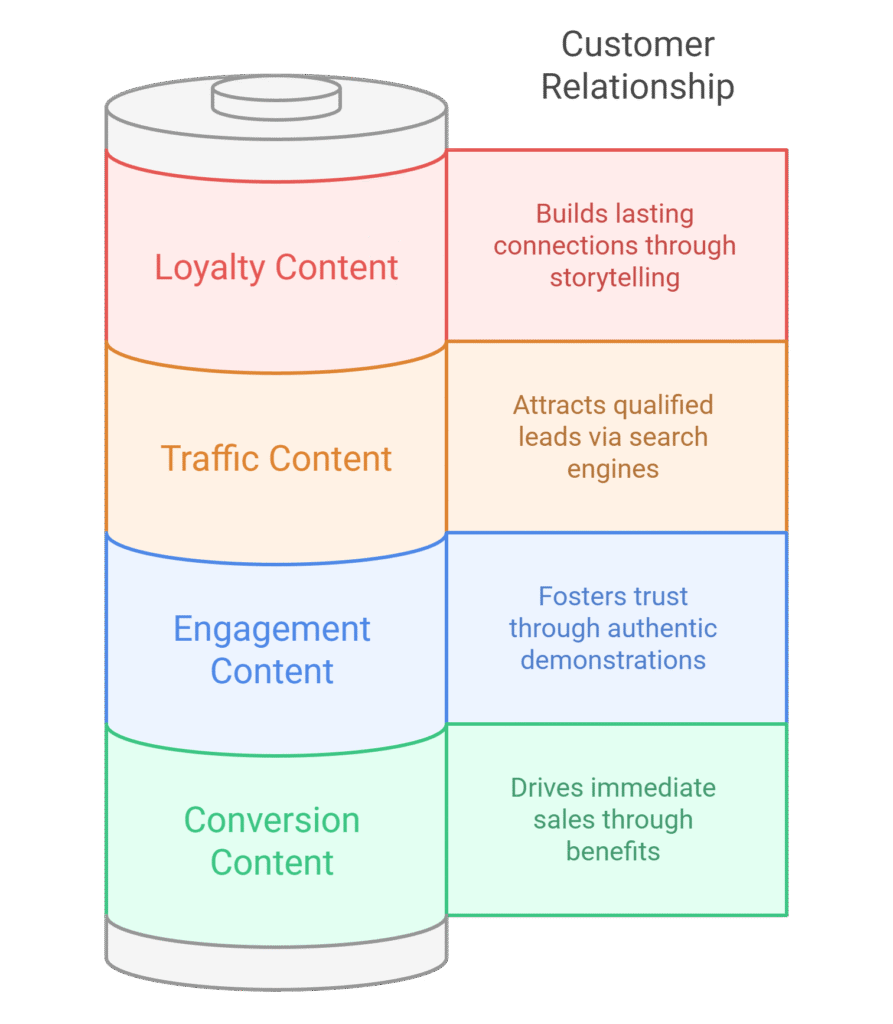
What kind of proof do I need to show on my website to get more sales?
Data and social proof aren’t just nice additions, they’re conversion essentials for skeptical modern consumers.
Numbers that matter: Quantify your track record:
- “Over 2,000 UAE businesses served”
- “4.8-star rating from 500+ Google reviews”
- “98% customer satisfaction rate”
- “Average project completion: 2 weeks ahead of schedule”
Make sure these are accurate and verifiable. False claims will destroy trust faster than you built it.
Case studies and success stories: Detailed case studies showing how you solved specific problems for UAE clients are incredibly powerful. Structure them as:
- Client background and challenge
- Your solution approach
- Specific results achieved
- Client testimonial
Make them relevant to your target audience. If you serve restaurants in Dubai, showcase restaurant clients, not random unrelated industries.
Live social proof: Real-time indicators work well:
- “23 people viewing this product”
- “4 bookings made today”
- “Join 5,000+ UAE subscribers”
Just ensure these are genuine. Fake scarcity or false urgency backfires when customers discover the deception.
Awards and media mentions: Have you won industry awards? Been featured in Gulf Business, Arabian Business, or local media? Showcase these prominently. Third-party validation carries significant weight with UAE audiences.
Professional affiliations: Membership in Dubai Chamber of Commerce, Abu Dhabi Chamber, industry associations, or professional bodies adds credibility. Display relevant logos and link to verification when possible.
Should I use urgency and scarcity tactics on my website?
When used ethically, urgency and scarcity can push hesitant visitors toward action. When abused, they destroy trust. The line is thin but clear.
Legitimate urgency:
- “Ramadan special offer ends in 5 days”
- “Limited slots available for March projects”
- “Sale ends when current stock sells out”
- “First 20 customers get free installation”
Fake urgency (avoid):
- Permanent countdown timers that reset
- “Only 2 left!” when you have unlimited stock
- False deadlines with no real limitation
UAE customers are sophisticated enough to spot fake scarcity. Use these tactics only when genuinely true, and you’ll build trust while creating motivation to act now rather than later.
Seasonal opportunities: UAE has distinct seasons and events perfect for legitimate urgency:
- Ramadan and Eid promotions
- DSS (Dubai Summer Surprises) and GITEX offers
- Back-to-school periods
- National Day specials
- Summer preparation (AC maintenance before May, etc.)
These create natural, credible urgency that UAE audiences understand and respond to.
What features does my online store need to increase sales?
If you’re selling products online in UAE, additional elements become critical:
Multiple payment options: UAE customers want choice. Offer:
- Credit/debit cards (Visa, Mastercard)
- Digital wallets (Apple Pay, Google Pay)
- Cash on delivery (still popular in UAE)
- Buy now, pay later options (Tabby, Postpay)
- Bank transfers for larger purchases
More options = more conversions. The customer who won’t use a credit card might happily do cash on delivery.
Clear shipping information: Before checkout, display:
- Shipping costs (or free shipping threshold)
- Delivery timeframes for different emirates
- Tracking availability
- Return and exchange policy
Uncertainty about these factors causes cart abandonment. Remove the uncertainty, increase conversions.
Product information depth: UAE online shoppers research thoroughly before buying. Provide:
- Multiple high-quality images (zoom capability)
- Detailed specifications
- Sizing guides with local measurements
- Videos showing product in use
- Related products and comparisons
- Customer Q&A section
Security and trust during checkout: Make customers feel safe:
- Display security badges and SSL certificate indicators
- Show accepted payment logos
- Offer guest checkout (don’t force account creation)
- Clearly state privacy policy
- Provide immediate order confirmation
Cart abandonment recovery: Many UAE shoppers add items to cart but don’t complete purchase. Combat this with:
- Exit-intent popups offering assistance
- Email reminders about abandoned carts
- Limited-time discount codes to encourage completion
- Saved carts accessible from any device
How do I test and improve my website’s conversion rate?
Here’s a truth many UAE businesses miss: conversion optimization isn’t a one-time project. It’s an ongoing process of testing, measuring, and improving.
What to test:
- Headline variations
- CTA button colors and text
- Form field numbers and types
- Page layouts and content order
- Images and videos
- Pricing displays
- Trust badge placements
How to test effectively: Use tools like Google Analytics, Hotjar, or Microsoft Clarity to understand user behavior. Where do people drop off? Which pages have high bounce rates? Where do they spend time?
For significant changes, run A/B tests: show version A to half your visitors, version B to the other half, and measure which converts visitors into paying customers better. Even small improvements (a 0.5% conversion rate increase) compound significantly over time.
UAE-specific testing considerations:
- Test Arabic vs. English user behavior separately
- Compare performance across different emirates
- Test mobile vs. desktop conversion paths
- Analyze conversion rates for different traffic sources
Measure what matters: Vanity metrics (page views, time on site) are interesting but don’t pay bills. Focus on:
- Conversion rate (% of visitors who complete desired action)
- Average order value (for e-commerce)
- Cost per acquisition (how much to get one customer)
- Customer lifetime value (total value of a customer relationship)
What mistakes are killing my website conversions?
Let me save you time and money by calling out the most common mistakes I see UAE businesses making:
Auto-playing videos with sound: Nothing irritates visitors faster. If you use videos, make them click-to-play.
Aggressive popups: Showing a newsletter popup before someone has even read your homepage is intrusive. Let them explore first.
Poor Arabic translation: If you offer Arabic content, invest in professional translation. Bad Arabic translation suggests low quality throughout.
Hidden contact information: Making customers hunt for how to reach you suggests you don’t want to be contacted. Put contact info prominently in headers and footers.
Complicated checkout: Every additional step in your checkout process loses customers. Streamline ruthlessly.
Unclear pricing: “Contact us for pricing” frustrates customers who want to self-qualify before reaching out.
Broken links and errors: 404 errors, broken forms, or non-functioning features signal unprofessionalism and kill trust instantly.
No mobile optimization: I can’t emphasize this enough. If your site doesn’t work perfectly on mobile, you’re losing most UAE traffic.
How do I build a website that actually converts visitors into paying customers?
If you’re building a new website or redesigning, here’s your conversion optimization checklist:
Define clear conversion goals: What specific actions do you want visitors to take? Build your site around these goals.
Research your UAE audience: Understand their pain points, language preferences, device usage, and buying behavior.
Plan user journeys: Map out the ideal path from landing page to conversion for different visitor types.
Prioritize page loading speed: Set a target of under 2 seconds on mobile, under 1 second on desktop.
Design mobile-first: Start with mobile layouts, then expand to desktop, not the other way around.
Create compelling, benefit-focused content: Write for your customer, not about yourself.
Build in trust elements: Reviews, testimonials, certifications, guarantees from the foundation.
Simplify everything: Every element on every page should either support conversion or be removed.
Test before launch: Verify every form, button, link, and feature works flawlessly on multiple devices and browsers.
Plan for ongoing optimization: Budget for regular updates, testing, and improvements.
The Bottom Line for UAE Businesses
Converting visitors into customers isn’t about tricks or hacks. It’s about understanding human psychology, removing friction, building trust, and making it easy for people to take action.
Your website should answer three questions within seconds:
- What do you offer?
- Why should I trust you?
- What should I do next?
Get these right, optimize continuously, and your website will become your best sales representative, working around the clock to grow your UAE business.
The difference between a website that generates AED 10,000 monthly revenue and one that generates AED 100,000 often isn’t the design budget, it’s the conversion optimization. The best investment you can make isn’t in aesthetics; it’s in understanding your customers and eliminating everything that stops them from becoming buyers. Quality website development services Dubai should focus not just on how your site looks, but on how effectively it turns visitors into paying customers.
Frequently Asked Questions
What is a good conversion rate for a business website in UAE?
Conversion rates vary significantly by industry, traffic source, and conversion goal, but here are realistic benchmarks for UAE businesses: Service-based businesses typically see 2-5% conversion rates (contact forms or calls), e-commerce sites average 1-3% (completed purchases), and B2B websites often achieve 3-8% (qualified leads). If your rate is below 1%, there’s definitely room for improvement. Focus first on the fundamentals: page load speed, mobile optimization, clear CTAs, and trust signals. Remember that a 2% conversion rate means 98% of visitors leave without converting, small improvements here create significant business impact.
How long does it take to see conversion improvements after optimizing a website?
Some changes show impact immediately, while others require time to accumulate sufficient data. Quick wins (within 1-2 weeks) include improving page load speed, fixing broken elements, clarifying CTAs, and adding prominent contact information. These fundamental fixes often boost conversions 10-30% right away. Medium-term improvements (1-3 months) come from content optimization, trust-building elements, and A/B testing different approaches. Significant long-term gains (3-6 months) emerge from ongoing testing, SEO improvements bringing better-qualified traffic, and refining your value proposition based on customer feedback. The key is to start measuring immediately, so you have baseline data to compare against when implementing changes.
Should I focus on getting more traffic or converting existing traffic better?
For most UAE businesses, conversion optimization provides better ROI than simply increasing traffic. Here’s why: if you’re currently getting 1,000 visitors monthly with a 1% conversion rate, you’re getting 10 customers. Doubling your traffic costs money (ads, SEO, etc.) and gives you 20 customers. But improving your conversion rate to 3% gives you 30 customers from the same traffic, better results with no increase in traffic acquisition costs. The smartest approach is to optimize conversion first, then scale traffic once you’ve proven your site converts visitors into paying customers well. Sending more traffic to a poor-converting website just wastes your marketing budget. Fix the conversion fundamentals first, then increase traffic to a website that’s proven to converts visitors into paying customers effectively.
What’s the most important element for conversion: design, content, or functionality?
They’re interconnected, but if forced to prioritize for UAE businesses, functionality trumps everything. A beautiful site that loads slowly or has broken forms converts visitors into paying customers poorly. A gorgeously designed site with weak content fails to persuade. However, a simple-looking site that loads instantly, communicates value clearly, and makes taking action effortless can convert exceptionally well. Think of it as a hierarchy: functionality must work perfectly (fast loading, mobile-responsive, no broken elements), content must communicate value and build trust effectively, and design should enhance rather than distract from these goals. Many UAE businesses over-invest in design aesthetics while neglecting the fundamentals of fast loading, clear messaging, and friction-free conversion paths. Start with the foundation, make it work flawlessly, then layer on compelling content and appealing design.
How can I test what’s stopping visitors from converting on my website?
Start with Google Analytics to identify where visitors drop off, which pages have high bounce rates, where people exit your site, and how conversion funnels perform. Install heatmap tools like Hotjar or Microsoft Clarity to see where people click, how far they scroll, and watch session recordings of real user behavior. These often reveal friction points you’d never notice yourself, buttons users can’t find, forms they abandon halfway through, or content they ignore completely. Conduct user testing by asking 5-10 people from your target UAE audience to complete a task on your site while thinking aloud. Their struggles reveal conversion barriers. Check your site on multiple devices (iPhone, Android phones, tablets) since issues often appear device-specific. Finally, directly ask customers who did convert what almost stopped them, and ask non-converters (if you can reach them) what held them back. Real user feedback beats assumptions every time.
Do I need to hire a conversion optimization specialist or agency?
It depends on your situation. If you have basic analytics skills and time to learn, you can handle fundamental improvements yourself: fixing page speed, improving mobile experience, clarifying CTAs, and adding trust elements. Free resources and tools are abundant. However, hire specialists if you’re running e-commerce with significant traffic (1,000+ monthly visitors), spending substantial amounts on advertising where conversion improvements directly impact ROI, lack time or technical skills to implement changes yourself, or want to scale quickly and need proven expertise. For UAE businesses, agencies familiar with local market nuances (bilingual optimization, local payment preferences, cultural considerations) provide added value beyond just conversion tactics. A good specialist pays for themselves through improved results, but start with low-hanging fruit yourself before investing in expensive optimization consulting.

How Much Does a Professional Website Cost in UAE?
If you’re running a business in the UAE and thinking about building a website, you’ve probably noticed something frustrating: nobody wants to give you a straight answer about pricing. You’ll see “starting from AED 2,000” on one site and “custom quotes only” on another. So what’s the real story?
Let’s cut through the confusion. The truth is, a professional website in the UAE can cost anywhere from AED 3,000 to AED 50,000+, depending on what you actually need. That’s a huge range, I know. But here’s the thing, understanding why prices vary so much will help you make a smarter investment for your business.
Whether you’re a startup in Dubai Media City, a retail shop in Sharjah, or a service provider in Abu Dhabi, this guide will break down the real costs, hidden fees, and what you should actually be paying for a website that works for your business.
Why do website prices vary so much in the UAE?
The UAE’s digital landscape is unique. Your customers expect slick, fast-loading websites that work flawlessly on mobile. They’re comparing you to both local competitors and international brands. That sets a high bar.
Here’s what drives website cost in UAE:
Local market expectations: UAE consumers are sophisticated. They’ve shopped on Amazon, browsed luxury brand sites, and used apps like Noon and Careem. Your website needs to match that experience, even if you’re a small business. This means investing in proper design, user experience, and performance, not just throwing up a basic template.
Multilingual requirements: Many UAE businesses need Arabic and English versions of their site. That’s not just translation, it’s adapting layouts for right-to-left text, culturally appropriate imagery, and maintaining SEO effectiveness in both languages. This typically adds 30-40% to development costs.
Payment gateway integration: If you’re selling online, you’ll need local payment solutions. Integrating services like Network International, Telr, or PayTabs costs extra but is essential for UAE customers who want to pay with their preferred methods.
Hosting and compliance: Data residency requirements and optimal performance for UAE users mean hosting considerations matter. While you can use international hosting, local or regional hosting often performs better for your target audience.
How much should you budget for different types of business websites?
Let me give you realistic numbers for different business scenarios. These are based on what UAE businesses actually pay for quality work, not the cheapest options on Fiverr, and not the inflated quotes from agencies charging for their fancy office rent.
Small Business / Startup Website (AED 3,000 – AED 8,000)
Perfect for service providers, consultants, small retail shops, or startups testing the market.
What you get:
- 5-8 page informational website
- Mobile-responsive design
- Contact forms and Google Maps integration
- Basic SEO setup
- Content management system (usually WordPress)
- One language version
What you won’t get:
- Custom design from scratch (you’ll work with customized templates)
- E-commerce functionality
- Advanced integrations
- Ongoing support beyond initial setup
Real talk: This budget works if you have clear content ready, know what you want, and can handle minor updates yourself once the site is live. Many freelance developers and small agencies in Dubai and Abu Dhabi offer solid work in this range.
Professional Business Website (AED 8,000 – AED 20,000)
This is the sweet spot for established SMBs that need a website that actually represents their brand properly.
What you get:
- 10-15 custom pages
- Original design tailored to your brand
- Professional copywriting assistance
- Advanced SEO optimization
- Blog or news section
- Lead capture and CRM integration
- Bilingual capability (Arabic + English)
- Basic analytics setup
- 3 months post-launch support
What makes the difference: You’re paying for strategy here, not just execution. A good agency will research your competitors, understand your target audience, and build a site that converts visitors into customers, not just looks pretty.
UAE context: At this level, agencies understand local market nuances. They know that UAE customers expect certain trust signals (like displaying your trade license, physical location, and local contact numbers prominently). They’ll optimize your site for Dubai, Abu Dhabi, and other emirates separately if needed.
E-Commerce Website (AED 15,000 – AED 40,000)
If you’re selling products online, you’re looking at a more complex build.
What you get:
- Full online store with product catalog
- Shopping cart and checkout system
- Payment gateway integration (multiple options)
- Inventory management
- Customer account system
- Order tracking and notifications
- Mobile app-like experience
- SSL certificate and security measures
- Shipping zone configuration for UAE delivery
- Integration with VAT requirements
Platform considerations: Shopify might cost AED 15,000-25,000 for setup and customization. WooCommerce or custom solutions run AED 20,000-40,000 depending on complexity. Magento or custom platforms for larger operations can exceed AED 50,000.
Hidden costs to watch: Monthly platform fees, payment gateway transaction fees (usually 2.5-3.5% in UAE), SSL certificates, and maintenance. Budget at least AED 500-1,500 monthly for keeping an e-commerce site running smoothly.
Enterprise / Custom Web Application (AED 40,000+)
Large companies, booking platforms, SaaS products, or businesses needing complex functionality fall here.
What you get:
- Fully custom design and development
- Complex database architecture
- Third-party integrations (CRM, ERP, logistics systems)
- Custom features and functionality
- Advanced security measures
- Load testing and performance optimization
- Dedicated project management
- Extended support and maintenance
Examples: Real estate portals with property search, healthcare platforms with appointment booking, educational platforms with learning management systems, or restaurant chains with online ordering across multiple locations.
What factors affect the website cost in UAE?
Let’s get specific about what makes one quote AED 5,000 and another AED 25,000:
Design complexity: Using a pre-made theme with your colors and logo? Cheaper. Want custom illustrations, animations, video backgrounds, and a unique layout? More expensive. Each custom design element requires a designer’s time.
Functionality requirements: A contact form is simple. A booking system that integrates with your calendar, sends automated emails, processes payments, and handles cancellations? That’s complex. Every interactive feature adds development time.
Content creation: If you provide all text, images, and videos ready to go, costs drop. Need a professional photographer for your products? Copywriter for your pages? Video production? These add up quickly. Professional product photography in Dubai runs AED 1,500-5,000 per day. Copywriting ranges from AED 500-1,500 per page.
Number of pages: More pages = more time designing, developing, and populating with content. Simple math, but people underestimate this. A 5-page site might take 2 weeks. A 25-page site could take 8-10 weeks.
Mobile optimization: Every website should be mobile-friendly now (it’s 2025, come on). But doing it well, ensuring everything looks perfect and works smoothly on phones and tablets, requires additional testing and refinement time.
SEO and performance: Basic SEO means meta tags and alt text. Comprehensive SEO means keyword research, competitor analysis, content optimization, schema markup, page speed optimization, and ongoing monitoring. The difference between ranking on page 1 and page 5 of Google.
Integration needs: Connecting your website to your existing tools, email marketing platforms, CRM systems, booking software, inventory management, each integration needs custom development or API configuration.
What hidden costs should I know about when building a website?
Here’s where businesses get surprised:
Domain registration: AED 50-200 annually. Not much, but it’s recurring. Choose a reputable registrar (like GoDaddy, Namecheap, or local providers) and never let it expire.
Hosting: AED 300-2,000+ annually depending on traffic and performance needs. Cheap hosting (under AED 500/year) often means slow loading times, which costs you customers. Quality hosting matters more than most people think.
SSL certificate: AED 0-500 annually. Many hosts include free SSL now, but some businesses need extended validation certificates for trust signals. If you’re handling payments or sensitive data, don’t skip this.
Maintenance and updates: Websites aren’t “set and forget.” Software updates, security patches, content updates, and plugin maintenance are ongoing. Budget AED 500-2,000 monthly or learn to do it yourself.
Email hosting: Professional email addresses (@yourbusiness.ae) cost AED 15-30 per account monthly. Google Workspace and Microsoft 365 are popular in UAE businesses.
Backup services: If your host doesn’t include automatic backups, you need them. AED 100-300 annually for reliable backup solutions. Trust me, when (not if) something goes wrong, you’ll be glad you have backups.
Marketing and optimization: A website that doesn’t get traffic is useless. Budget for Google Ads, social media marketing, SEO work, or content creation to actually bring visitors to your new site.
How do I choose the right web developer in UAE?
Price shopping alone is a terrible strategy. Here’s what actually matters:
Portfolio review: Look at their previous work. Does it look modern? Does it work well on your phone? Do those businesses seem similar to yours? If they only show big corporate sites but you’re a small café, they might not be the right fit.
Local understanding: Do they get the UAE market? Do they know local payment gateways, understand bilingual requirements, and have experience with UAE businesses? Someone who’s built 50 websites in India might struggle with local nuances here.
Communication: How quickly do they respond to your initial inquiry? Are they asking good questions about your business goals? Poor communication during sales means disaster during development.
Support terms: What happens after launch? Do they disappear? Do they charge hourly for every tiny change? Get clear terms upfront about post-launch support.
Timeline realism: If someone promises a full custom website in 1 week, run away. Quality work takes time. A professional business website typically needs 6-12 weeks from kickoff to launch.
Contract clarity: Are deliverables clearly defined? What about revision rounds? What happens if you’re not satisfied? A vague contract protects them, not you.
What warning signs should I watch out for when hiring a developer?
Watch out for these warning signs:
“We’ll rank you #1 on Google guaranteed”: Nobody can guarantee rankings. SEO takes time and ongoing effort. This is either naïve or dishonest.
Prices way below market: If everyone else quotes AED 8,000-12,000 and someone offers AED 2,000, there’s a reason. You’ll get template work, poor support, or hidden costs later.
Refusing to show portfolio: Legitimate developers are proud of their work. If they can’t show you examples (with reasonable explanations for confidential clients), something’s off.
Pressure tactics: “This price expires tomorrow!” or “We only take 3 clients per month.” Good agencies don’t need aggressive sales tactics.
Ownership confusion: Make sure YOU own the website, domain, and content. Some developers maintain ownership and hold it hostage if you want to leave.
No contract or vague agreements: Professional relationships need professional contracts. If they’re casual about agreements, they’ll be casual about delivery.
How can I get more value from my website budget?
If your budget is tight, here’s how to maximize value:
Prioritize strategically: Start with essential pages (home, about, services, contact) and add more later. A focused 5-page site that works brilliantly beats a scattered 15-page site that confuses visitors.
Provide your own content: Writing your own page content and gathering your images saves significant cost. Developers charge for content creation because it takes time.
Use quality templates wisely: There’s no shame in starting with a premium template if customized well. Save custom design budget for when your business has proven the model and needs to scale.
Phase your features: Launch with core functionality first. Add booking systems, e-commerce, or advanced features in phase 2 once you’re generating revenue from the initial site.
Learn basic updates: WordPress and similar platforms are designed for non-technical users. Learning to add blog posts or update text yourself saves ongoing costs.
Invest in SEO from the start: It’s harder and more expensive to retrofit SEO later. Even on a tight budget, proper SEO foundation during initial build pays off for years.
What are the actual going rates for websites in UAE in 2025?
Based on current market rates for quality work in the UAE:
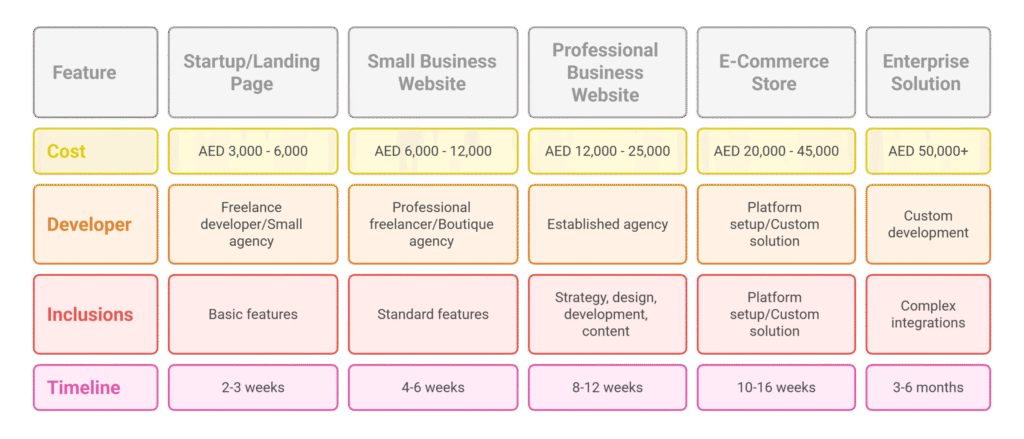
These prices reflect working with reputable professionals who understand the UAE market, provide proper support, and deliver quality work. You can find cheaper options, but understand what you’re sacrificing.
Is spending more on a website worth it for my business?
Here’s what nobody talks about enough: your website cost in UAE should be measured against what it generates, not just what you spend.
A AED 15,000 website that brings in 10 new customers per month at AED 2,000 average value pays for itself in under a month. A AED 5,000 website that looks cheap and drives customers to your competitor is expensive at any price.
UAE consumers are sophisticated. They judge your business by your website within seconds. If your site looks dated, loads slowly, or doesn’t work well on mobile, they’re clicking back to Google and trying your competitor.
Think of your website as your hardest-working employee. It works 24/7, never takes vacation, and doesn’t ask for a raise. Would you hire an employee for AED 3,000 annually who could bring in dozens of customers? Of course. Apply the same thinking to your website budget.
Final Recommendations for UAE Businesses
If you’re a startup testing a concept: Start with AED 5,000-8,000 for a solid landing page or basic site. Prove your model, then reinvest in a better site once you have revenue.
If you’re an established SMB: Budget AED 12,000-20,000 for a professional website that properly represents your brand. This is where you get the most value for money in the UAE market.
If you’re selling online: Don’t cheap out. Budget minimum AED 20,000-30,000 for an e-commerce site that actually converts. Poor checkout experiences lose sales fast.
If you’re scaling or enterprise: Budget AED 40,000+ and work with agencies that specialize in your industry. At this level, strategic thinking and experience matter more than saving a few thousand dirhams.
Remember: in the UAE’s competitive market, your website isn’t an expense, it’s an investment in capturing market share from competitors who are already online. The question isn’t “how much will a website cost in UAE?” but “how much revenue am I losing without a proper website?”
Frequently Asked Questions
How long does it take to build a professional website in UAE?
A typical professional business website takes 6-12 weeks from initial consultation to launch. This includes strategy discussions, design approval, development, content creation, testing, and revisions. Rush jobs are possible but often sacrifice quality. E-commerce sites need 10-16 weeks due to additional complexity like payment gateway testing and product catalog setup. Simple landing pages can be done in 2-3 weeks.
Do I need to pay monthly fees after my website is built?
Yes, ongoing costs are unavoidable. At minimum, you’ll pay for domain registration (AED 50-200 annually), hosting (AED 300-2,000+ annually), and SSL certificate (often included with hosting). Most businesses also budget AED 500-2,000 monthly for maintenance, security updates, content changes, and technical support. E-commerce sites have additional costs for payment gateway transaction fees (2.5-3.5% per sale) and platform subscriptions if using Shopify or similar services.
Should I use a freelancer or agency for my website in UAE?
Freelancers work well for smaller budgets (AED 3,000-10,000) and simpler projects where you have clear requirements and can manage the project yourself. They’re often more flexible and affordable. Agencies (AED 10,000-50,000+) provide better project management, diverse skills (design, development, SEO, copywriting), accountability, and ongoing support. For business-critical websites or e-commerce projects, agencies reduce risk through structured processes and team expertise. Many successful UAE businesses start with freelancers and graduate to agencies as they scale.
What’s the difference between a AED 5,000 and AED 15,000 website?
The AED 5,000 website typically uses a pre-made template with minor customization, includes 5-8 pages, basic functionality, and minimal strategic input. You’ll likely provide all content yourself and handle your own updates post-launch. The AED 15,000 website includes custom design tailored to your brand, strategic planning (competitor research, user journey mapping), professional copywriting assistance, comprehensive SEO, bilingual capability, CRM integration, and 3-6 months post-launch support. The more expensive site is designed to convert visitors into customers, not just look professional. For established businesses, the price difference often pays for itself through better conversion rates.
Can I build my website myself using Wix or Squarespace?
Absolutely, and it might be the right choice if you’re extremely budget-constrained or just testing concept. DIY website cost in UAE is around AED 200-800 annually and let you build a basic site without coding. However, there are tradeoffs: limited customization, template designs that might look like competitors, restricted SEO capabilities, and the time investment required (learning curve is steeper than advertised). For UAE businesses, DIY platforms struggle with bilingual requirements and local payment gateway integrations. Most businesses find that DIY works for initial testing but professional development becomes necessary as they grow and need their website to actually drive business results.
What happens to my website if I stop paying my developer?
This depends entirely on your contract and who owns what. In a proper setup, YOU should own your domain name, hosting account, and all website files. If you registered these yourself (recommended) and the developer just built the site, you can take the files and move to another developer anytime. However, many budget developers maintain control of hosting and domain, making you dependent on them. Before starting any project, clarify: Who owns the domain? Who controls the hosting? Can you get all files and database access? Will you have admin credentials to your website? Get these terms in writing. If a developer refuses to answer these questions clearly, that’s a major red flag.

How Do Small Businesses Compete with Big Brands Using Viral Content?
Your competitor just posted a video. Within 24 hours, it has 2 million views, thousands of comments, and your potential customers are sharing it everywhere. Their marketing budget? Probably 50 times bigger than yours.
You’re sitting in your office in Business Bay or running your shop in Karama, watching these big brands dominate the conversation. The question isn’t whether they have advantages (they obviously do). The question is: can you still win without their resources?
The answer is yes, but not by playing their game. Small businesses in the UAE are competing with multinational brands right now and winning, not through bigger budgets, but through smarter viral content strategies that big companies are actually too slow to use.
Why is viral content actually more accessible for small businesses than big brands?
This might sound counterintuitive, but small businesses have built-in advantages when it comes to creating viral content. You just haven’t been using them.
Big brands move slowly. Every piece of content goes through legal reviews, brand compliance checks, multiple approvals, and corporate procedures. By the time they’re ready to post about a trending topic, the trend is already over. You can film, edit, and post something within an hour. That speed is gold in 2025.
Big brands sound like corporations. Their content feels polished, scripted, and designed by committee because it usually is. Audiences in the UAE (and globally) are craving authenticity. Your small team, your real personality, your actual workspace, these feel human in a way that brands spending millions on production can’t replicate.
Big brands can’t take risks. One controversial post can trigger a PR crisis, so they play it safe. Safe content rarely goes viral. You have the freedom to experiment, be bold, push boundaries (within reason), and create the unexpected content that actually gets shared.
A coffee shop in Al Quoz created a video showing their “worst latte art fails” with humorous commentary. Zero production budget, shot on an iPhone, posted on a Wednesday afternoon. It got 1.2 million views because it was real, relatable, and something Starbucks would never post. That’s your competitive advantage.
What makes content actually go viral in the UAE market specifically?
The UAE’s digital landscape has unique characteristics that smart small businesses can exploit. Understanding these differences is how you create content that resonates locally while reaching global audiences.
Cultural relatability hits differently here. The UAE’s multicultural population means content that bridges languages, nationalities, and experiences has massive potential. A small grocery store in Bur Dubai created a video showing “how different nationalities shop for groceries” that went viral across multiple communities because it celebrated diversity with humor and respect.
Trending sounds and challenges spread incredibly fast in the Gulf region. When a sound goes viral in Saudi Arabia, it typically hits UAE feeds within hours. Small businesses that jump on these trends immediately, before big brands can execute, win massive reach. A modest tailoring shop in Sharjah used a trending Arabic sound with their fabric selection process and reached 800,000 people in three days.
Local moments matter more than global ones. Yes, international trends work, but UAE-specific events, holidays, weather changes, and cultural moments create viral opportunities that local businesses can own. During the unexpected Dubai rain last year, dozens of small businesses created timely content that outperformed their usual posts by 500-1000% because they were immediate and relevant.
Visual spectacle works everywhere, but especially in a country known for superlatives. You don’t need a Burj Khalifa budget to create visually striking content. A street food vendor in Deira used slow-motion shots of their shawarma being made with dramatic music. The production cost was zero, but the visual appeal drove 400,000 views.
How do you identify what type of content will resonate with your target audience?
Stop guessing and start looking at what your audience already engages with. This sounds obvious, but most small businesses skip this step entirely.
Study your competitors’ content, not just what they post, but specifically what gets comments, shares, and saves. These signals tell you what your shared audience actually cares about. A home cleaning service in Dubai looked at what their competitors’ most-saved videos had in common: quick organization tips that viewers could screenshot and reference later. They created similar content and tripled their following in two months.
Look at your own analytics with fresh eyes. Instagram and TikTok show you exactly which videos kept viewers watching versus which ones they scrolled past. If your 15-second product showcases consistently outperform your 60-second tutorials, your audience is telling you something. Listen.
Pay attention to comments and DMs. When customers ask the same questions repeatedly, that’s a content opportunity. A small electronics repair shop in Sharjah kept getting asked “how do I know if my phone battery needs replacing?” They made a 30-second video answering it, which became their most-viewed content ever because it solved a genuine problem.
Monitor trending sounds and hashtags within your niche. Use TikTok’s Creative Center or Instagram’s trending audio features to see what’s gaining momentum. The key is adapting trends to your business, not copying them directly. A car wash in Abu Dhabi used a trending dance sound but filmed it with their pressure washers creating water choreography. Completely on-brand, totally unexpected, massively viral.
Test different content formats systematically. Post one behind-the-scenes video, one educational tip, one customer testimonial, and one entertainment piece all in one week. Track which format drives the most meaningful engagement (not just views, but follows and inquiries). Double down on what works.
What are the key elements that viral videos have in common?
After analyzing thousands of viral videos from small businesses across the UAE, certain patterns emerge consistently. These aren’t guaranteed formulas, but they stack the odds in your favor.
Strong emotional hooks in the first 3 seconds. Viral content grabs attention immediately through surprise, curiosity, humor, or relatability. A bakery in Jumeirah started their videos with the phrase “Nobody believes this is made without eggs” before revealing their product. That curiosity hook drove 600% more watch time than their previous intro style.
Relatability over perfection. Content that makes people think “that’s so me” or “I’ve experienced that exact thing” gets shared because viewers want to tag friends. A small gym in Motor City created a video titled “5 types of people at every Dubai gym” that went viral because every viewer recognized themselves or someone they knew.
Clear value delivery. Whether it’s entertainment, education, or inspiration, viewers need to finish your video feeling they gained something. A currency exchange in Deira created quick comparison videos showing “what 100 AED gets you in different countries.” Educational, entertaining, and perfectly suited to their business expertise.
Unexpected twists or reveals. Your brain releases dopamine when expectations are subverted. Use this. A modest salon in Ajman posted before-and-after transformations but filmed them in reverse, starting with gorgeous results and “revealing” the before. The unexpected format made people watch twice to understand it.
Shareability factor. Ask yourself: would someone send this to a friend? Tag someone in it? Repost it? If not, you’re missing the viral ingredient. A pet grooming business in Arabian Ranches created “dogs reacting to seeing their owners after grooming” videos that people couldn’t help but share because they were universally adorable and relatable.
Cultural or trending relevance. Tying content to what people are already talking about reduces friction. When “Dubai Chocolate” was trending globally, dozens of UAE small businesses created their own interpretations, riding the wave of existing interest to reach new audiences.
How can small businesses use trending sounds and challenges without looking desperate?
There’s a fine line between leveraging trends and looking like you’re trying too hard. Here’s how to stay on the right side of that line.
Adapt, don’t copy. Take the trending format or sound and make it authentically yours. When the “tell me you’re X without telling me you’re X” format was trending, a moving company in Dubai created “tell me you’re a Dubai mover without telling me you’re a Dubai mover” showing typical challenges like narrow elevator doors and extreme heat. On-trend but completely unique to their business.
Move fast or skip it entirely. Trends have a 3-7 day peak window. If you’re posting on day 8, you’re late and it shows. Either be among the first in your market to use a trend or wait for the next one. A nursery in Al Ain jumped on a gardening trend within 12 hours and reached 500,000 people. Three days later, similar attempts from competitors barely broke 10,000 views.
Make sure it aligns with your brand. Not every trend fits every business. A professional law firm probably shouldn’t use a silly dance trend, but an educational format trend absolutely works. Choose trends that let you maintain your brand identity while staying current.
Add your unique perspective. The businesses that win with trends aren’t those that copy them exactly, they’re the ones that add something new. A car parts supplier in Ras Al Khaimah used a trending comparison format but made it about “cheap parts vs. quality parts” with humor and expertise. Trend-based, but educational and branded.
Check if the trend works in your market. Some global trends don’t resonate in the UAE. Others blow up bigger here than anywhere else. A home decor store in Dubai pays attention to what’s trending specifically in GCC countries using TikTok’s location filters, giving them culturally relevant trends to work with.
What tools and strategies help small businesses create shareable content on tight budgets?
You don’t need expensive equipment or software. You need strategy and the right free or affordable tools.
For filming: Your smartphone is enough. Modern phones (even mid-range ones) shoot in 4K. The quality difference between a 3,000 AED phone and a 30,000 AED camera is invisible on social media after compression. Invest in one thing if your budget allows: a simple tripod or phone holder (50-100 AED) for stable shots.
For editing: CapCut is free and incredibly powerful. It includes trending effects, auto-captions, and templates that make professional-looking videos accessible to anyone. Many viral videos from major brands were edited in CapCut, it’s that good. Instagram and TikTok’s native editing tools are also underrated and optimized for their own algorithms.
For sound: Use the platforms’ built-in trending audio libraries. When you use a trending sound, your content gets added to that sound’s discovery page, exponentially increasing your reach potential. A small electronics store in Karama gained 15,000 followers in one month just by consistently using trending sounds relevant to their content.
For captions: Auto-caption features in CapCut or Instagram are accurate enough for most content. Edit them for accuracy (especially important for bilingual audiences), and style them boldly so they’re readable on mobile screens. Remember: 85% of viewers watch without sound.
For graphics and thumbnails: Canva’s free version offers templates specifically designed for social media dimensions and viral formats. A boutique in Meena Bazaar creates all their branded content graphics in Canva in under 10 minutes per video.
For strategy: Batch-create content. Film 10-15 videos in one 2-hour session, then schedule them throughout the week. This approach reduces the “what should I post today” paralysis and ensures consistent output. A massage therapy center in JLT films all their weekly content every Monday morning, freeing them to focus on clients the rest of the week.
For timing: Post when your specific audience is online, not when generic “best time” articles suggest. Check your Instagram Insights to see exactly when your followers are most active. For UAE businesses, this is typically 8-10 PM on weekdays and 9 PM-12 AM on weekends, but your audience might differ.
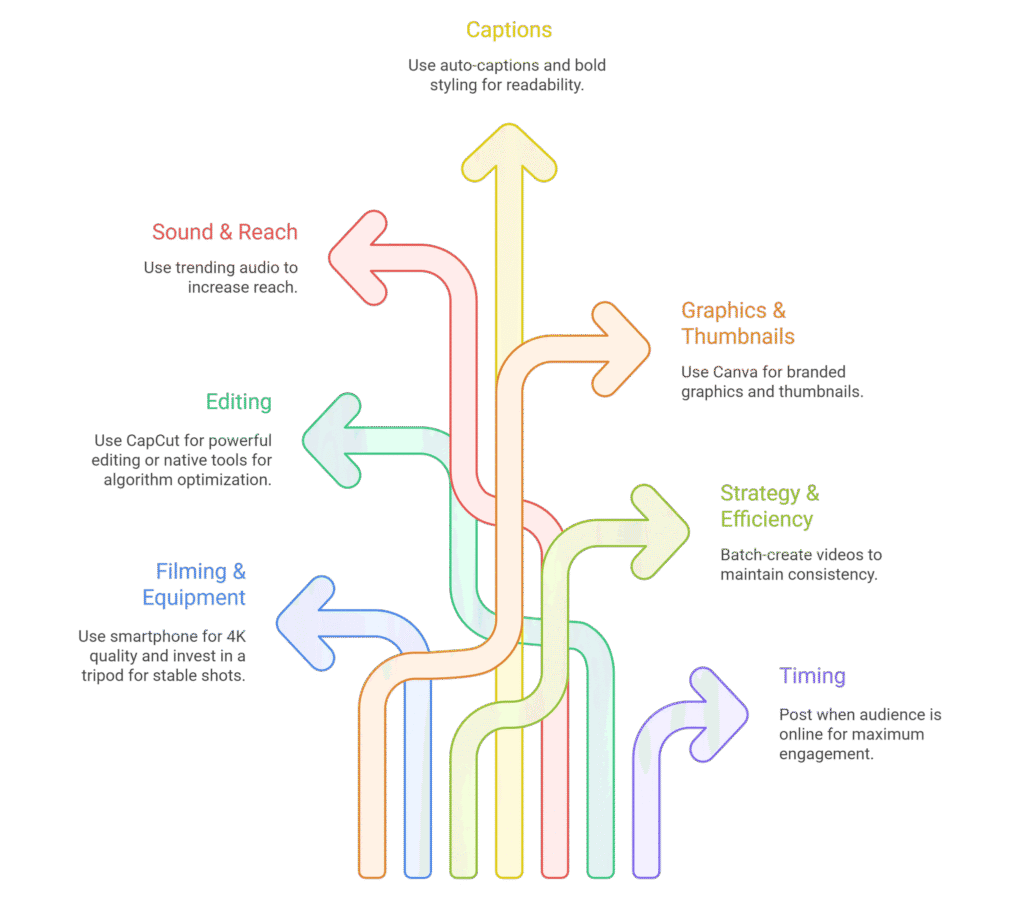
Should small businesses focus on one platform or post everywhere simultaneously?
Quality over quantity wins every time. It’s better to dominate one platform than to be mediocre on five.
Start where your audience actually is. If you’re a B2B service targeting UAE professionals, LinkedIn should be your priority. If you’re selling fashion or beauty products to young UAE residents, TikTok and Instagram need your focus. A consulting firm in DIFC wasted six months trying to maintain TikTok, Instagram, LinkedIn, Facebook, and YouTube before realizing 80% of their clients came from LinkedIn. They went all-in there and doubled their business.
Master one platform’s algorithm and culture before expanding. Each platform has different content styles, optimal lengths, and audience expectations. A video that crushes on TikTok might flop on LinkedIn using the exact same content. A furniture store in International City became TikTok experts first (reaching 100,000 followers in eight months) before expanding to Instagram with confidence and proven content.
Repurpose strategically, don’t copy-paste. Once you’ve created great content for your main platform, adapt it for others. Change the format (vertical to horizontal), adjust the length (30 seconds to 60 seconds), modify the caption style (casual to professional). A personal trainer in Dubai Sports City films one workout, then edits it into a 15-second TikTok, a 30-second Reel, and a 60-second YouTube Short, same core content, three optimized versions.
Consider your capacity realistically. If you’re a small team or solo entrepreneur, maintaining multiple platforms at a high quality level is brutal. Better to post 5 excellent videos per week on one platform than 2 mediocre videos each across 4 platforms. Consistency and quality on one channel build momentum. Sporadic posting everywhere builds nothing.
The exception: if you’re paying for content creation (hiring a freelancer or agency like, well, us), then multi-platform makes sense because the marginal cost of reformatting is low. But if you’re creating everything yourself, focus matters.
How do you measure if your viral content strategy is actually working for your business?
Views are vanity metrics. What actually matters is whether your content drives business results.
Track follower growth, but more importantly, track follower quality. Are new followers in your target market? Do they live in the UAE? Are they your ideal customers? A water delivery service in Dubai gained 50,000 followers from a viral video, but 90% were outside the UAE. Great for the ego, useless for business. Their next viral video was UAE-specific and brought 8,000 local followers who actually converted to customers.
Monitor engagement rate trends. Your engagement rate (total engagements divided by reach or followers) tells you if your audience actually cares about your content. If your rate is dropping even as followers increase, you’re attracting the wrong people. A healthy engagement rate for business accounts in 2025 is 3-5% on Instagram and 5-10% on TikTok. Above that is excellent.
Track profile visits and website clicks. These indicate intent. Someone watching your video is passive. Someone clicking through to learn more is an actual lead. Instagram Insights shows these numbers clearly. A photography studio in Umm Suqeim tracks this weekly and can directly connect viral videos to booking increases.
Measure direct inquiries and conversions. The ultimate test: does your viral content lead to sales, bookings, or qualified leads? Tag your campaigns, ask new customers how they found you, and connect the dots between content and revenue. A landscaping company in Arabian Ranches saw their inquiry rate jump 300% during weeks when they posted viral content versus weeks they didn’t.
Calculate cost per acquisition. If you’re spending time creating content (time is money), what’s your return? If 10 hours of content creation leads to 5 new customers worth 5,000 AED each in lifetime value, your ROI is clear and strong. If those same 10 hours bring zero customers, your strategy needs adjustment.
Watch saves and shares specifically. These metrics indicate your content has lasting value. Saves mean people want to reference your content later (great for educational or tutorial content). Shares mean people think your content is worth showing their friends (the true viral indicator). A restaurant in Motor City noticed their recipe videos got saved 10x more than their promotional videos, so they shifted their content mix accordingly.
What mistakes do small businesses make when trying to create viral content?
Let’s address the failures we see constantly, so you can avoid them.
Chasing virality over brand alignment. Going viral with content that has nothing to do with your business is pointless. A Dubai car wash went viral with a funny pet video (3 million views) but gained zero relevant followers or customers because the content had no connection to their service. Viral for viral’s sake wastes your momentum.
Ignoring consistency for viral shots. Posting once every three weeks and hoping that one post goes viral doesn’t work. The algorithm rewards consistent creators. Small businesses that post quality content 4-5 times per week build momentum that makes individual videos more likely to go viral than accounts that post sporadically. A salon in Barsha found that their viral posts only happened after they’d been consistently posting for 6+ weeks, building algorithmic trust first.
Overproducing content. Ironically, highly polished content often underperforms raw, authentic videos. Audiences can smell corporate production from a mile away. A real estate agency in Dubai Marina spent 10,000 AED on professionally produced property tours that averaged 5,000 views each. Their agent filming iPhone walkthroughs while talking naturally averaged 50,000 views. The less polished version felt real, which made it shareable.
Not engaging with comments. Viral content generates conversations. If you don’t respond to comments in the first few hours after posting, you’re missing a massive opportunity. The algorithm sees engagement as a signal to push your content further. Plus, potential customers are literally talking to you, ignoring them is bad business. A home bakery in Mirdif responds to every comment within the first hour of posting and credits this habit with turning viral viewers into regular customers.
Copying competitors exactly. When you see a competitor’s viral video and recreate it shot-for-shot, you’re already late. The format is stale, and you look like a follower rather than a leader. Instead, analyze why their video worked (the emotional hook? the format? the timing?) and apply those principles to something completely original. A cleaning service in Springs copied a competitor’s viral video and got 2,000 views. When they created their own unique take on the same problem, they hit 200,000 views.
Forgetting clear calls-to-action. Your video went viral, now what? If viewers don’t know what action to take next, you’ve wasted the opportunity. Always include a simple CTA: “Follow for more tips,” “Link in bio for booking,” “DM us for pricing.” A fitness equipment supplier in Al Quoz went viral twice without CTAs and gained followers but zero sales. Their third viral video included “DM ‘quote’ for pricing” and generated 47 qualified leads.
Giving up too soon. Most small businesses post 10-15 videos, see mediocre results, and quit. Viral success is often about volume and timing. You’re testing what resonates, learning your audience, and building algorithmic momentum. A modest café in Al Nahda posted consistently for four months with modest results before a single video hit 2.3 million views. That one video generated six months of new customer flow, but it only happened because they didn’t quit at video 50.
How can businesses maintain authenticity while trying to go viral?
This is the real challenge, and frankly, where most small businesses have a natural advantage over big brands.
Your story is your differentiator. Big brands can’t talk about the founder’s journey from a small shop in Satwa to three locations across Dubai because they don’t have that story. You do. A family-run spice shop in Deira created a video series about “three generations of spice blending” that resonated deeply because it was genuinely their story, not a marketing construct.
Show real people, not actors. Your actual team, your actual customers (with permission), your actual workspace. These elements feel authentic because they are authentic. A dental clinic in Jumeirah featured their receptionist in videos (she had a naturally warm, funny personality) and those videos outperformed their dentist-led content by 400% because she felt real and relatable.
Be honest about challenges and imperfections. Viral content doesn’t require perfection, it requires honesty. A small logistics company in Jebel Ali created a video titled “Things that went wrong this week” showing minor mishaps (nothing that compromised clients) with humor. It humanized their brand and got shared 15,000 times because businesses and customers both related to the reality that things don’t always go perfectly.
Let your personality show through. If you’re naturally funny, be funny. If you’re more educational and serious, own that. Trying to be something you’re not feels fake instantly. A tax consulting firm in Business Bay is run by someone with a dry, witty sense of humor. Instead of hiding that behind corporate-speak, they leaned into it, creating deadpan tax tip videos that went viral because the personality was genuine and unexpected.
Don’t manufacture trends that don’t fit. If a dance challenge is trending but you run a B2B industrial supply company, you don’t need to participate. There will be other trends that fit your brand better. Wait for those. A law firm in DIFC skips 90% of trends because they don’t align with their professional image, but when legal-topic trends emerge, they execute brilliantly.
Share customer stories with permission. Real testimonials, real transformations, real experiences. These are inherently authentic and often more compelling than anything you could script. A weight loss clinic in Dubai Silicon Oasis shares client journeys (with full consent and privacy considerations) and those videos consistently outperform their promotional content because the emotion and results are real.
What role does timing play in viral content success for UAE businesses?
Timing isn’t everything, but it’s a significant multiplier that most small businesses completely overlook.
Cultural calendar awareness matters immensely. Ramadan content posted in August is irrelevant. Back-to-school content posted in December misses the mark. The UAE has a specific rhythm of holidays, school schedules, weather changes, and cultural events. A children’s entertainment service in Sharjah plans their viral content calendar around school holidays, long weekends, and summer break, when parents are actively looking for activities. Their best-performing content comes from posting exactly when parents need solutions.
Time of day affects initial momentum. The algorithm gives your content a small initial push to a subset of your audience. If those people are asleep or at work when you post, engagement is slow, and the algorithm interprets that as low quality. For most UAE consumer-focused businesses, 8-10 PM on weekdays captures both local and international audiences (reaching South Asian and some European time zones). A restaurant in JBR tested posting times for three months and found their 9 PM posts got 3x the engagement of identical content posted at 2 PM.
Newsjacking requires speed. When something becomes a cultural moment in the UAE (unexpected weather, a major event, a viral local story), you have a 12-48 hour window to create relevant content before it’s saturated. A car service center in Sharjah created a safety tips video during the first major rain of the season within six hours of the rain starting. It reached 400,000 people because it was timely, helpful, and early.
Trend participation timing is critical. Be among the first 100-500 businesses to use a trending sound or format, not the 10,000th. The early adopters get algorithmic preference. A hardware store in Al Ain monitors trending sounds daily and sets aside 30 minutes to create content the same day a relevant trend emerges. This speed has made them one of the most-followed hardware stores in the region.
Seasonal content should be early, not on-time. Post your summer content in April, not June. Post your holiday content in early November, not late December. People are searching for solutions before they need them, not during. A event planning company in Dubai posts about Ramadan event services in January, when companies are planning, not in March when Ramadan is already happening.
Day of week matters for B2B versus B2C. If you’re targeting consumers, weekends (especially Friday and Saturday evenings) perform best as people have more leisure scrolling time. If you’re targeting business decision-makers, Tuesday through Thursday during commute times or lunch breaks work better. A corporate catering service in Media City gets 5x better engagement on Wednesday mornings than Sunday evenings because that’s when their target audience is thinking about office solutions.
How do small businesses turn viral moments into long-term customer relationships?
Going viral once is luck. Building a business from viral content requires turning attention into relationships.
Have a conversion path ready before you go viral. Your bio needs to clearly state what you do and how people can work with you. Your website (if you have one) should load fast and have clear contact options. Your DMs should be monitored. A handyman service in International City went viral but had a broken phone number in their bio, they lost hundreds of potential customers because they weren’t prepared for the attention.
Create a welcome sequence for new followers. Pin a video that introduces your business to anyone discovering you for the first time. This video should answer: who you are, what you offer, and why people should care. A personal stylist in Dubai Mall area created a 45-second “Welcome to my page” video that stays pinned at the top of her profile. New followers watch it, understand her services immediately, and convert to consultations at a 12% rate.
Follow up viral content with related content. If your viral video was about a specific problem or topic, create 5-10 more videos expanding on that theme while interest is high. Keep the momentum going. A pet grooming business in Arabian Ranches went viral with a “cats who hate baths” video. They immediately created a series about “how to make bath time easier for cats” and converted viral viewers into followers and then customers through continued valuable content.
Capture leads with a bio link strategy. Use tools like Linktree or bio links in your Instagram bio to direct viral traffic to specific offers, booking pages, or lead magnets. A photography studio in Umm Suqeim offers a “free photoshoot checklist” through their bio link. After viral videos, they see 200-300 downloads, which become email contacts they nurture into bookings.
Engage deeply with your new audience. Respond to DMs promptly, reply to comments thoughtfully, and show appreciation for the attention. People are giving you their time, reciprocate. A home maintenance company in JLT assigns someone specifically to handle social media inquiries within 2 hours. This responsiveness converts viral viewers to customers at a much higher rate than competitors who take days to reply.
Create exclusive offers for social media followers. Give people a reason to not just watch but to take action. “DM us ‘viral deal’ for 20% off this week” turns passive viewers into active leads. A car detailing service in Motor City created time-limited offers specifically for people discovering them through viral content, converting attention into immediate revenue.
Build a content series, not one-off hits. Viral videos introduce people to your brand, but series content makes them stay. “Part 1 of 5” creates anticipation and return viewers. A real estate agent in Dubai Marina created a “First-time buyer mistakes” series after one video in that theme went viral. The series kept viewers engaged for weeks and positioned him as the go-to expert for that audience.
What makes UAE-specific content more likely to go viral locally and internationally?
The UAE’s unique position as a global crossroads creates specific content opportunities that smart businesses exploit.
Multicultural relatability hits differently here. Content that speaks to the experience of living in a diverse city resonates with millions. A grocery store in Karama created content showing “how to say ‘thank you’ in 20 languages you hear in Dubai” which went viral because it celebrated the local experience authentically. Both residents and international viewers found it fascinating.
Unexpected UAE juxtapositions capture attention. The contrast between ultramodern and traditional, extreme wealth and modest businesses, desert and city, these visual contrasts are inherently interesting. A modest carpentry workshop in Ras Al Khaimah created time-lapse videos of traditional furniture-making with the caption “Old school craftsmanship in a modern UAE” that went viral because the juxtaposition was compelling.
Humor about expat life is universally relatable here. Content about finding parking in Dubai, dealing with summer heat, understanding “Dubai time,” or navigating multicultural communication resonates deeply with the massive expat population. A laundry service in Barsha created a series called “Things every Dubai expat understands” that went viral because every video made residents laugh and tag their friends.
Showcasing the UAE to the world creates dual appeal. International audiences are fascinated by life in the Emirates, while local audiences love seeing their home represented. A tour guide service in Dubai created “Things that shock tourists about Dubai” videos that went viral both locally (residents sharing “yes, this is so true”) and internationally (people planning visits or curious about the culture).
UAE success stories inspire globally. Content about building a business here, overcoming challenges, achieving success in this unique market, these narratives work because the UAE represents opportunity for millions worldwide. A small tech startup in Dubai Silicon Oasis shared their journey from idea to 50 employees in 18 months. The content resonated because people everywhere connect with entrepreneurial success stories.
Bilingual or multilingual content expands reach exponentially. Videos that incorporate both English and Arabic, or that celebrate the linguistic diversity of the UAE, reach multiple audience segments simultaneously. A restaurant in Bur Dubai creates menu explainer videos in three languages (English, Arabic, Hindi) and reaches vastly more people than English-only competitors.
Conclusion
Competing with big brands isn’t about matching their budgets, it’s about leveraging advantages they can’t access. Your speed, your authenticity, your willingness to take creative risks, and your ability to connect genuinely with audiences are weapons that no marketing budget can buy.
The small businesses winning in the UAE right now aren’t trying to out-spend their competition. They’re out-thinking them, out-hustling them, and out-authenticating them. They’re creating content that big brands are too slow, too corporate, or too risk-averse to make.
Start by understanding your audience deeply, experiment with content formats boldly, move quickly on trends that align with your brand, and measure what actually matters to your business, not vanity metrics but real conversions and customer relationships.
Your first viral video might not come this week or even this month. But if you commit to consistent, strategic, authentic content creation, it will come. And when it does, you’ll be ready to turn that moment of attention into lasting business growth.
The playing field isn’t level, but it’s more accessible than it’s ever been. The tools are free, the platforms reward quality over budget, and audiences are hungry for real connection. That’s your opportunity. Take it.
FAQ
Can a small business actually compete with major brands on social media?
Yes, absolutely. Small businesses have advantages in speed, authenticity, and creative flexibility that large brands cannot match. Viral success on social media in 2025 depends more on understanding your audience and creating relatable content than on budget size. Dozens of UAE small businesses are currently outperforming major brands in engagement and reach.
How much should a small business budget for viral content creation?
You can start with zero budget beyond your time. A smartphone, free editing apps like CapCut, and trending sounds from social platforms are sufficient for viral content. Most successful small business viral videos in the UAE were created for under 100 AED. If you want to invest, spend on learning (courses, strategy) rather than equipment.
How often should small businesses post to build viral momentum?
Consistency matters more than frequency, but aim for 4-5 times per week minimum on your primary platform. This builds algorithmic trust and gives you more opportunities to create viral hits. Small businesses posting once or twice weekly rarely achieve viral success because they don’t generate enough momentum.
Is it better to focus on viral content or steady growth content?
Both, strategically. Create consistent valuable content that serves your audience (steady growth), while regularly attempting viral-style content that could expand your reach dramatically. The steady content builds trust and converts followers, while viral attempts bring new audiences. A 70/30 split (steady/viral attempts) works well for most businesses.
What should a small business do immediately after a video goes viral?
First, ensure your bio and contact information are clear and functional. Second, respond to comments and DMs promptly. Third, create follow-up content related to the viral video’s theme to capture interested viewers. Fourth, have a clear offer or call-to-action ready to convert attention into business. Speed matters, capitalize within 24-48 hours.
How do you know if viral content is helping your business or just boosting vanity metrics?
Track profile visits, website clicks, direct inquiries, and actual conversions, not just views and followers. Ask new customers how they found you. Calculate if the time invested in content creation correlates with business growth. If viral content brings followers who never become customers, adjust your content strategy to attract more qualified audiences.