
If you’ve spent any time trying to grow your business online, you’ve probably heard about SEO. You might have even invested in it. But there’s a new term making waves in digital marketing circles: GEO, or Generative Engine Optimization.
Most business owners in the UAE are just starting to hear about GEO, and many assume it’s just another buzzword for the same old SEO tactics with a fresh coat of paint. That assumption could cost you customers.
The truth is, SEO and GEO are fundamentally different strategies designed for fundamentally different technologies. SEO helps you rank in traditional search engines like Google. GEO helps you appear in AI-generated responses from tools like ChatGPT, Perplexity, Google’s AI Overviews, and Bing’s Copilot.
Both matter. Both can drive business. But they require different approaches, and understanding the distinction is becoming critical for any business that wants to stay visible online. This article breaks down exactly what separates SEO from GEO, why both matter for UAE businesses, and how to approach each strategically.
How do traditional search engines and AI engines find and display information differently?
The fundamental difference between SEO and GEO comes down to how information gets found and presented to users. Traditional search engines and AI engines operate on completely different principles.
When you search on Google, the engine scans billions of web pages, ranks them based on hundreds of factors, and presents you with a list of links. The goal is to send you to websites where you’ll find your answer. Google’s business model depends on you clicking those links, seeing ads, and coming back to search again.
AI engines work differently. When you ask ChatGPT or Perplexity a question, these tools generate a direct answer by synthesizing information from multiple sources. Instead of giving you ten blue links to explore, they give you a comprehensive response right there. You might never click a single link.
This changes everything about how businesses need to think about visibility.
Traditional search engines prioritize ranking. The game is about getting your website into the top positions for specific keyword searches. Position one gets roughly 28% of clicks, position two gets about 15%, and it drops quickly from there. Being on page two might as well be invisible.
AI engines prioritize synthesis. They pull information from various sources to construct answers. Your business might be mentioned alongside competitors, or not mentioned at all, depending on whether the AI considers you authoritative and relevant. There’s no position one. There’s only whether you’re included in the response or not.
Search engines value links. Backlinks from other websites signal authority in traditional SEO. The more quality sites linking to you, the more Google trusts you. Link building has been the backbone of SEO strategy for decades.
AI engines value citations and structured data. While links still matter, AI tools place heavier weight on how often you’re mentioned across credible sources, how clear your business information is, and how well you demonstrate expertise. A single mention in a respected publication can carry more weight than dozens of backlinks from obscure blogs.
Search engines reward keyword optimization. Knowing what terms people search for and optimizing your content around those exact phrases has been essential for SEO success. Keyword research tools and strategic placement drive strategy.
AI engines reward natural language and comprehensive answers. They’re trained to understand context and intent, not just match keywords. Content that thoroughly addresses questions in natural, conversational language performs better than keyword-stuffed pages.
For UAE businesses, this means you can’t just rely on your existing SEO strategy and expect to appear in AI responses. You need a parallel approach designed specifically for how AI engines evaluate and cite sources.
What specific strategies work for SEO that may not work for GEO?
SEO tactics have been refined over two decades. Many of them are still valuable, but some don’t translate well to GEO. Understanding which strategies remain effective and which need rethinking is essential.
Keyword stuffing has always been questionable for SEO, but it’s completely ineffective for GEO. Traditional SEO, especially in its early days, sometimes rewarded repeating keywords throughout content. Modern SEO algorithms penalize this, but some businesses still try it. AI engines ignore keyword density entirely. They focus on whether your content comprehensively answers questions and demonstrates genuine expertise.
Exact match domains matter less for GEO. In traditional SEO, having a domain like “dubaimarketingagency.com” provided ranking advantages for related searches. AI engines don’t weigh domain names as heavily. They care more about the authority and quality of your actual content and citations.
Traditional link building schemes don’t help GEO. Buying links from link farms, participating in link exchanges, or creating networks of sites that link to each other might have provided short-term SEO gains. These tactics don’t influence AI engines, which focus on legitimate mentions from authoritative sources rather than technical backlink profiles.
Meta descriptions work differently. For traditional SEO, meta descriptions help improve click-through rates from search results pages. AI engines don’t display meta descriptions. Instead, they parse your actual content to extract relevant information. This means every part of your visible content needs to be substantive, not just the meta tags.
Title tag optimization is less critical for GEO. SEO best practices emphasize perfect title tags with target keywords near the beginning. AI engines can understand content regardless of title structure. They’re more interested in the depth and accuracy of the information itself.
Focusing solely on your own website limits GEO effectiveness. Traditional SEO is largely about optimizing your own site and building links to it. GEO requires a broader approach. You need to be mentioned and cited across the web, not just have a perfect website. Guest posting, getting featured in publications, and building a presence on third-party platforms become more important.
Bounce rate and time on page matter differently. Traditional SEO uses behavioral signals like how long users stay on your page. AI engines don’t have access to this data when training or generating responses. They evaluate content quality through different signals like citation frequency, content structure, and demonstrated expertise.
This doesn’t mean traditional SEO is dead or irrelevant. Many core principles still apply to both. Quality content matters for both SEO and GEO. User experience matters. Authority matters. The difference is how each system evaluates these factors and what specific tactics work best for each.
Why does content structure matter more for GEO than traditional SEO?
Content structure has always mattered for SEO, but GEO takes it to another level. AI engines are fundamentally designed to extract and synthesize information. How you structure your content directly impacts how easily AI can understand and cite it.
AI engines prioritize scannable, clearly organized information. When ChatGPT or Perplexity processes content, it looks for clear hierarchies, defined sections, and logical flow. Content that rambles or buries key information in dense paragraphs is harder for AI to parse and less likely to be cited.
Question-based headings align with how users query AI. People don’t just type keywords into ChatGPT. They ask full questions: “What’s the best way to market a restaurant in Dubai?” or “How much should I budget for social media management?” Structuring your content with headings that mirror these natural questions helps AI engines match your content to user queries.
FAQ sections are particularly valuable for GEO. Frequently asked questions provide AI engines with clear question-answer pairs they can easily extract and cite. A well-crafted FAQ section optimized for actual user questions significantly improves your chances of being mentioned in AI responses.
Lists and bullet points enhance extractability. AI engines excel at pulling specific facts from lists. When you present information as clear bullet points or numbered lists, you make it easier for AI to extract exactly what it needs. This increases the likelihood your content will be referenced.
Comprehensive coverage outperforms surface-level content. Traditional SEO sometimes rewarded shorter, keyword-focused pages. AI engines favor thorough, in-depth content that fully addresses a topic. A 2,000-word comprehensive guide often performs better in GEO than five 400-word blog posts on related topics.
Explicit definitions and explanations help AI understand context. Don’t assume AI engines know what you’re talking about. If you use industry jargon or local references, define them clearly. For example, if you mention “free zones” in a UAE business context, briefly explain what they are. This helps AI provide accurate information to users who might not be familiar with the term.
Section summaries and clear transitions improve comprehension. AI engines process content sequentially. Clear transitions between sections and brief summaries of key points help AI follow your argument and understand how different pieces of information relate to each other.
For businesses creating content, this means shifting from purely keyword-focused writing to question-focused, comprehensive, and clearly structured writing. The good news is this approach also improves user experience, making it valuable for both SEO and GEO simultaneously.
How do backlinks for SEO compare to citations for GEO?
Backlinks have been the currency of SEO for years. Citations are becoming the currency of GEO. While they might seem similar, they function differently and require different strategies to build.

A backlink is a hyperlink from another website to yours. Traditional SEO treats backlinks as votes of confidence. Each quality site linking to you signals to Google that your content is valuable and trustworthy. The authority of the linking site, the relevance of the link, and the anchor text all influence how much SEO value that backlink provides.
A citation is any mention of your business across the web. For GEO purposes, a citation might include your business name, address, and phone number, but it can also be any reference to your company, services, or expertise. Citations don’t always include clickable links. The mention itself carries weight with AI engines.
Backlinks focus on volume and authority. Traditional link building strategies often emphasize getting as many quality backlinks as possible from high-authority domains. Tools like Ahrefs or Moz measure your site’s authority largely based on your backlink profile.
Citations focus on consistency and context. GEO cares more about whether your business information appears consistently across credible sources and whether those mentions demonstrate expertise. One detailed case study published in a respected UAE business publication might matter more than ten generic backlinks from random blogs.
Backlink anchor text influences SEO rankings. When sites link to you using specific keywords as anchor text, it helps you rank for those keywords. This is why SEO strategies often focus on getting backlinks with target keywords in the anchor text.
Citation context influences GEO recommendations. How your business is described in citations matters more than specific keywords. If multiple credible sources cite your agency as innovative or client-focused, AI engines incorporate those associations when generating recommendations.
Backlinks can be built through outreach and content marketing. Traditional link building involves creating link-worthy content, reaching out to webmasters, guest posting, and various tactics designed to earn links. It’s a proactive, targeted process.
Citations are built through broader presence and authority. Building citations for GEO requires getting featured in publications, contributing expert commentary, earning press coverage, maintaining consistent directory listings, and establishing thought leadership. It’s less about individual link placements and more about building a comprehensive digital footprint.
SEO penalizes manipulative link schemes. Google actively punishes sites caught buying links, participating in link networks, or using other black-hat link building tactics. The penalties can be severe.
GEO is harder to manipulate. Because AI engines evaluate patterns across diverse sources and prioritize authoritative mentions, there’s less opportunity for gaming the system. Fake citations or manipulated mentions are less effective because AI engines look for genuine authority signals.
For UAE businesses, this means your strategy needs to evolve beyond just link building. You need to focus on earning legitimate mentions across respected platforms, maintaining consistent business information everywhere you appear, and building genuine authority in your industry.
What role do reviews play differently in SEO versus GEO?
Reviews have always influenced consumer decisions, but their role in SEO versus GEO reveals important differences in how each system evaluates businesses.
For SEO, reviews primarily impact local search rankings. Google’s local search algorithm considers review quantity, velocity, and rating as ranking factors. Businesses with more positive reviews generally rank higher in local map packs and location-based searches. The reviews themselves don’t directly influence organic rankings for non-local queries.
For GEO, reviews influence whether AI engines recommend you at all. When someone asks ChatGPT for a recommendation, the AI considers review patterns as social proof of quality. Consistently positive reviews across platforms increase the likelihood your business gets mentioned. The content of reviews also matters because AI can extract specific information about your services and strengths.
SEO focuses on Google reviews primarily. While reviews on other platforms matter for reputation, Google reviews specifically influence Google search rankings. Businesses often concentrate their review generation efforts on Google for SEO purposes.
GEO values reviews across multiple platforms. AI engines don’t privilege Google reviews over others. Reviews on Trustpilot, industry-specific platforms, social media, and other sites all contribute to the pattern AI engines recognize. Diversity of review sources can be as important as total review count.
Review keywords matter differently. In traditional SEO, having reviews that mention specific services or keywords can help local rankings for those terms. If multiple reviews mention “web design,” Google associates your business more strongly with that service.
Review patterns and sentiment matter more for GEO. AI engines analyze review content to understand what customers value about your business. They look for patterns in sentiment, common praise points, and specific service mentions. This qualitative analysis influences how AI describes and recommends your business.
Response rates impact local SEO rankings. Google rewards businesses that respond to reviews, viewing engagement as a signal of active business management. Response content is less important than the fact that you respond.
Response quality influences GEO perception. AI engines can analyze how you respond to reviews, particularly negative ones. Thoughtful, professional responses demonstrate customer service quality and can influence how AI engines characterize your business when making recommendations.
Star ratings create clear SEO thresholds. Local SEO research shows that maintaining above 4.0 stars is important for ranking well. Small increases in average rating can impact visibility.
GEO considers review authenticity and detail. AI engines are increasingly sophisticated at recognizing genuine versus fake reviews. Detailed, specific reviews carry more weight than generic ones. A few thorough, authentic reviews can be more valuable than dozens of brief, generic ratings.
For businesses in the UAE, this means expanding review strategy beyond Google. Focus on earning detailed, authentic reviews across multiple platforms, respond thoughtfully to all feedback, and ensure your service quality generates the kind of specific, positive feedback that AI engines recognize as credible.
How does local optimization differ between SEO and GEO for UAE businesses?
Local optimization has always been crucial for UAE businesses serving specific emirates or communities. How you approach local visibility differs significantly between traditional SEO and GEO. Working with an SEO & GEO agency in Dubai that understands both strategies ensures your business maintains visibility across traditional search engines while also capturing the growing audience using AI-powered search tools.
Traditional local SEO centers on Google Business Profile. For local search rankings, your Google Business Profile is the single most important asset. Optimizing it completely, maintaining accurate information, posting regularly, and managing reviews directly impacts your visibility in local map packs and location-based searches.
GEO requires local presence across diverse sources. While Google Business Profile still matters, AI engines evaluate local relevance by finding consistent location information across many sources. Being listed in local directories, mentioned in regional publications, and cited in UAE-specific contexts all contribute to AI engines recognizing you as a local business.
SEO uses location keywords strategically. Traditional local SEO emphasizes including location keywords throughout your website. Pages optimized for “digital marketing agency Dubai” or “web design Abu Dhabi” help you rank for those geographic searches.
GEO focuses on natural local context. AI engines understand geographic relevance through context rather than just keywords. Writing content that naturally discusses UAE business challenges, references local regulations, or provides Dubai-specific examples signals local expertise more effectively than simply inserting location keywords.
Local SEO emphasizes proximity to the searcher. Google’s local algorithm heavily weighs physical distance between the business and the person searching. Being located in the right area provides ranking advantages.
GEO emphasizes local authority and relevance. Physical location matters less to AI engines than demonstrated local expertise. A business in Abu Dhabi with strong local content, citations in UAE publications, and clear focus on serving the region can be recommended to users asking about Dubai services.
Traditional SEO focuses on NAP consistency. Name, Address, and Phone number consistency across directories is a cornerstone of local SEO. Inconsistent NAP information confuses search engines and hurts rankings.
GEO values comprehensive local presence. While NAP consistency still matters, AI engines also evaluate how embedded you are in the local business ecosystem. Being mentioned in local news, participating in regional events, and demonstrating connection to the UAE business community all strengthen local relevance.
Local SEO tracks rankings for specific location-keyword combinations. Success is measured by where you rank for searches like “marketing agency near me” or “best web designer in Dubai.”
GEO tracks whether you’re mentioned in location-based queries. Success is measured by whether AI engines include you when users ask questions like “I need a marketing agency in Dubai, who should I contact?” The metric is inclusion, not position.
Review location matters for local SEO. Google prioritizes reviews from people physically near your business. Local customers leaving reviews help local rankings more than reviews from distant customers.
Review content matters for GEO location signals. AI engines analyze what reviewers say about your local service. Reviews mentioning quick response times in Dubai, understanding of UAE market, or serving local businesses strengthen your local authority for GEO purposes.
For UAE businesses, effective local optimization now requires a dual approach. Maintain strong traditional local SEO fundamentals while also building genuine local authority through content, citations, and demonstrated expertise in serving the regional market.
Why do technical SEO requirements differ from technical GEO requirements?
Technical optimization has always been a critical part of digital visibility, but what matters technically for traditional search engines doesn’t always align with what matters for AI engines.
Traditional SEO emphasizes crawlability. Search engines need to crawl your website to index it. Technical SEO focuses on removing barriers to crawling through proper robots.txt files, XML sitemaps, clean URL structures, and avoiding duplicate content issues that confuse crawlers.
GEO emphasizes interpretability. AI engines need to understand and extract information from your content. While crawlability still matters, the focus shifts to structured data, clear content hierarchy, and machine-readable formats that AI can parse and synthesize.
SEO technical audits focus on indexation issues. Are all important pages being indexed? Are there crawl errors? Is there duplicate content creating indexation problems? These questions drive traditional technical SEO.
GEO technical audits focus on data structure. Is your content marked up with appropriate schema? Are your key facts presented in extractable formats? Is your business information consistent and machine-readable across your site? These questions drive technical GEO.
Page speed impacts SEO rankings directly. Google explicitly uses page load time as a ranking factor. Faster sites rank better, especially for mobile searches. Technical SEO invests heavily in speed optimization through caching, compression, and code minimization.
Page speed impacts GEO indirectly through accessibility. While AI engines don’t directly rank based on speed, extremely slow sites might not be crawled as effectively. More importantly, speed affects user experience and whether your content gets shared and cited, which influences GEO.
Mobile optimization is critical for SEO rankings. Google’s mobile-first indexing means your mobile site performance directly impacts all rankings, not just mobile searches. Responsive design and mobile usability are non-negotiable.
Mobile optimization matters for GEO accessibility. AI engines need to access and understand your content regardless of format. Mobile-responsive design ensures content remains structured and readable when AI crawlers access it, but the ranking implications differ.
Internal linking structure influences SEO rankings. How you link between pages on your site affects how authority flows through your website and helps search engines understand your site hierarchy and most important pages.
Internal linking influences GEO context understanding. For AI engines, internal links help establish relationships between topics and provide context about how different pieces of content connect. This helps AI understand your expertise areas.
HTTPS security impacts SEO trust signals. Google gives ranking preference to secure sites. Having an SSL certificate and proper HTTPS implementation is a ranking factor.
HTTPS security impacts GEO credibility signals. While not a direct ranking factor, security signals contribute to overall site credibility. AI engines evaluating authoritative sources factor in whether a site meets basic security standards.
Structured data markup has limited SEO benefits. Schema markup can enable rich snippets in search results but doesn’t directly improve rankings. Traditional SEO treats it as a enhancement rather than a requirement.
Structured data markup is increasingly important for GEO. Schema helps AI engines extract and understand specific facts about your business, services, locations, and expertise. Proper implementation of LocalBusiness, Organization, FAQPage, and other schema types significantly helps GEO.
For businesses managing their technical presence, this means audit requirements expand. You need to ensure your site meets both traditional crawlability standards and newer interpretability standards that help AI engines extract and cite your information effectively.
What metrics indicate success in SEO versus success in GEO?
Measuring success requires different metrics depending on whether you’re optimizing for traditional search engines or AI engines. What matters for SEO doesn’t always translate to GEO success.
SEO success metrics focus on rankings and traffic. The primary KPIs for traditional SEO include keyword rankings, organic traffic volume, pages per session, bounce rate, and conversion rates from organic traffic. You can track exactly which position you hold for target keywords and measure changes over time.
GEO success metrics focus on mentions and citation frequency. Tracking GEO is less straightforward because there are no fixed rankings. Success is measured by how often AI engines mention your business when answering relevant queries, whether you’re included in recommendation lists, and the context in which you’re cited.
SEO provides clear competitive benchmarking. You can see exactly where you rank compared to competitors for any given keyword. Tools like SEMrush or Ahrefs show your position relative to others in your space.
GEO competitive analysis is more qualitative. You need to manually test relevant queries across different AI platforms and note whether you’re mentioned alongside competitors, instead of competitors, or not at all. The analysis requires regular testing rather than automated tracking.
SEO conversion tracking is straightforward. You can attribute leads and sales directly to organic search traffic using standard analytics tools. The path from keyword ranking to conversion is measurable.
GEO attribution is more complex. Users who discover your business through AI recommendations might come to your site through various paths or contact you directly without clicking through. Attribution requires asking customers how they found you and tracking mentions separately from direct traffic sources.
SEO rewards incremental keyword expansion. Success often means gradually ranking for more keywords in your target space. Expanding keyword coverage directly expands potential traffic.
GEO rewards authority depth. Success means being recognized as authoritative enough that AI engines cite you across a range of related queries. It’s less about individual keywords and more about becoming an established reference in your field.
SEO has established benchmarks and industry standards. There’s extensive data on average organic click-through rates by position, typical conversion rates by industry, and expected traffic based on search volume.
GEO benchmarks are still emerging. We’re in early days of understanding what citation frequency or mention rates indicate success. Standards are being established as more businesses track these metrics and correlations with business outcomes.
SEO tools provide automated tracking. Rank tracking tools automatically monitor your positions daily or weekly, generating reports without manual work.
GEO tracking requires more manual effort. Currently, measuring GEO success involves regularly testing queries across multiple AI platforms and documenting results. Automated tracking tools are emerging but less mature than SEO equivalents.
SEO focuses on owned properties primarily. Most SEO metrics center on your website performance, your rankings, and traffic to your properties.
GEO requires tracking mentions beyond owned properties. Success includes being cited in AI responses that pull from news articles, directories, review sites, and other third-party sources where you’re mentioned but don’t control the content.
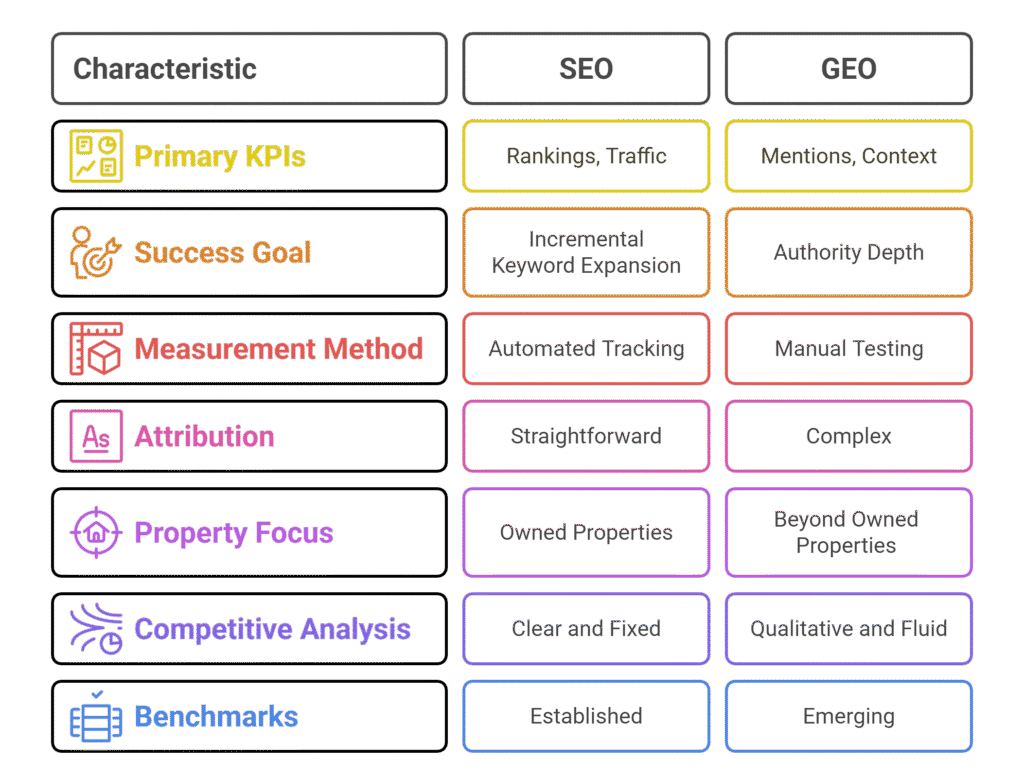
For UAE businesses, this means establishing new measurement frameworks. Continue tracking traditional SEO metrics for search engine performance, but also implement regular AI query testing, citation monitoring, and customer source tracking to understand your GEO effectiveness.
Can a business succeed with one strategy but not the other?
This is the question most businesses eventually ask: do I need both, or can I focus on just SEO or just GEO? The answer depends on your business model, target audience, and where your customers actually look for services.
You can still succeed with SEO alone in 2024, but the window is narrowing. Many businesses, especially established ones with strong existing rankings, still drive significant revenue from traditional search. If your customers primarily use Google to find services and click through to websites, SEO remains viable as a standalone strategy.
However, relying only on SEO means missing a growing customer segment. Usage of AI tools for research and discovery is growing rapidly. Studies show that younger demographics increasingly bypass traditional search engines in favor of asking AI tools directly. If you’re not optimized for GEO, you’re invisible to these users.
You could theoretically succeed with GEO alone, but it’s unnecessarily limiting. Being recommended by AI engines can drive business, but traditional search still represents the majority of online discovery. Ignoring SEO means abandoning a major channel that still works and converts.
The businesses winning are doing both strategically. The good news is that many optimization strategies benefit both SEO and GEO simultaneously. Quality content, authoritative citations, positive reviews, and technical excellence help both channels. The most successful businesses treat them as complementary rather than competing priorities.
B2B businesses might lean more toward GEO initially. Business decision-makers often use AI tools to research solutions, compare options, and gather information before reaching out. Being cited as an expert in AI responses can be particularly valuable for B2B lead generation.
Consumer-facing businesses still heavily rely on SEO. For restaurants, retail, or local services, customers often still use traditional search to find options nearby. Local SEO remains critical for these businesses, though GEO is becoming increasingly relevant.
High-consideration purchases benefit from both. When customers invest significant money or time in a decision, they often use multiple research methods. A potential client might start with a traditional search, then ask ChatGPT for additional perspective, then return to Google to visit specific sites. Being visible in both channels increases likelihood of being considered.
The integration of AI into traditional search blurs the line. Google’s AI Overviews and Bing’s Copilot integration mean traditional search engines are incorporating AI-generated answers directly into results. Optimizing only for traditional SEO without considering how AI engines cite sources increasingly means missing visibility even in traditional search contexts.
Budget constraints require prioritization. Smaller businesses with limited resources might need to choose where to focus initially. In these cases, prioritize based on where your specific target customers are looking. Test both channels, track results, and allocate resources based on what drives actual business outcomes.
The reality is that SEO and GEO aren’t really separate strategies anymore. They’re both part of comprehensive digital visibility. The businesses that will thrive are those that understand both, implement strategies that serve both simultaneously, and continuously adapt as the landscape evolves.
Conclusion
SEO and GEO represent two distinct approaches to the same fundamental goal: being found when potential customers are looking for services you provide. SEO focuses on ranking in traditional search engines through backlinks, keywords, and technical optimization. GEO focuses on being cited by AI engines through authoritative mentions, structured data, and comprehensive expertise demonstration. Understanding generative engine optimization in Dubai means recognizing that these strategies complement rather than replace each other, creating a more robust digital presence overall.
The key difference isn’t just technical. It’s philosophical. SEO asks, “How do I get my website to rank higher?” GEO asks, “How do I establish authority AI engines recognize and cite?” The tactics differ because the underlying systems evaluate businesses differently.
For UAE businesses navigating this landscape, the path forward isn’t choosing between SEO and GEO. It’s understanding how each works and building a strategy that addresses both. Many tactics serve both purposes: creating quality content, building genuine authority, earning positive reviews, and maintaining technical excellence.
Start by auditing where you currently stand in both channels. Search for your key services on Google and note your rankings. Then ask ChatGPT and other AI tools the same questions your customers would ask. Where do you appear? Where don’t you?
Then build a dual optimization strategy. Maintain strong technical foundations, create comprehensive content that serves both keyword targeting and question answering, build both backlinks and citations, and establish expertise that resonates across all platforms where your customers discover services.
The businesses that understand both SEO and GEO, and more importantly understand how they complement each other, will dominate visibility in the years ahead. The businesses that ignore one or both will find themselves increasingly invisible as search behavior continues evolving.
The future of digital discovery isn’t SEO or GEO. It’s SEO and GEO, integrated into a comprehensive visibility strategy that meets customers wherever they’re looking.
FAQs
Should I stop investing in SEO now that GEO exists?
No, absolutely not. Traditional search engines still drive the majority of web traffic and customer discovery. SEO remains essential for most businesses. However, you should start incorporating GEO strategies alongside your existing SEO efforts rather than waiting until AI engines completely dominate discovery. Think of GEO as an addition to your strategy, not a replacement. The businesses winning are doing both.
Is GEO more expensive than SEO to implement?
Not necessarily. Many GEO strategies overlap with SEO and require similar effort. Creating quality content, building citations, and managing reviews benefit both channels. The main difference is emphasis rather than entirely new work. Some aspects of GEO, like getting featured in authoritative publications or building thought leadership, may require different skills or relationships than traditional link building. Overall investment depends on your current state and how aggressively you want to pursue visibility in AI responses.
How quickly can I see results from GEO compared to SEO?
Both require patience, but timelines differ. Traditional SEO typically shows measurable results in 3 to 6 months for competitive keywords. GEO can take 6 to 12 months before AI engines consistently cite your business, primarily because you’re building authority patterns across multiple sources rather than optimizing a single website. However, once established, GEO authority tends to be more stable and less vulnerable to algorithm changes than SEO rankings.
Do small businesses need to worry about GEO or is it just for big companies?
Small businesses should absolutely care about GEO, perhaps even more than larger competitors. AI engines don’t necessarily favor big brands when making recommendations. They cite businesses that demonstrate clear expertise and authority. This levels the playing field. A small Dubai agency with strong local citations, quality content, and genuine expertise can be recommended by AI engines alongside or instead of larger competitors. For smaller businesses with limited marketing budgets, GEO represents an opportunity to compete effectively.
Will AI engines eventually replace traditional search engines completely?
Probably not completely, but their role is definitely growing. Traditional search engines are already incorporating AI features directly into results. The future likely involves both types of discovery coexisting, with different users preferring different approaches for different tasks. Some queries are better served by traditional search results with multiple options. Others are better served by AI-synthesized answers. Rather than trying to predict which will dominate, businesses should prepare to be visible in both.
Can I hire the same agency for both SEO and GEO or do I need separate specialists?
Many digital marketing agencies are expanding their services to include GEO alongside traditional SEO. The fundamentals overlap enough that an agency good at SEO can learn and implement GEO strategies. However, not all SEO agencies have adapted yet. When evaluating agencies, ask specifically about their GEO capabilities, whether they track AI mentions for clients, and what specific strategies they use to build authority for AI citations. An agency that only talks about keywords and rankings may not be equipped for comprehensive visibility strategy. At BRB, we integrate both SEO and GEO into our approach because we understand they’re both essential for modern digital visibility.