

Your website is getting traffic. People are clicking, scrolling, maybe even reading. But they’re not calling. They’re not filling out the contact form. They’re not booking consultations. The leads you expected aren’t materializing, and you’re left wondering whether your marketing is working at all.
This is the conversion challenge that frustrates service businesses across the UAE. You’ve invested in a professional website. You might be running ads or posting on social media. The visitors arrive, look around, and leave without taking action. The problem isn’t your service quality. It’s that your website isn’t doing its job: converting interested visitors into actual customers.
Improving website conversion rates isn’t about tricks or manipulation. It’s about removing friction, building trust, and making it absolutely clear why someone should choose your business and what they need to do next. For service businesses in particular, where the buying decision often involves trust, expertise, and sometimes significant investment, getting this right makes the difference between a website that generates leads and one that just looks nice.
What exactly is conversion rate and why does it matter more than traffic?
Website conversion rate is the percentage of website visitors who complete a desired action. For service businesses, this usually means filling out a contact form, calling your number, booking a consultation, or requesting a quote. If 100 people visit your website and 3 become leads, your conversion rate is 3%.
This metric matters more than traffic because it directly impacts your business growth and marketing efficiency. If you’re currently converting at 2% and you improve to 4%, you’ve doubled your leads without spending another dirham on advertising. Meanwhile, doubling your traffic while keeping the same website conversion rate requires twice the marketing budget with no guarantee of success.
For UAE service businesses, the math is compelling. If you’re investing 5,000 AED monthly in digital marketing and generating 20 leads at a 2% conversion rate, improving to 4% gives you 40 leads for the same spend. If your close rate is 25% and your average customer value is 10,000 AED, that conversion improvement just added 50,000 AED in monthly revenue without any increase in marketing costs.
The most successful businesses focus on both traffic and conversion simultaneously, but conversion optimization typically delivers faster, more cost-effective results. You’re working with visitors you’ve already paid to attract, making every improvement in conversion efficiency highly profitable.
How do I know what is stopping visitors from converting on my site?
Understanding conversion barriers requires looking at both data and user experience systematically. You need to identify where visitors drop off and why they’re hesitating.
Start with Google Analytics 4 to identify behavioral patterns. Look at your landing pages and track where visitors go next. If 80% of visitors land on your services page but only 5% proceed to your contact page, something on the services page is creating friction. Check bounce rates by page to find content that’s failing to engage. High bounce rates on key pages signal problems.
Set up conversion funnels to see exactly where drop-off happens. For a typical service business, the funnel might be: Homepage → Services page → Contact page → Form submission. If you’re losing 70% of people between the contact page and form submission, the issue is your form design or the information you’re requesting.
Use heatmap and session recording tools like Hotjar or Microsoft Clarity. These show you exactly where people click, how far they scroll, and where their cursor hovers but doesn’t click. When you watch real visitors navigate your site, patterns emerge. You’ll see them click non-clickable elements, scroll past your call-to-action, or abandon forms at specific fields.
Conduct user testing with people who match your target audience. Ask five potential customers to complete a task on your site like finding your pricing or requesting a quote while thinking aloud. Their confusion, questions, and pain points reveal issues you’ve become blind to through familiarity.
Monitor form analytics specifically. Most form tools show field-by-field drop-off rates. If 40% of people abandon your form at the phone number field, you’re either asking too early in the relationship or your privacy concerns aren’t addressed. If people start forms but don’t submit, you’re requesting too much information.
Pay attention to traffic sources. Visitors from Google Ads might convert differently than those from social media or organic search. If one source converts at 5% and another at 1%, the problem might not be your website but the message-match between your ads and landing pages.
What website elements have the biggest impact on service business conversions?
Certain website elements disproportionately affect whether service business visitors convert. Focusing on these high-impact areas delivers the fastest improvements.
Your value proposition and headline are the first test. Within three seconds of landing on your site, visitors should understand what you do, who you serve, and why it matters. For a Dubai-based accounting firm, “Tax Planning for Growing SMEs in the UAE” is clearer than “Your Financial Partner.” Specificity builds trust and helps the right people self-select.
Trust signals matter enormously for services because customers are buying expertise and reliability, not physical products. Client testimonials with real names, photos, and specific results outperform generic praise. Display recognized certifications, industry memberships, and years in business prominently. For UAE businesses, showing local credentials like Dubai Chamber membership or free zone registration adds legitimacy.
Contact information accessibility directly impacts conversions. Your phone number should be visible on every page, preferably in the header. For markets like the UAE where many clients prefer calling to form-filling, a clickable phone number on mobile is essential. Multiple contact options (phone, email, WhatsApp, contact form) accommodate different preferences.
Social proof beyond testimonials includes case study numbers, client logos from recognized companies, media mentions, and awards. If you’ve served 200+ UAE businesses or work with known brands, showcase it. Specific numbers (increased leads by 40%, saved clients an average of 15,000 AED) make testimonials more credible.
Clear, specific calls-to-action eliminate ambiguity about next steps. Instead of generic “Contact Us” buttons, use “Schedule Your Free Consultation,” “Get Your Custom Quote,” or “Book a Strategy Call.” Specify what happens next and what commitment level you’re requesting. “Get Started” is vague; “Speak with a specialist within 24 hours” sets clear expectations.
Page loading speed impacts website conversion rates dramatically. Studies consistently show that every additional second of loading time reduces conversions. In mobile-heavy markets like the UAE where users often browse on cellular connections, speed optimization isn’t optional.
Mobile responsiveness determines whether 70%+ of your traffic can actually use your site. Forms must be easy to complete on phones. Buttons must be appropriately sized for thumbs. Text must be readable without zooming. If your site isn’t mobile-optimized, you’re automatically losing the majority of potential conversions.
How should I structure my service pages to maximize conversions?
Service pages are often your highest-traffic pages and prime conversion opportunities. Their structure directly influences whether visitors become leads.
Lead with the outcome, not the process. People don’t care about your methodology until they understand the results. Instead of starting with “Our 5-step social media management process,” open with “Get 3-5 qualified leads per week from Instagram.” Benefits before features is the cardinal rule.
Address objections and concerns directly on the page. For expensive services, acknowledge the investment and explain the ROI. For time-consuming services, detail the timeline and what’s required from the client. For complex services, break down the process into understandable stages. When you preemptively answer the questions creating hesitation, you remove conversion barriers.
Include specific pricing information or ranges where possible. “Starting from 5,000 AED” or “Typical projects range from 15,000-30,000 AED” helps qualified prospects self-select and reduces time-wasters. If you can’t show specific pricing, explain your pricing model: “Priced based on team size and required features” clarifies what determines cost.
Use visual hierarchy to guide visitors toward conversion actions. Your primary call-to-action should be the most visually prominent element. Use contrasting colors, whitespace, and strategic placement. Secondary CTAs can exist lower on the page, but don’t create visual competition that confuses priority.
Break up text with subheadings, bullet points, and visuals. Long paragraphs intimidate readers and reduce comprehension. Each section should focus on one key point with a clear subheading. For service businesses, before-and-after images, process diagrams, or infographics help visitors understand what you do.
Include FAQs specific to that service. Common questions about timelines, requirements, processes, and expectations should be answered on the service page itself. This reduces friction by preventing visitors from having to hunt for information or contact you for basic questions.
Position multiple conversion opportunities throughout the page. Someone ready to convert immediately shouldn’t have to scroll to find your contact form. Place a CTA above the fold, another mid-page after explaining benefits, and a final one at the end. Different placement catches visitors at different decision points.
Add a secondary low-commitment option. Not everyone is ready to request a quote or book a consultation. Offer downloadable resources, free assessments, or valuable checklists that capture contact information from less-committed visitors. These nurture leads who need more time to decide.
What role does website copy and messaging play in conversion?
Your website copy is your 24/7 salesperson. It needs to communicate value, build trust, and motivate action, all while speaking directly to your ideal customer’s situation and concerns.
Write in second person, addressing the visitor directly. “You’ll get weekly performance reports” creates more engagement than “Clients receive weekly performance reports.” This subtle shift makes content feel conversational and personally relevant rather than generic.
Focus on customer problems and outcomes, not your company. The biggest copy mistake service businesses make is centering content around themselves: “We offer,” “We provide,” “Our expertise.” Visitors care about their problems being solved. Restructure content around their needs: “Struggling with inconsistent leads? Our system generates predictable new business every month.”
Use specific language over vague claims. “Increase your online visibility” is meaningless. “Rank on page one for 5+ high-value keywords in your industry within 4 months” is specific and measurable. Specificity builds credibility.
Match your copy sophistication to your audience’s knowledge level. If you’re targeting business owners with no technical background, avoid jargon. If you’re selling to CTOs, technical depth demonstrates expertise. For mixed audiences, start simple with options to dive deeper.
Create urgency without resorting to fake scarcity. Real reasons for action work better than countdown timers: “Q4 campaigns perform 30% better when started in September” or “We’re accepting 3 new retainer clients this month.” If you have genuine capacity constraints or seasonal advantages, communicate them.
Tell micro-stories within your copy. Instead of listing features, briefly describe a customer situation that mirrors your visitor’s experience and how your service resolved it. These narrative elements create emotional connection that pure facts can’t.
Address risk explicitly. Service purchases involve uncertainty. Statements like “No long-term contracts required,” “100% satisfaction guarantee,” or “Your data stays confidential” remove psychological barriers to conversion.
How do I optimize my contact forms for higher completion rates?
Contact forms are often the final conversion step, making their design critical. Small changes in form structure can dramatically affect submission rates.
Request only essential information initially. Every additional field reduces completion rates by 5-10%. For the initial contact, you typically only need name, email, and phone or a brief message about their needs. You can gather detailed information later in the sales process. If you’re asking for company size, budget, timeline, and other details upfront, you’re creating unnecessary friction. Any best web development company in Dubai will tell you that simpler forms convert better, it’s about making it easy for people to reach out first, then having the conversation about specifics.
Make required fields obvious and minimal. Use clear labels, mark required fields with asterisks, and provide immediate feedback when something is wrong. Don’t make people guess what format you need or submit only to see error messages.
Use multi-step forms for longer information requests. If you genuinely need 8-10 pieces of information, break the form into 2-3 steps with a progress indicator. “Step 1 of 3” feels more manageable than one overwhelming form. Each completed step creates commitment that increases the likelihood of finishing.
Reduce typing with dropdown menus and checkboxes where appropriate. If you’re asking what services they’re interested in, offer checkboxes of your service list rather than an open text field. This is faster for users and gives you cleaner data.
Include privacy reassurance near the submit button. A brief note like “We’ll respond within 24 hours and never share your information” addresses common hesitations about form submission.
Make forms mobile-friendly with large tap targets and appropriate input types. Phone number fields should trigger numeric keyboards. Email fields should offer autocomplete. Zoom-in on fields is acceptable, but zooming shouldn’t be required.
Implement smart defaults and autocomplete where possible. If someone is browsing from a Dubai IP address, pre-select Dubai in location dropdowns. Use browser autocomplete for names and contact information to speed completion.
Test different form placements. Some businesses find that embedded forms on service pages convert better than separate contact pages. Others succeed with floating contact widgets. Try both approaches with similar traffic volumes and measure completion rates.
What trust signals should service businesses display to increase conversions?
Trust is the primary conversion factor for service businesses. People are hiring expertise, often for important business needs. Every element that builds confidence increases conversion likelihood.
Client testimonials with specificity outperform generic praise. Include the client’s full name, company, role, and ideally a photo. The testimonial itself should mention specific results or experiences: “BRB’s content strategy increased our Instagram engagement by 200% and generated 15 qualified leads in two months” is more credible than “Great team, highly recommended.”
Case studies that detail challenges, solutions, and measurable results demonstrate proven capability. For UAE businesses, local case studies are particularly valuable. Showing you’ve successfully served businesses in Dubai, dealt with regional market conditions, or understand local business challenges builds relevant confidence.
Display professional certifications, memberships, and credentials prominently. If you’re a licensed professional, registered with industry bodies, or hold recognized certifications, showcase them. For UAE businesses, local legitimacy markers like Dubai Chamber membership or specific free zone registrations matter.
Show how long you’ve been in business. “Serving UAE businesses since 2015” signals stability and experience. New businesses can emphasize founder experience: “20+ years of combined marketing experience.”
Include recognizable client logos if you’ve worked with known brands. Even local recognition helps. If you’ve served companies your target audience would recognize, permission-based logo displays build credibility.
Media mentions, awards, and speaking engagements demonstrate industry recognition. Have you been featured in local publications? Spoken at industry events? Won business awards? These third-party validations carry significant weight.
Transparent team information with photos and bios personalizes your business. People prefer working with people, not anonymous companies. Show who they’ll be working with and why those people are qualified to help them.
Money-back guarantees or satisfaction guarantees reduce perceived risk. For service businesses, this might be “If you’re not satisfied after the first month, we’ll refund your retainer” or “Free revisions until you’re happy with the result.” Real guarantees that you actually honor build trust.
Security badges and certifications matter for forms processing payment or sensitive information. SSL certificates (the padlock in the browser) are baseline requirements. For businesses handling financial data or personal information, display relevant security credentials.
How can I use urgency and scarcity ethically to improve conversions?
Real urgency and scarcity can motivate action without manipulation. The key is authenticity, using only genuine constraints that exist in your business.
Limited capacity is often a real constraint for service businesses. If you can only take on three new web design projects per month due to team capacity, communicate this: “We’re accepting 3 new projects for December start dates.” This is honest and creates reasonable urgency.
Seasonal advantages provide natural urgency. “Q1 marketing campaigns perform better when planned in Q4” or “Get your website redesigned before the Dubai business season peaks in January” connect timing to real business benefits.
Early-bird pricing for new services or packages creates urgency without false scarcity. “Launch pricing: First 10 clients receive 20% off our new social media audit service” rewards quick decision-makers while being completely transparent about the limitation.
Project-based timelines establish urgency around business needs. “Want to launch before Ramadan? We need to start by March 15th” ties timing to the client’s goals rather than arbitrary deadlines.
Avoid fake countdown timers, inflated “limited spots,” or other manipulative tactics. These erode trust when discovered and can damage your reputation. If you’re displaying scarcity, it should be verifiable and honest.
Communicate the cost of inaction when relevant. For some services, delay has real consequences. “Every month without proper SEO is estimated lost revenue” isn’t creating false urgency; it’s stating a business reality.
What website features help service businesses stand out from competitors?
Differentiation isn’t about having the flashiest website. It’s about showcasing what makes your service genuinely different in ways that matter to customers.
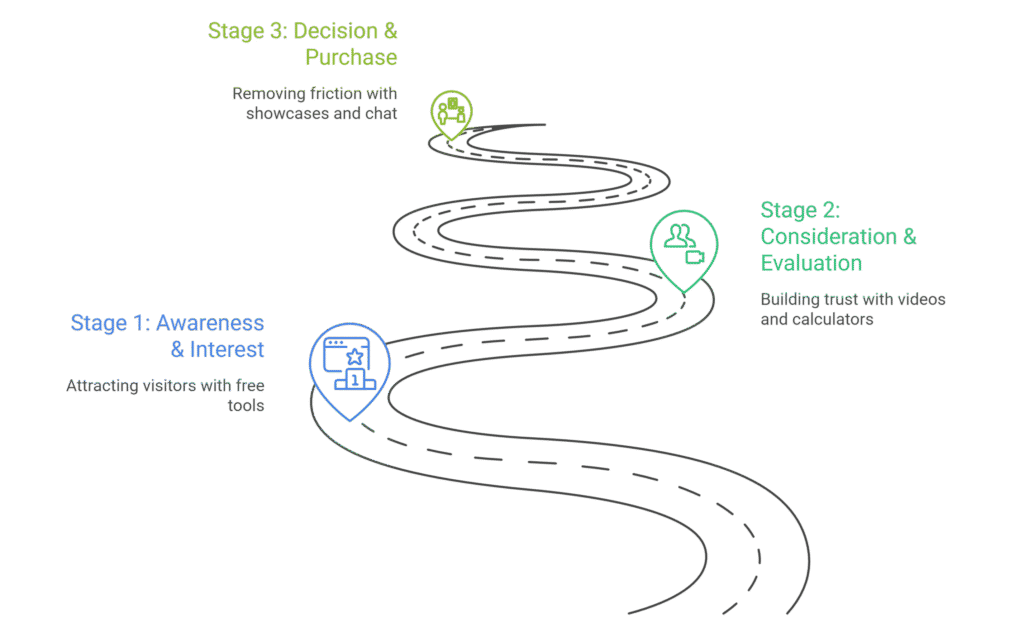
Interactive pricing calculators let visitors estimate costs before contacting you. For services with transparent pricing models, this self-service tool qualifies leads and builds trust. A web design agency might offer a calculator based on page count, features, and complexity. This transparency differentiates you from competitors who hide pricing.
Video introductions from the founder or team create personal connection. A 60-90 second video explaining who you are, why you started the business, and what you believe about serving clients humanizes your brand. In the UAE market where relationship-building matters, this personal touch can be decisive.
Live chat or WhatsApp integration provides immediate response for urgent questions. Many UAE customers prefer chat communication over forms. Being accessible in their preferred channel removes conversion friction. You don’t need 24/7 staffing; clearly communicated business hours with reliable responses during those times work well.
Before-and-after showcases demonstrate tangible results. For web design, show the old site versus the new one. For marketing, display engagement metrics before and after your involvement. For consulting, present business metrics that improved. Visual proof of your impact is more compelling than any description.
Free tools or resources that provide immediate value establish expertise. A marketing agency might offer a free website audit tool. An accounting firm could provide a tax planning checklist. These value-adds generate leads while demonstrating capability.
Process transparency documentation shows exactly what working with you looks like. Create a clear timeline of what happens from first contact through project completion. Detail who does what, what’s expected from the client, and how communication works. This reduces anxiety about the unknown.
Specialized expertise positioning differentiates you from generalists. Rather than claiming to serve everyone, demonstrate deep knowledge in your niche. “Instagram Marketing for Dubai Restaurants” is more compelling to restaurant owners than “Social Media Marketing.”
Comparison pages that honestly assess your service against alternatives help decision-making. “In-House vs. Agency Marketing: Which is Right for Your Business?” positions you as a trusted advisor, not just a vendor. You can fairly acknowledge when your service isn’t the best fit.
How do page load speed and technical performance affect conversions?
Technical performance has direct, measurable impact on website conversion rates. Google research shows that as page load time increases from 1 to 3 seconds, bounce probability increases by 32%. From 1 to 5 seconds, it increases by 90%.
For UAE businesses targeting mobile users on varying connection qualities, this matters even more. Someone browsing on 4G in a Dubai mall has different constraints than someone on fiber at home, but both expect fast loading.
Optimize images aggressively. Large, uncompressed images are the most common speed killer. Use modern formats like WebP, compress before uploading, and implement lazy loading so images only load as users scroll to them. A hero image doesn’t need to be 5MB; 200-300KB delivers excellent quality at fraction of the file size.
Minimize code bloat by removing unused plugins, scripts, and CSS. Many websites load dozens of resources that serve no active purpose. Regular audits of what’s actually necessary keep your site lean.
Use browser caching so returning visitors don’t reload unchanged elements. This makes subsequent page loads much faster, improving the experience for people exploring multiple pages.
Implement a content delivery network (CDN) if you serve international audiences or have media-heavy pages. CDNs store copies of your site on servers worldwide, delivering content from the closest location to each user.
Monitor Core Web Vitals through Google Search Console. These metrics (Largest Contentful Paint, First Input Delay, Cumulative Layout Shift) directly impact both user experience and search rankings. Address any pages flagged as poor performers.
Test your site on actual mobile devices with varying connection speeds. Emulators don’t fully replicate the experience. Have team members or testers access your site on 3G connections to understand real-world performance.
What conversion optimization mistakes do UAE service businesses commonly make?
Recognizing common mistakes helps you avoid them and spot opportunities competitors are missing.
Hiding contact information or making it difficult to reach you is surprisingly common. Some businesses bury their phone number in the footer or require visitors to navigate to a separate contact page. In markets where trust and accessibility matter, this creates unnecessary barriers.
Using generic stock photos instead of real team and work photos damages credibility. Visitors can spot stock imagery immediately, and it signals that you’re not confident enough to show your actual business. Invest in professional photos of your real team, office, and work.
Overwhelming visitors with too many choices paralyzes decision-making. If your homepage offers 10 different services, 5 calls-to-action, and multiple navigation paths, visitors don’t know where to focus. Clarity and prioritization convert better than comprehensive options.
Failing to optimize for mobile despite 70%+ mobile traffic is inexcusable. If your site requires pinching, zooming, or rotating to use, you’re losing the majority of potential conversions automatically.
Writing about yourself instead of customer problems makes content self-centered rather than customer-focused. Every page should primarily address what the visitor cares about: their challenges, goals, and desired outcomes.
Not testing different approaches means you’re guessing about what works. Implementing changes without A/B testing means you might be making things worse. Test different headlines, CTA buttons, form lengths, and page layouts systematically.
Ignoring returning visitors who don’t convert immediately misses the nurturing opportunity. Most service purchases require multiple touchpoints. If you’re not retargeting interested visitors with relevant content or offers, you’re losing potential customers who need more time.
Requesting too much information too early scares away potential leads. You don’t need to qualify every detail before initial contact. Get basic information, start the conversation, and gather specifics during the consultation.
How should I approach conversion optimization as an ongoing process?
Conversion optimization isn’t a one-time project. It’s a continuous process of testing, learning, and refining based on data and customer feedback.
Start by establishing baseline metrics. Before making any changes, document your current website conversion rate, traffic sources, top landing pages, and form completion rates. You need to know where you started to measure improvement.
Prioritize changes based on potential impact and ease of implementation. The ICE framework (Impact, Confidence, Ease) helps. Score each potential change on these three factors, then tackle high-scoring items first. Fixing a high-traffic landing page with a 1% conversion rate has more impact than optimizing a rarely-visited blog post.
Make one significant change at a time for clear attribution. If you simultaneously redesign your contact form, rewrite your homepage, and change your CTA buttons, you won’t know which change drove results. Sequential testing provides clearer learning.
Run A/B tests for significant changes to pages with sufficient traffic. You need at least 100-200 conversions per variation to reach statistical significance. For lower-traffic sites, test broader changes and trust directional data over strict statistical thresholds.
Implement obvious improvements without testing. If your form is broken on mobile or your contact number isn’t visible, fix it immediately. Don’t waste time testing things that are clearly broken.
Review analytics monthly to spot new patterns and opportunities. Which pages have traffic but low conversions? Which referral sources bring the most qualified visitors? What search terms are people using to find you? Regular reviews reveal optimization opportunities.
Gather qualitative feedback through customer conversations. Ask new clients what nearly stopped them from reaching out, what convinced them to contact you, and what could have made the decision easier. These insights reveal barriers data alone won’t show.
Stay updated on your industry and market changes. As AI search grows, as social platforms evolve, as customer preferences shift, your optimization strategy needs to adapt. What worked last year might be less effective now.
Document what you test and the results. Create a simple spreadsheet tracking changes, dates implemented, metrics before and after, and key learnings. This institutional knowledge prevents repeating failed experiments and identifies winning patterns.
Conclusion
Improving your website conversion rate isn’t about manipulating visitors or using psychological tricks. It’s about removing obstacles, building trust, and making it crystal clear how you solve problems that matter to your customers.
For UAE service businesses, the opportunity is substantial. Many competitors have decent websites but haven’t optimized the conversion path. By systematically addressing the elements covered here, you can double or even triple your website conversion rate, turning your existing traffic into significantly more leads and customers. A skilled web development company UAE can help implement these optimization strategies properly, ensuring every element works together to guide visitors toward taking action.
Start with the highest-impact changes: clarify your value proposition, add specific trust signals, simplify your contact process, and ensure mobile responsiveness. These foundational improvements often deliver 20-30% conversion increases before you move to more sophisticated optimization.
Remember that conversion optimization is ongoing. Your first round of improvements won’t be perfect, and your market evolves. Commit to monthly reviews, quarterly major optimizations, and consistent testing. The businesses that treat this as a continuous process rather than a one-time project build compounding advantages that competitors can’t easily overcome.
Your website should be your hardest-working salesperson, generating qualified leads around the clock. With systematic optimization, that becomes reality rather than aspiration.
FAQs
What is a good conversion rate for a service business website?
Service business website conversion rates typically range from 2% to 5%, though this varies significantly by industry, service complexity, and traffic quality. Professional services like legal or accounting often see 3-5% because visitors are highly qualified but cautious. Creative services like design or marketing might see 2-3% with broader audiences. What matters more than industry averages is your own improvement trajectory. If you’re currently at 1.5% and reach 3%, you’ve doubled your lead generation. Focus on beating your own baseline rather than achieving arbitrary benchmarks.
How long does it take to see results from conversion optimization?
For high-traffic websites, you can measure impact within 2-4 weeks of implementing changes. Lower-traffic sites might need 4-8 weeks to gather meaningful data. Some improvements show immediate results: fixing broken forms or adding visible phone numbers often increase conversions within days. More subtle optimizations like refined messaging or trust signals might take longer to demonstrate impact. Plan for a 3-month minimum commitment to conversion optimization, with monthly reviews to assess progress and adjust strategy.
Should I focus on increasing traffic or improving website conversion rate first?
Generally, optimize conversion first. If your site converts at 1%, doubling traffic gives you twice as many leads but at twice the cost. Improving conversion to 2% gives you the same result without additional ad spend. Start with conversion optimization until you’re converting at least 3-4%, then scale traffic knowing you’re efficiently converting visitors. The exception is if you have almost no traffic; you need at least 500-1000 monthly visitors to gather meaningful conversion data and test effectively.
Can I improve conversions without redesigning my entire website?
Absolutely. Most significant conversion improvements come from strategic adjustments, not complete redesigns. Focus on high-traffic pages first, particularly your homepage, top service pages, and contact page. Improvements like clearer headlines, simplified forms, added testimonials, prominent CTAs, and better mobile responsiveness often deliver substantial results without touching your overall design. Full redesigns are expensive and risky; incremental optimization is safer and more cost-effective.
How do I know if my conversion rate is being hurt by traffic quality or website problems?
Analyze your traffic sources separately. If visitors from Google Ads convert at 5% but organic traffic converts at 1%, the issue is likely traffic quality or message-match, not your website. If all sources convert poorly, website optimization is needed. Look at engagement metrics too. High bounce rates with short time-on-page suggest traffic quality issues; low bounce rates with good engagement but no conversions suggest website friction. Heat maps showing engaged visitors who don’t convert point to website problems rather than traffic issues.
What tools do I need to start website conversion rate optimization?
Begin with free tools that provide substantial insight. Google Analytics 4 tracks conversions and user behavior. Google Search Console shows which queries drive traffic. Microsoft Clarity offers free heat maps and session recordings. Your website platform likely includes form analytics. These tools provide everything needed for initial optimization. As you advance, consider paid A/B testing tools like Optimizely or VWO, but exhaust free tool insights first. Most UAE service businesses can achieve significant improvements using only free tools combined with systematic analysis and implementation.