
If you’re running a business in the UAE and thinking about building a website, you’ve probably noticed something frustrating: nobody wants to give you a straight answer about pricing. You’ll see “starting from AED 2,000” on one site and “custom quotes only” on another. So what’s the real story?
Let’s cut through the confusion. The truth is, a professional website in the UAE can cost anywhere from AED 3,000 to AED 50,000+, depending on what you actually need. That’s a huge range, I know. But here’s the thing, understanding why prices vary so much will help you make a smarter investment for your business.
Whether you’re a startup in Dubai Media City, a retail shop in Sharjah, or a service provider in Abu Dhabi, this guide will break down the real costs, hidden fees, and what you should actually be paying for a website that works for your business.
Why do website prices vary so much in the UAE?
The UAE’s digital landscape is unique. Your customers expect slick, fast-loading websites that work flawlessly on mobile. They’re comparing you to both local competitors and international brands. That sets a high bar.
Here’s what drives website cost in UAE:
Local market expectations: UAE consumers are sophisticated. They’ve shopped on Amazon, browsed luxury brand sites, and used apps like Noon and Careem. Your website needs to match that experience, even if you’re a small business. This means investing in proper design, user experience, and performance, not just throwing up a basic template.
Multilingual requirements: Many UAE businesses need Arabic and English versions of their site. That’s not just translation, it’s adapting layouts for right-to-left text, culturally appropriate imagery, and maintaining SEO effectiveness in both languages. This typically adds 30-40% to development costs.
Payment gateway integration: If you’re selling online, you’ll need local payment solutions. Integrating services like Network International, Telr, or PayTabs costs extra but is essential for UAE customers who want to pay with their preferred methods.
Hosting and compliance: Data residency requirements and optimal performance for UAE users mean hosting considerations matter. While you can use international hosting, local or regional hosting often performs better for your target audience.
How much should you budget for different types of business websites?
Let me give you realistic numbers for different business scenarios. These are based on what UAE businesses actually pay for quality work, not the cheapest options on Fiverr, and not the inflated quotes from agencies charging for their fancy office rent.
Small Business / Startup Website (AED 3,000 – AED 8,000)
Perfect for service providers, consultants, small retail shops, or startups testing the market.
What you get:
- 5-8 page informational website
- Mobile-responsive design
- Contact forms and Google Maps integration
- Basic SEO setup
- Content management system (usually WordPress)
- One language version
What you won’t get:
- Custom design from scratch (you’ll work with customized templates)
- E-commerce functionality
- Advanced integrations
- Ongoing support beyond initial setup
Real talk: This budget works if you have clear content ready, know what you want, and can handle minor updates yourself once the site is live. Many freelance developers and small agencies in Dubai and Abu Dhabi offer solid work in this range.
Professional Business Website (AED 8,000 – AED 20,000)
This is the sweet spot for established SMBs that need a website that actually represents their brand properly.
What you get:
- 10-15 custom pages
- Original design tailored to your brand
- Professional copywriting assistance
- Advanced SEO optimization
- Blog or news section
- Lead capture and CRM integration
- Bilingual capability (Arabic + English)
- Basic analytics setup
- 3 months post-launch support
What makes the difference: You’re paying for strategy here, not just execution. A good agency will research your competitors, understand your target audience, and build a site that converts visitors into customers, not just looks pretty.
UAE context: At this level, agencies understand local market nuances. They know that UAE customers expect certain trust signals (like displaying your trade license, physical location, and local contact numbers prominently). They’ll optimize your site for Dubai, Abu Dhabi, and other emirates separately if needed.
E-Commerce Website (AED 15,000 – AED 40,000)
If you’re selling products online, you’re looking at a more complex build.
What you get:
- Full online store with product catalog
- Shopping cart and checkout system
- Payment gateway integration (multiple options)
- Inventory management
- Customer account system
- Order tracking and notifications
- Mobile app-like experience
- SSL certificate and security measures
- Shipping zone configuration for UAE delivery
- Integration with VAT requirements
Platform considerations: Shopify might cost AED 15,000-25,000 for setup and customization. WooCommerce or custom solutions run AED 20,000-40,000 depending on complexity. Magento or custom platforms for larger operations can exceed AED 50,000.
Hidden costs to watch: Monthly platform fees, payment gateway transaction fees (usually 2.5-3.5% in UAE), SSL certificates, and maintenance. Budget at least AED 500-1,500 monthly for keeping an e-commerce site running smoothly.
Enterprise / Custom Web Application (AED 40,000+)
Large companies, booking platforms, SaaS products, or businesses needing complex functionality fall here.
What you get:
- Fully custom design and development
- Complex database architecture
- Third-party integrations (CRM, ERP, logistics systems)
- Custom features and functionality
- Advanced security measures
- Load testing and performance optimization
- Dedicated project management
- Extended support and maintenance
Examples: Real estate portals with property search, healthcare platforms with appointment booking, educational platforms with learning management systems, or restaurant chains with online ordering across multiple locations.
What factors affect the website cost in UAE?
Let’s get specific about what makes one quote AED 5,000 and another AED 25,000:
Design complexity: Using a pre-made theme with your colors and logo? Cheaper. Want custom illustrations, animations, video backgrounds, and a unique layout? More expensive. Each custom design element requires a designer’s time.
Functionality requirements: A contact form is simple. A booking system that integrates with your calendar, sends automated emails, processes payments, and handles cancellations? That’s complex. Every interactive feature adds development time.
Content creation: If you provide all text, images, and videos ready to go, costs drop. Need a professional photographer for your products? Copywriter for your pages? Video production? These add up quickly. Professional product photography in Dubai runs AED 1,500-5,000 per day. Copywriting ranges from AED 500-1,500 per page.
Number of pages: More pages = more time designing, developing, and populating with content. Simple math, but people underestimate this. A 5-page site might take 2 weeks. A 25-page site could take 8-10 weeks.
Mobile optimization: Every website should be mobile-friendly now (it’s 2025, come on). But doing it well, ensuring everything looks perfect and works smoothly on phones and tablets, requires additional testing and refinement time.
SEO and performance: Basic SEO means meta tags and alt text. Comprehensive SEO means keyword research, competitor analysis, content optimization, schema markup, page speed optimization, and ongoing monitoring. The difference between ranking on page 1 and page 5 of Google.
Integration needs: Connecting your website to your existing tools, email marketing platforms, CRM systems, booking software, inventory management, each integration needs custom development or API configuration.
What hidden costs should I know about when building a website?
Here’s where businesses get surprised:
Domain registration: AED 50-200 annually. Not much, but it’s recurring. Choose a reputable registrar (like GoDaddy, Namecheap, or local providers) and never let it expire.
Hosting: AED 300-2,000+ annually depending on traffic and performance needs. Cheap hosting (under AED 500/year) often means slow loading times, which costs you customers. Quality hosting matters more than most people think.
SSL certificate: AED 0-500 annually. Many hosts include free SSL now, but some businesses need extended validation certificates for trust signals. If you’re handling payments or sensitive data, don’t skip this.
Maintenance and updates: Websites aren’t “set and forget.” Software updates, security patches, content updates, and plugin maintenance are ongoing. Budget AED 500-2,000 monthly or learn to do it yourself.
Email hosting: Professional email addresses (@yourbusiness.ae) cost AED 15-30 per account monthly. Google Workspace and Microsoft 365 are popular in UAE businesses.
Backup services: If your host doesn’t include automatic backups, you need them. AED 100-300 annually for reliable backup solutions. Trust me, when (not if) something goes wrong, you’ll be glad you have backups.
Marketing and optimization: A website that doesn’t get traffic is useless. Budget for Google Ads, social media marketing, SEO work, or content creation to actually bring visitors to your new site.
How do I choose the right web developer in UAE?
Price shopping alone is a terrible strategy. Here’s what actually matters:
Portfolio review: Look at their previous work. Does it look modern? Does it work well on your phone? Do those businesses seem similar to yours? If they only show big corporate sites but you’re a small café, they might not be the right fit.
Local understanding: Do they get the UAE market? Do they know local payment gateways, understand bilingual requirements, and have experience with UAE businesses? Someone who’s built 50 websites in India might struggle with local nuances here.
Communication: How quickly do they respond to your initial inquiry? Are they asking good questions about your business goals? Poor communication during sales means disaster during development.
Support terms: What happens after launch? Do they disappear? Do they charge hourly for every tiny change? Get clear terms upfront about post-launch support.
Timeline realism: If someone promises a full custom website in 1 week, run away. Quality work takes time. A professional business website typically needs 6-12 weeks from kickoff to launch.
Contract clarity: Are deliverables clearly defined? What about revision rounds? What happens if you’re not satisfied? A vague contract protects them, not you.
What warning signs should I watch out for when hiring a developer?
Watch out for these warning signs:
“We’ll rank you #1 on Google guaranteed”: Nobody can guarantee rankings. SEO takes time and ongoing effort. This is either naïve or dishonest.
Prices way below market: If everyone else quotes AED 8,000-12,000 and someone offers AED 2,000, there’s a reason. You’ll get template work, poor support, or hidden costs later.
Refusing to show portfolio: Legitimate developers are proud of their work. If they can’t show you examples (with reasonable explanations for confidential clients), something’s off.
Pressure tactics: “This price expires tomorrow!” or “We only take 3 clients per month.” Good agencies don’t need aggressive sales tactics.
Ownership confusion: Make sure YOU own the website, domain, and content. Some developers maintain ownership and hold it hostage if you want to leave.
No contract or vague agreements: Professional relationships need professional contracts. If they’re casual about agreements, they’ll be casual about delivery.
How can I get more value from my website budget?
If your budget is tight, here’s how to maximize value:
Prioritize strategically: Start with essential pages (home, about, services, contact) and add more later. A focused 5-page site that works brilliantly beats a scattered 15-page site that confuses visitors.
Provide your own content: Writing your own page content and gathering your images saves significant cost. Developers charge for content creation because it takes time.
Use quality templates wisely: There’s no shame in starting with a premium template if customized well. Save custom design budget for when your business has proven the model and needs to scale.
Phase your features: Launch with core functionality first. Add booking systems, e-commerce, or advanced features in phase 2 once you’re generating revenue from the initial site.
Learn basic updates: WordPress and similar platforms are designed for non-technical users. Learning to add blog posts or update text yourself saves ongoing costs.
Invest in SEO from the start: It’s harder and more expensive to retrofit SEO later. Even on a tight budget, proper SEO foundation during initial build pays off for years.
What are the actual going rates for websites in UAE in 2025?
Based on current market rates for quality work in the UAE:
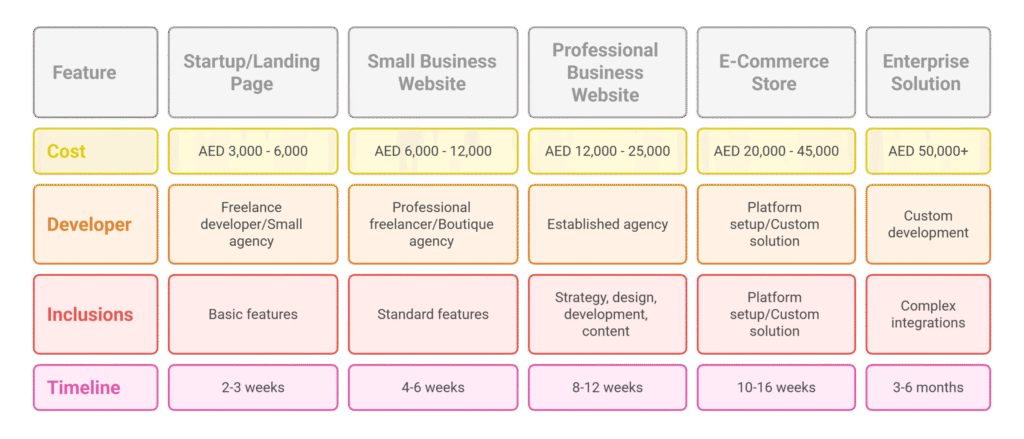
These prices reflect working with reputable professionals who understand the UAE market, provide proper support, and deliver quality work. You can find cheaper options, but understand what you’re sacrificing.
Is spending more on a website worth it for my business?
Here’s what nobody talks about enough: your website cost in UAE should be measured against what it generates, not just what you spend.
A AED 15,000 website that brings in 10 new customers per month at AED 2,000 average value pays for itself in under a month. A AED 5,000 website that looks cheap and drives customers to your competitor is expensive at any price.
UAE consumers are sophisticated. They judge your business by your website within seconds. If your site looks dated, loads slowly, or doesn’t work well on mobile, they’re clicking back to Google and trying your competitor.
Think of your website as your hardest-working employee. It works 24/7, never takes vacation, and doesn’t ask for a raise. Would you hire an employee for AED 3,000 annually who could bring in dozens of customers? Of course. Apply the same thinking to your website budget.
Final Recommendations for UAE Businesses
If you’re a startup testing a concept: Start with AED 5,000-8,000 for a solid landing page or basic site. Prove your model, then reinvest in a better site once you have revenue.
If you’re an established SMB: Budget AED 12,000-20,000 for a professional website that properly represents your brand. This is where you get the most value for money in the UAE market.
If you’re selling online: Don’t cheap out. Budget minimum AED 20,000-30,000 for an e-commerce site that actually converts. Poor checkout experiences lose sales fast.
If you’re scaling or enterprise: Budget AED 40,000+ and work with agencies that specialize in your industry. At this level, strategic thinking and experience matter more than saving a few thousand dirhams.
Remember: in the UAE’s competitive market, your website isn’t an expense, it’s an investment in capturing market share from competitors who are already online. The question isn’t “how much will a website cost in UAE?” but “how much revenue am I losing without a proper website?”
Frequently Asked Questions
How long does it take to build a professional website in UAE?
A typical professional business website takes 6-12 weeks from initial consultation to launch. This includes strategy discussions, design approval, development, content creation, testing, and revisions. Rush jobs are possible but often sacrifice quality. E-commerce sites need 10-16 weeks due to additional complexity like payment gateway testing and product catalog setup. Simple landing pages can be done in 2-3 weeks.
Do I need to pay monthly fees after my website is built?
Yes, ongoing costs are unavoidable. At minimum, you’ll pay for domain registration (AED 50-200 annually), hosting (AED 300-2,000+ annually), and SSL certificate (often included with hosting). Most businesses also budget AED 500-2,000 monthly for maintenance, security updates, content changes, and technical support. E-commerce sites have additional costs for payment gateway transaction fees (2.5-3.5% per sale) and platform subscriptions if using Shopify or similar services.
Should I use a freelancer or agency for my website in UAE?
Freelancers work well for smaller budgets (AED 3,000-10,000) and simpler projects where you have clear requirements and can manage the project yourself. They’re often more flexible and affordable. Agencies (AED 10,000-50,000+) provide better project management, diverse skills (design, development, SEO, copywriting), accountability, and ongoing support. For business-critical websites or e-commerce projects, agencies reduce risk through structured processes and team expertise. Many successful UAE businesses start with freelancers and graduate to agencies as they scale.
What’s the difference between a AED 5,000 and AED 15,000 website?
The AED 5,000 website typically uses a pre-made template with minor customization, includes 5-8 pages, basic functionality, and minimal strategic input. You’ll likely provide all content yourself and handle your own updates post-launch. The AED 15,000 website includes custom design tailored to your brand, strategic planning (competitor research, user journey mapping), professional copywriting assistance, comprehensive SEO, bilingual capability, CRM integration, and 3-6 months post-launch support. The more expensive site is designed to convert visitors into customers, not just look professional. For established businesses, the price difference often pays for itself through better conversion rates.
Can I build my website myself using Wix or Squarespace?
Absolutely, and it might be the right choice if you’re extremely budget-constrained or just testing concept. DIY website cost in UAE is around AED 200-800 annually and let you build a basic site without coding. However, there are tradeoffs: limited customization, template designs that might look like competitors, restricted SEO capabilities, and the time investment required (learning curve is steeper than advertised). For UAE businesses, DIY platforms struggle with bilingual requirements and local payment gateway integrations. Most businesses find that DIY works for initial testing but professional development becomes necessary as they grow and need their website to actually drive business results.
What happens to my website if I stop paying my developer?
This depends entirely on your contract and who owns what. In a proper setup, YOU should own your domain name, hosting account, and all website files. If you registered these yourself (recommended) and the developer just built the site, you can take the files and move to another developer anytime. However, many budget developers maintain control of hosting and domain, making you dependent on them. Before starting any project, clarify: Who owns the domain? Who controls the hosting? Can you get all files and database access? Will you have admin credentials to your website? Get these terms in writing. If a developer refuses to answer these questions clearly, that’s a major red flag.