
If you’re running a service business in the UAE right now, you’ve probably noticed something. The old playbook doesn’t work the way it used to. Posting on social media sporadically, updating your website once a year, and hoping Google will send you customers isn’t cutting it anymore.
The competition has gotten fiercer. Your potential clients are spending time on platforms you might not even fully understand yet. And the way people search for services has completely changed. They’re not just typing into Google anymore. They’re asking ChatGPT, Perplexity, and other AI tools for recommendations. They’re watching short videos on Instagram and TikTok instead of reading blog posts.
The good news? Service businesses that adapt to these changes are seeing incredible results. The ones that stick to 2020 strategies are quietly losing ground. This guide will walk you through exactly what works in 2026, with a focus on what actually moves the needle for service businesses in the UAE market.
What does a modern digital marketing strategy actually need to include?
Let’s start with the foundation. A complete digital marketing strategy in 2026 isn’t just about having a website and some social media accounts. It’s about creating a connected system where every piece works together to attract, engage, and convert your ideal clients.
First, you need a content engine. This means consistently creating valuable content that answers the questions your potential clients are actually asking. Not generic blog posts that nobody reads, but content that shows up when someone searches for solutions you provide.
Second, you need visibility across multiple channels. Your ideal client isn’t just hanging out in one place online. They’re moving between Google, social media, AI chatbots, and industry-specific platforms. You need to show up wherever they’re looking.
Third, you need conversion mechanisms. Traffic means nothing if it doesn’t turn into leads and clients. Your strategy needs clear pathways that guide interested people toward working with you.
And finally, you need measurement systems. You should know which efforts are bringing in actual business and which ones are just keeping you busy. Too many service businesses are flying blind, spending time and money on activities that don’t generate revenue.
For UAE service businesses specifically, this also means understanding the local market dynamics. Dubai and Abu Dhabi have incredibly competitive service sectors, but they also have clients who value quality and are willing to pay for expertise. Your strategy needs to position you as the obvious choice in your category.
How do service businesses get found online in 2026?
The discovery landscape has fundamentally shifted. Five years ago, if you wanted your service business to get found, you focused heavily on Google SEO. You’d optimize your website, build backlinks, and hope to rank for key search terms in your industry.
That still matters, but it’s no longer the whole picture. Today, potential clients are discovering service providers through multiple pathways, and many of them don’t start with a traditional Google search.
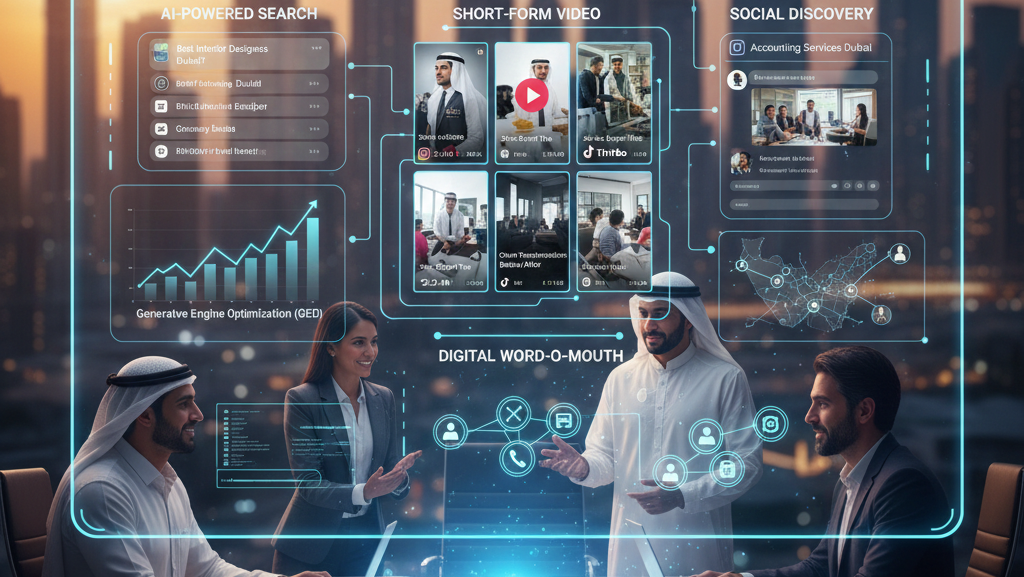
AI-powered search is exploding. When someone asks ChatGPT or Perplexity “Who are the best interior designers in Dubai?” or “What digital marketing agency should I use in Abu Dhabi?”, these tools are pulling information from across the web to generate answers. If your business isn’t optimized for these AI engines, you’re invisible in these conversations. This is what we call Generative Engine Optimization, or GEO.
Social media discovery has become more powerful than ever. Instagram, TikTok, and LinkedIn aren’t just places to post updates anymore. They’re search engines in their own right. People are literally typing “accounting services Dubai” into Instagram’s search bar and making decisions based on what they find.
Short-form video has become the most powerful discovery tool available. A 30-second video showcasing your expertise or a client result can reach thousands of potential clients who would never have found you through a Google search. The algorithm pushes engaging content to people who don’t even follow you yet.
Word-of-mouth has gone digital. When your clients have a great experience, they’re not just telling their friends over coffee anymore. They’re posting stories, leaving reviews, and tagging your business online. This creates discovery moments for their entire network.
The service businesses winning in 2026 are the ones showing up across all these channels, not just optimizing for one. They’re creating content that works for both traditional search engines and AI tools. They’re posting videos that showcase their expertise. They’re making it easy for happy clients to spread the word.
What content should service businesses create to attract clients?
Content creation sounds overwhelming to most service business owners. You’re already busy delivering services to clients. The last thing you want is to become a content factory. But here’s the reality: the businesses that consistently create valuable content are the ones getting discovered and trusted by new clients.
The key is creating the right content, not just more content. Start with the questions you hear repeatedly from prospects and clients. Every consultation call you take, every initial meeting you have, people are asking similar questions. Those questions are exactly what other potential clients are typing into search bars and asking AI tools.
Turn those questions into short-form videos. A 30 to 60 second video where you directly answer a common question is incredibly valuable. It positions you as the expert, it’s easily shareable, and it works across multiple platforms. You can post the same video on Instagram Reels, TikTok, YouTube Shorts, and LinkedIn.
Create showcase content that demonstrates your work. Before-and-after transformations, case study snippets, client testimonials, and project highlights all work beautifully. Service businesses often underestimate how powerful it is to simply show the results you deliver. People want proof that you can actually do what you say. This is precisely why successful digital marketing agency UAE portfolios focus heavily on documented results rather than just listing services, potential clients need tangible evidence of what you’ve accomplished for others.
Educational content builds trust faster than promotional content. When you teach something valuable without asking for anything in return, you’re demonstrating expertise and building credibility. A financial advisor creating content about tax strategies for UAE businesses. A fitness trainer sharing nutrition tips. A business consultant explaining growth frameworks. This positions you as the trusted authority in your field.
Behind-the-scenes content humanizes your business. People want to work with real humans, not faceless companies. Show your team, your process, your workspace, your day-to-day reality. This creates connection and makes you more relatable.
The mistake most service businesses make is trying to create perfectly polished content. They spend hours on a single post, stress about every word, and end up posting once a month. The businesses winning right now are creating good-enough content consistently. Three short videos per week will outperform one perfect video per month every single time.
How can service businesses optimize for AI search engines?
This is the question most service businesses aren’t asking yet, but they should be. While everyone’s still focused on Google SEO, a massive shift is happening. People are increasingly using AI tools like ChatGPT, Perplexity, and Google’s AI Overviews to find service providers.
When someone asks an AI tool for recommendations, it’s scanning the web for authoritative, well-structured information about businesses like yours. If your online presence isn’t optimized for AI comprehension, you won’t show up in these recommendations.
GEO is different from traditional SEO. Search engines read keywords and backlinks. AI engines read context, authority signals, and comprehensive information. They’re looking for clear answers to questions, expert perspectives, and trustworthy sources.
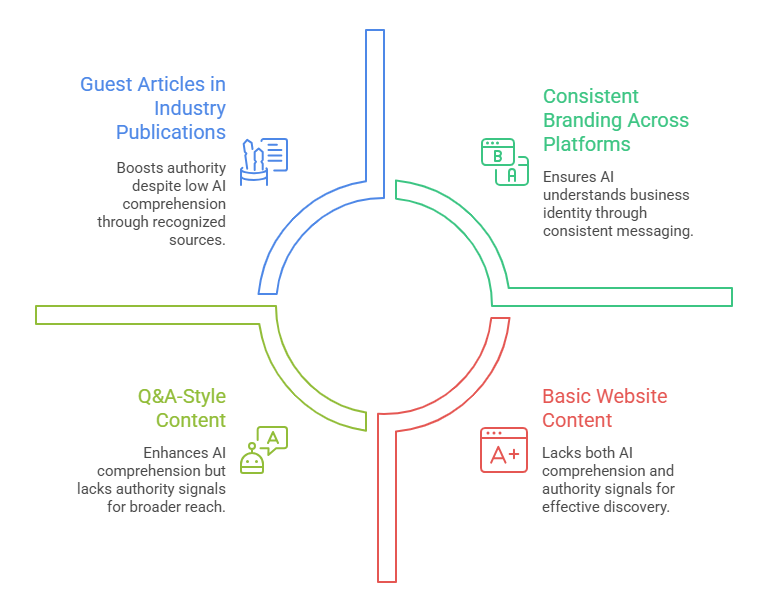
Make your expertise explicit. AI tools need to clearly understand what you do, who you serve, and what makes you qualified. Your website, your social profiles, and your content should clearly state your specialization, your experience, and your credentials. Don’t assume AI will figure it out from subtle clues.
Create Q&A-style content that directly answers questions. AI engines love content that clearly poses a question and provides a comprehensive answer. This matches how people interact with these tools. Structure your content with clear questions as headings and detailed answers below.
Get cited in authoritative sources. AI engines give more weight to information that appears on recognized platforms. Guest articles, podcast interviews, speaking engagements, and features in industry publications all increase your authority signals.
Maintain consistency across all platforms. AI tools pull information from multiple sources to understand your business. If your LinkedIn says one thing, your website says another, and your Instagram bio says something else, you’re confusing the AI. Keep your core information consistent everywhere.
For UAE service businesses, include location-specific information naturally in your content. When you mention projects, reference the emirates where you work. When you share client stories, mention the industries common in the GCC region. This helps AI tools understand your geographic relevance.
The businesses that start optimizing for AI discovery now are getting a significant first-mover advantage. In six months, this will be table stakes. Right now, it’s still an opportunity.
What social media strategy works for service businesses in 2026?
Social media has matured beyond just posting updates and hoping for engagement. The platform dynamics have changed, the algorithms have evolved, and user behavior is completely different than it was even two years ago.
The biggest shift is the dominance of short-form video. Every major platform has prioritized video content in their algorithms. Instagram Reels, TikTok videos, YouTube Shorts, and LinkedIn video posts all receive dramatically more reach than static posts. If you’re still primarily posting photos and text, you’re working against the algorithm.
For service businesses, this is actually a huge opportunity. You don’t need expensive equipment or a production team. A smartphone and good lighting are enough. The content that performs best is often simple, straightforward videos where you share expertise or showcase results.
Platform selection matters more than ever. You don’t need to be everywhere, but you need to be strategic about where you invest time. For B2B service businesses in the UAE, LinkedIn is non-negotiable. For lifestyle services, visual services, or consumer-focused businesses, Instagram is critical. TikTok is no longer just for teenagers; it’s become a legitimate business discovery platform across demographics.
Consistency beats perfection every single time. The accounts growing fastest are posting multiple times per week, often daily. They’re not spending hours perfecting each post. They’re capturing quick videos, adding captions, and publishing. The algorithm rewards consistency and recency far more than production quality. This is why any effective social media agency Dubai strategy prioritizes sustainable content rhythms over sporadic bursts of highly polished posts, the businesses winning are those showing up regularly, not occasionally.
Engagement is currency. The businesses winning on social media are actively engaging with their audience and with other accounts in their industry. They’re responding to comments, answering DMs, and showing up in other people’s content. This creates relationships and increases visibility.
Don’t ignore the local context. UAE audiences appreciate content that acknowledges local culture, business environment, and market dynamics. Reference local landmarks, discuss region-specific challenges, and feature local clients when appropriate. This makes your content more relatable and relevant.
The paid versus organic question comes up constantly. Here’s the reality: organic reach is harder than ever, but it’s still possible with the right content strategy. Paid promotion amplifies good content but won’t save bad content. The winning approach is creating strong organic content and selectively boosting the pieces that perform well.
How do you turn digital marketing efforts into actual clients?
This is where most strategies fall apart. Businesses create content, build followings, and drive traffic, but then struggle to convert that attention into paying clients. The gap between visibility and revenue is where strategy matters most.
Your digital presence needs clear conversion pathways. When someone discovers you through a video, a search result, or a social media post, what happens next? There should be an obvious next step that moves them closer to becoming a client.
For service businesses, this usually means capturing leads. A contact form is fine, but it’s often not enough. Consider offering something valuable in exchange for contact information. A free consultation, a downloadable guide, a video training, or an assessment tool. Make the exchange feel worth it.
Your website needs to convert, not just inform. Too many service business websites are basically online brochures. They explain what you do but don’t guide visitors toward taking action. Every page should have a clear call-to-action. Make it easy for interested people to take the next step.
Speed matters enormously in lead follow-up. When someone reaches out, they’re usually comparing multiple options. The service business that responds fastest often wins, even if they’re not the cheapest or most experienced. Set up systems to ensure leads get quick responses.
Social media DMs have become a primary conversion channel. Many potential clients will message you directly rather than filling out a form. If you’re not monitoring and responding to DMs quickly, you’re losing business. For many UAE service businesses, WhatsApp Business has become an essential tool for client communication.
Create trust before asking for commitment. Not everyone who discovers you is ready to hire immediately. Some need more information, more proof, or more time. Create content that nurtures this audience. Case studies, client testimonials, and educational content all build trust over time.
Make your pricing and process clear. One of the biggest barriers to conversion is uncertainty. When potential clients don’t understand how you work, what it costs, or what results to expect, they hesitate. The more transparent you can be about your process and pricing structure, the easier it becomes for qualified prospects to say yes.
What metrics actually matter for service businesses?
Digital marketing generates endless data, but most of it doesn’t matter. Service business owners get caught up tracking vanity metrics that feel good but don’t correlate with business growth.
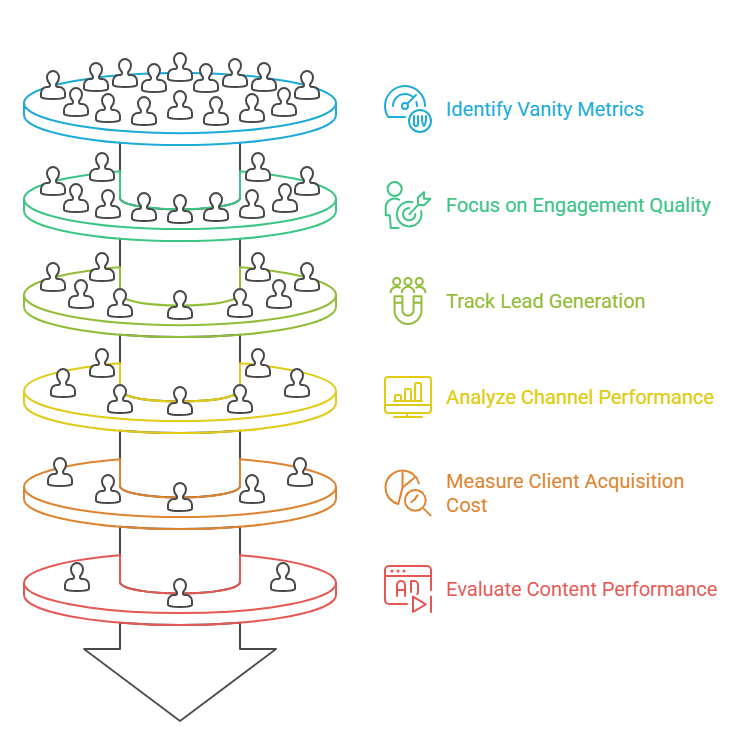
Website traffic is interesting but ultimately meaningless if those visitors don’t become clients. You could have 10,000 website visits per month and zero new clients, or 500 visits and ten new clients. The second scenario is infinitely better for your business.
Social media followers are another vanity metric. An account with 50,000 followers and no client inquiries is less valuable than an account with 2,000 followers that generates regular leads. Focus on engagement quality, not follower quantity.
The metrics that actually matter are lead generation metrics. How many qualified inquiries are you getting? Where are they coming from? What’s the conversion rate from inquiry to client? These numbers directly connect to revenue.
Track revenue by channel. If you’re investing in multiple marketing channels, you should know which ones are actually generating business. Maybe your Instagram drives lots of engagement but LinkedIn generates actual clients. Or maybe your website converts incredibly well but doesn’t get much traffic. This information guides where you invest more resources.
Client acquisition cost matters increasingly in competitive markets. How much are you spending in time and money to acquire each new client? If it costs you AED 5,000 in marketing to acquire a client worth AED 3,000, that’s a problem. For service businesses with high lifetime value clients, higher acquisition costs might be acceptable.
Content performance should be measured by action, not attention. A video with 100,000 views that generates zero inquiries is less valuable than a video with 1,000 views that generates five consultations. Track which content pieces actually drive business outcomes.
The ultimate metric is return on investment. For every hour you spend on marketing and every dirham you invest, what return are you getting? This keeps you focused on activities that actually grow your business rather than just keeping you busy.
What mistakes are UAE service businesses making with digital marketing?
After working with hundreds of service businesses across the Emirates, certain patterns emerge. The same mistakes show up repeatedly, holding businesses back from the results they could be achieving.
The biggest mistake is inconsistency. Businesses post content for a few weeks, don’t see immediate results, and stop. They try a new platform, give it a month, and abandon it. Digital marketing compounds over time. The businesses winning are the ones that kept showing up consistently for months and years.
Another common mistake is trying to do everything at once. A business owner decides to revamp their website, start posting on three social platforms, begin email marketing, and launch paid ads all simultaneously. They get overwhelmed, burn out, and nothing gets done well. Better to pick two channels and execute them excellently than spread yourself across five channels poorly.
Copying competitors without understanding strategy is surprisingly common. A business sees a competitor’s content performing well and tries to replicate it without understanding why it worked. They miss the context, the audience building that happened before, and the consistency behind the scenes.
Underestimating the importance of quality is another trap. Some businesses think they can just pump out massive amounts of low-quality content and the algorithm will reward volume. But platforms are increasingly sophisticated at identifying and deprioritizing low-quality content. One excellent video per week beats seven mediocre ones.
Ignoring mobile experience is still remarkably common. The vast majority of your potential clients are viewing your content and website on mobile devices. If your website isn’t mobile-optimized, if your videos have text that’s unreadable on small screens, you’re creating a poor experience for most of your audience. Any reputable creative digital marketing agency in Dubai will audit mobile performance first, because even the most compelling content fails when it’s not optimized for how people actually consume it.
Not investing in professional help when needed is costing businesses significant opportunity. Many service business owners try to do all their marketing themselves, even though they don’t enjoy it, aren’t good at it, and it takes time away from serving clients. The businesses growing fastest are the ones that brought in specialized help.
Finally, treating digital marketing as an expense rather than an investment. When marketing is seen as a cost to minimize, businesses underinvest and get poor results. When it’s seen as an investment that generates returns, businesses commit the resources needed and see much better outcomes.
Conclusion
Digital marketing in 2026 looks fundamentally different than it did even two years ago. The platforms have evolved, the algorithms have changed, and user behavior has shifted dramatically. Service businesses that adapt to these changes are thriving. The ones clinging to old strategies are struggling to stay competitive.
The complete digital marketing strategy for service businesses today includes visibility across multiple channels, particularly through short-form video content and optimization for AI-powered search. It requires consistent content creation that demonstrates expertise and builds trust. It needs clear conversion pathways that turn attention into clients.
For UAE service businesses specifically, the opportunity is enormous. The market is competitive but also sophisticated and willing to pay for quality. The businesses that show up consistently, create valuable content, and make it easy for clients to find and choose them are seeing exceptional growth.
The time to implement these strategies is now, not next quarter or next year. Every month you delay is a month your competitors are building advantages. Start with one or two channels, commit to consistency, and focus on creating content that showcases your expertise and results.
If you’re feeling overwhelmed by the scope of what modern digital marketing requires, that’s understandable. This is exactly why specialized agencies exist. The right partner can handle the execution while you focus on delivering exceptional service to your clients.
Frequently Asked Questions
How much should a service business spend on digital marketing in 2026?
Budget allocation depends heavily on your business size, growth goals, and current client acquisition channels. As a general guideline, service businesses should invest 7-12% of revenue into marketing, with a significant portion allocated to digital channels. For businesses just starting or aggressively growing, this percentage might be higher. The key is tracking return on investment and adjusting based on what channels are actually generating clients for your specific business.
Is it better to hire an agency or build an in-house marketing team?
For most small and medium-sized service businesses, working with a specialized agency is more cost-effective and delivers better results. Building an effective in-house team requires hiring multiple specialists (content creators, videographers, strategists, paid media experts), which is expensive and time-consuming. Agencies bring immediate expertise across all these areas. The exception is large service businesses with substantial ongoing marketing needs, where in-house teams with agency support might make sense.
How long does it take to see results from digital marketing?
This varies by strategy and channel. Paid advertising can generate leads within days. SEO typically takes 3-6 months to show meaningful results. Building a social media presence that consistently generates leads usually takes 4-8 months of consistent effort. GEO is still emerging, so early movers are seeing faster results. The key insight is that digital marketing is not a quick fix but a compound investment that gets more effective over time.
What digital marketing channels work best for B2B service businesses in the UAE?
LinkedIn is essential for B2B service businesses, offering both organic reach through content and highly targeted paid advertising. Google search (both SEO and ads) remains valuable for capturing high-intent prospects. Industry-specific platforms and communities are often underutilized but effective. Increasingly, AI-powered search is becoming important for B2B discovery. Email marketing to nurtured lists remains one of the highest-ROI channels for B2B services.
Can service businesses succeed with organic content alone or is paid advertising necessary?
Organic content can absolutely generate substantial business, but it requires consistency, quality, and patience. Many successful service businesses have built entirely on organic content, particularly through platforms like LinkedIn, Instagram, and YouTube. However, paid advertising accelerates results and provides more predictable lead flow. The most effective approach for growing service businesses is typically a combination: strong organic content that builds authority and trust, supplemented by selective paid promotion to expand reach and capture high-intent prospects.
How do you measure the ROI of content marketing for service businesses?
Start by implementing proper tracking systems that connect content consumption to lead generation. Use UTM parameters on links, track which content pieces generate consultation requests, and survey new clients about how they discovered you. Calculate the client lifetime value and work backwards to determine acceptable acquisition costs. Many service businesses track content ROI through attribution models that assign value to different touchpoints in the client journey. The key is connecting content efforts to actual revenue, not just engagement metrics.