

If you’re running a service business in Dubai, you’ve probably noticed something strange happening with your online visibility. You could have the best SEO in your industry, rank on page one of Google, and still watch potential clients slip through your fingers because they never clicked through to your website at all.
They’re getting their answers directly from ChatGPT, Google’s AI Overviews, Perplexity, and other AI engines. They’re asking questions like “best accounting firm in Dubai” or “how much does corporate branding cost in the UAE,” and these platforms are serving up recommendations without sending anyone to your site.
This is where Generative Engine Optimization (GEO) comes in. It’s not about replacing SEO. It’s about making sure your business gets mentioned, cited, and recommended when AI engines answer questions about your industry. GEO strategies for service businesses in Dubai is essential to maintain online visibility, especially as AI platforms increasingly answer search queries directly.
Let’s break down exactly how you can position your service business to win in this new landscape.
What exactly is GEO and why should service businesses in Dubai care?
GEO is the practice of optimizing your content so that AI-powered search engines and chatbots cite, mention, or recommend your business when users ask relevant questions. Unlike traditional SEO, which focuses on ranking in a list of blue links, GEO focuses on becoming the answer itself.
Think about how your potential clients search today. They’re not just typing “digital marketing Dubai” into Google anymore. They’re asking full questions like “What’s the most cost-effective way to grow my business online in Dubai?” or “Should I hire a marketing agency or build an in-house team in the UAE?”
When AI engines respond to these queries, they pull information from sources they trust. If your content is structured, authoritative, and genuinely helpful, you get cited. If it’s generic or outdated, you get skipped over entirely.
For service businesses in Dubai, this matters even more because the market is incredibly saturated. There are hundreds of agencies, consultants, and service providers competing for the same clients. GEO gives you a way to stand out by becoming the trusted voice that AI platforms reference when someone asks a question in your field.
The UAE’s digital adoption rate is among the highest in the world. People here expect fast, reliable, and relevant answers. If your business isn’t showing up in AI-generated responses, you’re losing clients to competitors who are.
How can service businesses structure their content to get cited by AI engines?
AI engines prefer content that directly answers questions, provides clear value, and feels authoritative. The key is to stop writing content for algorithms and start writing for real people with real problems, while keeping AI-friendly structures in mind.
Start by identifying the exact questions your target audience asks. These aren’t generic keywords like “web design” or “branding.” They’re specific, intent-driven queries like “How long does it take to build a website for a small business in Dubai?” or “What should I include in a social media strategy for a Dubai-based restaurant?”
Once you have these questions, build content around them. Use the question as your H2 heading. Answer it clearly and completely in the first two sentences. Then expand with examples, data, and context. This format works because it mirrors how people actually search and how AI engines actually summarize.
Let’s say you’re a business consultant in Dubai. Instead of writing a generic blog post titled “Business Consulting Services,” write one titled “What should UAE startups look for in a business consultant?” Then answer it thoroughly. Explain what qualifications matter, what red flags to watch for, what questions to ask during a consultation, and what realistic outcomes look like. Include examples from the UAE market. Mention pricing ranges if possible. Make it genuinely useful.
Another critical element is E-E-A-T: Experience, Expertise, Authoritativeness, and Trustworthiness. AI engines are trained to prioritize sources that demonstrate these qualities. That means including real case studies, client results, credentials, and original insights rather than repackaging generic advice.
For Dubai-based service businesses, adding local context strengthens your authority. Reference UAE regulations, local business challenges, cultural considerations, or GCC market trends. AI engines recognize this specificity as a signal that you actually know what you’re talking about.
Also, make sure your content is easy to scan. Use short paragraphs, clear subheadings, bullet points where appropriate, and concise language. AI engines parse content the same way busy humans do. If your answer is buried in five paragraphs of fluff, it won’t get cited.
Should service businesses focus on long-form content or quick answers for GEO?
Both, but for different reasons. Quick answers help you get cited in direct responses. Long-form content helps you build authority and get referenced in more complex queries.
For quick answers, think about the questions that have clear, concise responses. “What is corporate branding?” or “How much does a logo design cost in Dubai?” These can be answered in 50 to 100 words. Write a tight, direct response that AI engines can pull and cite immediately. Then expand with additional context, but lead with the answer.
Long-form content works when the question is more complex or strategic. “How do I choose between hiring a freelancer or an agency for my marketing in Dubai?” or “What’s the best way to scale a service business in the UAE?” These require depth, nuance, and examples. A 1,500 to 2,000-word article that thoroughly explores the topic will perform better than a shallow 300-word post.
The mistake most service businesses make is choosing one or the other. You need both. Your homepage and service pages should have clear, scannable sections with direct answers to common questions. Your blog should have in-depth articles that explore topics your audience genuinely cares about.
Here’s a practical example. If you’re a legal consultancy in Dubai, your service page might have a section titled “What types of businesses need legal consultants in Dubai?” with a quick two-sentence answer followed by a short list. Your blog might have a long-form article titled “How to navigate Dubai’s free zone regulations as a new business owner” that dives deep into the topic with step-by-step advice, case studies, and links to official resources.
This combination signals to AI engines that you’re both helpful and authoritative. You’re not just trying to rank for keywords. You’re genuinely serving your audience.
What role do FAQs play in getting recommended by AI platforms?
Massive. FAQ sections are one of the most GEO-friendly content formats you can use because they’re structured exactly how AI engines process information: question, answer, next question, next answer.
Most service businesses in Dubai already have FAQ sections on their websites, but they’re underutilized. They’re often generic, vague, or buried at the bottom of a page. To optimize FAQs for GEO, you need to treat each question as a search query and each answer as a citation opportunity.
Write your FAQ questions the way real people ask them. Instead of “What are our services?” use “What services does a digital marketing agency in Dubai typically offer?” Instead of “Pricing information,” use “How much should I expect to pay for web design in Dubai?”
Your answers should be clear, specific, and complete. Avoid vague responses like “Our pricing varies based on client needs.” Instead, say something like “Web design projects in Dubai typically range from AED 5,000 for a basic 5-page website to AED 50,000 or more for custom e-commerce platforms, depending on features, integrations, and ongoing support.”
The more specific you are, the more likely an AI engine will cite your answer. Specificity signals authority.
Include 4 to 6 FAQs on every major service page, and consider creating a dedicated FAQ page that covers broader industry questions. For example, if you’re a branding agency, your FAQ page might include questions like “How long does a full rebrand take?” or “What’s the difference between a brand refresh and a full rebrand?” or “Do Dubai-based businesses need Arabic branding materials?”
Each FAQ should also be an opportunity to naturally include keywords without forcing them. If your keyword research shows that people search for “affordable social media management in Dubai,” then one of your FAQs should directly address that: “What’s the most affordable way to manage social media for a small business in Dubai?”
FAQs also help with voice search and conversational queries, which are becoming more common. People using AI assistants or voice search tend to ask full questions, not short keywords. Your FAQs are perfectly positioned to capture these queries.
How important is local UAE context for getting mentioned by AI engines?
Extremely important, especially if you’re targeting clients in Dubai or the broader UAE market. AI engines prioritize relevance, and local context is one of the strongest relevance signals you can send.
When you mention Dubai-specific details like free zones, the Dubai Economic Department (DED), VAT regulations, or Emiratization policies, you’re signaling that your content is tailored to the UAE market. AI engines recognize this and are more likely to cite you when someone asks a location-specific question.
Let’s say someone asks ChatGPT “How do I market a restaurant in Dubai?” If your content includes examples of Dubai food trends, references to Zomato and Deliveroo, mentions of Instagram marketing strategies for Dubai’s expat communities, and tips on navigating Dubai Municipality guidelines for food businesses, you’re far more likely to get cited than a generic article about restaurant marketing.
This doesn’t mean you should force Dubai references into every sentence. It means you should genuinely understand your local market and reflect that understanding in your content. Talk about challenges specific to Dubai businesses. Reference local success stories. Mention regulations, cultural considerations, and market dynamics that matter here.
For example, if you’re a web development agency, you might discuss the importance of Arabic-English bilingual websites for businesses targeting both local and expat audiences. Or you could explain how UAE data privacy laws affect website design and cookie policies. These aren’t just SEO keywords. They’re real concerns for your potential clients, and addressing them makes your content more authoritative.
Location-specific long-tail keywords also help. Phrases like “business setup in Dubai,” “marketing for Dubai startups,” or “corporate branding in the UAE” are more targeted and less competitive than generic terms. They also align with how people search when they’re ready to take action. A Generative Engine Optimization (GEO) agency in the UAE can help businesses identify and leverage these location-specific opportunities more effectively.
One more thing: keep your content updated with current UAE trends and regulations. The business landscape here changes quickly. If your content references outdated rules or ignores recent developments, AI engines will deprioritize it in favor of more current sources.
What types of content formats perform best for GEO in the service industry?
The formats that perform best are the ones that directly answer user intent and provide clear, structured information. For service businesses, that usually means how-to guides, comparison articles, case studies, and problem-solution content.
How-to guides work well because they address specific, actionable questions. “How to choose a web developer in Dubai,” “How to build a social media strategy for a Dubai retail brand,” or “How to improve your website’s load speed.” These articles should be step-by-step, practical, and filled with real examples.
Comparison articles also perform strongly because they help people make decisions. “Freelancer vs agency: which is better for your Dubai business?” or “In-house marketing team vs outsourcing: what works for UAE startups?” These pieces should be balanced, data-driven, and honest. Don’t just pitch your service. Actually help the reader decide what’s best for their situation.
Case studies are powerful for building authority. “How we helped a Dubai retail brand increase online sales by 300%” or “How a UAE startup built a brand from scratch in six months.” These should include real numbers, challenges, solutions, and outcomes. AI engines love case studies because they demonstrate proven expertise.
Problem-solution content is another strong format. Identify a common pain point your audience faces, explain why it happens, and outline a clear solution. For example, “Why Dubai businesses struggle with social media engagement and how to fix it” or “The biggest web design mistakes UAE startups make and how to avoid them.”
Lists and roundups also work, but they need to be genuinely useful. “7 marketing mistakes Dubai service businesses make” or “5 essential web design features for UAE e-commerce sites.” These should be specific, backed by examples, and actionable.
Video transcripts are becoming more important too. If you create video content, publish the full transcript on your website. AI engines can parse transcripts just like written content, and it gives you another opportunity to get cited.
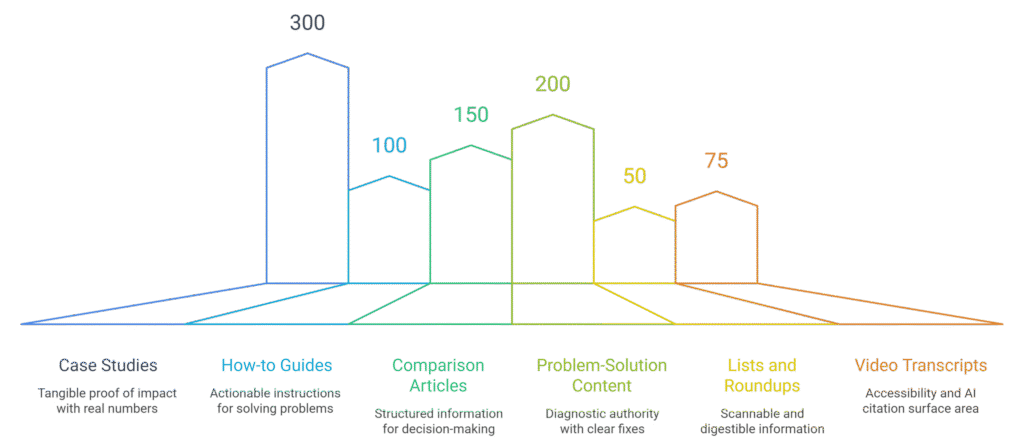
Whatever format you choose, the key is depth and originality. Don’t just rewrite what everyone else is saying. Add your own insights, experiences, and perspective. That’s what separates content that gets cited from content that gets ignored.
How can service businesses in Dubai build authority signals that AI engines recognize?
Authority isn’t just about what you say. It’s about who you are, what you’ve done, and who vouches for you. AI engines evaluate authority through a combination of on-site content, external signals, and reputation markers.
Start with your about page. This is one of the most underrated pages on your website. It should clearly explain who you are, what you’ve accomplished, and why you’re qualified to offer your services. Include team bios, credentials, certifications, awards, and years of experience. If you’ve worked with well-known UAE brands or completed notable projects, mention them.
Client testimonials and reviews are critical. AI engines recognize these as trust signals. Feature them prominently on your site, and make sure they’re specific. Instead of “Great service!” aim for testimonials like “BRB helped us double our Instagram engagement in three months by creating content that actually resonated with our Dubai audience.”
Backlinks from reputable sources still matter, even for GEO. If your business has been featured in Gulf News, Arabian Business, or industry publications, make sure those links are live and prominent. If you’ve published guest articles or been interviewed, showcase that work.
Original research and data are powerful authority builders. If you can publish a report, survey, or analysis that’s relevant to your industry and the UAE market, AI engines will treat it as a valuable source. For example, “2024 Social Media Trends for Dubai Businesses Based on 500 Local Brands” would be a highly citable piece of content.
Authorship also matters. If your team members have bylines on industry blogs, LinkedIn profiles with strong engagement, or speaking credentials at UAE business events, include that information. AI engines are increasingly looking at who wrote the content, not just the content itself.
Structured data and schema markup help too. These are snippets of code that tell AI engines exactly what your content is about. Use schema for FAQs, reviews, services, and local business information. This makes it easier for AI engines to parse and cite your content accurately.
Finally, consistency across platforms strengthens authority. Your website, Google Business Profile, LinkedIn, and other digital touchpoints should all have consistent information about your services, location, and brand. Inconsistencies confuse AI engines and weaken your credibility.
What mistakes do Dubai service businesses make that hurt their GEO performance?
The biggest mistake is creating content that’s too generic. Most businesses write for everyone, which means they resonate with no one. AI engines prioritize specificity, so if your content could apply to any business in any city, it’s not going to get cited.
Another common mistake is keyword stuffing. Some businesses try to force keywords into every sentence, thinking it’ll improve their visibility. It doesn’t. It makes your content awkward and unnatural, and AI engines are trained to detect and deprioritize that kind of writing.
Outdated content is another major issue. If your blog still has articles from 2019 that reference old trends or regulations, AI engines will skip over them. Keep your content fresh, update old posts regularly, and remove anything that’s no longer relevant.
Ignoring mobile optimization is a problem too. Most people in Dubai browse on their phones, and AI engines prioritize content that’s mobile-friendly. If your site is slow, hard to read on mobile, or poorly formatted, you’re losing visibility.
Thin content is another mistake. Publishing short, shallow articles just to fill space doesn’t help. AI engines prefer content that fully explores a topic. If your blog post only scratches the surface, it won’t get cited. Go deep or don’t publish at all.
Over-promoting is a turnoff. If every piece of content is just a sales pitch for your services, AI engines will recognize it as low-value. Your content should educate, inform, and help first. Promotion should be subtle and secondary.
Neglecting user experience hurts too. If your site is cluttered, hard to navigate, or full of pop-ups, visitors will leave quickly. AI engines factor in user behavior signals like bounce rate and time on page. If people don’t stick around, your content won’t get prioritized.
Finally, failing to track and measure results is a missed opportunity. You can’t improve what you don’t measure. Use tools to monitor which content gets cited, which pages get traffic from AI engines, and which queries lead people to your site. Then adjust your strategy accordingly.
Conclusion
Generative Engine Optimization is reshaping how service businesses in Dubai get discovered online. It’s not about gaming the system or chasing algorithms. It’s about creating genuinely useful content that answers real questions, demonstrates real expertise, and reflects a real understanding of your market.
For service businesses in the UAE, the opportunity is massive. The competition is using outdated strategies. They’re still focused solely on SEO, ignoring the fact that their potential clients are getting answers from AI engines without ever clicking through to a website. By optimizing for GEO now, you position your business as the trusted source that gets recommended when it matters most.
Start by understanding the questions your audience is actually asking. Structure your content to answer those questions clearly and completely. Add local UAE context wherever it makes sense. Build authority through case studies, testimonials, and original insights. Keep your content updated, mobile-friendly, and genuinely helpful.
The businesses that win in this new landscape won’t be the ones with the biggest budgets or the flashiest websites. They’ll be the ones that consistently provide value, earn trust, and show up as the answer when someone asks a question in their field.
If you’re ready to make your service business more visible in Dubai’s competitive digital landscape, start optimizing for the way people actually search today. The AI engines are listening. Make sure they’re hearing you.
FAQs
What’s the difference between SEO and GEO for service businesses in Dubai?
SEO focuses on ranking your website in traditional search engine results pages, while GEO focuses on getting your business cited and recommended by AI-powered engines like ChatGPT, Google’s AI Overviews, and Perplexity. SEO drives clicks to your site. GEO positions you as the answer so people trust you before they even visit. For Dubai service businesses, both matter, but GEO is becoming increasingly important as more users rely on AI tools for recommendations.
How long does it take to see results from GEO efforts?
GEO is not an overnight strategy. Most businesses start seeing citations and mentions in AI-generated responses within 3 to 6 months, depending on how competitive their industry is and how consistently they publish optimized content. The key is to keep creating high-quality, question-focused content that addresses real user intent. The more authoritative and specific your content, the faster AI engines will recognize and cite you.
Can small service businesses in Dubai compete with larger agencies using GEO?
Absolutely. GEO levels the playing field because it rewards relevance, authority, and helpfulness over budget size. A small business that consistently publishes deeply useful, locally relevant content can outperform a larger agency that’s relying on generic, outdated content. Focus on your niche, answer specific questions your audience asks, and demonstrate real expertise in the Dubai market. That’s how you win.
Do I need to hire a GEO specialist or can I do this myself?
You can start implementing GEO strategies for service businesses in dubai yourself if you’re willing to learn and invest time. The basics involve understanding your audience’s questions, structuring content around those questions, and building authority through case studies and local relevance. However, if you want faster, more strategic results, working with a digital marketing agency that specializes in GEO, like BRB, can save you time and help you avoid common mistakes.
What tools can help track GEO performance for my business?
Currently, there aren’t as many dedicated GEO tracking tools as there are for SEO, but you can monitor performance by tracking direct traffic, branded search volume, referral sources, and mentions of your business in AI-generated responses. Tools like Google Search Console, SEMrush, and Ahrefs can help you see which queries lead to your site. You can also manually test by asking questions in ChatGPT, Perplexity, and other AI engines to see if your business gets cited.
Is it worth optimizing older blog posts for GEO or should I just focus on new content?
Both. Updating older posts is one of the fastest ways to improve GEO performance because those posts may already have some authority and backlinks. Go through your existing content, identify posts that answer common questions, update them with current information and local UAE context, and restructure them with clear question-based headings. At the same time, keep publishing new content to expand your reach and authority. A mix of both strategies works best.