
Something fundamental changed in how people search for information, and most businesses in the UAE haven’t noticed yet. Your potential customers aren’t typing queries into Google anymore, at least not the way they used to. They’re having conversations with ChatGPT. They’re asking Perplexity for recommendations. They’re trusting AI Overviews that appear before any traditional search results.
This isn’t a minor trend. It’s a complete restructuring of search behavior that’s happening faster in markets like Dubai and Abu Dhabi than almost anywhere else globally. The UAE has some of the highest AI adoption rates worldwide, and your customers are already using these tools to research services, compare providers, and make purchasing decisions. If your business isn’t visible in these AI-powered conversations, you’re becoming invisible to an increasingly large segment of your market.
The businesses that recognize this shift now and adapt their digital presence accordingly will capture disproportionate market share over the next two years. Those that wait will find themselves competing for a shrinking pool of traditional search traffic while watching competitors dominate AI-driven discovery. This article explains exactly what’s changing, why it matters specifically for UAE businesses, and what you need to do about it.
What’s actually happening to search behavior in 2026?
The data tells a clear story. Conversational AI tools processed over 100 billion queries in 2025, and that number is projected to triple in 2026. More significantly, the type of queries moving to AI platforms represents the highest-value searches: detailed research questions, service comparisons, solution recommendations, and buying guidance.
People still use Google for simple navigational searches. If they want to find your website directly or check your business hours, they’ll type your name into a search bar. But when they’re researching which digital marketing approach works best for their industry, or comparing web development options, or trying to understand complex services, they’re increasingly turning to AI tools that provide comprehensive, synthesized answers rather than forcing them to click through ten different websites.
This shift is particularly pronounced among decision-makers and business buyers, the exact audience most UAE service companies need to reach. A business owner researching marketing strategies doesn’t want to read eight blog posts with conflicting advice. They want a clear, consolidated answer that addresses their specific situation. AI tools provide that experience, which is why adoption is accelerating.
For service businesses, this creates an urgent visibility problem. You might rank perfectly on traditional Google searches, but if prospects never make it to Google because they’re getting their answers from ChatGPT, your rankings become increasingly irrelevant. The traffic doesn’t disappear overnight, but it erodes steadily month after month as more people default to AI tools for research and discovery.
Why is this shift happening faster in the UAE than other markets?
The UAE’s technology adoption curve has always been steep. From smart city initiatives to digital government services, the market embraces new technology faster than most regions globally. The same pattern is playing out with AI search tools.
Several factors accelerate this trend specifically in Dubai, Abu Dhabi, and other UAE markets. First, the business community here is internationally connected and tech-savvy. Decision-makers are exposed to global best practices and adopt productivity tools quickly when they see clear benefits. AI assistants that save time and provide better information fit that criteria perfectly.
Second, the multilingual nature of the UAE market makes AI tools particularly valuable. ChatGPT and similar platforms handle queries in Arabic and English seamlessly, often providing better synthesized answers than traditional search results that might be fragmented across languages. This linguistic flexibility increases adoption among both local and expatriate communities.
Third, the premium service economy that dominates UAE business means buyers are researching high-value, complex purchases where AI’s ability to provide detailed, contextual answers offers significant advantage over traditional search. Someone researching a AED 50,000 web development project wants comprehensive guidance, not just a list of potential vendors.
The practical result is that UAE businesses face this transition earlier and more intensely than competitors in slower-adopting markets. That’s simultaneously a challenge and an opportunity. The businesses that master AI search optimization agency in Dubai strategies now will establish advantages that become increasingly difficult for competitors to overcome as the market matures.
How do people actually use AI tools differently than Google?
The behavioral difference is profound. Traditional search is transactional: you input keywords, scan results, click a link, evaluate the page, often go back and try another result. It’s a hunt for information across multiple sources, with the user doing the synthesis work.
AI search is conversational: you ask a question in natural language, receive a comprehensive answer, ask follow-up questions, and refine the response until you have exactly the information you need. The AI does the synthesis work, pulling from multiple sources to construct a unified answer tailored to your specific query.
This changes what “finding” a business means. In traditional search, being found meant ranking on the results page for relevant keywords. In AI search, being found means being mentioned, cited, or recommended in the AI’s response. Your visibility depends not on where you rank in a list, but on whether the AI considers you authoritative enough to include in its answer.
Consider a practical example relevant to UAE businesses. Someone researches “how to improve lead generation for my Dubai consultancy.” In traditional Google search, they’d see ten blue links to various blog posts, maybe some ads, and they’d need to visit multiple sites to piece together an answer. With ChatGPT, they receive a comprehensive response covering content strategy, platform selection, conversion optimization, and implementation steps, potentially with specific recommendations or citations to authoritative sources.
If your business provides these services but isn’t structured as an authoritative source the AI can cite, you’re invisible in that conversation. The prospect receives valuable guidance but never encounters your brand. They might eventually search for specific providers, but by that point, they’ve already formed opinions about the best approach, potentially based on methodologies your competitors are known for rather than your unique approach.
What makes AI engines decide which businesses to recommend?
AI recommendation logic differs fundamentally from search engine ranking algorithms. Google’s algorithm evaluates hundreds of technical and content factors to determine relevance and authority for specific keywords. AI engines evaluate conceptual authority: how comprehensively and accurately you’ve covered topics, how clearly you’ve defined concepts, and how well your content serves as a citeable source.
Several factors drive AI citation decisions. Content depth matters significantly. Superficial coverage of topics won’t generate citations. The AI looks for thorough explanations, clear frameworks, specific examples, and detailed guidance that it can extract and repurpose in its responses. A 600-word surface-level article about conversion optimization loses to a 2,000-word comprehensive guide every time.
Structural clarity is equally important. AI tools parse content programmatically, looking for clear sections, well-defined concepts, and logical information architecture. Content that rambles, uses ambiguous language, or buries key information in dense paragraphs is harder for AI to extract and therefore less likely to be cited. The businesses winning AI visibility are those structuring content explicitly for machine parsing while maintaining human readability.
Originality and unique perspective create lasting competitive advantage. AI engines are trained to synthesize information from multiple sources, but they prioritize sources that offer distinctive insights, proprietary frameworks, or original research. Generic content that repeats common industry advice blends into the background. Content that introduces new concepts, challenges conventional thinking, or provides data-driven evidence stands out.
For businesses wondering what is generative engine optimization and how does it work, the answer lies in creating content that meets these AI evaluation criteria systematically. It’s not about tricking algorithms or gaming systems. It’s about becoming genuinely authoritative in your domain in ways that both humans and AI engines can recognize and value.
What specific content changes help businesses appear in AI responses?
The content that succeeds in AI environments follows patterns that many traditional SEO-focused businesses haven’t adopted yet. First, entity-based writing matters more than keyword-based writing. Define every concept, service, and term explicitly. Don’t assume the reader or the AI understands what you mean by industry jargon or service categories. Clarity and specificity win.
Second, your content structure must facilitate extraction. Use question-based H2 headings that mirror real user queries. Break complex topics into discrete, well-labeled sections. Include concrete examples with specific details rather than vague generalizations. Make it easy for an AI to identify the core information in any section and extract it cleanly.
Third, answer density beats word count. A 1,200-word article that directly addresses six specific questions with clear, actionable answers outperforms a 3,000-word piece that meanders through generic advice. Every paragraph should deliver value. If a section doesn’t add new information or deeper insight, cut it.
Fourth, incorporate structured data and schema markup from the start. These technical elements tell AI engines exactly what your content represents: service descriptions, how-to guides, comparison articles, or case studies. Without schema, AI tools must infer your content’s purpose, which reduces citation accuracy and frequency.
For service businesses specifically, this means rethinking your entire content approach. Your service pages shouldn’t just list what you offer. They should explain why it matters, how it works, what outcomes clients can expect, and how your approach differs from alternatives. If you’re exploring this further, we’ve covered this in detail here: how to optimize website content for AI-powered search.
How does this affect different types of UAE businesses differently?
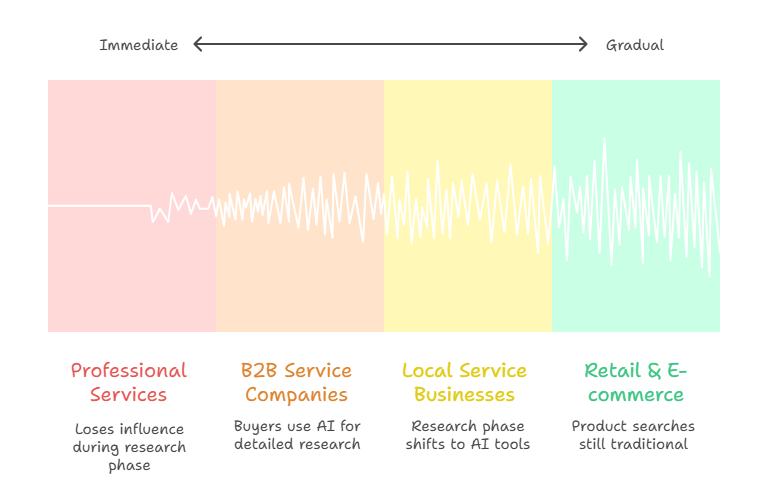
The impact varies significantly across industries and business models. B2B service companies face the most immediate disruption because their buyers use detailed research processes where AI tools excel. A business researching web development agency in Dubai options will likely consult AI tools for guidance on technology stacks, cost expectations, and vendor selection criteria before ever visiting individual agency websites.
Retail and e-commerce businesses experience different dynamics. Product searches still happen primarily through traditional platforms because Google Shopping, Amazon, and other marketplace tools dominate that behavior. However, product research and comparison queries are moving to AI, particularly for complex or high-value purchases.
Local service businesses with physical locations maintain some insulation because “near me” searches and map-based discovery still default to traditional tools. But even here, the research phase is shifting. Someone might use ChatGPT to understand what makes a quality service provider, then use Google Maps to find local options that match those criteria.
Professional services, consulting firms, and specialized agencies face the highest urgency. These businesses depend on being discovered during the research phase when prospects are still forming opinions about what solutions they need. If AI tools are answering those foundational questions without mentioning your business, you’re losing influence over the buyer’s journey at its most critical stage.
The common thread across all industries is that businesses with concentrated expertise in specific domains have natural advantages. A company trying to be everything to everyone struggles to build the focused authority AI engines prioritize. A company that dominates one or two specific service areas can establish citeable expertise that AI tools recognize and reference consistently.
What happens to businesses that ignore this transition?
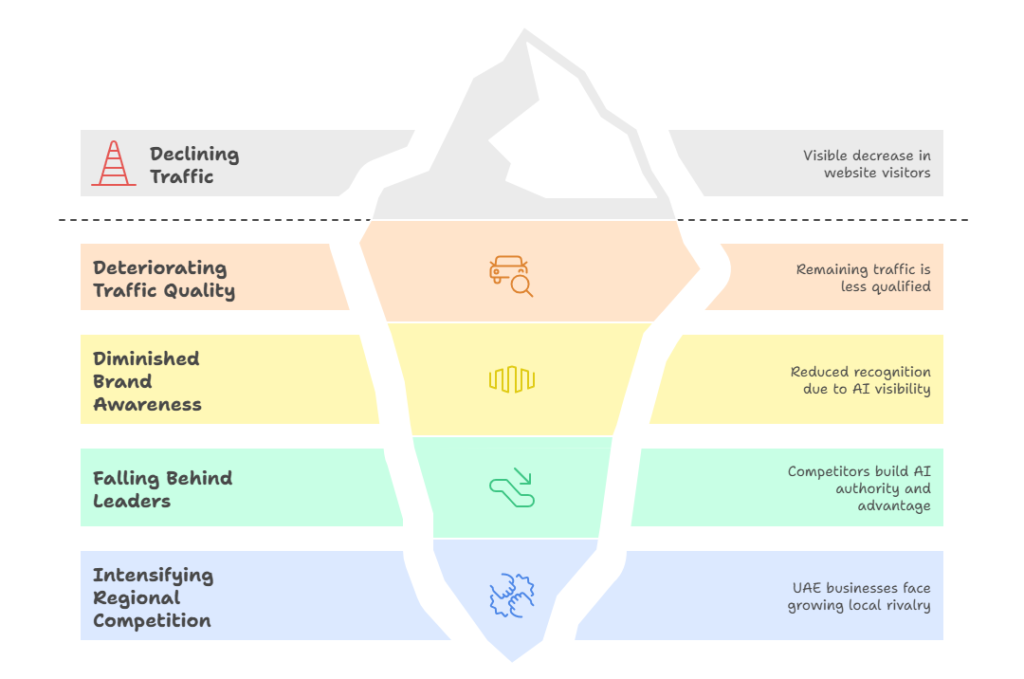
The decline isn’t immediate or dramatic, which is why many businesses don’t recognize the threat until it’s difficult to reverse. You won’t wake up one day with zero traffic. Instead, you’ll notice organic search traffic declining by 5% one quarter, 8% the next, 12% after that. Each individual drop seems manageable, possibly attributable to seasonality or algorithm updates, but the cumulative effect over twelve to eighteen months is severe.
More insidiously, the quality of traffic that remains often deteriorates. As informed, research-intensive prospects move to AI tools, the traffic still coming through traditional search skews toward less qualified leads: bargain hunters, tire kickers, and people too late in their buying journey to consider alternatives. Your cost per acquisition increases because you’re competing for a smaller pool with everyone else experiencing the same decline.
Brand awareness suffers in ways that are hard to measure directly. When prospects research solutions using AI tools that never mention your business, you don’t just lose that immediate opportunity. You lose the cumulative brand recognition that comes from appearing in multiple research contexts. Competitors optimized for AI visibility build recognition and credibility with prospects you never even knew existed.
The strategic danger is falling behind established category leaders who are building AI authority now. Just as early SEO dominance compounded over time, creating difficult-to-overcome advantages, early GEO authority will compound similarly. The businesses establishing themselves as the definitive sources AI engines cite will be progressively harder to displace as their authority grows.
For UAE businesses specifically, this matters because regional competition is intensifying. Markets in Dubai and Abu Dhabi are sophisticated enough to attract strong local competitors but not so saturated that new entrants can’t establish position. The window for capturing AI authority at reasonable competitive intensity is open now but won’t stay open indefinitely.
What’s the minimum viable response for businesses with limited resources?
Not every business can afford comprehensive digital transformation immediately. The good news is that strategic, focused improvements deliver meaningful results even with constrained budgets. Start with your highest-value service or product category. Don’t try to optimize everything at once.
Create one exceptionally authoritative piece of content for that core offering. Not a 500-word blog post, but a comprehensive 2,000 to 3,000-word guide that definitively answers every question prospects ask about that topic. Structure it clearly with question-based headings. Define all concepts explicitly. Include specific examples with real numbers and outcomes. Add schema markup to help AI engines understand its structure.
Next, audit your existing service pages and rewrite them with entity clarity. Make sure every service is clearly defined: what it is, who it’s for, how it works, what outcomes clients can expect, and why your approach matters. Remove vague marketing language and replace it with specific, concrete descriptions.
Third, claim and optimize every platform where AI tools gather data: Google Business Profile, LinkedIn, industry directories, review sites. Ensure your information is consistent, comprehensive, and includes detailed service descriptions. These profiles feed into the knowledge base AI engines use when evaluating businesses.
Fourth, monitor your appearance in AI responses monthly. Query ChatGPT, Perplexity, and Google’s AI Overviews with the questions your customers ask. Track whether you’re mentioned, how you’re described, and what competitors appear alongside you. This qualitative tracking reveals your AI visibility trajectory before it shows up in analytics.
Even this focused approach requires sustained effort over six to twelve months, but it’s achievable for small businesses without dedicated marketing teams. The key is concentration: deep authority in one area beats shallow presence across many areas.
How should marketing budgets shift to address this change?
The businesses adapting most successfully aren’t abandoning traditional channels but are systematically reallocating resources toward AI-optimized content and authority building. A practical framework for most UAE SMBs might allocate 30% of digital marketing budget to traditional SEO and paid search, 40% to content and authority building optimized for AI, and 30% to social media and direct engagement.
That 40% AI-focused allocation funds several initiatives. Content creation becomes more strategic and less volume-driven. Instead of publishing twenty mediocre blog posts monthly, you produce four to six exceptional pieces quarterly, each thoroughly researched and comprehensively structured. Quality over quantity becomes operational reality, not just aspiration.
Technical optimization receives increased investment. Schema markup implementation, site structure improvements, entity optimization, and internal linking strategy all require expertise that most businesses don’t have in-house. Budget for either training existing team members or working with specialists who understand both traditional SEO foundations and emerging GEO requirements.
Authority building through strategic partnerships, guest contributions, and earned media becomes more important. AI engines don’t evaluate businesses in isolation. They assess what others say about you, where you’re cited, and whether industry authorities reference your work. Building this external validation requires dedicated effort and often some budget for relationship development and content distribution.
The reallocation doesn’t mean abandoning paid advertising or traditional SEO. Those channels still deliver results. But their effectiveness is declining gradually while AI-optimized approaches are gaining effectiveness. The businesses that shift budget proactively rather than reactively position themselves ahead of competitive pressure.
What role does brand building play in AI search visibility?
Brand strength matters more in AI search than it did in traditional SEO. Google’s algorithm could elevate relatively unknown websites based purely on technical optimization and backlink profiles. AI engines prioritize established, recognized brands because they’re trained to provide reliable information, and brand recognition serves as a trust signal.
This creates both challenges and opportunities for UAE businesses. Established brands with existing recognition have natural advantages, but smaller businesses can build concentrated brand authority in specific niches faster than they could achieve broad market recognition. A specialized GEO services for UAE businesses provider can establish category authority more easily than a generalist marketing agency trying to be known for everything.
Brand building for AI visibility requires consistent messaging across all digital properties. Your website, social profiles, directory listings, guest articles, and interview appearances should reinforce the same core expertise and value proposition. AI engines synthesize information from multiple sources, and consistent messaging across those sources strengthens the algorithms’ confidence in your authority.
Thought leadership content becomes more valuable than promotional content. AI tools don’t cite advertisements or sales pages. They cite educational content, research, frameworks, and insights that help users understand topics better. The businesses investing in genuine thought leadership build citeable authority that promotional content never achieves.
Strategic PR and media coverage accelerate brand recognition in AI systems. When reputable publications mention your business or cite your expertise, that validation enters the corpus of information AI engines train on. One feature in a respected industry publication can do more for AI visibility than dozens of self-published blog posts.
How long does it realistically take to see results from these changes?
Expectations need calibration. AI authority builds more slowly than paid advertising delivers results but faster than traditional SEO typically showed meaningful movement. Most businesses implementing comprehensive strategies see initial indicators within two to four months: occasional mentions in AI responses, small increases in branded search volume, and qualitative improvements in how AI tools describe their services.
Substantial results typically emerge between six and twelve months. By this point, businesses with strong implementation should see consistent citations in AI responses for their core topics, measurable increases in branded traffic, and improved lead quality from prospects who’ve researched using AI tools before making contact.
Full category dominance takes twelve to eighteen months for most competitive markets. This is the stage where AI tools begin recommending your business by name when users ask for provider recommendations, where you appear in multiple contexts across different query types, and where your authority becomes self-reinforcing through recognition and external citations.
These timelines assume consistent, strategic execution. Sporadic effort produces sporadic results. The businesses seeing fastest progress treat AI optimization as a sustained strategic initiative, not a one-time project. They allocate resources consistently, measure progress systematically, and refine their approach based on what’s working.
For UAE businesses specifically, the competitive landscape currently works in your favor. Many local competitors haven’t recognized this shift yet, creating opportunity for early movers to establish positions that become progressively harder to challenge. The businesses that wait another year will face much more competitive environments and longer timelines to achieve meaningful visibility.
Frequently Asked Questions
Why are people switching from Google to AI tools for business research?
The fundamental reason is efficiency and quality of answers. Traditional search requires users to evaluate multiple sources, synthesize conflicting information, and piece together comprehensive understanding themselves. AI tools do that synthesis work, providing consolidated answers that address specific situations directly. For business buyers researching complex services or evaluating strategic options, this saves hours of research time while often delivering better-informed answers than they could construct independently. The behavior shift accelerates as AI tools improve and as users experience the superior research efficiency these platforms provide.
Does this mean Google is becoming irrelevant for business marketing?
Not at all. Google remains dominant for navigational searches, local discovery, and direct information seeking. What’s changing is that informational and research queries, particularly complex ones, are migrating to AI platforms. Businesses still need strong Google presence for when prospects know what they’re looking for and are ready to engage. But the earlier research phase, where prospects form opinions about what solutions they need and which providers might be best, is increasingly happening through AI tools. Effective digital strategy requires optimization for both traditional search and AI platforms.
How much does it cost for a UAE business to optimize for AI search?
Investment varies significantly based on current digital presence and competitive positioning. Basic optimization, including technical improvements and content restructuring for existing pages, might cost AED 20,000 to 40,000 as a one-time project. Comprehensive ongoing strategies involving new authoritative content creation, technical maintenance, and systematic authority building typically require AED 8,000 to 20,000 monthly. However, unlike paid advertising that stops working when spending stops, AI authority compounds over time. After the initial twelve to eighteen month investment period, maintenance requirements and costs decrease while results continue improving.
Can small businesses with limited budgets compete in AI search?
Yes, but the strategy must be focused rather than broad. Small businesses can’t compete across all topics simultaneously, but they can establish concentrated authority in specific niches. Choose one or two core services or topics where you have genuine expertise. Create exceptionally thorough, well-structured content on those specific areas. Optimize your technical infrastructure properly. Build consistent brand messaging across all platforms. This focused approach allows smaller businesses to achieve AI visibility in their specific domains even while larger competitors dominate broader categories. The key is depth in narrow areas rather than shallow presence across many areas.
How do I track if my business is appearing in AI search results?
Direct monitoring remains the most reliable method currently. Regularly query ChatGPT, Perplexity, Claude, and Google’s AI Overviews using the exact questions your target customers ask. Document when your business is mentioned, how it’s described, and what competitors appear alongside you. Track branded search volume in Google Analytics as a secondary indicator, since AI citations often drive awareness that leads to direct searches for your business name. Monitor referral traffic from AI platforms when identifiable. Several specialized tracking tools are emerging, though the field is still developing. Manual testing combined with branded search monitoring provides the clearest picture of your AI visibility trajectory.
What happens if AI tools provide incorrect information about my business?
This is a legitimate concern. AI models occasionally generate inaccurate or outdated information, particularly about less well-known businesses or rapidly changing situations. The best defense is ensuring accurate, comprehensive information exists across authoritative sources. Claim and optimize your profiles on major platforms. Publish detailed, clear information on your own website. Engage with industry publications and directories. The more high-quality, consistent information available about your business, the less likely AI tools are to generate inaccurate responses. When inaccuracies do appear, contacting the platform provider with corrections helps, though response times vary. Building strong foundational authority reduces the frequency and severity of these issues significantly.
Adapting to the New Search Reality
The transition from traditional search to AI-mediated discovery isn’t a distant future scenario. It’s happening now, accelerating particularly fast in technology-forward markets like the UAE. The businesses that recognize this shift and adapt their digital strategies accordingly will capture increasing market share as traditional organic traffic continues its gradual decline.
This isn’t about abandoning everything that’s worked before. Your SEO foundations, your paid advertising, your social presence, all these channels remain valuable. But they’re no longer sufficient by themselves. The businesses thriving through this transition are those layering AI optimization on top of their existing strategies, ensuring visibility across both traditional search and AI-powered discovery.
The practical steps are clear: audit your content for entity clarity and structural optimization, create comprehensive authoritative resources for your core offerings, implement proper technical infrastructure, and build consistent brand messaging across all platforms. These changes require investment, but they compound over time in ways that paid advertising never does.
The competitive window is open now but narrowing. As more businesses recognize the importance of AI search optimization, the effort required to achieve prominence increases. The companies establishing authority today will have significant advantages over those who wait. Market leadership in this new environment will go to businesses that act strategically now rather than reactively later.
The search behavior shift is permanent. The only question is whether your business will lead this transition or spend the next several years struggling to catch up while competitors who moved earlier dominate the AI-driven conversations where your customers are making decisions.