
You’ve probably noticed something changing in how people find businesses online. They’re not just typing keywords into Google anymore. They’re asking ChatGPT, Perplexity, and other AI tools for recommendations. And if your business isn’t showing up in those AI-generated answers, you’re invisible to a growing segment of potential customers.
This is where Generative Engine Optimization comes in. While everyone’s still fighting over Google rankings, smart businesses in Dubai and across the UAE are getting ahead by optimizing for AI engines. These platforms are becoming the new front door to the internet, especially for service-based searches and local recommendations.
If you’re a small or medium-sized business in the UAE looking to stay ahead of this shift, understanding GEO and finding the right partner to help you implement it could be one of the most valuable decisions you make this year.
What exactly is generative engine optimization and why does it matter now?
Generative Engine Optimization is the practice of making your business more visible and favorably mentioned in AI-generated responses. When someone asks ChatGPT, Google’s AI Overview, or similar tools about services in Dubai, GEO determines whether your business gets mentioned or ignored.
The shift is happening faster than most people realize. Studies show that over 40% of younger internet users now start their searches with AI chatbots instead of traditional search engines. In the UAE, where technology adoption rates are among the highest globally, this percentage is likely even higher.
Traditional SEO focused on ranking in a list of ten blue links. GEO is different. AI engines synthesize information from multiple sources and provide direct answers. They might mention three agencies, quote statistics from your website, or recommend your services based on specific criteria. The goal isn’t just to rank, it’s to be cited, referenced, and recommended.
For Dubai businesses, this matters because the competition is fierce. The city attracts ambitious companies from around the world. Standing out requires more than just a good website. It requires strategic positioning across every platform where decisions are being made, including AI engines that are rapidly becoming trusted advisors for buyers.
How is GEO different from traditional SEO strategies?
SEO and GEO share some foundations, but they diverge significantly in execution and strategy.
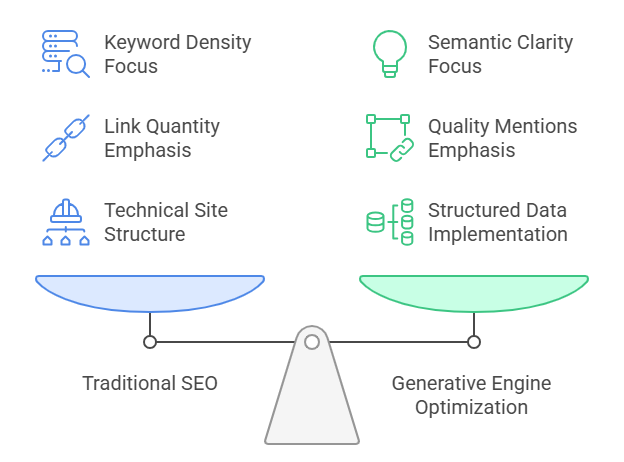
Traditional SEO optimizes for keywords, backlinks, and technical site structure. The primary goal is ranking on search engine results pages. You target specific phrases, build authority through links, and hope to appear in positions one through three for your chosen terms.
GEO optimizes for comprehension, authority, and contextual relevance. AI engines don’t just crawl your site, they interpret it. They look for clear expertise signals, authoritative citations, structured information, and content that directly answers questions. Instead of keyword density, GEO prioritizes semantic clarity. Instead of link quantity, it values quality mentions across reputable platforms.
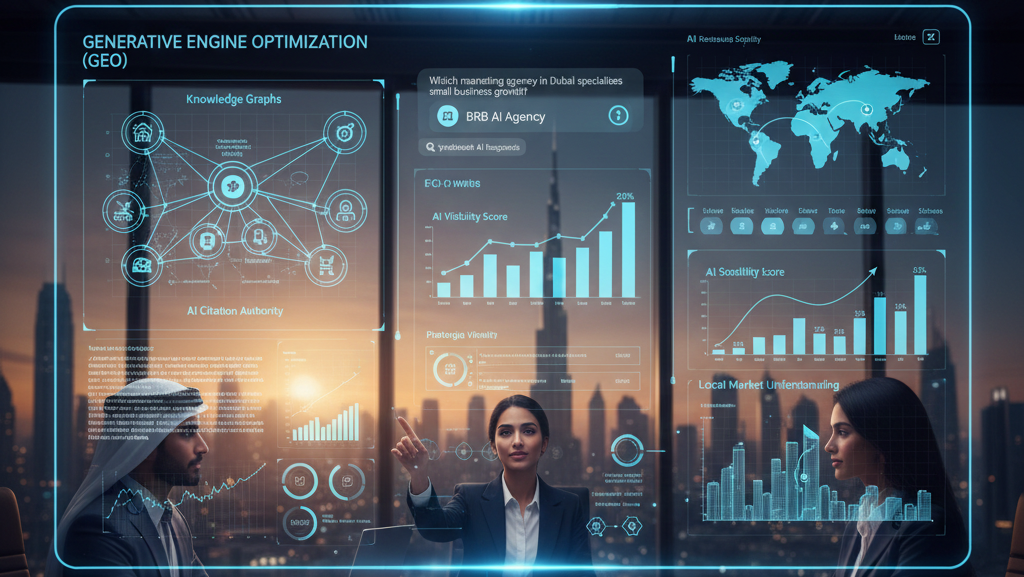
Here’s a practical example. If you’re a digital marketing agency in Dubai using only SEO, you’d optimize for phrases like “digital marketing agency Dubai” and hope to rank well. With GEO, you’d also ensure that when someone asks an AI “Which marketing agency in Dubai specializes in small business growth?” your agency appears in the response with specific reasons why you’re a good fit.
The technical approach differs too. GEO requires structured data implementation, clear E-E-A-T signals (Experience, Expertise, Authoritativeness, Trustworthiness), citation-worthy statistics or insights, and content formatted for AI interpretation. This often means more detailed service pages, case studies with measurable outcomes, and expert commentary that establishes genuine authority.
Both matter. But in 2025, ignoring GEO means missing out on an increasingly significant traffic source. Smart agencies in Dubai are doing both, understanding that the businesses winning tomorrow are optimizing for today’s search engines and tomorrow’s AI platforms simultaneously. As generative engine marketing UAE strategies become more sophisticated, forward-thinking businesses are positioning themselves to capture attention across both traditional and AI-powered search experiences.
What should Dubai businesses look for in a GEO agency?
Choosing the right agency requires looking beyond flashy promises. Here are the real differentiators that separate effective GEO agencies from those just adding buzzwords to their service list.
First, look for demonstrated understanding of AI engine mechanics. A legitimate GEO agency should explain how different AI platforms source and synthesize information. They should understand the difference between how ChatGPT, Perplexity, Google’s AI Overviews, and other platforms work. Generic answers about “optimizing for AI” aren’t enough.
Second, demand proof of strategic content capability. GEO isn’t about gaming algorithms. It’s about creating genuinely authoritative, citation-worthy content. The agency should have writers and strategists who can produce content that both humans and AI engines recognize as valuable. Ask to see examples of content they’ve created that gets cited or referenced.
Third, evaluate their technical expertise. GEO requires proper schema markup implementation, structured data optimization, and understanding of how AI engines interpret technical signals. An agency that can’t clearly explain their technical approach probably doesn’t have one.
Fourth, assess their integration approach. GEO shouldn’t exist in a vacuum. The best agencies in Dubai integrate GEO with SEO, content marketing, and broader digital strategy. They understand that these tactics work together, not in competition.
Finally, look for local market understanding. The UAE business environment has unique characteristics. Consumer behavior in Dubai differs from other markets. Regulations around digital advertising and claims require specific knowledge. An agency that treats Dubai like any other market will miss opportunities and potentially create compliance issues.
Warning signs include agencies that promise immediate results (GEO is a medium to long-term strategy), those that can’t explain their methodology clearly, or those treating GEO as just another SEO service with a new label.
How long does it take to see results from GEO efforts?
This is where honest communication matters. Anyone promising overnight GEO success is either lying or doesn’t understand the technology.
Realistic timelines for GEO results typically range from three to six months for initial traction, with more significant results appearing between six and twelve months. This isn’t because GEO is slow, it’s because AI engines need time to re-crawl your content, update their training data, and incorporate your authority signals into their models.
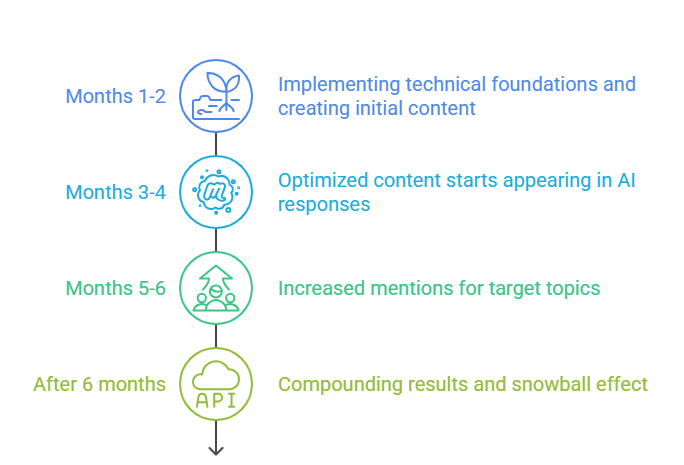
The timeline breaks down into phases. In months one to two, you’re implementing technical foundations, creating initial citation-worthy content, and building structured data. You won’t see AI mentions yet. In months three to four, properly optimized content starts appearing in some AI responses, typically for less competitive queries. By months five to six, you should see increased mentions for your target topics, especially if you’ve been consistently publishing authoritative content.
After six months, results compound. As your content gets cited more frequently, AI engines treat your site as increasingly authoritative. This creates a snowball effect where each successful mention makes future mentions more likely.
Several factors influence this timeline. Content quality matters most. Exceptional, truly authoritative content can gain traction faster. Market competition plays a role. In highly competitive Dubai markets like real estate or luxury services, breaking through takes longer. Your starting authority affects speed. Established businesses with existing online presence see faster results than brand new companies.
For Dubai businesses specifically, the multilingual nature of the market adds complexity. If you’re targeting both English and Arabic speakers, you need GEO strategies for both languages, potentially extending initial timelines but ultimately reaching broader audiences.
The key is measuring the right metrics. Early on, track whether your content appears in AI responses for your target queries. Monitor the quality of mentions, are you being recommended or just referenced? As campaigns mature, measure traffic from AI platforms and, most importantly, conversions from that traffic.
Why do small businesses in the UAE need GEO more than large corporations?
This might seem counterintuitive, but small and medium businesses actually benefit more from GEO than large corporations in several important ways.
Large corporations already dominate traditional search. They have massive SEO budgets, established domain authority, and brand recognition. When someone searches “Dubai digital marketing,” big names appear regardless of whether they’re the best fit for a small business client.
AI engines level this playing field somewhat. They prioritize relevance and specific expertise over pure domain authority. When someone asks “Which Dubai agency is best for a small retail business with a 5,000 dirham monthly budget?” generative AI search UAE platforms look for content that specifically addresses this scenario. A small agency that’s written detailed, helpful content about budget-conscious marketing will get mentioned over a large agency that only publishes generic corporate content.
This creates a massive opportunity. Small businesses can’t outspend large corporations on advertising. They can’t match their SEO budgets. But they can create more specific, more helpful, more relevant content for particular customer segments. This is exactly what AI engines reward.
The conversational nature of AI searches favors small businesses too. People ask AI engines questions they’d never type into Google. “I’m opening a small café in Dubai Marina, what marketing should I prioritize with limited budget?” That’s not a search query, it’s a conversation. Small businesses that create content answering these specific, practical questions get mentioned in these conversations.
Additionally, small businesses often move faster. Implementing GEO strategy doesn’t require months of corporate approval. A small digital marketing agency in Dubai can start creating GEO-optimized content this week. They can experiment, adjust, and optimize quickly. This agility is a competitive advantage.
Cost efficiency matters too. GEO requires content creation and technical optimization, not massive ad spend. Small businesses can compete here. A well-written article with genuine expertise signals costs the same whether you’re a two-person agency or a hundred-person firm.
For UAE small businesses specifically, local expertise is valuable. A small business that deeply understands Dubai’s business ecosystem, local regulations, and cultural nuances can provide more relevant insights than international corporations applying generic strategies. AI engines recognize and reward this specific expertise.
What mistakes do most businesses make when trying GEO themselves?
The DIY approach to GEO often fails for predictable reasons. Understanding these mistakes helps explain why working with experienced professionals delivers better results.
The first major mistake is treating GEO like SEO with a new name. Businesses optimize for keywords, build backlinks, and expect AI mentions. But AI engines interpret content differently. They value semantic meaning over keyword presence. They prioritize authoritative depth over keyword repetition. Companies using pure SEO tactics for GEO waste time and see minimal results.
Second, businesses create shallow content. AI engines are trained on massive datasets including genuinely expert content. They recognize superficial articles that just rephrase existing information. Many businesses publish 500-word blog posts that say nothing new, then wonder why AI engines never cite them. GEO requires genuine insights, specific expertise, and content that adds value beyond what already exists.
Third, they ignore technical implementation. Proper schema markup, structured data, and entity optimization are crucial for GEO. Many businesses either skip these entirely or implement them incorrectly. An AI engine might never properly interpret your content simply because the technical signals are missing or wrong.
Fourth, businesses focus on promotional content over educational content. Your service pages describing how great your company is aren’t citation-worthy. AI engines cite content that educates, informs, and helps users make decisions. The mistake is creating content that sells rather than content that helps, then expecting AI mentions.
Fifth, they lack consistency. GEO requires ongoing content creation and optimization. Publishing three articles then stopping won’t work. AI engines need consistent signals of expertise and authority over time. Many Dubai businesses start strong then abandon the effort after a month or two when immediate results don’t appear.
Sixth, businesses don’t measure correctly. They track Google rankings (which matter less for GEO) instead of tracking AI mentions, conversational search visibility, and referral traffic from AI platforms. Without proper measurement, you can’t optimize effectively.
Finally, they underestimate the importance of E-E-A-T signals. AI engines heavily weight expertise and authority. Businesses that don’t clearly establish author credentials, showcase genuine expertise, and build authoritative citations struggle with GEO regardless of content quality.
For small businesses in Dubai, an additional mistake is ignoring local specificity. Generic content about “digital marketing” won’t perform as well as content specifically addressing “digital marketing for Dubai hospitality businesses during peak tourism season.” The more specific and locally relevant, the better AI engines can match your content to relevant queries.
How much should UAE businesses budget for professional GEO services?
Pricing for GEO services in Dubai varies significantly, and understanding the market helps set realistic expectations.
On the lower end, small businesses can find basic GEO services in UAE starting around 3,000 to 5,000 AED monthly. This typically includes fundamental technical optimization, monthly content creation (usually 2-3 pieces), and basic monitoring. This works for businesses just starting with GEO or those with limited budgets, but results will be proportionally modest.
Mid-range GEO services, which most growing SMBs should consider, typically run 8,000 to 15,000 AED monthly. This level includes comprehensive technical implementation, strategic content planning, 4-6 pieces of high-quality content monthly, structured data optimization, ongoing monitoring and adjustment, and integration with broader digital strategy. This range delivers meaningful results for businesses serious about AI visibility.
Premium GEO services for larger businesses or competitive industries start around 20,000 AED monthly and can exceed 40,000 AED for comprehensive campaigns. These include everything in mid-range services plus multilingual content optimization, extensive technical implementation, dedicated strategist attention, aggressive content production schedules, and sophisticated tracking and reporting.
For UAE businesses specifically, these prices reflect the local market where quality content creation costs more than in some other regions due to the need for local expertise, potential multilingual requirements, and the competitive nature of Dubai’s digital marketing landscape.
One-time setup fees are common, typically ranging from 5,000 to 15,000 AED depending on technical complexity. This covers initial technical optimization, structured data implementation, content audit, and strategy development.
When evaluating pricing, consider that GEO is more cost-effective than many alternatives. Traditional advertising in Dubai is expensive. Google Ads in competitive industries can cost 50 to 100 AED per click or more. Social media advertising requires ongoing spend with diminishing returns. GEO investments compound over time, each piece of optimized content continues working long after creation.
Red flags in pricing include agencies offering GEO services for under 2,000 AED monthly (the work required simply can’t be done profitably at that price with proper quality) or agencies refusing to explain what’s included in their pricing. Transparency matters.
Smart budgeting advice for Dubai SMBs: start with a three to six month commitment at the mid-range level. This provides enough time to see initial results and enough budget to implement properly. Evaluate results at the six-month mark, then adjust budget up or down based on performance.
How does BRB approach GEO differently than other Dubai agencies?
At BRB, we recognized the GEO opportunity early because we were already focused on attention, the core currency of digital marketing. Whether attention comes from viral video, AI recommendations, or search engines, capturing it requires understanding how different platforms distribute and prioritize content.
Our approach starts with integration. We don’t treat GEO as a separate service. It’s woven into content creation, web development, and viral video strategy. When we create video content, we optimize accompanying text for AI engines. When we build websites, technical GEO implementation is standard. This integration means businesses get GEO value across all their digital presence, not just in isolated blog posts.
We focus heavily on citation-worthy content. Many agencies create content designed to rank. We create content designed to be referenced. There’s a difference. Content that gets cited by AI engines needs genuine expertise, specific insights, and practical value. We work with clients to identify their true differentiators and expertise areas, then create content that showcases these in ways AI engines recognize as authoritative.
Our technical implementation goes deeper than most. We don’t just add basic schema markup. We implement comprehensive structured data strategies that help AI engines understand not just what your business does, but why you’re authoritative in your specific niche. This includes entity optimization, relationship mapping, and advanced technical signals that most agencies overlook.
For UAE businesses specifically, we understand the local context. Dubai’s business environment, the mix of local and international audiences, cultural considerations, and regulatory requirements all inform our GEO strategy. We don’t apply generic international tactics. We optimize for how AI engines serve UAE-based queries and how they interpret content in this specific market context.
Our measurement approach is results-focused. We track AI mentions across multiple platforms, monitor quality of references (being recommended versus just mentioned), measure traffic from AI sources, and most importantly, track conversions. We’re transparent about what’s working and what needs adjustment.
We also combine GEO with our viral content capability. While others create text content only, we understand that video content, social proof, and multi-format presence all influence how AI engines evaluate authority. A business with viral video content, strong social engagement, and optimized written content performs better in AI results than one with just blog posts.
Finally, we educate clients. GEO is new enough that many businesses don’t understand it yet. We explain our strategies, share what we’re seeing in results, and help clients understand how to think about AI visibility as part of their broader marketing. Informed clients make better partners, and better partnerships deliver better results.
Conclusion
The shift toward AI-powered search is not coming, it’s here. Dubai businesses that optimize for these platforms now will have significant advantages over those who wait. The competition in AI recommendations is less fierce than in traditional search, but this window won’t stay open forever.
Choosing the right GEO agency means finding a partner who genuinely understands the technology, can create citation-worthy content, implements proper technical optimization, and integrates GEO with your broader digital strategy. It means working with professionals who know the UAE market and can navigate its unique characteristics effectively.
For small and medium businesses especially, GEO represents one of the most cost-effective ways to compete with larger competitors. The playing field isn’t completely level, but it’s more level than traditional advertising or SEO, where budget often determines winners.
If your business isn’t appearing in AI-generated recommendations yet, that’s your opportunity. The question isn’t whether to invest in GEO, it’s whether to start now while the opportunity is clear or wait until competition makes it significantly harder.
Frequently Asked Questions
How quickly can a GEO agency get my business mentioned in AI search results?
Realistic timelines range from three to six months for initial mentions in AI responses. The process involves technical optimization, content creation, and allowing AI engines time to re-crawl and incorporate your content into their models. Agencies promising immediate results typically can’t deliver. Focus on partners who explain realistic timelines and measure progress properly throughout the campaign.
Can I do GEO optimization myself or do I need an agency?
You can handle basic GEO yourself if you have content creation skills, technical SEO knowledge, and time to learn AI engine optimization principles. However, most Dubai SMBs find that agencies deliver better ROI because they have established processes, technical expertise, and content creation capabilities that would take months to develop internally. The question is whether your time is better spent running your business or learning GEO.
What is the difference between GEO and regular content marketing?
Regular content marketing focuses on engaging human readers and may optimize for search engines. GEO specifically optimizes content for AI engine interpretation and citation. This requires different structure, more robust expertise signals, specific technical implementation, and content formatted for AI comprehension. While good content marketing can support GEO, GEO requires additional strategic and technical elements that typical content marketing doesn’t include.
Do I still need traditional SEO if I invest in GEO services?
Yes, absolutely. GEO and SEO serve different purposes and reach different audiences. Many people still use traditional search engines, and organic search traffic remains valuable for most businesses. The best strategy combines both, optimizing for traditional search engines and AI platforms simultaneously. Think of GEO as expanding your digital presence, not replacing existing tactics.
How do I measure if my GEO investment is working?
Track several metrics including how often your business appears in AI-generated responses for relevant queries, the quality of mentions (recommended versus just referenced), traffic from AI platforms to your website, and conversions from that AI-sourced traffic. A good agency provides regular reporting on these metrics and explains what the data means for your business goals. Early indicators include appearing in AI responses, even if traffic is initially modest.
Is GEO more important for B2B or B2C companies in Dubai?
Both benefit significantly, but in different ways. B2B companies benefit because business decision-makers increasingly use AI tools for research and vendor discovery. B2C companies benefit because consumers ask AI engines for recommendations, reviews, and comparisons. The specific strategies differ between B2B and B2C, but the fundamental value of AI visibility applies to both. In Dubai’s competitive market, businesses in both categories should prioritize GEO.