

When someone asks ChatGPT, “What’s a good digital marketing agency in Dubai?” or “Where can I find web design services in the UAE?” there’s a very real chance your business won’t even be mentioned. And that should worry you.
We’re in the middle of a major shift in how people discover businesses. Traditional search engines are still important, but AI-powered tools like ChatGPT, Perplexity, and Google’s AI Overviews are becoming the new front door to the internet. These platforms don’t just list links anymore. They give direct answers, recommendations, and complete responses without requiring users to click through to websites.
For businesses in the UAE, this changes everything. If your company isn’t being cited by AI engines, you’re invisible to a rapidly growing segment of potential customers. The good news? You can influence what these AI tools say about you. It’s not magic, and it’s not luck. It’s a deliberate strategy called Generative Engine Optimization (GEO), and it’s becoming just as critical as SEO ever was.
This article will show you exactly how to position your business so that when someone asks an AI about your industry, your services, or your location, your name comes up.
What makes AI engines recommend certain businesses over others?
AI engines like ChatGPT don’t browse the web in real time the way you do. Instead, they pull information from massive datasets they were trained on, plus real-time sources when search capabilities are enabled. What matters most is whether your business exists in credible, structured, and accessible places across the internet.
Think of it like this: if a journalist were writing an article about the best marketing agencies in Dubai, they’d look for businesses with strong reputations, clear expertise, and visible proof of their work. AI engines operate similarly. They scan for signals of authority, relevance, and trust.
Here’s what influences their recommendations:
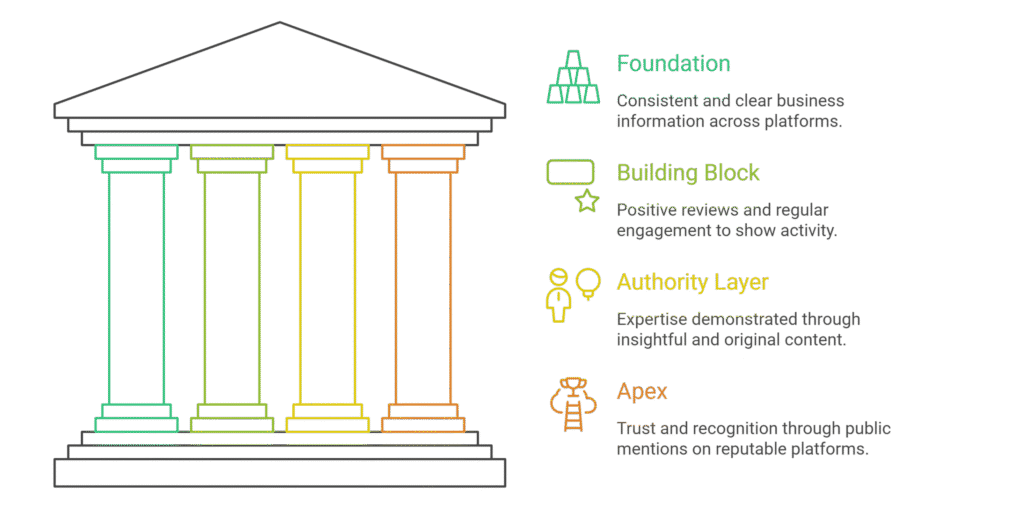
Public mentions across trusted platforms. If your business is cited on reputable websites, industry blogs, news outlets, or business directories, AI engines are more likely to recognize you as legitimate. A single mention on a high-authority site can carry more weight than dozens of low-quality backlinks.
Structured business information. AI tools favor businesses with clear, consistent details across the web. Your name, location, services, and contact information should match everywhere. Inconsistent NAP (Name, Address, Phone) data confuses AI engines just like it confuses search engines.
Content that demonstrates expertise. Publishing insightful, well-researched content signals authority. When you write about your industry with depth and originality, AI engines treat you as a credible source. Generic blog posts won’t cut it. You need to offer perspectives and information that others don’t.
Reviews and social proof. AI engines notice patterns in customer feedback. Businesses with consistent positive reviews across Google, Trustpilot, or industry-specific platforms get weighted more favorably. The volume and quality of reviews matter.
Engagement and activity. Regular updates to your website, active social media presence, and fresh content all indicate that your business is current and operational. Dormant websites raise red flags.
The key takeaway? AI engines reward businesses that look credible from multiple angles. It’s not about gaming a single algorithm. It’s about building a genuinely authoritative online presence.
How can UAE businesses make their information more accessible to AI tools?
Getting mentioned by AI engines starts with making your business easy to find and understand. Many UAE businesses have great services but poor digital foundations. If an AI can’t easily parse who you are, what you do, and where you operate, you won’t get recommended.
Claim and optimize your Google Business Profile. This is non-negotiable. Your Google Business Profile is often the first structured data source AI engines encounter. Make sure your profile is complete with accurate business hours, service areas, high-quality photos, and regular posts. Respond to every review, both positive and negative.
Get listed in reputable business directories. Focus on quality over quantity. Directories like Yelp, Yellow Pages UAE, Bayut (for real estate), and industry-specific platforms carry weight. Make sure your information is identical across all listings. Even small discrepancies can dilute your authority.
Build citations on local and industry-relevant websites. A citation is any online mention of your business name, address, and phone number. Getting cited by UAE business publications, chambers of commerce, or local event pages strengthens your regional relevance. AI engines use geographic signals heavily when making recommendations.
Create detailed service pages on your website. Don’t just list your services. Explain them thoroughly. For example, if you offer social media management, create a dedicated page that covers what’s included, who it’s for, case studies, pricing considerations, and common questions. The more comprehensive your content, the more likely AI engines will reference it.
Use structured data markup (schema). This is technical but important. Schema markup helps AI engines understand your website’s content in a structured way. Implement LocalBusiness schema, FAQPage schema, and Service schema where relevant. Most modern website platforms or plugins can handle this with minimal effort.
Publish on third-party platforms. Write guest articles for UAE business blogs, contribute to industry forums, or get interviewed for podcasts. Every mention on an external, credible platform increases your visibility to AI tools.
For UAE businesses specifically, emphasizing your local presence is crucial. Mention your Emirates location, reference local business challenges, and connect your services to regional needs. AI engines are getting better at understanding geographic context, and being explicitly UAE-focused helps.
Why do citations and authoritative mentions matter more than website traffic alone?
Here’s something most businesses get wrong: they obsess over website traffic but ignore digital authority. High traffic doesn’t automatically make AI engines recommend you. What matters more is who’s talking about you and where.
Traditional SEO focused heavily on driving clicks. The goal was to rank high in search results so people would visit your site. But AI engines don’t send traffic the same way. They synthesize information and deliver it directly. If your business is mentioned in their response, users might not even visit your website. They’ll just contact you based on the recommendation.
This shift means citations, mentions, and authoritative references have become more valuable than ever. When a respected UAE business publication mentions your agency, when a client case study appears on a partner’s website, or when you’re quoted in an industry report, these signals tell AI engines you’re worth recommending.
Quality beats quantity. One mention in Arabian Business or Gulf News carries more weight than 50 mentions on obscure blogs. Focus your effort on getting featured in places that matter. Reach out to journalists, offer expert commentary, and build relationships with industry publications.
Context matters. How you’re mentioned is just as important as where. A casual mention in a list isn’t as powerful as a detailed case study or an in-depth interview. The more context provided around your business, the more useful the information becomes to AI engines.
Consistency reinforces credibility. When the same accurate information about your business appears across multiple trustworthy sources, it creates a pattern AI engines recognize. This is why maintaining consistent NAP data matters so much.
Many UAE businesses still treat link building as a numbers game. They chase backlinks without considering source quality. But in the age of AI-powered search, a single authoritative mention can outperform hundreds of low-quality links. Shift your strategy accordingly.
What content strategies help businesses get cited by ChatGPT and other AI platforms?
Content is still king, but the rules have changed. Writing generic blog posts won’t get you noticed by AI engines. You need to create content that’s authoritative, structured, and directly answers specific questions people are asking.
Answer real questions with depth. AI engines prioritize content that thoroughly addresses user intent. Identify questions your target audience asks and create comprehensive answers. For example, instead of a surface-level post about “digital marketing tips,” write an in-depth guide on “How UAE retail businesses can use Instagram Reels to increase foot traffic.”
Focus on originality and expertise. AI engines are trained to recognize unique insights. Share case studies, proprietary data, or frameworks you’ve developed. If you’re just repackaging information available everywhere else, you won’t stand out. Offer something competitors don’t.
Use clear structure and formatting. Break your content into logical sections with descriptive headings. Use bullet points, numbered lists, and short paragraphs. AI engines parse well-structured content more effectively. FAQ sections are particularly valuable because they match how users ask questions to AI tools.
Write for questions, not just keywords. Traditional SEO targeted keywords like “best marketing agency Dubai.” GEO requires thinking about how people phrase questions to AI: “Which marketing agencies in Dubai specialize in e-commerce?” Structure your content around these natural question patterns.
Include statistics and sources. AI engines favor content that cites credible data. When you reference studies, reports, or statistics, you’re signaling authority. Always link to your sources. This not only strengthens your credibility but also creates connections to other authoritative content.
Publish consistently. Fresh content signals that your business is active and current. Aim for at least one substantial piece of content per month. Updating older content is equally important. Refresh outdated statistics, add new sections, and ensure everything remains accurate.
Create location-specific content. If you’re targeting UAE clients, make your geographic focus explicit. Write about UAE business regulations, local market trends, or regional case studies. This helps AI engines understand your geographic relevance when users ask location-specific questions.
The businesses getting recommended by AI engines aren’t necessarily the ones with the most content. They’re the ones creating the most valuable, authoritative, and well-structured content.
How should businesses handle online reviews to improve their AI visibility?
Reviews are one of the most underrated factors in AI visibility. When someone asks ChatGPT for a recommendation, positive reviews act as social proof that influences whether your business gets mentioned. But simply having reviews isn’t enough. You need the right reviews in the right places.
Focus on Google reviews first. Google remains the most important review platform for most businesses. Actively encourage satisfied customers to leave detailed reviews on your Google Business Profile. The more specific and descriptive the review, the better. Generic “great service” reviews help, but detailed feedback about specific services carries more weight.
Diversify across platforms. Don’t put all your eggs in one basket. Depending on your industry, reviews on Trustpilot, Facebook, or industry-specific platforms matter. For UAE businesses, regional platforms can be just as important as international ones.
Respond to every review. Engaging with reviews, both positive and negative, shows AI engines that your business is active and customer-focused. When responding to negative reviews, be professional, empathetic, and solution-oriented. How you handle criticism speaks volumes about your business.
Encourage detailed feedback. Generic reviews don’t provide much signal. Politely ask customers to mention specific services they used, what problems you solved, and what made their experience positive. Detailed reviews give AI engines more context to work with.
Address consistency. Make sure the services mentioned in your reviews align with what’s on your website. If customers consistently praise your web design work but your website barely mentions it, that’s a missed opportunity. Use review feedback to guide your content strategy.
Don’t buy fake reviews. This should go without saying, but businesses still do it. AI engines and platforms are increasingly sophisticated at detecting fake reviews. Getting caught can destroy your credibility permanently. Focus on earning genuine reviews through excellent service.
Monitor your reputation regularly. Set up alerts for your business name across the web. When you’re mentioned, whether in a review, article, or forum, you want to know about it. This allows you to respond appropriately and address any misinformation quickly.
For UAE businesses, remember that customer expectations around service and responsiveness are high. Building a strong review profile isn’t just about AI visibility, it’s about demonstrating that you consistently deliver quality work.
What technical elements make your website more recognizable to AI engines?
Even the best content won’t help if AI engines can’t properly interpret your website. Technical optimization ensures that when AI tools crawl your site, they understand exactly what you offer and who you serve.
Implement schema markup properly. Schema is structured data that explicitly tells AI engines what different elements of your website represent. Use LocalBusiness schema to identify your company information, Service schema to describe your offerings, and FAQPage schema for your FAQ sections. These tags make your content machine-readable.
Create an XML sitemap. A sitemap helps AI engines understand your site structure and find all your important pages. Submit your sitemap to Google Search Console and keep it updated whenever you add new content.
Ensure mobile optimization. AI engines prioritize mobile-friendly websites because most users access the internet on mobile devices. Your site needs to load quickly and display properly on all screen sizes. Test your site regularly using Google’s Mobile-Friendly Test tool.
Improve site speed. Slow websites get penalized. Compress images, minimize code, use caching, and choose quality hosting. Page speed affects both traditional SEO and how AI engines perceive your site’s quality.
Fix broken links and errors. A website with numerous 404 errors or broken links appears neglected. Regularly audit your site for technical issues and fix them promptly. Tools like Screaming Frog or Google Search Console can help identify problems.
Use descriptive URLs. Your URL structure should be clean and descriptive. Instead of “yoursite.com/page123,” use “yoursite.com/social-media-management-dubai.” This helps both users and AI engines understand page content at a glance.
Optimize for security. HTTPS is now standard. If your site still uses HTTP, switch to HTTPS immediately. Security certificates signal trust to both users and AI engines.
Create comprehensive internal linking. Link related pages within your website. This helps AI engines understand relationships between your content and discover all your important pages. It also keeps users engaged longer.
For UAE businesses, technical optimization is often overlooked in favor of design. But a beautiful website that AI engines can’t properly interpret won’t get you recommended. Invest in both.
How can businesses track whether they are being mentioned by AI engines?
You can’t improve what you don’t measure. Tracking your AI visibility is different from monitoring traditional SEO metrics. You need new tools and approaches to understand how often and where AI engines mention your business.
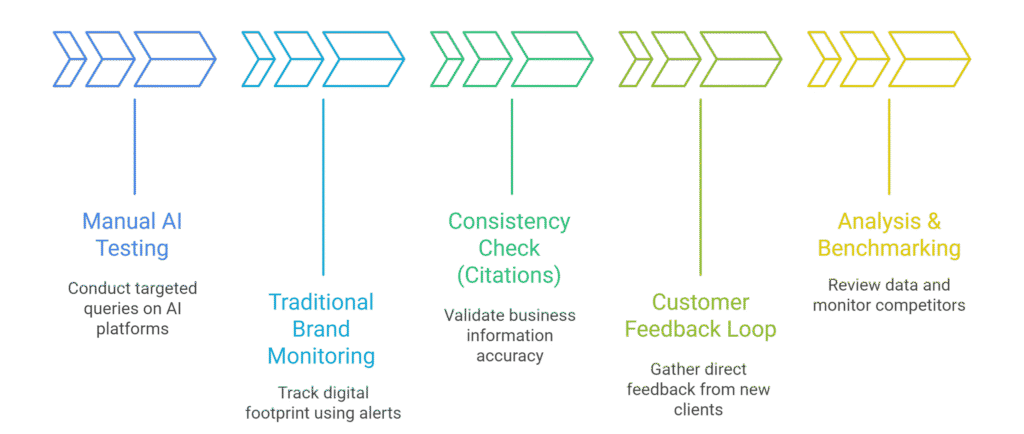
Test manually with targeted queries. Regularly ask ChatGPT, Perplexity, Google’s AI Overviews, and Bing Chat questions your customers might ask. Try different variations like “best marketing agencies in Dubai,” “where can I find web design services in UAE,” or “digital marketing help for small businesses in Abu Dhabi.” Document when and how your business appears.
Set up brand monitoring. Use tools like Google Alerts, Mention, or Brand24 to track when your business name appears online. While these tools primarily track traditional web mentions, they help you understand your overall digital footprint, which influences AI recommendations.
Monitor your citation profile. Tools like Moz Local or BrightLocal help track where your business information appears across the web and whether it’s consistent. Inconsistent citations hurt your visibility.
Track referral traffic sources. Pay attention to where your website traffic comes from. While AI engines don’t always send direct traffic, you might notice referrals from platforms where AI tools cited your content.
Use AI detection tools cautiously. Some emerging tools claim to track AI mentions, but the technology is still developing. Approach these tools with realistic expectations and validate their findings manually.
Survey your customers. Ask new clients how they found you. If they mention using ChatGPT or another AI tool, document it. This qualitative data is valuable for understanding your actual AI visibility.
Monitor competitor mentions. Don’t just track your own business. See how often competitors appear in AI responses. Understanding their strategies can inform your own approach.
Tracking AI visibility is still an evolving practice. There’s no perfect tool yet that captures everything. A combination of manual testing, traditional monitoring tools, and customer feedback gives you the clearest picture. Do this monthly at minimum, weekly if you’re actively working on improving your presence.
What role does social media activity play in getting recommended by AI platforms?
Social media isn’t just for engagement anymore. It’s becoming a significant factor in how AI engines evaluate businesses. Active, authentic social media presence sends signals about your business’s legitimacy and relevance.
Consistency matters more than frequency. You don’t need to post five times a day, but you should maintain a regular presence. Inactive accounts suggest a dormant business. Aim for at least a few quality posts per week across your primary platforms.
Platform choice depends on your audience. For UAE businesses, LinkedIn is crucial for B2B, Instagram works well for visual services and B2C, and Twitter can be valuable for tech and media industries. Focus your effort on platforms where your customers actually spend time.
Engagement signals authenticity. Responding to comments, participating in conversations, and interacting with your community shows AI engines that real people engage with your business. It’s not just about broadcasting messages.
Share your expertise. Use social media to demonstrate thought leadership. Share insights, comment on industry trends, and provide value. When your social content gets shared and referenced, it contributes to your overall authority profile.
Link back to your comprehensive content. Use social media to drive attention to your in-depth blog posts and resources. This creates a bridge between your social presence and your website content, both of which AI engines evaluate.
Maintain consistent branding and information. Your social profiles should match your website and business listings. Same logo, same business description, same contact information. Inconsistencies create confusion.
Build genuine connections with industry accounts. Engage with journalists, publications, and other businesses in your space. These relationships can lead to mentions and citations that boost your AI visibility.
Social media alone won’t get you recommended by AI engines, but it’s an important piece of the puzzle. It demonstrates your business is real, active, and connected to your industry.
Why should UAE businesses start optimizing for AI engines now rather than waiting?
The businesses that start positioning themselves for AI visibility today will have an enormous advantage over those who wait. This isn’t a future concern. It’s happening right now, and the gap between early adopters and laggards is widening quickly. Securing AI Search visibility optimization support UAE can help businesses bridge this gap and ensure they’re not left behind as search behavior continues to evolve.
User behavior is already changing. Millions of people worldwide already use ChatGPT, Perplexity, and other AI tools as their primary research method. This number is growing exponentially. In the UAE, tech adoption rates are among the highest globally. Your potential customers are already using these tools.
First-mover advantage is real. AI engines often develop preferences for businesses they consistently see mentioned across credible sources. If your competitors establish authority first, you’ll have to work harder to catch up. Being early means building a foundation while competition is still light.
The strategies compound over time. Unlike paid advertising where you stop getting results the moment you stop paying, GEO strategies build momentum. Each citation, each piece of authoritative content, each positive review contributes to a growing pattern AI engines recognize. Starting now means you’ll have months or years of compounding authority when your competitors finally catch on.
It’s more cost-effective than traditional advertising. Building AI visibility requires effort, not massive budgets. Small and medium businesses in the UAE can compete effectively with larger competitors by focusing on authoritative content and strategic citations. This levels the playing field in ways that paid advertising never could.
Search is fragmenting. Google’s dominance is declining as users spread across multiple platforms. Optimizing for AI engines means showing up wherever people are looking, not just in traditional search results. This diversification protects your business from over-reliance on any single channel.
UAE’s digital landscape is evolving rapidly. The UAE government’s digital transformation initiatives, smart city projects, and tech-forward policies mean AI adoption will likely accelerate faster here than in many other regions. Businesses that adapt early will be positioned to capitalize on these changes.
The question isn’t whether you should optimize for AI visibility. It’s whether you’ll do it before your competitors do. Every month you wait, they’re building authority you’ll have to overcome.
Conclusion
Appearing in ChatGPT responses and other AI engine recommendations isn’t about tricks or shortcuts. It’s about building genuine digital authority through strategic, consistent effort. The businesses AI engines recommend are the ones with credible citations across the web, structured and comprehensive content, positive reviews, and clear expertise in their field.
For UAE businesses, this represents both a challenge and an opportunity. The challenge is that many local businesses haven’t invested in building this kind of digital foundation. The opportunity is that starting now with AI Search Optimization UAE puts you ahead of most of your competition and positions your brand as a forward-thinking leader in your industry.
The fundamentals haven’t changed: provide excellent service, build real expertise, and communicate clearly about what you do and who you serve. What’s changed is how AI engines evaluate these signals and how people discover businesses. Traditional search isn’t disappearing, but it’s no longer the only game in town.
Start by auditing your current digital presence. Is your business information consistent across the web? Are you creating valuable content that demonstrates expertise? Are you actively building citations and reviews? Are you making your website technically sound and easy for AI engines to understand?
Then commit to consistent improvement. This isn’t a one-time project. It’s an ongoing strategy that compounds over time. The businesses winning with AI visibility aren’t necessarily the biggest or oldest. They’re the ones that recognized the shift early and acted deliberately.
The future of business discovery is already here. The only question is whether you’ll be part of it.
FAQs
How long does it take for a business to start appearing in AI engine responses?
There’s no fixed timeline because it depends on your starting point and how aggressively you implement GEO strategies. Businesses with some existing authority might see mentions within 2-3 months of focused effort. Companies starting from scratch should expect 6-12 months of consistent work before seeing regular AI recommendations. The key is persistence. Each citation, review, and piece of content contributes to a pattern AI engines will eventually recognize.
Do I need to hire an agency to optimize for AI engines or can I do it myself?
You can absolutely do this yourself if you have time and willingness to learn. The fundamentals involve creating quality content, building citations, managing reviews, and ensuring technical optimization. These are learnable skills. However, an experienced agency can accelerate results by knowing exactly which strategies work, having existing relationships with relevant platforms, and handling technical implementation properly. For most small businesses in the UAE, starting with DIY basics and bringing in help for technical aspects offers the best balance.
Will optimizing for AI engines hurt my traditional SEO rankings?
No, they complement each other. The strategies that help AI engines discover and recommend you also strengthen traditional SEO. Quality content, authoritative citations, positive reviews, and technical optimization benefit both. The main difference is emphasis: traditional SEO focuses heavily on keywords and backlinks, while GEO prioritizes structured information, authoritative mentions, and comprehensive expertise. A business can and should optimize for both simultaneously.
What if my competitors are mentioned by AI engines but I am not?
This means they’ve built more recognizable digital authority in areas AI engines value. Research where they’re being cited, what content they’ve published, and what review platforms they’re active on. You’ll likely find they’re doing several things consistently that you’re not. The good news is authority can be built. Focus on creating better content, earning citations from higher-quality sources, and providing exceptional service that generates genuine positive reviews. Consistency beats shortcuts.
Are some industries more likely to be recommended by AI engines than others?
Currently yes, though this is changing rapidly. Industries with clear service definitions, measurable outcomes, and established review cultures see more AI recommendations. This includes restaurants, hotels, software tools, and professional services. However, AI engines are quickly expanding into virtually every sector. Regardless of your industry, the fundamentals remain the same: demonstrate expertise, build authority, and make your information accessible and trustworthy.
Can I pay to be mentioned in ChatGPT responses or other AI tools?
Not directly, and that’s by design. AI engines aim to provide unbiased, helpful recommendations based on actual authority and relevance, not advertising dollars. However, you can invest in the strategies that build that authority: creating exceptional content, earning legitimate citations, generating genuine reviews, and improving your technical presence. These require investment of time and resources, but they’re fundamentally different from paying for placement. Focus on earning your way into AI recommendations rather than trying to buy them.