
If you’ve been following the shifts in digital marketing over the past two years, you’ve probably noticed something significant: people aren’t just searching on Google anymore. They’re asking ChatGPT, Claude, Perplexity, and other AI engines for recommendations, comparisons, and buying advice. For businesses in the UAE, this creates both a challenge and an opportunity.
The challenge? Traditional SEO tactics don’t guarantee visibility in AI-generated responses. The opportunity? Getting cited by these engines can position your brand as a trusted authority in ways that old-school search rankings never could.
But here’s the question everyone’s asking: how long does it actually take to rank on generative AI engines? The answer isn’t as straightforward as “3 months” or “6 months” like traditional SEO timelines. Generative Engine Optimization (GEO) works differently, and understanding the timeline can help you set realistic expectations and build a strategy that actually works.
What does it mean to rank on generative AI engines?
Before we talk timelines, let’s clarify what “ranking” means in this context. When someone asks ChatGPT or Perplexity a question like “best digital marketing agency in Dubai” or “how to improve Instagram engagement for UAE businesses,” these engines don’t show a list of ten blue links. Instead, they generate a conversational response, often citing specific sources, brands, or insights.
“Ranking” in GEO means your business, content, or expertise gets mentioned, cited, or recommended in these AI-generated answers. It could be a direct citation with a link, a mention of your brand name, or your insights being paraphrased as authoritative information.
Unlike traditional search where you either rank or you don’t, GEO visibility exists on a spectrum. You might get cited occasionally for niche queries but not for broader topics yet. Or you might appear in answers from Claude but not ChatGPT. The goal is consistent, relevant visibility across multiple platforms and query types.
How is GEO different from traditional SEO in terms of timeline?
Traditional SEO has fairly predictable patterns. New websites typically take 6 to 12 months to build domain authority and rank for competitive keywords. Established sites can see movement in 3 to 6 months with strong content and backlinks.
GEO operates on different mechanics entirely. AI engines don’t crawl and index the web the same way search engines do. They pull from training data, live web searches, curated databases, and real-time information depending on the platform and query type.
This means a brand new business can potentially get cited by AI engines within weeks if they produce exceptional, authoritative content that gets picked up by the right sources. Conversely, an established brand with good SEO might not appear in AI responses at all if their content isn’t structured or formatted in ways these engines recognize as valuable.
The timeline for GEO depends less on domain age and more on content quality, citation signals, and topical authority. A well-executed GEO strategy can show initial results in 4 to 8 weeks, but building consistent, broad visibility typically takes 3 to 6 months of focused effort.
What factors actually influence how fast you can rank on generative AI engines?
Several variables determine your GEO timeline, and understanding them helps you prioritize your efforts effectively.
Content quality and depth matter enormously. AI engines favor comprehensive, well-researched content that demonstrates genuine expertise. A 2,000-word guide that answers questions thoroughly will outperform ten shallow blog posts every time. For UAE businesses, this means creating content that addresses local market nuances, regulatory considerations, and cultural context that generic international content misses.
Citation signals play a crucial role. When authoritative websites, industry publications, or trusted sources mention or link to your content, AI engines take notice. Getting featured in Gulf News, Arabian Business, or industry-specific publications accelerates your GEO timeline significantly. Building these citations takes time, typically 2 to 4 months of consistent outreach and relationship building.
Structured data and formatting help AI engines understand and extract information from your content. Using proper schema markup, clear headings, concise answers, and logical content hierarchy makes your content more “digestible” for AI systems. This is something you can implement immediately, but the impact compounds over time.
Topical authority develops through consistent publishing on specific subjects. If you publish one article about social media marketing, you’re a casual commentator. If you publish 20 well-researched pieces covering different aspects of social media strategy, platforms, tools, and case studies, you become a recognized authority. Building this authority typically requires 3 to 6 months of focused content production.
Brand mentions and awareness create signals that extend beyond your website. When people discuss your brand on social media, forums, review sites, or in other content, it builds recognition that AI engines can pick up on. For newer brands, this takes time to cultivate, usually 4 to 12 months depending on marketing investment and market penetration.
Can new businesses rank quickly or does it require established authority?
This is one of the most encouraging aspects of GEO: new businesses absolutely can rank on generative AI engines quickly if they approach it strategically.
Unlike traditional SEO where domain age and backlink history create significant barriers, AI engines prioritize content quality and relevance over legacy authority. A startup that publishes genuinely helpful, expert-level content can get cited within weeks, especially for niche or emerging topics where competition is lighter.
The key is focusing on areas where you have legitimate expertise or unique perspective. A new digital marketing agency in Dubai might struggle to rank for “best marketing agency in UAE” immediately, but could quickly establish authority for more specific queries like “TikTok marketing for Dubai restaurants” or “generative AI tools for UAE real estate marketing.”
Real-world example: a Dubai-based SaaS startup we work with began publishing detailed technical guides about their industry in March 2024. By May, ChatGPT was citing their content for specific product-related queries. By July, they were getting mentioned for broader industry topics. They had zero traditional SEO authority when they started, but they had genuine expertise and created content that demonstrated it clearly.
The timeline for new businesses typically looks like this:
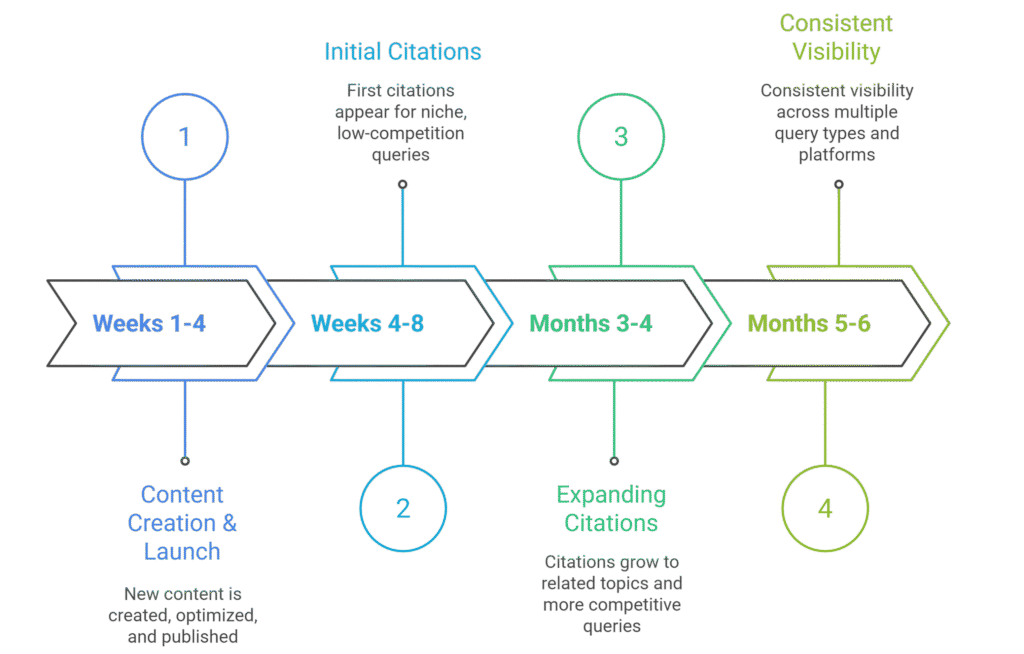
This assumes consistent, high-quality content production and proper optimization throughout the process.
Which AI platforms should UAE businesses focus on first?
Not all AI engines are created equal, and they don’t all pull information the same way. Prioritizing your efforts based on platform characteristics can accelerate your results.
ChatGPT is obviously the biggest player with massive user adoption globally and strong usage in the UAE. It pulls from a combination of training data and real-time web search through Bing. Getting cited here requires strong content quality and appearing in authoritative sources that Bing indexes well. Timeline: 6 to 12 weeks for initial citations on niche topics.
Perplexity has been growing rapidly and is particularly popular with research-focused users and professionals. It emphasizes source citation and pulls from real-time web searches. Strong content with clear sourcing and data can get picked up quickly here. Timeline: 4 to 8 weeks for specialized topics.
Claude (the platform you’re using right now) provides detailed, nuanced answers and favors comprehensive, well-structured content. It combines training data with web search capabilities. Timeline: 8 to 12 weeks as it emphasizes depth and authority.
Google’s AI Overview appears at the top of Google search results and represents Google’s entry into conversational AI. Since it’s integrated with Google Search, traditional SEO signals still matter here, but it also requires specific optimization for featured snippet-style content. Timeline: Similar to traditional SEO, 12 to 16 weeks.
For UAE businesses with limited resources, start with ChatGPT and Perplexity. These platforms have the strongest adoption locally, and success on these platforms often translates to visibility on others due to overlapping optimization principles.
How often should you publish content to see results faster?
Consistency matters more than volume, but there are practical thresholds that influence your timeline.
Publishing one piece per month won’t build topical authority quickly enough. You need sustained momentum to signal to both algorithms and human audiences that you’re a serious, active voice in your space.
A realistic content calendar for most SMBs targeting GEO results looks like this:
Minimum viable frequency: 2 comprehensive articles per week (8-10 per month). This establishes you as an active content producer and builds topical coverage steadily. Expected timeline: 5 to 7 months to strong visibility.
Accelerated frequency: 3-4 articles per week (12-16 per month). This creates faster topical authority and increases the chances of citations across multiple query types. Expected timeline: 3 to 4 months to noticeable results.
Aggressive frequency: Daily publishing (20-25 pieces per month). This is what established media brands do, and it delivers the fastest results but requires significant resources. Expected timeline: 6 to 10 weeks to initial citations.
The content type matters as much as frequency. Two 3,000-word comprehensive guides per month might deliver better results than fifteen 500-word blog posts. AI engines favor depth and expertise over surface-level content.
For UAE businesses specifically, consider cultural timing as well. Publishing during Ramadan, major holidays, or around industry events relevant to your market can accelerate visibility if the content aligns with trending queries during those periods.
What are the most common mistakes that slow down GEO results?
Even businesses that invest in content often sabotage their own timeline through avoidable mistakes.
Creating content that’s too promotional is probably the biggest issue. AI engines are designed to provide helpful, objective information. Content that reads like a sales pitch gets ignored. Instead of “Why BRB is the best digital marketing agency in Dubai,” write “How to evaluate digital marketing agencies in Dubai: a comprehensive guide.” The second approach positions you as helpful and expert while still building authority.
Ignoring structured data means AI engines struggle to extract and understand your content properly. Schema markup, clear headings, tables, lists, and logical information architecture aren’t just nice to have, they’re essential for GEO. Businesses that skip this technical foundation add 4 to 8 weeks to their timeline unnecessarily.
Publishing without citation signals limits your content’s reach. AI engines look for validation that your content is trustworthy. This comes from links, mentions, and citations from other authoritative sources. Creating great content but not promoting it, building relationships, or earning backlinks significantly delays results. Budget time for outreach and relationship building as part of your content strategy.
Focusing only on broad, competitive topics early on sets unrealistic timelines. A new business trying to rank for “digital marketing Dubai” faces enormous competition. Starting with more specific angles like “Instagram Reels strategy for Dubai fashion brands” or “LinkedIn marketing for UAE B2B companies” builds authority faster. Once you own the niche spaces, you can expand to broader topics.
Inconsistent publishing breaks momentum. Publishing 10 articles in one month then nothing for two months confuses both algorithms and audiences. Steady, predictable publishing beats sporadic bursts every time.
Not optimizing for multiple AI platforms limits your total visibility. Each platform has slightly different preferences for content structure, sourcing, and depth. Content optimized only for ChatGPT might not perform well on Perplexity or Claude. A comprehensive GEO strategy addresses multiple platforms simultaneously, which doesn’t increase timeline but does increase total citation opportunities.
How can you track and measure GEO progress over time?
Unlike traditional SEO where you can check rankings daily, GEO requires different measurement approaches.
Manual query testing is still the most reliable method. Create a list of 20 to 30 queries relevant to your business and test them weekly across different AI platforms. Document which platforms cite you, how often, and in what context. This gives you direct visibility into your progress.
Example queries for a Dubai digital marketing agency:
- “Best ways to increase Instagram engagement in UAE”
- “How do Dubai businesses use TikTok for marketing”
- “Digital marketing strategies for small businesses in Dubai”
- “What is Generative Engine Optimization”
Track these consistently, and you’ll see patterns emerge around which topics you’re gaining authority in and which need more content investment.
Citation tracking tools are emerging but still limited. Some platforms like Perplexity provide basic analytics if you’re cited. Monitor your referral traffic from AI platforms when possible. Set up Google Alerts for your brand name combined with key topics to catch mentions you might otherwise miss.
Indirect indicators help fill the gaps. Look at increases in branded search volume, direct traffic spikes following new content publication, and engagement metrics on the content itself. While not direct GEO measurements, they correlate with growing authority and visibility.
Timeframe expectations for measurement:
- Weeks 1-4: No measurable results yet; focus on production and optimization
- Weeks 4-8: First citations may appear; start tracking systematically
- Months 3-4: Clear patterns emerge; you can identify which content types work best
- Months 5-6: Consistent citation growth; you can forecast which topics to expand
Most businesses see their first measurable GEO results between week 6 and week 10, assuming they’re publishing quality content consistently and optimizing properly.
What role does traditional SEO play in speeding up GEO results?
There’s significant overlap between effective SEO and GEO, but the relationship isn’t always linear.
Traditional SEO benefits GEO primarily through these mechanisms:
Authority signals: Websites with strong backlink profiles and domain authority tend to get cited more by AI engines because these same signals indicate trustworthiness. Building high-quality backlinks remains valuable for both disciplines.
Content discoverability: AI engines often pull from indexed web content. Strong technical SEO ensures your content gets discovered, indexed, and considered for citations. Basic SEO hygiene (site speed, mobile optimization, proper indexing) supports GEO indirectly.
Structured data overlap: Schema markup benefits both traditional search and AI engine understanding. Implementing comprehensive structured data serves both goals simultaneously.
However, some traditional SEO tactics don’t accelerate GEO at all:
Keyword stuffing actually hurts GEO because AI engines are sophisticated enough to recognize and penalize unnatural language. Write for humans first.
Low-quality backlink volume doesn’t help. AI engines care about citation quality, not quantity. One mention in a respected industry publication matters more than 100 links from low-authority sites.
Over-optimization for specific keywords can make content less natural and less useful, which AI engines penalize.
The ideal approach is integrated optimization that serves both traditional search and generative AI simultaneously. This doesn’t necessarily speed up your GEO timeline, but it ensures you’re not sacrificing one channel for another. Learning how to rank on ChatGPT Dubai searches requires the same foundational content quality and authority that benefits traditional SEO, making it a natural extension of your existing digital strategy rather than a completely separate effort.
Should UAE businesses expect different timelines than international markets?
The UAE market has unique characteristics that can influence GEO timelines in both directions.
Advantages that can accelerate results:
The UAE digital market is relatively concentrated compared to global markets. There are fewer businesses competing for attention in many niches, which means less competition for AI citations in specific industries or topics. A Dubai-based e-commerce consultant, for example, faces less competition for “e-commerce strategy UAE” than they would for “e-commerce strategy” globally.
English-language content dominates business communication in the UAE despite the multicultural population. This creates opportunities because you’re not competing with non-English content that might be cited in other markets.
UAE businesses often have unique perspectives on navigating regional regulations, cultural considerations, and market conditions. This specialized knowledge naturally positions you as an authority for region-specific queries, which AI engines recognize and cite.
Challenges that might extend timelines:
The relatively smaller market size means fewer authoritative local publications to earn citations from. Gulf News, Arabian Business, and a handful of industry publications carry significant weight, but there are fewer tier-two and tier-three publications compared to larger markets like the US or UK.
Some industries in the UAE have limited local content ecosystems. If you’re in a specialized B2B industry, you might need to balance local content with international thought leadership to build sufficient topical authority.
International competition still exists for broader topics. A Dubai agency writing about “social media marketing” competes with global content, not just local competitors.
Realistic timeline expectations for UAE businesses:
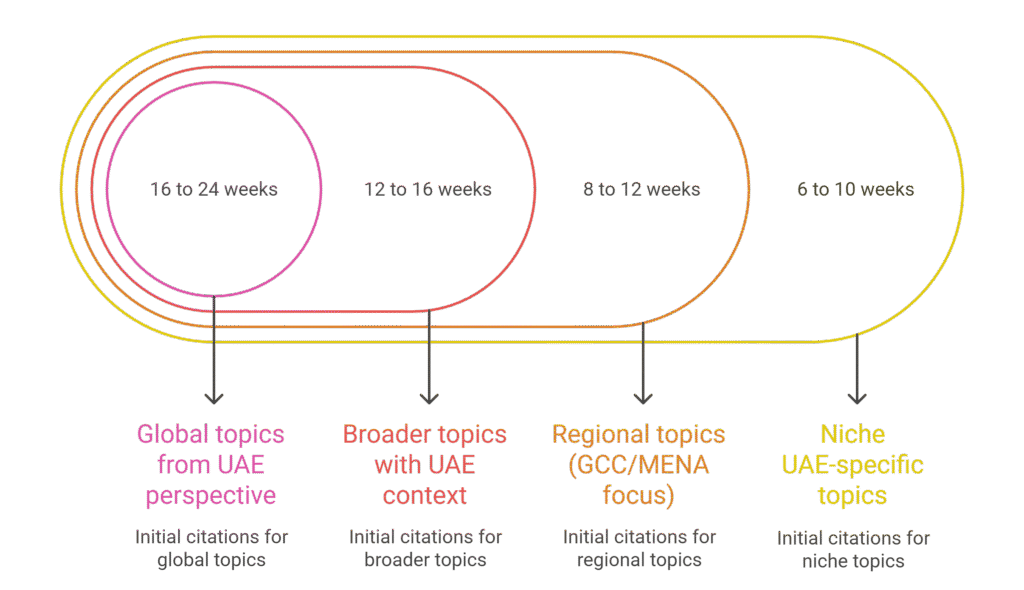
The key is leveraging your local expertise and unique market perspective while building broader topical authority over time.
What’s a realistic GEO strategy for small businesses with limited resources?
Most SMBs in the UAE can’t publish daily or hire large content teams. Here’s a practical, resource-conscious approach that still delivers results.
Month 1: Foundation
- Audit your existing content and identify your top 10 most valuable pieces
- Optimize these thoroughly for GEO (structure, depth, citations, schema)
- Identify 5 niche topics where you have genuine expertise
- Set up tracking systems for key queries
Months 2-3: Focused production
- Publish 2 comprehensive pieces per week on your niche topics
- Each piece should be 1,500+ words, well-researched, and genuinely helpful
- Begin outreach to local industry publications and relevant blogs
- Engage authentically in online communities where your audience gathers
Months 4-5: Expansion and optimization
- Continue publishing 2 pieces per week
- Update and expand successful content from months 2-3
- Begin covering related topics to broaden topical authority
- Pursue guest posting and collaborative content opportunities
Month 6+: Scaling and refinement
- Assess which topics generate citations and double down
- Maintain publishing cadence but focus on proven content types
- Update older content to maintain freshness and relevance
- Consider expanding team or resources based on documented ROI
This strategy requires approximately 15 to 20 hours per week, which a small business can handle with one dedicated team member or through agency partnership. Expected timeline for first citations: 8 to 12 weeks. Consistent visibility across multiple topics: 5 to 6 months.
Conclusion
Ranking on generative AI engines in Dubai doesn’t follow the same predictable timeline as traditional SEO, but it’s not mysterious either. Most businesses see their first citations within 6 to 12 weeks of starting a focused GEO strategy, with consistent broad visibility developing over 4 to 6 months.
The timeline depends heavily on content quality, publication consistency, topical focus, and technical optimization. New businesses can absolutely compete effectively without waiting years to build domain authority, but they need to produce genuinely expert content and optimize it properly for AI engines.
For UAE businesses, the market conditions create both opportunities through lower local competition and challenges through fewer regional citation sources. The key is leveraging unique local expertise while building broader authority strategically.
Success in GEO requires patience, consistency, and a commitment to creating genuinely valuable content. It’s not a quick fix, but businesses that invest properly are building visibility on platforms that will dominate how people find information for years to come.
If you’re ready to start building your GEO strategy but not sure where to begin, BRB specializes in helping UAE businesses navigate this transition. We handle everything from content strategy to technical optimization, letting you focus on running your business while we build your visibility on the platforms that matter most.
FAQs
How long before I see any results from GEO efforts?
Most businesses see their first citations from AI engines within 6 to 10 weeks of starting a focused GEO strategy, assuming they’re publishing high-quality, optimized content consistently. Initial results usually appear for niche, specific queries before expanding to broader topics. The timeline accelerates significantly if you already have strong content and domain authority.
Is GEO faster than traditional SEO for new websites?
Yes, typically. New websites often need 6 to 12 months to rank well in traditional search due to domain age and backlink requirements. With GEO, a new site can get cited within 8 to 12 weeks if the content demonstrates genuine expertise and is properly optimized. AI engines prioritize content quality and relevance over domain history.
Can I speed up my GEO timeline by publishing more content?
Publishing frequency matters, but quality is more important than volume. Publishing 2 comprehensive, well-researched articles per week will deliver better results than publishing 10 shallow pieces. That said, consistent publishing does accelerate results. Businesses publishing 3 to 4 quality pieces weekly typically see citations 4 to 6 weeks faster than those publishing weekly.
Do I need to optimize for all AI engines at once or can I focus on one?
You can start with one or two platforms, but the optimization principles overlap significantly. Content that works well for ChatGPT typically performs well on Perplexity and Claude too. Starting with ChatGPT and Perplexity makes sense for UAE businesses since these have the strongest local adoption. You can expand to other platforms once you’ve established authority.
How do I know if my GEO efforts are actually working?
Track specific queries related to your business across different AI platforms weekly. Create a list of 20 to 30 relevant questions and test them systematically. You should start seeing occasional citations within 6 to 8 weeks, with more consistent mentions developing by month 4. Also monitor referral traffic from AI platforms and branded search volume increases as indirect indicators.
What if I have good SEO rankings but no GEO visibility?
This is common because the optimization requirements differ. Traditional SEO content often lacks the depth, structure, and conversational quality that AI engines prefer. Audit your top-ranking pages and enhance them with more comprehensive information, better structure, clearer answers to specific questions, and proper schema markup. You should see GEO citations begin appearing within 4 to 8 weeks of these updates.