If you’ve been paying attention to digital marketing trends in 2024-2025, you’ve probably heard the term “GEO” thrown around. No, we’re not talking about geography or geological surveys. We’re talking about Generative Engine Optimization, and if you run a business in the UAE or anywhere else, this is something you need to understand right now.
Here’s why: the way people search for information is fundamentally changing. Instead of typing keywords into Google and clicking through ten blue links, millions of users are now asking questions to ChatGPT, Claude, Perplexity, Google’s AI Overviews, and other AI-powered search tools. And these tools don’t just show you websites, they generate complete answers by synthesizing information from multiple sources.
So if your business isn’t being mentioned in these AI-generated responses, you’re essentially invisible to a rapidly growing segment of online searchers. That’s where Generative Engine Optimization comes in.
In this comprehensive guide, we’ll break down exactly what GEO is, how it works, why it matters for UAE businesses, and most importantly, how you can start optimizing your content to appear in AI search results today.
What is Generative Engine Optimization (GEO)?
Generative engine optimization (GEO) is the process of optimizing content on web pages with the goal of ensuring it is properly displayed in AI-driven search engines such as ChatGPT, Perplexity, Gemini, Copilot, and others.
Think of it this way: Traditional SEO (Search Engine Optimization) helps your website appear in Google search results. GEO helps your content get cited when AI generates answers to questions.
Unlike traditional SEO which primarily aims to rank web pages higher in a list of search results, GEO focuses on ensuring content is directly used as a source for AI-generated answers for users.
Let’s say someone asks ChatGPT: “What are the best digital marketing agencies in Dubai?” If your agency is properly optimized for GEO, your business might be mentioned in the AI’s response, along with specific reasons why you’re worth considering. If you’re not optimized, you won’t appear at all, even if you rank #1 on Google.
That’s the fundamental difference.
Why should UAE businesses care about GEO?
You might be thinking, “Do I really need to worry about this? Isn’t regular SEO enough?”
The numbers tell a different story. AI platforms already drive 6.5% of organic traffic and are projected to hit 14.5% within the next year. That might not sound massive, but consider this: that’s growth happening in less than two years. The trajectory is clear.
For UAE businesses, the implications are even more significant. The UAE has one of the highest technology adoption rates globally. Residents here are early adopters of new tech, which means AI search tools are being used extensively across Dubai, Abu Dhabi, and the wider Emirates.
More importantly, brands with early GEO visibility gain higher pre-click trust, stronger brand recall and a long-term data advantage as AI engines learn from prior citations. Translation? If you start optimizing now while your competitors are sleeping on this trend, you’ll build a compounding advantage that becomes harder to overtake over time.
What’s the difference between SEO and GEO?
To really understand GEO, you need to see how it differs from traditional SEO:
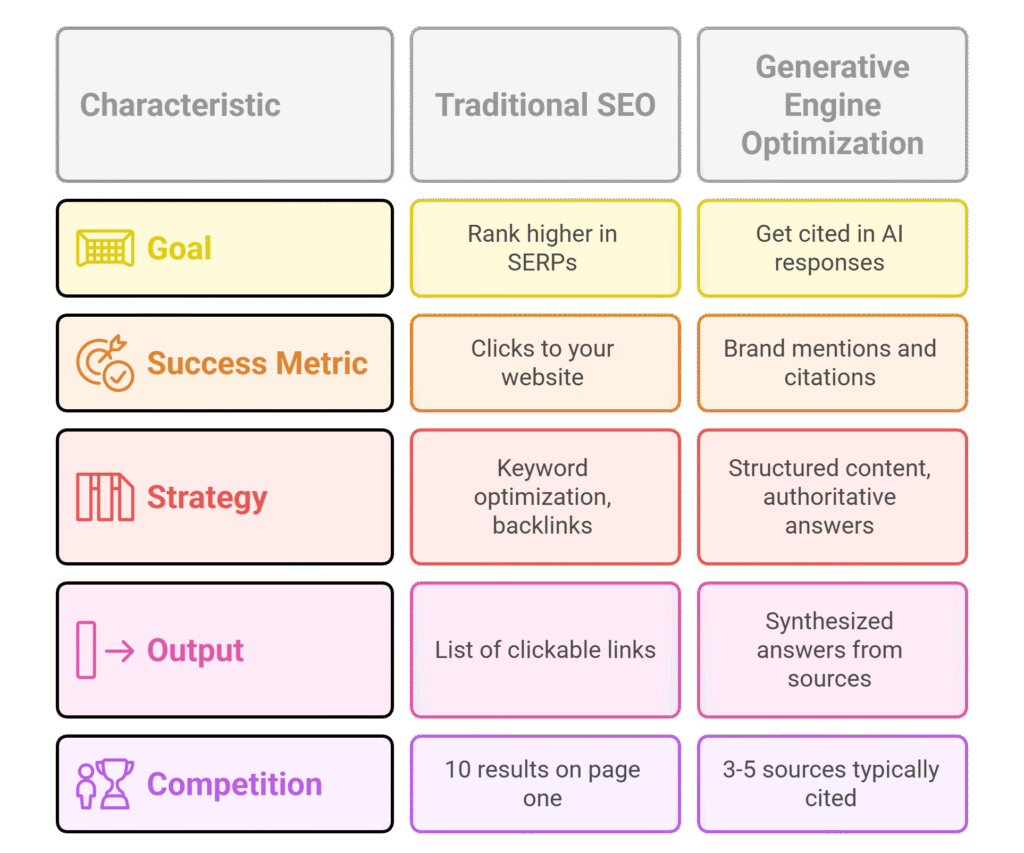
The key insight? Competition is fiercer due to the limited citation space compared to traditional search results. When Google shows search results, there are 10 spots on page one. When ChatGPT generates an answer, it might cite 2-4 sources at most. The bar is higher.
But here’s the good news: GEO doesn’t replace SEO; it extends it. A lot of SEO practices act as a foundation for GEO. A brand ranking well in the SERPs has a higher chance of getting cited in AI answers.
How do AI search engines like ChatGPT actually work?
To optimize for AI search, you need to understand how these systems function. Here’s the simplified version:
Step 1: Data Collection and Training
The engine gathers huge amounts of data from various sources to create a comprehensive knowledge base. This includes web content, documents, research papers, and structured databases. These AI models are trained on massive datasets that teach them patterns in language, context, and information relationships.
Step 2: Natural Language Processing
Natural language processing (NLP) is at the core of generative AI. It allows these models to comprehend the context and intent of the user’s query. When someone asks a question, the AI doesn’t just look for matching keywords, it understands what the person is really trying to learn or accomplish.
Step 3: Information Retrieval
When you ask a question, the AI searches through its knowledge base and recent web data to find relevant sources. This is similar to traditional search, but instead of ranking pages, it’s looking for information that can be synthesized into a cohesive answer.
Step 4: Content Synthesis
The AI reads through multiple sources, extracts key information, identifies patterns and agreements, and generates a comprehensive response in conversational language. It’s not just copying and pasting, it’s understanding and rewriting information in a way that directly addresses the user’s question.
Step 5: Citation
The AI attributes information to specific sources, typically linking to or naming the websites where information was found. This is where GEO matters most, being one of those cited sources.
What techniques actually help my content appear in AI answers?
Here’s where it gets really interesting. A peer-reviewed study conducted by researchers from Princeton, Georgia Tech, Allen Institute for AI, and IIT Delhi tested various optimization methods and found that certain techniques could boost source visibility by up to 40% in generative engine responses.
Let’s break down what actually works, based on research and real-world testing:
1. Adding Statistics and Data (High Impact)
Numbers add weight. Including data points makes your content more factually grounded, which helps AI include it in responses to factual or persuasive questions.
Example of poor optimization: “Many businesses in Dubai are investing in digital marketing.”
Example of strong optimization: “According to a 2024 market analysis, 73% of SMBs in Dubai increased their digital marketing budgets by an average of 42% compared to 2023.”
See the difference? The second statement is specific, sourced, and data-driven. AI systems love this because it’s verifiable and useful.
2. Including Direct Quotations from Experts (High Impact)
The study found that quotation addition significantly boosts performance, with some methods showing improvements of over 41% in visibility metrics.
When you include quotes from recognized authorities, industry leaders, or subject matter experts, AI engines view your content as more credible and comprehensive. This is especially valuable for UAE businesses writing about local market conditions, regulations, or industry-specific insights.
3. Optimizing for Fluency and Readability (Medium Impact)
Generative engines prefer clean, well-written content. This isn’t just about grammar but about how effortlessly the model can process and reproduce your content.
Your content should:
- Use clear, simple sentences (aim for 8th-10th grade reading level)
- Follow logical structure with proper transitions
- Avoid jargon unless it’s industry-standard terminology
- Use active voice more than passive voice
- Break up long paragraphs into digestible chunks
Fluency optimization can improve impression metrics up to 30%.
4. Citing Reliable External Sources (Medium Impact)
GEO is grounded in verifiable content. Linking or referencing known sources, even within your body text, signals trustworthiness. When you cite other authoritative sources, you’re demonstrating that your content is researched, credible, and part of a broader conversation.
For UAE businesses, this means citing:
- Local government statistics and reports
- Industry associations and regulatory bodies
- Academic research from recognized institutions
- Reputable news organizations
- International standards and certifications
5. Authoritative and Comprehensive Content (Foundational)
AI systems prioritize content that demonstrates E-E-A-T (Experience, Expertise, Authoritativeness, and Trustworthiness). GEO places a greater emphasis on the quality of the content itself, favoring expertise, experience, authoritativeness, and trustworthiness.
This means:
- Author credentials and bios matter
- Company background and credentials are important
- Industry certifications and awards add value
- Client testimonials and case studies build authority
- Depth of coverage signals expertise
6. What DOESN’T Work: Keyword Stuffing
Interestingly, keyword stuffing performs 10% worse than baseline content with no optimization at all. This is a crucial insight, tactics that might have worked in early-stage SEO are actually harmful for GEO.
AI systems can detect when content is artificially stuffed with keywords, and they penalize it by viewing the source as less trustworthy and less useful for citation.
How can I optimize my content for AI search results?
Now let’s get tactical. Here’s how to actually implement GEO for your business:
Strategy 1: Reframe Content Around Questions
Many AI queries start as a question. Producing that question with a direct answer gives the LLM exactly what it needs.
Instead of writing article titles like “Digital Marketing in Dubai,” reframe them as:
- “How much does digital marketing cost for small businesses in Dubai?”
- “What are the most effective social media platforms for UAE businesses?”
- “How long does it take to see ROI from SEO in the UAE market?”
Then answer these questions directly, clearly, and comprehensively in your content.
Strategy 2: Use Structured Formatting
AI systems can parse structured content more easily. Use:
- Clear headings and subheadings (H1, H2, H3 tags)
- Numbered lists for sequential information
- Bullet points for key takeaways
- Tables for comparisons or data
- FAQ sections that explicitly ask and answer questions
Many successful UAE businesses have noticed that content with strong structural formatting gets cited more frequently in AI responses.
Strategy 3: Implement Schema Markup
Schema markup is code that helps search engines (and AI systems) understand your content’s structure and meaning. Key schema types for GEO include:
- FAQ Schema: Marks up question-and-answer content
- How-To Schema: Identifies step-by-step instructions
- Article Schema: Defines article metadata (author, date, topic)
- Organization Schema: Establishes your business credentials
- Review Schema: Highlights ratings and testimonials
For WordPress users, plugins like All In One SEO make schema implementation straightforward without coding knowledge.
Strategy 4: Create Comprehensive, Definitive Content
GEO requires producing content that ranks and provides visual and interactive elements that AI can incorporate into its responses.
Instead of publishing five 500-word blog posts on related topics, consider creating one comprehensive 2,500-word guide that covers the topic exhaustively. AI systems tend to favor comprehensive resources that can answer multiple related questions.
For example, instead of separate posts on:
- “Best time to post on Instagram”
- “Instagram content ideas”
- “Instagram hashtag strategy”
Create one ultimate guide: “Complete Instagram Marketing Strategy for UAE Businesses in 2025”
Strategy 5: Build Topical Authority
Build your brand authority across multiple web platforms, as AI overview results reveal sites with 60% coverage in top 5 results gain significantly more visibility in generative engines.
This means consistently publishing high-quality content in your niche. If you’re a Dubai-based web development company, regularly publish content about:
- Web design trends in the UAE
- E-commerce development considerations for Middle Eastern markets
- Technical SEO for Arabic and English bilingual websites
- Website accessibility standards and UAE regulations
- Case studies of successful UAE web projects
Over time, AI systems will recognize you as an authority in this space and cite you more frequently.
Strategy 6: Leverage Local UAE Context
One massive advantage for UAE businesses is the ability to provide localized, contextually relevant information that international sources can’t match.
AI systems looking for UAE-specific information will prioritize sources that demonstrate local knowledge:
- Dubai business licensing procedures
- UAE labor law considerations
- Ramadan marketing strategies for the Gulf region
- VAT implications for e-commerce in the Emirates
- Cultural considerations for marketing to Emirati and expat audiences
Creating content that addresses these uniquely local topics positions you as the go-to source for AI systems answering UAE-related queries.
Does GEO work differently on ChatGPT vs Google vs Perplexity?
Different AI platforms have different characteristics. Here’s what you need to know:
ChatGPT (OpenAI)

- Emphasizes conversational, natural language
- Values recent, up-to-date information
- Prefers structured, well-organized content
- Often cites 2-4 sources per response
- Strong preference for authoritative domains
Google AI Overviews (formerly SGE)

- Heavily influenced by traditional SEO signals
- Prioritizes content from sites with strong domain authority
- Values structured data and schema markup
- Often pulls from existing featured snippets
- Tends to cite Google-indexed sources primarily
Perplexity AI
- Known for comprehensive source citation (often 5-8+ sources)
- Values real-time information and recent content
- Strong preference for primary sources and original research
- Good at synthesizing information from multiple perspectives
- Particularly effective for research-oriented queries
Claude (Anthropic)
- Emphasizes accuracy and nuance
- Values well-reasoned arguments and evidence
- Good at understanding context and intent
- Prefers detailed, comprehensive sources
- Strong at handling complex, multi-faceted questions
Gemini (Google)

- Integrated with Google’s knowledge graph
- Strong multimedia capabilities (images, videos)
- Values content from Google’s ecosystem (YouTube, Google News)
- Good at understanding multimodal content
- Prioritizes mobile-friendly, fast-loading sources
The key takeaway? Each AI platform has unique characteristics that require tailored optimization approaches. Understanding these differences helps you create content that performs well across multiple generative engines.
How do I track if my GEO efforts are working?
Unlike traditional SEO where you can track rankings and click-through rates easily, measuring GEO success requires different approaches:
Primary Metrics:
1. AI Visibility Score Tools like Writesonic, BrightEdge, and others are developing AI visibility tracking. This measures how often your brand appears in AI-generated responses for relevant queries.
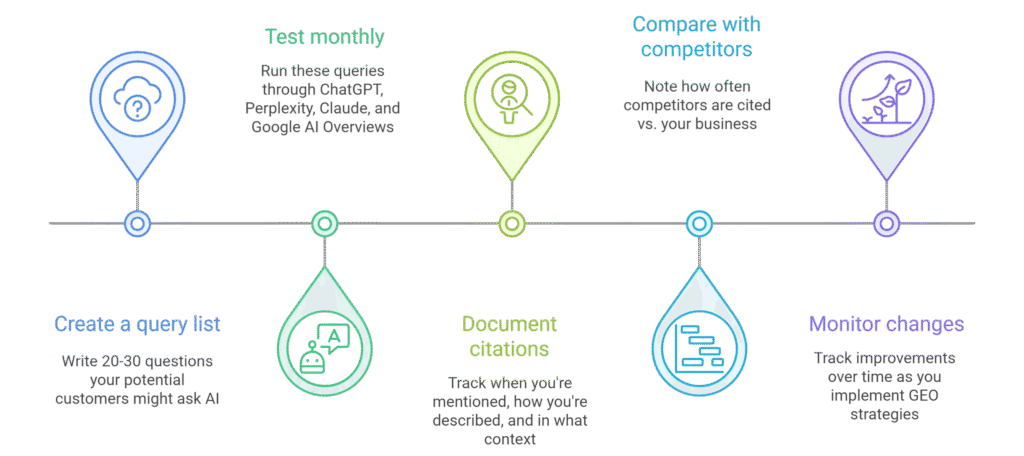
2. Citation Frequency Track brand mentions across AI platforms by manually testing prompts you imagine people might ask, using keywords you know your content is ranking for, to see how often it shows up in citations.
3. Share of Voice Among your competitors, what percentage of AI citations are you capturing in your industry or niche?
4. Sentiment Analysis How is your brand being described when it’s cited? Is the AI presenting you positively, neutrally, or negatively?
5. Referral Traffic from AI Some AI platforms now include clickable links. Track traffic coming from these sources in your analytics.
Practical Measurement Approach for UAE Businesses:
What mistakes should I avoid when optimizing for AI search?
As with any emerging field, there are pitfalls. Here’s what not to do:
Mistake 1: Abandoning SEO for GEO
GEO doesn’t replace SEO; it extends it. You still need strong SEO fundamentals (clear structure, authority, and relevance) to earn visibility inside AI answers.
Think of it this way: good SEO makes you discoverable; good GEO makes you citable. You need both.
Mistake 2: Over-Optimizing Content
AI systems are sophisticated enough to detect when content feels artificially optimized. If your content reads like it was written for robots rather than humans, both AI and human readers will reject it.
Mistake 3: Ignoring Content Quality
Traditional SEO tactics, like keyword stuffing and backlink building, will become less effective as generative engines prioritize content that delivers real value and context.
The future belongs to genuinely valuable content. Shortcuts won’t work.
Mistake 4: Neglecting Author Authority
AI systems increasingly consider who wrote the content. Anonymous or poorly-attributed content performs worse than content with clear author credentials, bios, and demonstrated expertise.
For UAE businesses, this means:
- Adding comprehensive team/author pages
- Including author bios on blog posts
- Highlighting credentials, certifications, and experience
- Linking author profiles to professional networks (LinkedIn, industry associations)
Mistake 5: Focusing Only on One AI Platform
Different users prefer different AI tools. A comprehensive GEO strategy optimizes for multiple platforms, not just ChatGPT or Google.
What’s coming next for AI search and how should I prepare?
Looking ahead, several trends will shape how GEO evolves:
Multimodal AI Search
Content creators will need to optimize across multiple formats to ensure their visibility in these enhanced search environments. This means AI systems that understand not just text, but images, videos, audio, and interactive content.
For UAE businesses, this creates opportunities to create rich, multimedia content that stands out:
- Video tutorials with transcripts
- Infographics with detailed alt text
- Interactive calculators or tools
- Audio content with show notes
- 360-degree product views
Voice Search Integration
As voice assistants become more sophisticated, optimizing for spoken queries will become crucial. Questions asked to Siri, Alexa, or Google Assistant that are answered by AI will drive another wave of search behavior change.
Localization and Language
For the UAE market specifically, bilingual content (Arabic and English) optimized for AI will become increasingly valuable. AI systems that can understand and generate responses in multiple languages will prioritize sources that provide quality content in both.
Real-Time Information
As AI algorithms become more advanced, they will deliver even more accurate and comprehensive responses to user queries. This means fresher content, more frequently updated, will have advantages over static, outdated resources.
How do I get started with GEO for my UAE business?
If you’re ready to start optimizing for generative engines, here’s your step-by-step action plan:
Phase 1: Audit and Assess (Week 1-2)
- List your top 20 service/product keywords
- Turn them into questions people might ask AI
- Test these questions across ChatGPT, Perplexity, and Google AI Overviews
- Document where you appear (or don’t appear)
- Note which competitors are being cited
Phase 2: Content Foundation (Week 3-6)
- Identify your top 5-10 most important topics
- Create comprehensive, definitive guides for each (2,000+ words)
- Ensure each includes: statistics, quotes, citations, clear structure, FAQ section
- Implement proper schema markup
- Add author bios and credentials
Phase 3: Optimization (Week 7-10)
- Rewrite existing top-performing blog posts with GEO principles
- Add data, statistics, and expert quotes to existing content
- Improve structural formatting (headings, lists, tables)
- Implement FAQ schema on relevant pages
- Create location-specific content highlighting UAE expertise
Phase 4: Expansion and Testing (Week 11-12)
- Publish new content consistently (minimum 2-4 pieces monthly)
- Test your target queries monthly
- Track citation improvements
- Adjust strategy based on what’s working
- Document successes and failures
Phase 5: Advanced Tactics (Ongoing)
- Build relationships with other authoritative sites for mutual citation
- Create original research or data that others will cite
- Engage on platforms where AI systems gather information (Reddit, Quora, industry forums)
- Monitor emerging AI platforms and optimize for new entrants
- Continuously update top-performing content with fresh information
Should I hire someone to do GEO or can I do it myself?
Should you hire a digital marketing agency in Dubai to handle GEO, or can you do it yourself?
DIY Approach Works If:
- You have in-house content creation capabilities
- Someone on your team understands SEO fundamentals
- You’re committed to learning and testing
- You have time to consistently publish content
- Your market is less competitive
Agency Makes Sense If:
- You need results faster
- Your market is highly competitive (real estate, hospitality, luxury retail)
- You lack internal resources or expertise
- You want integrated SEO + GEO + content strategy
- You need advanced technical implementation
Many UAE businesses find success with a hybrid model: working with an agency for strategy and high-value content while handling day-to-day updates in-house.
The Bottom Line: Why GEO Matters Now
Here’s the reality: AI search isn’t the future, it’s the present. Millions of people are already using ChatGPT, Perplexity, Claude, and Google’s AI Overviews as their primary search tools.
If your business isn’t appearing in AI-generated answers, you’re invisible to this growing audience. And unlike traditional SEO where you could catch up later, early GEO visibility creates compounding advantages as AI engines learn from prior citations.
The businesses that start optimizing now will build authority and recognition that becomes harder to displace over time. Think of it like domain authority in traditional SEO, it takes time to build, but once established, it provides lasting competitive advantage.
For UAE businesses specifically, the opportunity is even greater. The local market’s tech adoption rates, diverse international audience, and growing digital economy create perfect conditions for early GEO success.
The question isn’t whether you should care about Generative Engine Optimization. The question is: will you start optimizing while you still have the early-mover advantage, or will you wait until your competitors have already claimed the AI citation space in your industry?
Frequently Asked Questions
Q: Do I need to choose between SEO and GEO, or should I do both?
A: You should absolutely do both, they work together, not against each other. GEO doesn’t replace SEO; it extends it. Strong SEO fundamentals (structured data, topical authority, clarity) are still essential for getting cited in AI-generated answers. Think of SEO as building your foundation and GEO as expanding your reach into new search behaviors. The best strategy is an integrated approach where your content is optimized for both traditional search engines and AI platforms. Many of the same principles apply: quality content, clear structure, authoritative information, and user value.
Q: How long does it take to see results from GEO efforts?
A: Unlike traditional SEO where you might see ranking changes within weeks, GEO typically shows results over 2-4 months of consistent effort. This is because AI systems need time to crawl updated content, process it, and begin incorporating it into their knowledge base. However, once you start getting cited, the benefits compound. Once an AI starts citing a brand, it rarely stops, you build cumulative authority. For UAE businesses, we typically recommend a 3-month initial testing period where you implement GEO principles, monitor results, and adjust strategy. The businesses seeing fastest results are those publishing high-quality, comprehensive content consistently.
Q: Can small businesses compete with large brands in GEO, or is it only for big companies?
A: Small businesses actually have significant advantages in GEO, especially in local markets like the UAE. While large brands might have more content volume, AI systems value specificity, local expertise, and depth of knowledge, areas where small businesses can excel. For example, a boutique digital marketing agency in Dubai specializing in hospitality clients can outperform larger generalist agencies for specific queries about hotel marketing in the UAE. Focus on your niche, demonstrate deep expertise, create comprehensive content in your specialty, and build local authority. These strategies work regardless of company size.
Q: What tools are available to track my GEO performance?
A: GEO measurement tools are still emerging, but several options exist. Writesonic offers an AI visibility dashboard that tracks citations across platforms. BrightEdge has AI search analytics features. For manual tracking, you can use a simple spreadsheet approach: create a list of 20-30 questions your customers might ask AI about your industry, test them monthly across ChatGPT, Perplexity, Claude, and Google AI Overviews, and document when you’re cited. Tools like HubSpot’s AI Search Grader provide free visibility assessments. For UAE businesses, we recommend starting with manual tracking to understand the landscape, then investing in paid tools once you see traction and want to scale.
Q: Should I create separate content for GEO or optimize existing content?
A: Both approaches work, and the best strategy uses a combination. Start by optimizing your existing high-performing content, pages that already rank well in traditional search or get good traffic. These pages already have some authority, so adding GEO elements (statistics, quotes, better structure, FAQ sections) can boost them into AI citations faster. Simultaneously, create new comprehensive content specifically designed with GEO principles from the start. For UAE businesses, we recommend a 70-30 split: 70% effort on optimizing existing valuable content, 30% on creating new definitive guides. This approach delivers faster wins while building long-term authority.
Q: Does GEO work for B2B companies, or is it mainly for B2C businesses?
A: GEO works exceptionally well for B2B companies, often better than for B2C. Here’s why: B2B buyers do extensive research before purchasing, they ask detailed questions to AI about solutions, they value authoritative sources and expert content, and decision-makers often use AI tools to quickly understand complex topics. A Dubai-based software company answering detailed questions about “enterprise resource planning implementation costs in UAE” or “data privacy compliance for Middle Eastern businesses” can capture high-value B2B traffic through GEO. The key is creating educational, problem-solving content that addresses the specific questions your business customers are asking AI. B2B content tends to be more evergreen and authoritative, exactly what AI systems prefer to cite.